
Special Economic Zones in Saudi Arabia | Complete Guide for Foreign Investors

Anushka
Content Writer
Anushka Basu is a business content writer specialised in global business market insights. She aims to simplify complex regulatory, financial, and business concepts into… Read more

Tulika Saxena
AVP, Sales & Marketing | IIM Nagpur
Tulika Saxena specializes in business finance, sales strategy, and market positioning. Leads growth and partnerships, ensuring seamless business setup experiences and client success across… Read more


Key Fact: Saudi Arabia has four ECZA-designated Special Economic Zones: King Abdullah Economic City, Ras Al-Khair, Jazan and Cloud Computing SEZ. Each targets different industries and has its own operating environment, infrastructure and applicable incentives.
Table of contents
- Introduction
- What Are Special Economic Zones in Saudi Arabia?
- How Many Special Economic Zones Are There in Saudi Arabia?
- What Is the King Abdullah Economic City SEZ?
- What Is the Ras Al-Khair Special Economic Zone?
- What Is the Jazan Special Economic Zone?
- What Is the Cloud Computing Special Economic Zone?
- What Incentives Do Special Economic Zones in Saudi Arabia Offer?
- Can Foreign Investors Own 100% of a Saudi SEZ Business?
- What Are the Regulatory Requirements for Setting Up in a Saudi SEZ?
- How Do You Set Up a Business in a Saudi Special Economic Zone?
- How Should Foreign Investors Choose the Right Saudi SEZ?
- What Is the Difference Between Saudi SEZs and Other Specialised Zones?
- What Should Investors Consider Before Setting Up in a Saudi SEZ?
- Common Mistakes Foreign Investors Make When Choosing a Saudi SEZ
- How Can Arnifi Help With Saudi SEZ Setup?
- FAQs
- Conclusion
Introduction
Saudi Arabia’s Special Economic Zones (SEZs) give investors another route into the Kingdom’s growing economy. Rather than creating identical zones for every type of company, Saudi Arabia has built them around particular industries and commercial needs.
That distinction matters when choosing where to establish a business. A manufacturer, maritime company and cloud-service provider will not necessarily have the same requirements.
The four ECZA-designated zones are:
- King Abdullah Economic City (KAEC) SEZ
- Ras Al-Khair SEZ
- Jazan SEZ
- Cloud Computing SEZ
The choice ultimately comes down to the business activity, infrastructure, location, supply chain and conditions attached to the relevant incentives.
What Are Special Economic Zones in Saudi Arabia?
A Special Economic Zone is a designated investment area with a framework tailored to qualifying activities.
Saudi Arabia uses SEZs to attract investment into sectors considered important to its economic development. These include manufacturing, maritime industries, food production, logistics and digital infrastructure.
The Economic Cities and Special Zones Authority (ECZA) provides the overarching framework for the SEZ network. Individual investors, however, deal with the relevant entity and authorities associated with their chosen zone.
The framework has also continued to develop. ECZA’s current regulations specifically cover the four SEZs and provide rules governing companies operating within them.
How Many Special Economic Zones Are There in Saudi Arabia?
Saudi Arabia currently has four ECZA Special Economic Zones.
| Special Economic Zone | Location | Main focus | Notable strength |
| KAEC SEZ | Makkah Region | Automotive, pharmaceuticals, MedTech, consumer goods and logistics | King Abdullah Port and industrial infrastructure |
| Ras Al-Khair SEZ | Eastern Region | Maritime and heavy/mining industries | Industrial and maritime ecosystem |
| Jazan SEZ | Jazan Region | Food industries and agribusiness | Red Sea location and agricultural resources |
| Cloud Computing SEZ | Riyadh | Cloud computing and digital infrastructure | Technology and data-centre ecosystem |
ECZA identifies these four zones as its current SEZ network.
Important distinction
The Riyadh Integrated Special Logistics Zone (RISLZ/SILZ) is not one of these four ECZA SEZs. It is a separate specialised logistics zone and should not be counted when describing the four-zone ECZA framework.
What Is the King Abdullah Economic City SEZ?
The King Abdullah Economic City (KAEC) SEZ sits in the Makkah Region and covers approximately 60 km².
Its location around King Abdullah Port is one of its main advantages, particularly for businesses that depend on shipping and international supply chains.
Key areas include:
- Automotive and mobility
- Consumer goods
- Pharmaceuticals
- Medical technology
- Life sciences
- Logistics
- Maritime activities
ECZA also identifies an automotive cluster and logistics opportunities within the zone.
For companies involved in manufacturing or regional distribution, the combination of industrial infrastructure and port access can be an important consideration.
What Is the Ras Al-Khair Special Economic Zone?
Ras Al-Khair SEZ is located in Saudi Arabia’s Eastern Region. Its development is closely tied to the Kingdom’s industrial and maritime capabilities.
The zone is focused on areas such as:
- Maritime industries
- Shipbuilding
- Rig construction
- Metals conversion
- Heavy industry
- Mining-related activities
ECZA highlights Ras Al-Khair’s industrial infrastructure, energy availability and maritime positioning as part of its investment proposition.
Businesses considering the zone should first check whether their proposed activity falls within the qualifying sectors and whether the available industrial facilities match their operational requirements.
What Is the Jazan Special Economic Zone?
Jazan SEZ is situated on Saudi Arabia’s southern Red Sea coast.
The zone has a strong connection with food production and the region’s agricultural resources. Its focus includes:
- Food manufacturing
- Agribusiness
- Food industries
- Metal conversion
- Logistics
Its Red Sea position can also support businesses involved in regional trade and supply chains.
As with the other SEZs, incentives and regulatory treatment depend on the qualifying activity and applicable conditions. ECZA describes Jazan as a zone focused on food industries and leveraging the Kingdom’s agricultural resources.
What Is the Cloud Computing Special Economic Zone?
The Cloud Computing SEZ is based in Riyadh and forms part of the King Abdulaziz City for Science and Technology (KACST) ecosystem.
Its focus is considerably different from the industrial zones. It is designed around:
- Cloud computing
- Cloud service providers
- Digital infrastructure
- Data-centre operations
One notable feature is the flexibility to provide cloud computing services from the zone while establishing and operating data centres in locations across Saudi Arabia, subject to the applicable framework.
This makes the zone particularly relevant to businesses whose operations depend on distributed digital infrastructure rather than a conventional industrial site.
What Incentives Do Special Economic Zones in Saudi Arabia Offer?
Saudi Arabia’s SEZ framework provides a range of tax, customs and operational incentives, but the exact benefit depends on the zone, qualifying activity and applicable conditions. ECZA currently highlights:
| Incentive | SEZ framework |
| Corporate income tax | 5% under the stated incentive framework |
| Withholding tax | 0% under applicable conditions |
| VAT | 0% treatment for qualifying transactions/activities under the applicable framework |
| Customs | Customs-duty deferral for qualifying goods and transactions |
| Workforce | Flexible workforce arrangements, subject to the applicable framework |
These incentives should not be treated as automatic entitlements for every company operating in an SEZ. Investors should verify the conditions applicable to their specific zone, activity and transaction before relying on a particular tax or customs treatment.
Can Foreign Investors Own 100% of a Saudi SEZ Business?
Foreign investors can establish projects within Saudi Arabia’s SEZ framework.
However, ownership should be assessed together with the proposed activity and licensing conditions. Investors should check:
- Whether the activity qualifies
- Applicable SEZ regulations
- Investment requirements
- Licensing conditions
- Any sector-specific restrictions
The SEZ framework defines an investor as a Saudi or foreign natural or legal person, while qualifying activities determine access to the relevant exemptions and incentives.
What Are the Regulatory Requirements for Setting Up in a Saudi SEZ?
The paperwork varies according to the project. Depending on the activity, an investor may need:
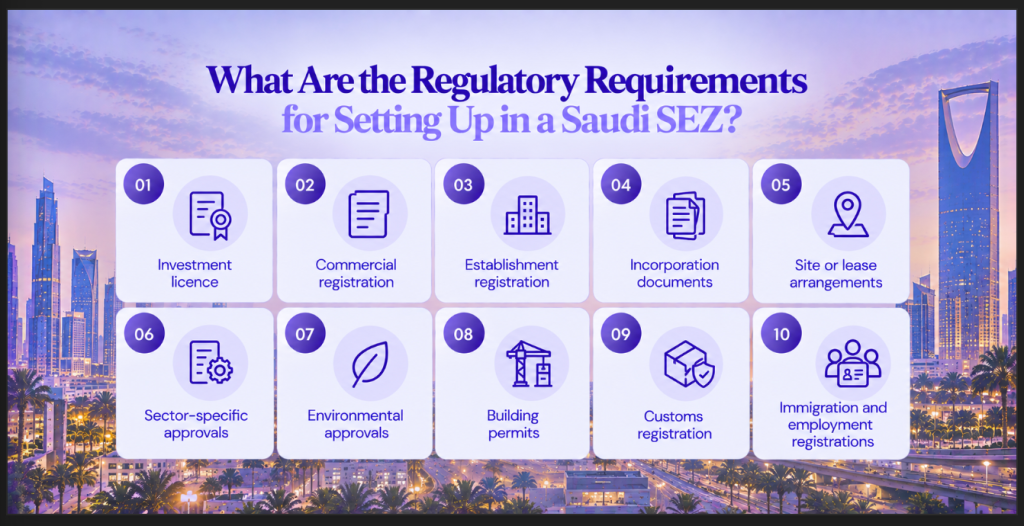
ECZA’s investor journey makes clear that the sequence changes according to project type. An industrial project, for instance, can involve site selection, trade-name reservation, investment licensing, commercial registration, incorporation licensing and lease registration before further operational approvals.
How Do You Set Up a Business in a Saudi Special Economic Zone?
While the precise route depends on the project, investors can generally expect the following stages:
| Step | What happens |
| 1. Select the zone | Match the activity with the relevant SEZ |
| 2. Check eligibility | Review qualifying activities and applicable conditions |
| 3. Select a site | Determine office, land or industrial requirements |
| 4. Reserve the business name | Complete the applicable name requirements |
| 5. Obtain investment approval | Submit the required project and investor information |
| 6. Incorporate | Complete the company’s formation requirements |
| 7. Register the business | Obtain the applicable registration |
| 8. Secure additional approvals | Complete environmental, industrial, construction or other approvals |
| 9. Complete operational registrations | Arrange tax, customs, immigration, employment and banking requirements |
| 10. Start operations | Begin activities once the required approvals are complete |
The current ECZA investor journey shows that actual steps and turnaround times depend on the type of project.
How Should Foreign Investors Choose the Right Saudi SEZ?
The starting point should be the business model, not the incentive package.
| Business activity | Relevant SEZ |
| Automotive, manufacturing and logistics | KAEC |
| Maritime and heavy industrial activities | Ras Al-Khair |
| Food manufacturing and agribusiness | Jazan |
| Cloud computing and digital infrastructure | Cloud Computing SEZ |
Investors should then look beyond the sector label and assess:
- Location and transport links
- Port or airport access
- Utilities
- Workforce availability
- Facility requirements
- Customer base
- Export plans
- Incentive eligibility
- Compliance obligations
What Is the Difference Between Saudi SEZs and Other Specialised Zones?
The four ECZA SEZs form only part of Saudi Arabia’s wider economic-zone landscape.
The Riyadh Integrated Special Logistics Zone (RISLZ/SILZ) is a useful example. It is a separate specialised logistics zone located near King Khalid International Airport.
Its focus includes areas such as:
- Consumer products
- Pharmaceuticals
- Medical and nutritional supplies
- Aerospace spare parts
- Luxury goods
This distinction matters because referring to every specialised economic or logistics zone as an ECZA SEZ can give investors an inaccurate picture of the regulatory framework.
What Should Investors Consider Before Setting Up in a Saudi SEZ?
Before committing to a zone, investors should check:
- Activity eligibility
- Applicable regulator
- Incentive conditions
- Tax treatment
- Customs requirements
- Premises and infrastructure
- Workforce requirements
- Capital needs
- Sector-specific approvals
- Long-term compliance
The advertised incentive package is only one part of the decision. The practical operating environment needs to work for the business as well.
Common Mistakes Foreign Investors Make When Choosing a Saudi SEZ
Watch out for these common assumptions:
- Choosing a zone before checking whether the activity qualifies
- Assuming every SEZ has the same incentives
- Treating all economic zones as ECZA SEZs
- Assuming tax benefits apply automatically
- Overlooking sector-specific approvals
- Ignoring infrastructure requirements
- Comparing zones only on tax treatment
How Can Arnifi Help With Saudi SEZ Setup?
Arnifi can help investors assess the practical requirements of establishing a business in Saudi Arabia.
Support can include:
- Identifying a suitable SEZ based on the proposed activity
- Supporting company formation and licensing
- Coordinating documentation
- Assisting with regulatory procedures
- Helping investors understand ownership and compliance requirements
- Supporting ongoing corporate requirements
FAQs
What are the Special Economic Zones in Saudi Arabia?
Saudi Arabia currently has four ECZA-designated Special Economic Zones: KAEC, Ras Al-Khair, Jazan and Cloud Computing SEZ. Each has a different sector focus and operating environment.
Which Saudi SEZ is suitable for foreign investors?
It depends on the proposed activity. KAEC is focused on areas including automotive, pharmaceuticals and logistics; Ras Al-Khair on maritime and heavy industries; Jazan on food and agribusiness; and Cloud Computing SEZ on cloud computing and digital infrastructure.
Can foreigners own 100% of a company in a Saudi SEZ?
Foreign investors can establish businesses within Saudi Arabia’s SEZ framework, subject to the applicable investment, licensing and activity requirements. The specific ownership conditions can depend on the relevant zone and qualifying activity, so investors should confirm the applicable rules before incorporation.
What incentives are available in Saudi Special Economic Zones?
ECZA currently highlights incentives including a 5% corporate income tax rate, 0% withholding tax, VAT benefits for qualifying activities or transactions, customs-duty deferral and flexible workforce arrangements. The availability and conditions of these incentives depend on the relevant zone, activity and applicable regulations.
How do you set up a company in a Saudi Special Economic Zone?
The process generally involves selecting a suitable zone, checking eligibility, choosing a site, completing investment and company registration requirements, securing relevant approvals and arranging operational registrations before starting activities.
Conclusion
Saudi Arabia’s Special Economic Zones are built around specific industries and investment needs, rather than following one standard free-zone model.
The four ECZA zones each bring something different to the table. KAEC is closely connected with manufacturing and logistics, Ras Al-Khair with maritime and heavy industry, Jazan with food and agribusiness, and Cloud Computing SEZ with digital infrastructure.
For a foreign investor, the practical question is therefore not simply which zone offers the most incentives. It is whether the zone’s activities, infrastructure, location, regulatory framework and applicable incentives fit the proposed business.
Choosing that framework first can make the subsequent licensing and incorporation process much clearer.
Arnifi can support foreign investors with Saudi company formation, licensing and ongoing compliance requirements.
References
ECZA – Special Economic Zones
ECZA – Investor Journey
ECZA – Rules of Companies in Special Economic Zones
Top Saudi Arab Packages
Related Articles
Top Saudi Arab Packages
Get in Touch
