
Employment Pass Singapore | Eligibility, Salary & Application Guide for Foreigners


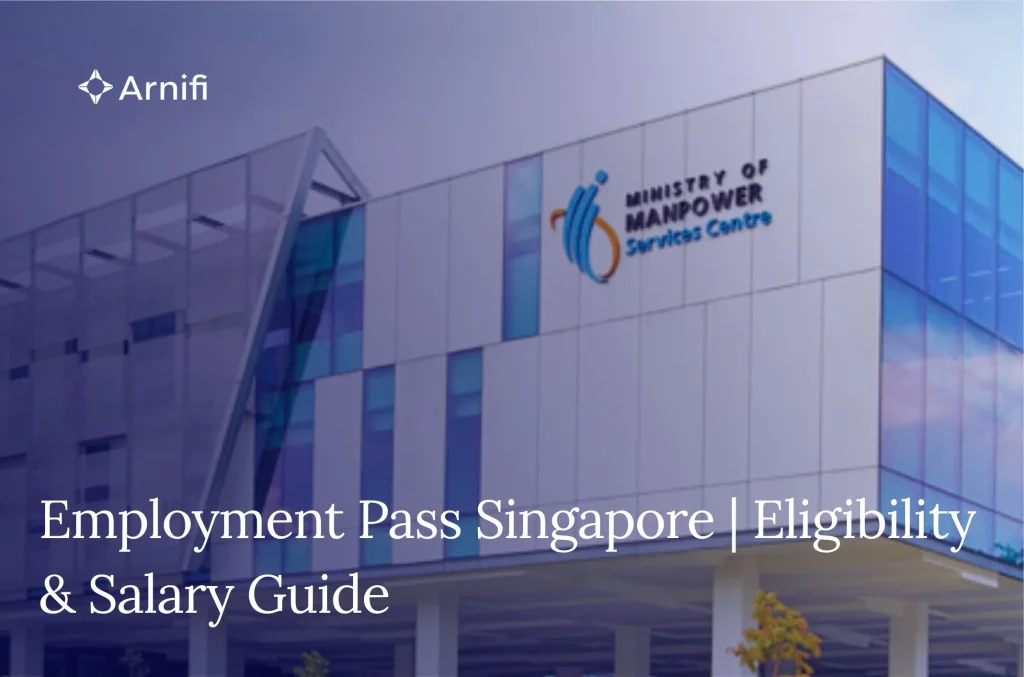
Employment Pass Singapore remains the primary work visa for foreign professionals planning to work, manage, or build businesses in the country. From salary benchmarks to MOM scrutiny, each element of the application matters. This guide explains how the system works in practice and what gives an application real credibility.
Table of contents
- 1. Introduction
- 2. What Is a Singapore Employment Pass?
- 3. Who Needs an Employment Pass in Singapore?
- 4. Employment Pass Eligibility and Criteria
- 5. Employment Pass Requirements in Singapore
- 6. Employment Pass Salary Requirements in Singapore
- 7. Step-by-Step Employment Pass Application Process
- 8. How to Check Employment Pass Status
- 9. Types of Employment Passes in Singapore
- 10. Employment Pass Renewal Process
- 11. Employment Pass Services Centre
- 12. Can a Foreigner Open a Bank Account in Singapore Without an Employment Pass?
- 13. Common Reasons Employment Pass Applications Get Rejected
- 14. How Arnifi Supports Employment Pass Applications
- 14. FAQs
- 15. Conclusion
1. Introduction
Singapore’s work visa framework rewards preparation, not assumptions. Employment Pass Singapore follows a structured and consistent approval process, but only for applicants who meet defined professional and salary standards.
An Employment Pass allows foreign professionals to work legally in Singapore as employees, directors, or senior managers. Without a valid work pass, employment is not permitted under Singapore law. All Employment Pass applications, renewals, and compliance matters are regulated by the Ministry of Manpower (MOM).
Employment Pass Singapore differs clearly from other work visas such as the S Pass or Work Permit. It is designed for higher-skilled, better-compensated professionals rather than mid-skilled or labour-based roles.
2. What Is a Singapore Employment Pass?
A Singapore Employment Pass is a work visa issued to foreign professionals, executives, managers, and company directors who meet MOM’s salary and qualification benchmarks.
It is intended for individuals hired into professional roles or formally appointed as directors of Singapore-registered companies. First-time approvals are usually granted for one to two years, with renewals of up to three years.
Employment Pass holders may reside in Singapore, work only for the sponsoring entity, and apply for dependant passes for eligible family members. Job mobility is restricted, and any change in employer or role requires a new application.
3. Who Needs an Employment Pass in Singapore?
An Employment Pass is required in the following situations:
- Foreign directors actively managing a Singapore company
- Foreign professionals employed in executive or managerial roles
- Founders relocating to Singapore to operate their own businesses
An EP is mandatory whenever hands-on work is performed in Singapore. It is not required for short-term business visits without operational involvement, board participation without management duties, or preliminary market exploration.
4. Employment Pass Eligibility and Criteria
Employment Pass eligibility is assessed as a whole, not based on salary alone.
Educational background plays an important role. A recognised degree from a reputable institution strengthens an application, although strong industry experience may offset academic gaps in certain sectors.
Work experience must align with the proposed role. Inflated titles or responsibilities unsupported by employment history often raise concerns.
The job role must justify professional-level pay and decision-making authority.
Employer credibility is equally critical. MOM evaluates whether the company has genuine operations, appropriate scale, and a legitimate business need for foreign expertise.
The COMPASS framework now forms part of the evaluation. It considers salary competitiveness, qualifications, workforce diversity, and local employment support at a broad level rather than through a single score.
5. Employment Pass Requirements in Singapore
Employer Requirements
The sponsoring company must be registered in Singapore and demonstrate genuine business activity. Dormant or shell entities face a higher risk of rejection. MOM also considers whether reasonable efforts are made to develop a local workforce.
Applicant Requirements
Applicants must hold a valid passport, relevant academic qualifications, and a verifiable employment history. A clear, detailed resume outlining roles, industries, and responsibilities is essential.
6. Employment Pass Salary Requirements in Singapore
Salary remains one of the most closely reviewed elements of an application.
Minimum qualifying salaries vary based on age, experience, and sector. Entry-level professionals face lower thresholds, while senior or specialised roles require higher compensation.
Salary expectations increase with experience, and sector-specific benchmarks apply, particularly in finance, technology, and professional services.
Employment Pass salary benchmarks are reviewed periodically to reflect market conditions. A salary that aligns with both role and experience significantly strengthens application credibility.
7. Step-by-Step Employment Pass Application Process
Step 1: Secure a Job or Director Appointment
An employment contract or director appointment letter must clearly define the role, salary, and responsibilities.
Step 2: Prepare the Employment Pass Application
Documents typically include passport details, educational certificates, resume, and company information.
Step 3: Submit Employment Pass Application Online
Applications are filed through the MOM portal by the employer or an authorised service provider.
Step 4: Application Processing and Review
Processing generally takes several weeks. MOM may request additional documents or clarifications during review.
8. How to Check Employment Pass Status
Employment Pass status can be tracked online through MOM’s system. Common outcomes include pending, approved, or rejected. Delays often relate to document verification or further assessment requests.
9. Types of Employment Passes in Singapore
Standard Employment Pass
The most widely used option for foreign professionals and directors.
Training Employment Pass
Issued for short-term professional training assignments.
Personalised Employment Pass (PEP)
Designed for high-income professionals, offering greater flexibility and reduced dependence on a single employer.
Choosing the correct pass type at the outset avoids unnecessary reapplications.
10. Employment Pass Renewal Process
Renewal should begin several months before expiry. MOM reassesses salary, role relevance, and employer standing during renewal.
Any changes in compensation, responsibilities, or company structure must be disclosed. Successful renewals are commonly granted for up to three years.
11. Employment Pass Services Centre
The Employment Pass Services Centre manages biometric registration, card issuance, and selected verification procedures. Visits occur only after approval and are strictly appointment-based.
12. Can a Foreigner Open a Bank Account in Singapore Without an Employment Pass?
In limited situations, yes. Some banks allow non-residents to open accounts for investment or incorporation purposes. However, an Employment Pass is typically required for full operational banking access.
13. Common Reasons Employment Pass Applications Get Rejected
- Salary misalignment with role seniority
- Job scope lacks clarity or appears inflated
- Employer lacks operational substance
- Incomplete or inconsistent documentation
14. How Arnifi Supports Employment Pass Applications
Arnifi works with founders, companies, and professionals navigating Employment Pass Singapore requirements with a compliance-first approach. Support includes role structuring, salary benchmarking, documentation preparation, and alignment with MOM expectations. The focus remains on long-term approval sustainability rather than short-term fixes that fail at renewal.
14. FAQs
What is the typical validity of an Employment Pass Singapore?
Usually one to two years, with renewals of up to three years.
Does Employment Pass Singapore allow dependent passes?
Yes, subject to meeting salary thresholds.
Is Employment Pass Singapore renewable after expiry?
Yes, if eligibility conditions continue to be met.
Can founders apply for Employment Pass Singapore through their own company?
Yes, provided the role and salary are properly justified.
Does salary alone guarantee Employment Pass Singapore approval?
No, MOM assesses multiple factors together.
15. Conclusion
Employment Pass Singapore remains the principal route for foreign professionals seeking legitimate, long-term careers in the country. Salary alignment, role credibility, and employer substance influence every decision made by MOM.
A disciplined, well-prepared approach reduces uncertainty and prevents costly delays. With the right structure and guidance, Employment Pass approval becomes a measured process rather than a speculative one.
Top Singapore Packages
Related Articles

Top Singapore Packages
Get in Touch
