
Inside the 2026 Shift | What the Next-Gen GCC Bank Looks Like


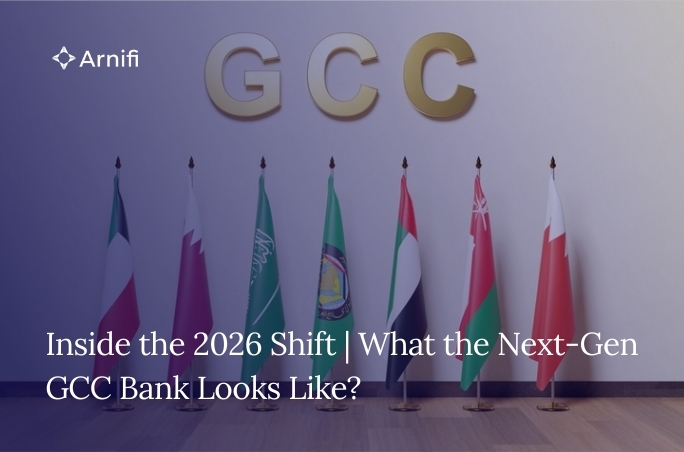
In 2026, a GCC Bank will feel less like a place to visit and more like a utility always present in daily life. AI will push banking into the background, real-time payments will be the norm, and embedded finance will connect money to every customer moment. What should a GCC Bank do now to stay relevant?
Table of contents
- 1. Introduction
- 2. The New Money Reality for a GCC Bank
- 3. Money, Payments and the End of Waiting
- 4. Embedded Finance | Where Banking Fits in Daily Digital Life
- 5. Digital Assets | A Real Shift, Not a Side Show
- 6. Risk, Trust and Governance | A New Responsibility
- 7. Sustainability and Inclusion | Beyond Compliance
- 8. How Arnifi Helps Modern GCC Banks
- 9. FAQs
- 10. Conclusion
1. Introduction
Here is a clear idea to hold on to while reading this, a GCC Bank no longer competes only with other banks. It is now challenged by platforms, AI agents and new payment systems that can serve financial services without a branch or even a login. For the Gulf’s financial leaders and planners, this moment demands decisions about what kind of institution a GCC Bank wants to be when money becomes invisible in daily life.
2. The New Money Reality for a GCC Bank
The concept of a GCC Bank in 2026 is shifting fast. Traditional activities like deposits or loans will still matter. But these will happen in places people already spend time: marketplaces, apps, online services. A GCC Bank that stays tied to old roles risks losing relevance.
Generative AI is central to this shift. Analysts estimate that AI could unlock up to $340 billion in annual value for global banks. That same potential applies to a GCC Bank. This technology will help assess credit, personalise services, manage risk and guide customer decisions faster than legacy systems. At the same time, it will push customers to expect instant responses and pricing that feels fair and tailored.
If a GCC Bank only adds another chatbot or automates simple tasks, it will miss what really matters: integrating AI into core operations, not just customer support.
3. Money, Payments and the End of Waiting
Real-time payments are now more than a feature. They are a baseline expectation. Over 100 countries have real-time payment systems. In the Gulf, Saudi Arabia and the UAE are building infrastructure that supports instant transfers, digital wallets and pilot projects for central bank digital currency. When a GCC Bank can settle payments instantly and securely, it removes the friction that once defined financial service experiences.
This matters for both consumers and businesses. Fee income from traditional payment services is under pressure. At the same time, richer data from real-time systems allows a GCC Bank to offer targeted insights, smarter reconciliation tools and credit offers at the point they matter most.
Payments will not simply be about moving money. They will be about understanding behaviour and timing financial options when they are most relevant.
4. Embedded Finance | Where Banking Fits in Daily Digital Life
Embedded finance means that a loan, payment, insurance or investment offer shows up where a decision is being made, not in a separate banking app. Infrastructure for embedded finance is growing worldwide, and a GCC Bank that embeds financial services into everyday digital journeys will capture value not through traditional branches, but through relevance and timing.
In this model, a GCC Bank provides licensing and risk oversight. Fintechs or platforms deliver the user experience. They share revenue. They share data insights. But the balance sheet and regulatory compliance remain anchored in the bank.
At checkout on an e-commerce platform or during a service purchase, a GCC Bank can deliver instant credit or financing options that feel built into the moment, not layered on afterwards. This is where money becomes invisible but deeply useful.
5. Digital Assets | A Real Shift, Not a Side Show
Digital assets are entering mainstream finance in a way that goes beyond speculation. Stablecoins now move large volumes of value on-chain and tokenisation is unlocking new asset classes. In the Gulf, real estate tokenisation is already underway, led by frameworks in cities like Dubai. A GCC Bank that supports digital asset custody, settlement and advisory services will position itself at a strategic intersection between traditional finance and new digital markets.
Tokenisation can turn assets that were previously difficult to trade into fractional, tradable units. This expands access and liquidity. For a GCC Bank, this is not about short-term gains. It is about integrating these capabilities into core service lines and infrastructure.
6. Risk, Trust and Governance | A New Responsibility
As technology reshapes finance, the role of a GCC Bank in trust and governance becomes even more important. Regulators in the Gulf and beyond are asking tougher questions about how AI systems make decisions, how cloud providers are selected, and how cyber threats are managed.
Classic risk frameworks are being expanded. Banks are now expected to know how their machine-learning models behave, how third-party agents act, and how decisions are made in automated processes. This requires a shift in how boards and risk committees view technology risks with tech no longer delegated to an IT silo but treated as a central part of enterprise risk management.
A GCC Bank that refuses to confront these questions risks not only penalties but loss of reputation and customer confidence. The future of money will be invisible, but trust will not.
7. Sustainability and Inclusion | Beyond Compliance
In the Gulf, sustainability and inclusion are not buzzwords. They are economic priorities. Green finance, ESG-linked lending and tools that help measure environmental impact are becoming part of how people think about money. A GCC Bank that embeds sustainability into product design and reporting will meet growing expectations from stakeholders and investors.
At the same time, digital wallets, instant payment access and SME-focused fintech partnerships are improving access to financial services for young and underserved populations. This is a demographic reality in many Gulf economies. A GCC Bank that supports inclusion through accessible digital services strengthens its social and economic impact.
8. How Arnifi Helps Modern GCC Banks
Arnifi is an example of a partner that understands this transition. It helps modern finance teams build clearer financial insights from complex data. In a world where a GCC Bank must interpret real-time flows, assess risk dynamically and respond to customer needs instantly, Arnifi brings clarity to chaos.
By integrating with existing systems and providing analytics that matter to decision makers, Arnifi supports a transition from legacy reporting to forward-looking intelligence. For a GCC Bank that wants to be proactive rather than reactive, this kind of support matters. It bridges the gap between raw data and confident action.
Arnifi’s focus on simplicity and insight helps finance teams reduce manual work and uncover opportunities quickly. When a GCC Bank is transforming its operating model, these capabilities are not optional. They are part of what makes transformation real.
9. FAQs
What does invisible banking mean for a GCC Bank?
It means financial services operate in the background of digital life, not only through traditional channels.
Will AI replace staff at a GCC Bank?
AI will change roles, but the goal is to enhance human decision-making, not eliminate it.
Are digital assets safe for GCC Bank customers?
With proper governance and risk controls, digital asset services can be secure and regulated.
Can embedded finance increase revenue for a GCC Bank?
Yes, by placing financial services at key customer touchpoints and sharing value with partners.
How does real-time payment infrastructure benefit a GCC Bank?
It improves customer experience and opens data-rich services that were previously unavailable.
10. Conclusion
A GCC Bank in 2026 must look beyond its physical presence. Money will become invisible in daily life not by disappearing, but by becoming useful where decisions are made, instantly and intelligently. Real-time payments, embedded finance, AI-native operations and digital assets are not trends. They are structural changes. A GCC Bank that embraces these changes, governs them well and partners with tools like Arnifi will define the future of finance in the Gulf. The window to act is now.
Top UAE Packages


Related Articles

Top UAE Packages
Get in Touch