
Banking Licenses in ADGM | A Detailed Overview

Shethana P
SEO Content Writer
Shethana specialises in creating content that simplifies complex business, compliance, and regulatory topics for global business incorporation. She focuses on SEO strategy, content accuracy,… Read more


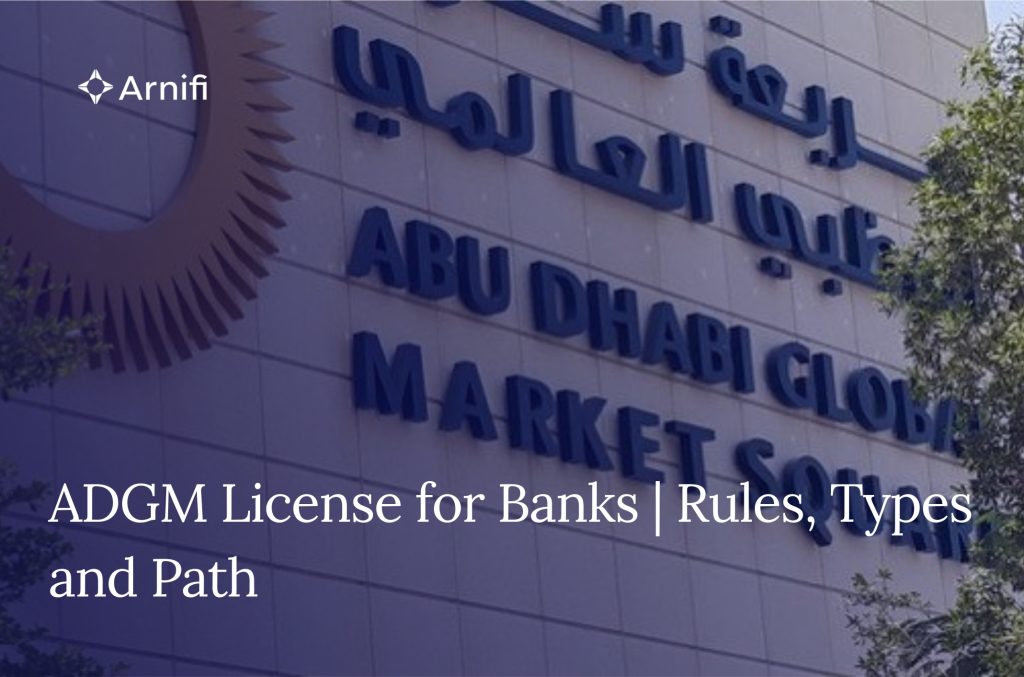
A banking presence inside Abu Dhabi Global Market is not built on ambition alone. It is built on capital, control, and credibility. This guide explains how the ADGM License works for banks, which models qualify, and what it takes to earn regulatory trust.
Table of contents
- 1. Introduction
- 2. What Is an ADGM Banking License?
- 3. Types of Banking Licenses Available in ADGM
- 4. Who Is Eligible for a Banking License in ADGM?
- 5. Key Regulatory Requirements for ADGM Banking Licenses
- 6. Banking License Approval Process in ADGM
- 7. Common Challenges in Obtaining an ADGM Banking License
- 8. Banking vs Other Financial Licenses in ADGM
- 9. How Arnifi Supports Banking License Applications
- 10. FAQs
- 11. Conclusion
1. Introduction
Treat this as a serious test of readiness. A banking application inside Abu Dhabi Global Market is not a formality or a paperwork exercise. It is a full examination of capital strength, leadership quality, systems, and long-term intent. An ADGM License for banking places an institution inside one of the most closely supervised financial zones in the Middle East. That is exactly why global groups, private banks, and digital challengers consider it. The process filters out weak plans early and rewards only those built to last. This guide breaks down what an ADGM Banking License really allows, how the Financial Services Regulatory Authority assesses applicants, and why the bar remains intentionally high. Read it as a practical briefing, not a brochure.
2. What Is an ADGM Banking License?
An ADGM License for banking is issued by the Financial Services Regulatory Authority, the independent regulator of Abu Dhabi Global Market. It authorises a firm to perform deposit-taking, lending, payment services, and other core banking functions within the ADGM framework.
This is not the same as an investment firm or a fintech registration. A banking approval gives access to public and institutional funds, which is why the regulator demands far deeper oversight. Capital buffers are larger, reporting is more frequent, and governance standards match those seen in leading international financial centres.
An ADGM Banking License also places a bank inside a legal system based on English common law, offering clarity to investors, depositors, and counterparties.
3. Types of Banking Licenses Available in ADGM
Full Banking License
A full ADGM License for banking permits the widest scope of activity. This includes accepting deposits from the public, issuing loans, offering credit facilities, and running payment services. These institutions sit at the core of the financial system. As a result, capital adequacy, liquidity coverage, and board oversight sit at the highest regulatory level.
Wholesale Banking License
A wholesale ADGM Banking License serves institutions rather than retail customers. Activities focus on corporate lending, interbank markets, trade finance, and treasury operations. Public deposits are not permitted. This model suits regional and international banks that want a Middle East base without running a retail branch network.
Digital and Challenger Bank Models
Digital banks can operate under an ADGM Banking License if technology is supported by sound risk controls. The FSRA evaluates systems, cyber security, data handling, and business continuity with the same seriousness as balance sheet strength. Innovation is welcomed only when stability remains intact.
4. Who Is Eligible for a Banking License in ADGM?
ADGM does not approve speculative ventures. Eligibility depends on four pillars: financial backing, leadership, clarity of purpose, and control frameworks. A sponsor must demonstrate the ability to absorb losses and support growth. The board and senior management must show a track record in regulated financial services. A detailed business plan must explain how profits will be generated without endangering depositors. Risk, compliance, and internal audit functions must be designed before the application is filed.
This is where many proposals fall apart. An ADGM License for banking is not granted on the strength of a pitch deck.
5. Key Regulatory Requirements for ADGM Banking Licenses
Capital is only the starting point. The FSRA sets minimum capital levels based on the scale and risk profile of each bank. Governance rules require independent directors, clear committee structures, and documented decision making. Compliance and anti-money laundering systems must meet international standards. Regular reporting on liquidity, credit exposure, and operational risk is mandatory.
An ADGM Banking License also brings ongoing supervision. Inspections, audits, and regulatory dialogue continue long after approval.
6. Banking License Approval Process in ADGM
The path begins with a pre-application discussion. This allows the FSRA to assess whether a proposal is realistic before formal documents are submitted. The next stage is the full application, including financial models, policies, and senior management details. The regulator then issues detailed questions and requests for clarification. Only after all concerns are resolved does final approval arrive.
A typical ADGM License for banking takes between six and twelve months, depending on complexity and preparedness.
7. Common Challenges in Obtaining an ADGM Banking License
The most common failure is underestimating capital needs. Another is weak governance, where boards lack independence or banking experience. Incomplete compliance frameworks also cause delays. Some applicants propose growth targets that look exciting but make regulators uneasy. These issues can derail an ADGM Banking License even when funding is available.
8. Banking vs Other Financial Licenses in ADGM
Not every financial business needs a banking approval. Asset managers handle investments but do not take deposits. Payment firms move money but do not lend it. A bank combines both. That is why a banking ADGM License carries heavier oversight than most other approvals. Choosing the wrong category leads to wasted time and rejected applications. A full comparison appears in the ADGM License Categories Overview.
9. How Arnifi Supports Banking License Applications
Arnifi works with founders, banking groups, and fintech leaders who need clarity before capital is committed. The process begins with an eligibility review that tests whether a proposal fits the FSRA framework. Regulatory documents, financial models, and governance structures are then prepared to meet ADGM standards. Arnifi also coordinates directly with the regulator, helping applicants respond to questions without losing momentum. Planning for ongoing compliance is built in from the start, which is critical for any ADGM Banking License.
10. FAQs
Can foreign banks apply for an ADGM Banking License?
Yes. Foreign banks can apply through either a branch structure or by setting up a locally incorporated subsidiary in ADGM.
How much capital is required for an ADGM Banking License?
There is no fixed number. Capital requirements depend on the bank’s size, risk profile, and the type of activities being carried out.
Are digital banks allowed under an ADGM Banking License?
Yes. Digital banks are permitted, provided their technology, risk controls, and operational systems meet FSRA standards.
How long does FSRA approval for an ADGM Banking License take?
The approval process typically takes between six and twelve months, depending on the complexity of the application.
Can an ADGM Banking License be upgraded later?
Yes. A banking license can be upgraded if the institution later meets higher capital, governance, and regulatory requirements.
11. Conclusion
A bank inside Abu Dhabi Global Market operates in one of the most disciplined regulatory environments in the region. That is what gives depositors and counterparties confidence. An ADGM License for banking is not easy to secure, but it offers long-term credibility that few jurisdictions can match. With the right capital, leadership, and preparation, an ADGM Banking License becomes a strategic platform for regional and global growth. Arnifi stands ready to guide serious applicants through each step, from early feasibility to full regulatory approval inside ADGM.
Top UAE Packages


Related Articles
Top UAE Packages
Get in Touch