
How ESOPs Work in the UAE: A Practical Guide for Founders and Employees
by Snigdha Sujan Dec 29, 2025  9 MIN READ


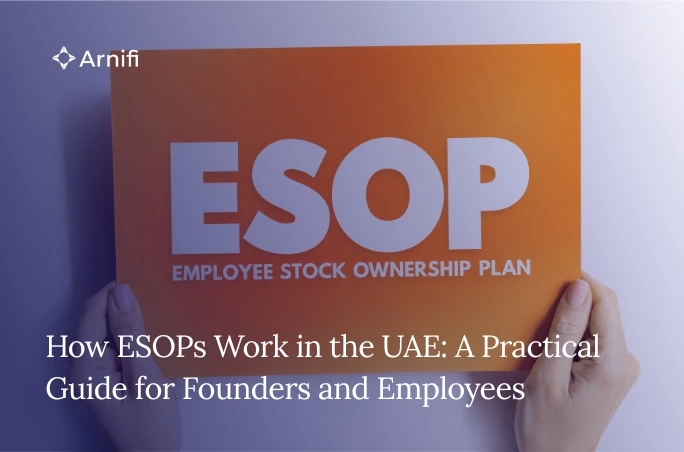
ESOPs in the UAE are one of the smartest ways to attract and retain talent without drowning the company in fixed payroll costs. How ESOPs work in the UAE is easy to understand. If done right, they turn employees into long-term builders, not short-term, temporary hires. This guide will help you navigate how ESOPs work in the UAE.
Table of contents
- 1. Introduction
- 2. What is an ESOP?
- 3. Why does equity compensation matter in the UAE right now?
- 4. The UAE Landscape and What You Must Know
- 5. Common ESOP structures used in the UAE
- 6. Jurisdiction-by-Jurisdiction Checklist
- 7. Designing an ESOP that Actually Retains People
- 8. Tax and Payroll Consequences
- 9. Implementation roadmap
- 10. Key Risks
- 11. Case Study: UAE Companies adopting Equity Buybacks
- 12. Templates and Resources
- 13. Conclusion
1. Introduction
You find the perfect person, they love the mission, and they’re ready to join. Then comes the awkward part: salary expectations. And suddenly you’re stuck between two bad choices: overpay and shrink your runway, or underpay and lose the candidate.
This is exactly why founders are leaning into ESOP UAE plans. But there is a catch. ESOPs in the UAE aren’t always straightforward. The rules change depending on whether you’re set up in mainland UAE, a free zone, DIFC, or ADGM.
The structure that works perfectly for one company can be totally messy for another. That’s where Arnifi comes in, helping founders structure ESOP UAE plans that are compliant, investor-friendly, and actually understandable for employees.
2. What is an ESOP?
An ESOP, also known as an Employee Stock Ownership Plan, is a clear and documented plan that entails that if an employee stays and performs, they get a real stake in what the founders are building.
Most ESOPs UAE are built around Employee Stock Options UAE, which means employees get the right to buy shares later at a fixed price. They don’t pay today; they earn the right over time.
Founders care because ESOPs are one of the rare tools that do three things at once: help you hire better people, help you keep them longer, and help you preserve cash while scaling.
3. Why does equity compensation matter in the UAE right now?
The UAE job market is getting sharper and more competitive. Employees don’t just compare monthly salaries anymore; they compare brand, growth potential, stability, and upside. Equity is becoming relevant because it solves a very real founder problem. You want strong talent, but you don’t want to overpay in cash before product-market fit.
Hiring has become more global, senior talent expects long-term incentives, startups need cash for growth, and equity plans signal seriousness. If your startup can’t compete on cash today, ESOP UAE is how you compete on tomorrow.
4. The UAE Landscape and What You Must Know
Founders tend to get stuck when they assume ESOPs are all one format, because in the UAE, they are not. Your ESOP plan depends heavily on where your company is incorporated.
The same ESOP structure can be simple in one jurisdiction and very chaotic in another. Different jurisdictions, like mainland versus free zones versus ADGM/DIFC, matter a lot because they are the deciding factor on how your ESOP structure turns out to be.
The practical impact of jurisdiction :
- What approvals do you need
- Whether issuing options is straightforward or requires workarounds
- How shareholder rights apply
- How easy it is to manage the cap table as the team grows
- Whether investors will consider the ESOP standard
For Commercial Companies Law, even if your ESOP is just for employees, it still touches share capital, shareholder rights, and governance.
What your company usually needs for ESOP UAE rollout :
- Board approval
- Shareholder approval
- Updated articles / constitutional documents if needed
- A formal plan document and grant mechanics
- Clean record-keeping so that due diligence doesn’t become a nightmare later
5. Common ESOP structures used in the UAE
Different UAE startups choose different models depending on legal setup, investors, and how clean they want their cap table.
Share options (option grants): Employees receive the right to buy shares later at a fixed price.
Pros:
- Most common ESOP UAE structure for startups
- Flexible and scalable for growing teams
- Employees earn equity through vesting.
Cons:
- Employees may not understand the value without explanation.
- Exercise price + timing needs clarity, or it feels meaningless.
Restricted stock: Employees receive shares earlier, usually with restrictions or buyback terms.
Pros:
- Feels more real to employees
- Strong alignment for early team members
Cons:
- More cap table complexity
- Harder to manage when many employees join
- Needs tight leaver + buyback drafting
Phantom share plans: Employees don’t get real shares. They get a payout linked to company value, exit, or milestones.
Pros:
- Keeps the cap table clean
- Easier in some mainland setups
- Often easier for employees to understand
Cons:
- Requires very clear payout rules and valuation logic
- Needs strong communication so it still feels valuable
LTIPs (Long-Term Incentive Plans): Long-term rewards linked to retention and/or performance milestones.
Pros:
- Great for leadership and senior hires
- Can be customised heavily
Cons:
- If too complex, employees won’t trust it
- Must be documented cleanly to avoid disputes
Nominee/SPV structures and ESOP trusts: A nominee, SPV, or trust holds shares on behalf of employees.
Pros:
- Cap table stays clean and investor-friendly
- Easier to manage voting and shareholder processes
Cons:
- Must be structured correctly, or it backfires
- Needs clear beneficial ownership documentation
6. Jurisdiction-by-Jurisdiction Checklist
ADGM
What founders usually like about ESOP ADGM :
- Strong governance and structure for equity schemes
- Investor-friendly setup for future fundraising
- Clearer framework for employee share schemes
What to look out for :
- Proper documentation
- Clean board/shareholder approvals
- Plan administration
DIFC
Why ESOP DIFC is popular :
- Flexible corporate environment
- Familiar structure for international founders/investors
- Easier to draft modern option terms in many cases
What to look out for :
- Pre-emption rights
- Carve-outs must be drafted properly so ESOP doesn’t create friction later.
- Alignment with investor docs and cap table planning
Mainland
Mainland ESOP UAE realities
- You can do ESOPs, but it may require workarounds.
- Phantom shares in the UAE can be cleaner for the cap table management
- Nominee/SPV routes are sometimes used for practical reasons.
What to look out for
- Share issuance mechanics
- Shareholder approval requirements
- Avoiding informal promises that aren’t legally enforceable
7. Designing an ESOP that Actually Retains People
This is where most ESOPs fail, not legally, but emotionally. Employees leave when the ESOP feels confusing, unfair, or unrealistic.
Pool sizing
- Pool size depends on the hiring plan and the role’s seniority
- Too small means constant renegotiations and internal resentment
- Too big means dilution panic during fundraising
Vesting schedule + cliff
- 4 years vesting is common
- 1-year cliff avoids giving equity to short-term hires
- Monthly/quarterly vesting after the cliff feels fair
Exercise price
- Employees should know what they pay to convert options into shares
- If exercise feels expensive or vague, motivation drops
- A simple explanation beats fancy legal text every time
Leaver provisions
- Good leaver means fair treatment in genuine cases
- Bad leaver means protection if someone exits in bad faith
- Define it upfront so it’s not emotional later
Buyback triggers
- Keeps the cap table clean
- Helps avoid ex-employees holding equity forever
- Makes exits and restructuring smoother
8. Tax and Payroll Consequences
Many UAE residents benefit from a tax environment that’s simpler than other countries, but if an employee has ties to another country, say, through the means of tax residency, citizenship-based taxes, or reporting obligations, they might still face taxes or filing requirements.
For companies:
- Don’t promise tax-free benefits to employees casually
- Align ESOP language with payroll and HR policies
- Encourage employees to take personal tax advice if cross-border
For employees:
- Understand when you’re taxed
- Know your home-country obligations if relevant
- Ask questions early instead of panicking during an exit
9. Implementation roadmap
This is the part founders actually need: a realistic checklist for how to set up an ESOP in UAE.
- Decide goal: hiring, retention, leadership incentives, or all three
- Choose structure: options vs restricted stock vs phantom shares
- Confirm jurisdiction pathway: mainland vs free zone vs ESOP DIFC / ESOP ADGM
- Prepare internal approvals: board resolution and shareholder resolution if needed
- Draft ESOP plan documents and grant templates
- Amend articles if required for share/option mechanics
- Set up nominee/SPV/trust
- Build an ESOP tracker
- Integrate with payroll/HR onboarding and exit workflows
- Roll out internally with a clear employee explainer and FAQs
- Set a timeline so employees know what vesting actually looks like
10. Key Risks
Most ESOP problems in the UAE are predictable because they happen when founders rush, copy templates from other countries, or skip communication. Key risks include:
- Employees expect cash quickly, but ESOP is long-term
- Dilution surprises during fundraising
- Leaver clauses are vague and become fight material
- Misalignment between HR promises and legal documents
- Cap table becomes messy, and investors push back
- Approval gaps create due diligence red flags
Smart startups should instead explain liquidity honestly, covering aspects of exit, buyback, and secondary ESOPs. They should use simple employee language alongside proper legal documents. Another key factor is keeping grant processes consistent and trackable, and planning ESOP alongside fundraising and not after it.
11. Case Study: UAE Companies adopting Equity Buybacks
A simple market signal founders are seeing in the UAE is equity buybacks becoming more common, especially as startups mature. When companies reach a stable phase or have cash events, they sometimes buy back employee shares or provide liquidity options to early team members. It shows the ecosystem is moving beyond paper equity and towards real outcomes.
Even a small buyback sends a strong message internally, and that is one reason ESOPs in UAE are gaining trust when designed properly.
12. Templates and Resources
- Grant letter template
- Option agreement template
- Phantom shares UAE plan rules
- Board resolution checklist
- Shareholder resolution checklist
- Vesting schedule policy and cliff explanation
- Employee handbook note
- Buyback clause language
- ESOP tracker format
13. Conclusion
A well-designed ESOPs in the UAE plan is one of the most practical tools for building a serious startup team in the region. Done right, ESOPs in the UAE help you hire faster, retain longer, and create a real ownership culture, without destroying your cash runway. Done poorly, they create confusion, distrust, and messy cap tables.
If you want to implement ESOP UAE properly across the mainland, free zones, ESOP DIFC, or ESOP ADGM, Arnifi can help you structure the plan, draft the documents, align approvals, and roll it out cleanly. Reach out to us today!
Top UAE Packages


Related Articles

Top UAE Packages
Get in Touch