
Sheikh Hamdan and Elon Musk Discuss Technology Partnerships for the Greater Good


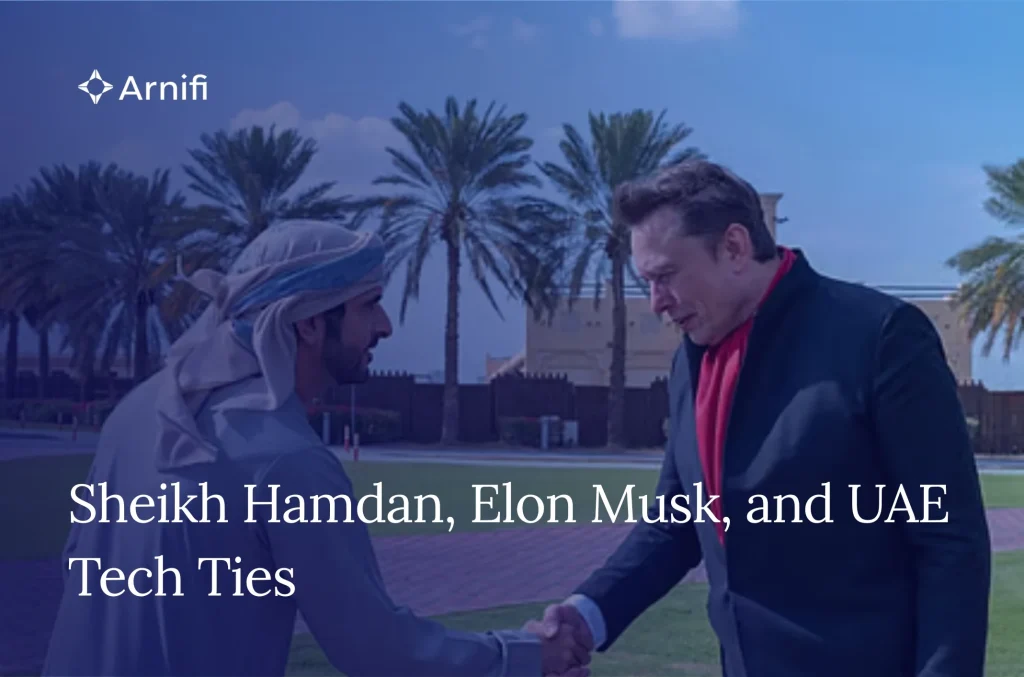
Dubai recently played host to a conversation that did not seek attention, yet quietly revealed where global technology, governance, and long-term thinking may be heading next.
Table of contents
- 1. Introduction
- 2. A Meeting That Reflects a Larger Shift
- 3. Why This Conversation Stands Out
- 4. Dubai’s Technology Strategy in Practice
- 5. Artificial Intelligence as a Policy Priority
- 6. Space, Connectivity, and Long-Term Thinking
- 7. A Signal to Global Technology Leaders
- 8. Economic Competitiveness Without Shortcuts
- 9. Arnifi as a Gateway to Dubai’s Technology Landscape
- 10. Why This Moment Matters
- 11. Conclusion
1. Introduction
Conversations shaping the future of technology are no longer confined to conference halls or closed boardrooms in the West. Increasingly, they are happening in cities that know how to turn ambition into execution. Dubai has become one of those cities, and a recent meeting between His Highness Sheikh Hamdan bin Mohammed bin Rashid Al Maktoum and Elon Musk made that shift unmistakable.
This was not a ceremonial handshake or a moment staged for headlines. It was a focused discussion rooted in technology, responsibility, and long-term consequence. For business leaders, founders, policymakers, and investors tracking global change, the significance of this meeting runs deeper than it first appears.
2. A Meeting That Reflects a Larger Shift
His Highness Sheikh Hamdan bin Mohammed bin Rashid Al Maktoum, Crown Prince of Dubai, Deputy Prime Minister and Minister of Defence of the UAE, met Elon Musk at his majlis in Nad Al Sheba. The discussion took place in the presence of His Highness Sheikh Maktoum bin Mohammed bin Rashid Al Maktoum, First Deputy Ruler of Dubai and Minister of Finance.
The setting mattered. This was not a hurried exchange on the sidelines of a global summit. It was a considered conversation held in a space associated with dialogue, reflection, and trust. That atmosphere shaped both the substance and the tone of what followed.
Talks centred on global technological transformation and the role of emerging solutions in supporting comprehensive development. Commercial opportunity was part of the picture, but not the focus. The language leaned toward humanity, sustainability, and the shared challenges that cross national boundaries.
3. Why This Conversation Stands Out
Many leaders speak about technology. Far fewer speak about how it should serve society at scale. That distinction defined this meeting.
Sheikh Hamdan pointed to the UAE and Dubai’s approach to innovation, one grounded in strong legislative frameworks, meaningful global partnerships, and sustained investment in people. This model has helped build an environment where technology does not exist in isolation from governance, ethics, or public benefit.
Elon Musk’s response reflected recognition rather than formality. Praise for the UAE’s forward-looking vision and tangible progress in artificial intelligence, space exploration, and advanced technology was specific and grounded. These were not abstract endorsements. They acknowledged outcomes already visible on the global stage.
4. Dubai’s Technology Strategy in Practice
Dubai’s emergence as a technology and innovation destination has not been accidental. It is the result of coordination, patience, and consistency.
Advanced digital infrastructure sits at the centre of this progress. Clear regulation, efficient government services, and strong data frameworks allow companies to operate with confidence. These foundations support fields ranging from artificial intelligence research to satellite connectivity and future mobility.
The meeting highlighted how this infrastructure enables meaningful partnerships with global technology leaders. The UAE does not present itself as a passive market. It acts as a collaborator, capable of testing ideas, scaling solutions, and setting benchmarks that others watch closely.
5. Artificial Intelligence as a Policy Priority
Artificial intelligence was not treated as a passing trend. It was discussed as a national priority.
The UAE has approached AI through structure rather than speed, embedding it within a broader strategy to improve quality of life, strengthen economic competitiveness, and enhance public services. This integrated approach distinguishes it from regions where AI development remains fragmented or reactive.
The presence of Omar bin Sultan Al Olama, Minister of State for Artificial Intelligence, Digital Economy and Remote Work Applications, reinforced this focus. In the UAE, AI operates with ministerial oversight, long-term planning, and a mandate clearly tied to national development goals.
6. Space, Connectivity, and Long-Term Thinking
Elon Musk’s work through SpaceX and Starlink added further depth to the discussion. Space exploration and satellite connectivity are no longer distant ambitions. They now play a direct role in economic resilience, security, and digital inclusion.
The UAE’s existing space initiatives align naturally with these priorities. From satellite programs to planetary research, the country has shown that space strategy can balance commercial relevance with public interest.
The meeting explored how these technologies could address practical challenges such as connectivity gaps, climate monitoring, and data-led decision-making. The tone reflected confidence and maturity rather than experimentation.
7. A Signal to Global Technology Leaders
The message to global founders and technology executives was clear. The UAE and Dubai are not standing on the sidelines of the global tech race. They are helping shape its direction.
This approach favours enduring partnerships over transactional engagements. The emphasis remains on solutions that scale responsibly and deliver measurable value. That mindset tends to attract companies prepared to think beyond short-term results.
The discussion also reinforced Dubai’s role as a neutral platform where global innovators can collaborate without political tension or regulatory ambiguity.
8. Economic Competitiveness Without Shortcuts
Technology-led growth often comes with trade-offs. Rapid expansion can strain regulation, labour systems, or public trust. Dubai’s model aims to avoid those pitfalls.
Legislation evolves alongside innovation rather than lagging behind it. Talent development remains central, ensuring that technology adoption expands opportunity instead of narrowing it.
This balance surfaced repeatedly throughout the meeting. Progress was framed as something built through discipline and intent, not rushed through hype.
9. Arnifi as a Gateway to Dubai’s Technology Landscape
As global dialogue shifts toward meaningful technology partnerships, entering the UAE requires more than ambition. Structure, compliance, and clarity matter.
Arnifi operates at this intersection. From company formation to regulatory support, Arnifi helps businesses establish and scale within the UAE’s evolving ecosystem. This includes technology firms, digital platforms, and innovation-driven enterprises seeking a stable base in the region.
The UAE’s appeal lies not only in vision but in execution. Arnifi supports that execution by simplifying market entry, aligning operations with local requirements, and allowing founders to focus on growth rather than administrative complexity.
For companies influenced by conversations like the one between Sheikh Hamdan and Elon Musk, Arnifi provides the practical foundation needed to move from interest to presence.
10. Why This Moment Matters
Global technology leadership is entering a more reflective phase. Scale alone no longer defines credibility. Impact, responsibility, and alignment with societal needs now carry equal weight.
This meeting captured that shift. It showed how governments and technology leaders can engage without spectacle. It demonstrated respect for long-term thinking over immediate gain.
Dubai’s role in these conversations is likely to deepen, driven not by narrative, but by consistency and results.
11. Conclusion
The meeting between His Highness Sheikh Hamdan bin Mohammed bin Rashid Al Maktoum and Elon Musk was not about announcements or agreements. It was about alignment.
Alignment between technology and humanity. Between ambition and governance. Between innovation and responsibility.
As the UAE continues to strengthen its position as a global technology and innovation destination, moments like this will influence how progress takes shape. Those observing closely will recognise the deeper signals at work.
For organisations ready to take part in this ecosystem, Arnifi remains a trusted partner, helping businesses move from intent to establishment within one of the world’s most forward-focused markets.
The future is not being debated in isolation but it is being shaped through deliberate conversations, thoughtful partnerships, and places willing to think beyond the obvious.
Top UAE Packages


Related Articles


Top UAE Packages
Get in Touch