
Are Multi-Class Shares Allowed in the UAE? | A Clear Breakdown for Founders & Investors

Anushka
Content Writer
Anushka Basu is a business content writer specialised in global business market insights. She aims to simplify complex regulatory, financial, and business concepts into… Read more

Tulika Saxena
AVP, Sales & Marketing | IIM Nagpur
Tulika Saxena specializes in business finance, sales strategy, and market positioning. Leads growth and partnerships, ensuring seamless business setup experiences and client success across… Read more



Key Fact: Federal Decree-Law No. 20 of 2025 introduced greater flexibility for multiple classes of quotas and shares in UAE companies, including LLCs, while the exact rights and registration requirements depend on the applicable framework.
Table of contents
- Introduction
- What Are Multi-Class Shares?
- Why Do Founders and Investors Use Multi-Class Shares?
- What Was the Historical Position on Multi-Class Shares in Mainland UAE?
- Were Multi-Class Shares Allowed in UAE Free Zones?
- What Has Changed With UAE Multi-Class Share Rules?
- Are Multi-Class Shares Allowed in the UAE Right Now?
- What Types of Multi-Class Shares Could UAE Companies Use?
- Can UAE Companies Have Different Voting Rights?
- Can UAE Companies Issue Preference Shares?
- Can Multi-Class Shares Be Used for ESOPs in the UAE?
- Can UAE Startups Use Multi-Class Shares for Venture Capital?
- ADGM vs DIFC vs Mainland UAE for Multi-Class Shares
- Why Are ADGM and DIFC Popular for Investor-Friendly Share Structures?
- What Should Founders Consider Before Choosing a Multi-Class Share Structure?
- How Does a Multi-Class Structure Affect a Company’s Cap Table?
- What Are the Risks of Using Multi-Class Shares?
- How Should Multi-Class Shares Be Documented?
- How Can Arnifi Help With UAE Company Structuring?
- FAQs
- Conclusion
Introduction
Multi-class shares allow a company to give different groups of shareholders different economic or governance rights. A founder may want stronger voting control, while an investor may seek priority in dividends or liquidation.
This flexibility has become more relevant in the UAE following the 2025 amendments to the Commercial Companies Law. The changes expressly allow different classes of quotas in LLCs and multiple share classes in joint-stock companies, subject to the applicable requirements.
ADGM and DIFC also remain important options for founders who want established corporate frameworks for differentiated share rights.
What Are Multi-Class Shares?
A share class is a category of shares carrying a defined set of rights and restrictions.
Depending on the applicable legal framework, different classes can provide for:
- Ordinary or preference rights
- Different voting rights
- Different dividend entitlements
- Priority on liquidation or capital recovery
- Conversion rights
- Redemption rights
- Transfer restrictions
- Founder or employee equity arrangements
The important distinction is that shareholders may have different rights even where they hold interests in the same company.
Why Do Founders and Investors Use Multi-Class Shares?
Multi-class structures can separate control from economic participation.
For example:
Founder Shares
→ Enhanced voting or control rights
Investor Shares
→ Preferred economic or liquidation rights
Employee Shares
→ Equity participation or incentive rights
This can help founders raise capital without automatically giving investors the same level of voting control, while investors can negotiate specific economic protections.
The UAE Ministry of Economy and Tourism has specifically identified differentiated voting, dividend, liquidation and other rights as part of the new share-class flexibility introduced by the 2025 amendments.
What Was the Historical Position on Multi-Class Shares in Mainland UAE?
Before the 2025 amendment, multiple quota classes were not available to LLCs in the manner now expressly permitted by the amended law.
Article 208 of Federal Decree-Law No. 32 of 2021 stated that shareholders generally had equal rights attached to shares and allowed the Cabinet to specify other classes of shares and their conditions.
This made conventional venture-style structures less straightforward for mainland companies, particularly where founders wanted differentiated voting, dividend or liquidation rights.
The position changed materially with Federal Decree-Law No. 20 of 2025.
Were Multi-Class Shares Allowed in UAE Free Zones?
Free zones do not all operate under one identical corporate-law framework.
Some financial free zones developed their own corporate legislation with greater flexibility around share classes. ADGM’s framework, for example, expressly provides for different classes of shares, while DIFC legislation also allows companies to create different share classes through their Articles of Association.
Therefore, founders should check the specific free zone’s company regulations rather than assuming that one free-zone rule applies across the UAE.
What Has Changed With UAE Multi-Class Share Rules?
Federal Decree-Law No. 20 of 2025 significantly expanded the UAE’s corporate-law framework.
The Ministry of Economy and Tourism confirms that the amendments allow LLCs to establish multiple classes of quotas and allow joint-stock companies to issue multiple classes of shares, subject to the applicable regulatory conditions and procedures.
The Ministry has identified possible differentiated rights relating to:
- Profit or dividend distribution
- Capital recovery on exit or liquidation
- Voting rights
- Nominal value
- Transfer restrictions
- Other privileges or restrictions
The specific rights and categories remain subject to the requirements of the applicable legislation and competent authority.
Are Multi-Class Shares Allowed in the UAE Right Now?
Yes. The 2025 amendments create the legal basis for differentiated quota/share classes in mainland UAE companies, but the precise classes, rights and registration mechanics depend on the implementing framework and competent authority.
However, founders should distinguish between the law permitting differentiated classes and the practical registration of a particular structure. The company’s constitutional documents and commercial registration must reflect the relevant rights and comply with the requirements of the competent authority.
The Ministry of Economy and Tourism describes multiple quotas and share classes as a legal right under the amended framework.
This means founders should not rely on older guidance stating that mainland companies can only use a single class of shares. At the same time, they should confirm the current registration process before implementing a complex structure.
What Types of Multi-Class Shares Could UAE Companies Use?
The amended framework allows differentiated classes, with the Ministry identifying examples such as:
- Preferred shares
- Shares with dividend preferences
- Shares with priority in capital recovery
- Shares with special voting rights
- Shares with different nominal values
- Restricted shares
Other structures may also be possible where permitted by the applicable framework and approved by the competent authority.
Mainland UAE: rights/categories expressly contemplated by the amended CCL and implementing framework.
ADGM/DIFC: broader established mechanisms under their own company laws.
Founders should therefore avoid assuming that a US, UK or other international share structure can simply be copied into a UAE company without checking the local requirements.
Can UAE Companies Have Different Voting Rights?
Different voting rights are one of the most important uses of a multi-class structure.
A company may, where permitted, create a class with enhanced voting rights while another class carries ordinary voting rights. This can allow founders to retain greater control while bringing in investors.
The 2025 amendments expressly recognise voting rights as one of the areas in which classes of quotas or shares may differ.
The exact voting arrangement should be clearly recorded in the company’s constitutional documents and commercial records.
Can UAE Companies Issue Preference Shares?
Preference shares give investors rights that differ from ordinary shares.
Depending on the applicable framework, these can include:
- Preferred Shares
- Additional privileges regarding profits/liquidation
- Special Voting Rights
The UAE Ministry specifically identifies preferred shares and priority rights over profits or liquidation among the structures contemplated by the amended framework.
ADGM and DIFC have established frameworks that expressly accommodate different share classes and preference structures.
Can Multi-Class Shares Be Used for ESOPs in the UAE?
Employee Stock Option Plans can give employees an economic interest in a growing business and help companies retain key talent.
A business may use actual shares, options or other incentive arrangements depending on its legal structure and jurisdiction.
The important point is that an ESOP should not be treated as automatically equivalent to creating a new share class. The company must consider vesting, dilution, voting rights, transfer restrictions and the applicable corporate rules.
Jurisdictions such as ADGM provide a more developed framework for companies using differentiated share structures.
Can UAE Startups Use Multi-Class Shares for Venture Capital?
Yes. The new framework can be particularly relevant to startups raising private capital.
A funding round may involve:
- Founder shares
- Investor preference rights
- Different voting rights
- Liquidation preferences
- Transfer restrictions
- Employee equity pools
- Future funding provisions
For a founder, the choice of jurisdiction can therefore affect how easily the intended investment structure can be documented and registered.
ADGM vs DIFC vs Mainland UAE for Multi-Class Shares
| Factor | Mainland UAE | ADGM | DIFC |
| Multi-class flexibility | Permitted under the amended federal framework, subject to applicable requirements | Established framework | Established framework |
| Preference shares | Subject to applicable framework and registration requirements | Available | Available |
| ESOP structures | Depends on company structure and applicable rules | Available subject to applicable company and employment/incentive rules | Flexible framework |
| VC-style structures | Greater flexibility following 2025 reforms | Established | Established |
| Legal framework | UAE federal corporate law | Common-law-based framework | Common-law-based framework |
ADGM’s official materials expressly provide for different classes of shares, including ordinary, preference and redeemable categories. DIFC’s Companies Law similarly permits different share classes where allowed by the Articles.
Why Are ADGM and DIFC Popular for Investor-Friendly Share Structures?
ADGM and DIFC operate under separate legal frameworks based on common-law principles and have long provided mechanisms for companies to structure different classes of shares.
Their frameworks can accommodate arrangements involving:
- Multiple share classes
- Preference shares
- Redeemable shares
- Different voting rights
- Investor rights
- Employee incentive structures
- Tailored constitutional documents
ADGM’s official incorporation guidance specifically lists preferential, ordinary, redeemable and other share categories and states that Articles of Association set out the division into different classes and their respective rights.
What Should Founders Consider Before Choosing a Multi-Class Share Structure?
Before choosing a structure, founders should consider:

Practical Checklist:
- Define founder rights
- Define investor rights
- Determine voting structure
- Determine economic rights
- Plan future funding rounds
- Consider ESOP requirements
- Confirm jurisdictional rules
- Confirm registration process
How Does a Multi-Class Structure Affect a Company’s Cap Table?
A traditional cap table usually shows economic ownership. A multi-class structure may require founders and investors to look at control separately.
For example:
Founder: 40% economic ownership → 60% voting rights
Investor: 40% economic ownership → 30% voting rights
Employee pool: 20% economic ownership → standard voting rights
The exact arrangement depends on the rights attached to each class and whether the relevant jurisdiction permits those rights.
This is why investors usually examine both ownership percentages and voting/control rights during due diligence.
What Are the Risks of Using Multi-Class Shares?
Multi-class structures can provide useful flexibility, but they also make governance more complicated.
Potential issues include:
- Complex shareholder rights
- Investor disputes
- Minority-rights concerns
- Poorly drafted constitutional documents
- Registration difficulties
- Regulatory uncertainty
- Future fundraising complications
- Tax and accounting considerations
- Problems with transferring, converting or redeeming shares
The more complicated the share structure, the more important it becomes to document every right clearly.
How Should Multi-Class Shares Be Documented?
The company’s constitutional and ownership documents should clearly reflect the rights attached to each class. Depending on the jurisdiction and transaction, this may include:
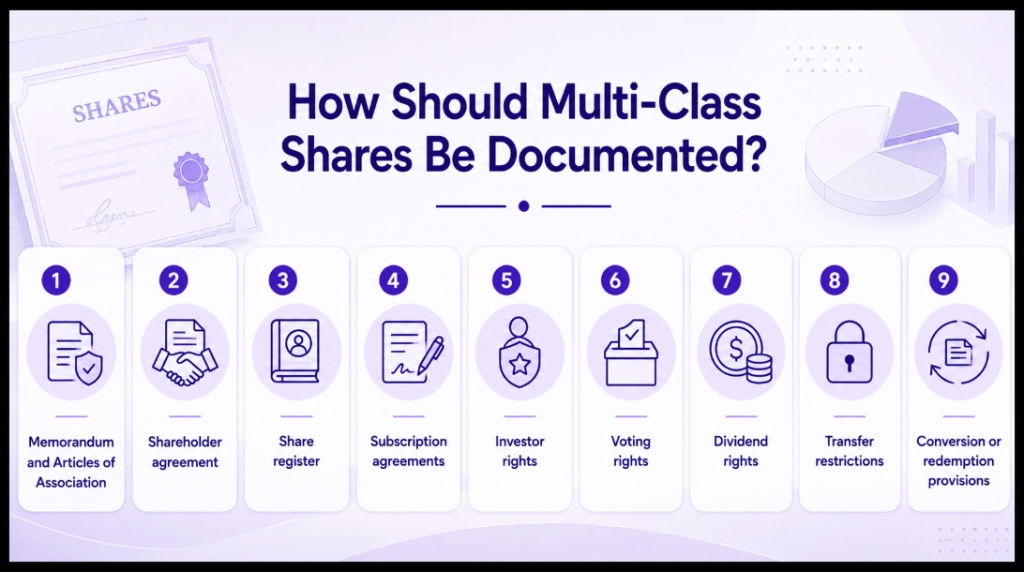
ADGM’s Registration Authority, for example, maintains the public register and registers changes involving shareholders and share capital.
How Can Arnifi Help With UAE Company Structuring?
Arnifi can help founders assess the appropriate UAE jurisdiction and organise the administrative side of company structuring.
Support can include:
- Mainland company setup
- ADGM company setup
- DIFC company setup
- Shareholding structure
- Corporate documentation
- Investor-readiness
- Share registers
- Post-setup compliance
- Accounting and ownership records
The objective is to help founders build a corporate structure that matches their ownership, funding and governance requirements.
FAQs
Are multi-class shares allowed in the UAE?
Yes. The 2025 amendments to the Commercial Companies Law allow multiple classes of quotas and shares, subject to applicable requirements.
Can a UAE LLC issue different classes of shares?
Yes. The amended framework allows LLCs to establish multiple classes of quotas with differentiated rights, subject to applicable requirements.
Can UAE companies issue preference shares?
The amended framework recognises preferred shares and preferential rights, but the precise classes, rights and registration requirements depend on the applicable legislation and competent-authority framework.
Can startups use multi-class shares for investor funding in the UAE?
Yes. Multi-class structures can separate founder control from investor economic rights where the applicable jurisdiction permits the arrangement.
Are multi-class shares allowed in ADGM and DIFC?
Yes. Both ADGM and DIFC have established corporate frameworks that permit companies to create different classes of shares.
Which UAE jurisdiction is best for multi-class shares?
It depends on the required rights, investors, business activity and registration process. ADGM, DIFC and mainland UAE should be assessed against those requirements.
Conclusion
Multi-class shares give founders and investors greater flexibility to separate voting, economic and governance rights.
The UAE’s 2025 Commercial Companies Law amendments represent a significant shift by expressly allowing multiple classes of quotas and shares, including for LLCs. The Ministry of Economy and Tourism has confirmed that the framework can accommodate differentiated voting, dividend, liquidation and other rights.
ADGM and DIFC remain established choices for founders seeking sophisticated share structures, while mainland UAE now offers considerably more flexibility than under the earlier framework.
Before implementing a multi-class structure, founders should look beyond the headline legal permission and confirm the precise rights available, constitutional-document requirements and registration process applicable to their company.
References
Top UAE Packages
Related Articles



Top UAE Packages
Get in Touch
