
How Dubai’s New Petroleum Trading Rules Reshape the Market for Petroleum Companies
by Rifa S Laskar Dec 03, 2025  6 MIN READ


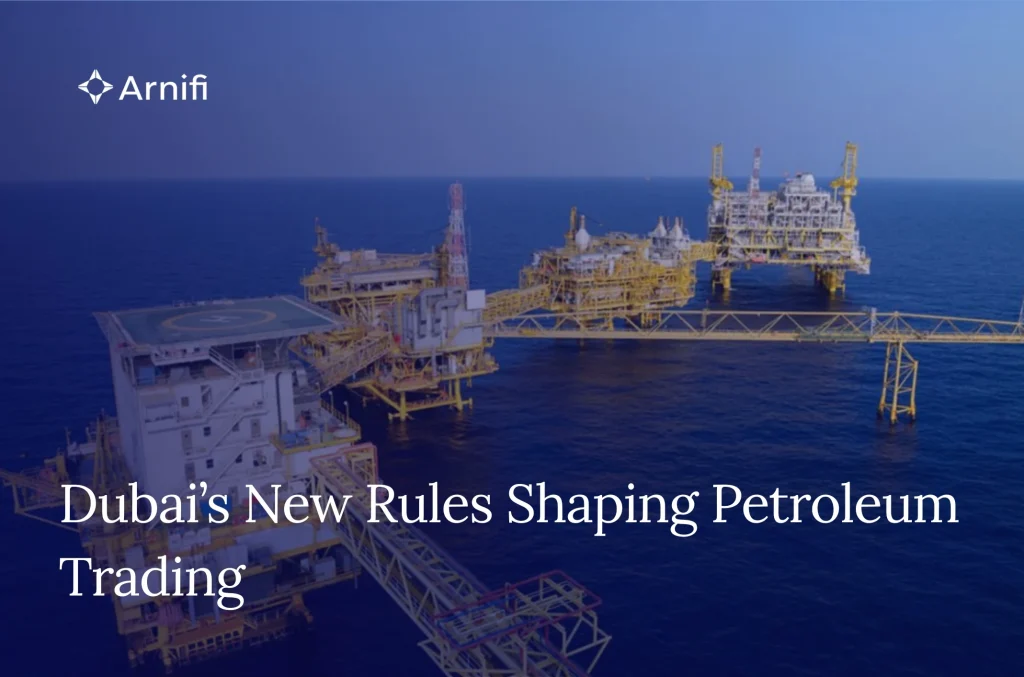
Dubai has introduced a new regulatory framework that reshapes how petroleum companies in Dubai operate. From permits to pricing rules, the system is shifting toward tighter safety, cleaner market practices and more accountability across every stage of petroleum trading.
Table of contents
- 1. Introduction
- 2. Why This Regulatory Shift Matters
- 3. The Role of the Dubai Supreme Council of Energy
- 4. A Clear Stand Against Illegal Trading
- 5. Permit Rules Every Operator Must Understand
- 6. Safety First, With Real Consequences
- 7. Urban Planning and Fuel Station Allocation
- 8. Strong Inter-Agency Coordination
- 9. Transition Period for Existing Operators
- 10. How Arnifi Helps Businesses Navigate These New Rules
- 11. Conclusion
1. Introduction
The moment you look at the latest regulatory shift, one point becomes clear that petroleum companies in Dubai can’t treat compliance as a routine checklist anymore. Dubai has introduced a new, detailed framework for how petroleum should be imported, stored, transported and traded across the Emirate. And if you operate in this field, you’re expected to understand it, adapt to it and build it into your core operations.
This isn’t a minor administrative update also, Dubai is asking everyone involved in petroleum trading to raise their operational standards, tighten safety practices and clean up market behaviour that has previously gone unchecked. If you operate within this ecosystem, don’t skim these rules but study them and adjust your business model accordingly.
2. Why This Regulatory Shift Matters
For years, petroleum companies in Dubai have operated in a high-growth environment with relatively decentralised oversight. The new framework puts structure around every activity tied to petroleum products: import, production, storage, transport, sale and supply.
Dubai wants a safe, transparent and well-regulated petroleum environment that protects people, property and market integrity. And it wants every operator aligned with this vision.
3. The Role of the Dubai Supreme Council of Energy
With the new rules, the Dubai Supreme Council of Energy becomes the main authority overseeing petroleum trading activities. That means petroleum companies in Dubai now answer to a single, central body for:
- Competition rules and market concentration
- Technical standards for storage, transport and trading
- Environmental, health and safety requirements
- Permit approvals, renewals and amendments
- Standards for transport vehicles and fuel storage facilities
- Regulations for household gas cylinder safety
Think of it as the Council setting the tone for how petroleum companies in Dubai must operate today and how they’re expected to evolve in the coming decade.
4. A Clear Stand Against Illegal Trading
The framework directly targets the grey areas of petroleum trading unverified sourcing, improper storage, unsafe transport and unlicensed operations.
Under the new rules:
- No one can engage in petroleum trading without authorisation
- All petroleum materials must come from Council-approved sources
- Documentation proving the legitimacy of materials must be verified before any activity
- Operators must register in the Petroleum Trading Register
- Prices must be clearly displayed
- All incidents must be reported within 24 hours
Petroleum companies in Dubai that have been compliant will benefit & those operating carelessly will find the market less forgiving.
5. Permit Rules Every Operator Must Understand
The new framework outlines exactly how permits will be issued, amended and renewed. Some of the biggest changes include:
Defined permit types and validity periods
Every activity has its own permit category. Operators can’t assume broad permission or act outside the scope of approval.
Rules for transporting petroleum between emirates
Movement isn’t free-flowing anymore. It must comply with technical and safety standards.
Conditions for establishing retail fuel stations
These include location approvals, safety distances, storage guidelines and technical criteria.
Requirements for importing petroleum products
Only approved companies with validated origins can supply to the market.
For petroleum companies in Dubai, this means operational planning must now start with regulatory alignment, not after-the-fact adjustments.
6. Safety First, With Real Consequences
One of the strongest elements in the new framework is its intolerance for negligence.
Operators must:
- Keep documentation for at least five years
- Follow approved technical standards
- Implement stringent safety protocols
- Report incidents quickly and transparently
- Maintain full compliance across every stage of the supply chain
Violations come with fines that double for repeat offences within a year, up to one million dirhams. The Council may also:
- Cancel permits
- Close facilities for up to six months
- Revoke commercial licences
- Seize and destroy non-compliant vehicles or products
- Re-export seized material
- Charge violators the cost of corrective work plus 25 percent administrative fees
This is where petroleum companies in Dubai must pay close attention. Safety is no longer negotiable, and non-compliance is expensive.
7. Urban Planning and Fuel Station Allocation
You’ll notice another major shift: fuel station locations will now align with Dubai’s Urban Plan.
This means:
- No random approvals
- No cluster-based expansion
- A more strategic distribution of stations
The city wants safety, traffic efficiency and land optimisation. The Council will ensure fuel stations meet the standards, not just business demand.
8. Strong Inter-Agency Coordination
The framework also requires every government and non-government entity in Dubai to support the Council in carrying out these rules. This creates a unified ecosystem where enforcement, oversight and compliance work together rather than in silos.
Petroleum companies in Dubai will feel the difference in inspections, permit workflows and the level of scrutiny applied to operational practices.
9. Transition Period for Existing Operators
Existing operators have a one-year window to comply, with the possibility of a one-year extension if approved.
This gives petroleum companies in Dubai time to:
- Update internal policies
- Rework sourcing arrangements
- Upgrade storage and transport infrastructure
- Train staff on safety and reporting obligations
- Align documentation and record-keeping processes
But it’s not a long runway. And the expectation is absolute compliance.
10. How Arnifi Helps Businesses Navigate These New Rules
This level of regulatory complexity can overwhelm even experienced operators. That’s why many petroleum companies in Dubai work with Arnifi to manage compliance from the start.
Arnifi helps you:
- Understand the exact permits your business needs
- Prepare documentation and align sourcing workflows
- Navigate approvals with the Dubai Supreme Council of Energy
- Ensure storage, transport and safety standards meet the new framework
- Set up or restructure your entity to match regulatory obligations
- Stay compliant through changing inspection and reporting rules
- Avoid costly violations and penalties
In short, we help you build a petroleum business that runs confidently and compliantly in Dubai’s new regulatory landscape.
11. Conclusion
Dubai’s updated petroleum trading framework is more than a rulebook. It’s a blueprint for a safer, cleaner and more organised petroleum sector. For petroleum companies in Dubai, the message is straightforward: operate with transparency, meet the technical standards and treat compliance as a core business function.
Those who adapt quickly will thrive. Those who underestimate these changes will struggle with fines, closures and operational setbacks.
If you’re planning to set up or restructure your petroleum-related business in Dubai, Arnifi is ready to guide you through every step.
Top UAE Packages


Related Articles

Top UAE Packages
Get in Touch