
UAE Cyber Security Council 2026 | Role, Responsibilities & National Cybersecurity Strategy

Ishika Bhandari
Content Writer
Ishika Bhandari is a content writer with experience in creating SEO-focused content across diverse industries, including business, lifestyle, and jewellery. She specializes in turning… Read more

Tulika Saxena
AVP, Sales & Marketing | IIM Nagpur
Tulika Saxena specializes in business finance, sales strategy, and market positioning. Leads growth and partnerships, ensuring seamless business setup experiences and client success across… Read more


Key Facts: The UAE Cyber Security Council, established in 2020, leads national cybersecurity efforts across policies, regulations, digital infrastructure, and cyber readiness. Its initiatives cover cloud, AI, critical infrastructure and information sharing, alongside new projects such as the National Cyber Centre of Excellence.

Introduction
Cybersecurity is now a key part of the UAE’s digital economy, with businesses increasingly relying on cloud services, AI, digital platforms and connected systems. This also increases risks to data, payments, operations and critical infrastructure. The UAE Cyber Security Council, established in 2020, leads national cybersecurity strategy, policies and coordination. Its work covers areas such as cloud security, AI, critical infrastructure and information sharing. For businesses, understanding the Council’s role helps them identify relevant cybersecurity requirements across federal, emirate-level and sector-specific regulations.
What Is the UAE Cyber Security Council?
The UAE Cyber Security Council is a federal body established by the UAE Cabinet in November 2020 to strengthen national cybersecurity and build a secure, resilient digital infrastructure. The Council works with federal and local authorities to develop cybersecurity policies, legislation and standards, improve cyber incident preparedness and support the secure use of emerging technologies. It also promotes cybersecurity awareness and information sharing, making it a key part of the UAE’s broader digital transformation.
What Does the UAE Cyber Security Council Do?
The UAE Cyber Security Council responsibilities cover several areas of national cybersecurity.
| Area | Role |
| Cybersecurity policy | Develop and propose national cybersecurity policies and strategies |
| Regulations | Support legislation, standards and regulatory frameworks |
| National readiness | Strengthen preparedness and response to cyber incidents |
| Coordination | Coordinate with federal, local and sector-specific authorities |
| Digital infrastructure | Support protection and resilience of national digital infrastructure |
| Awareness | Promote cybersecurity awareness and safer digital practices |
| Emerging technology | Address security risks linked to AI, cloud and other technologies |
The Council helps develop cybersecurity laws, policies and standards, secures emerging technologies, strengthens sector readiness and coordinates the national cyber incident response plan.
What Is the UAE National Cybersecurity Strategy?
The UAE’s national cybersecurity strategy provides the broader direction for strengthening the country’s cyber resilience as digital adoption increases. The strategy focuses on areas such as governance, protection, innovation, capability development and partnerships. These priorities recognise that cybersecurity requires cooperation between government entities, businesses, technology providers and other stakeholders.
The wider UAE national cybersecurity approach includes:
- Protection of digital and critical infrastructure
- Cyber resilience and incident response
- Secure digital transformation
- Cybersecurity governance
- Protection of critical sectors
- Cybersecurity workforce development
- Technology and security innovation
- Public-private cooperation
- Cybersecurity awareness
The strategy is particularly relevant as the UAE expands its use of AI, cloud computing, smart infrastructure and other connected technologies.
Which UAE Cybersecurity Policies and Frameworks Should Businesses Know?
Businesses should not assume that one UAE cybersecurity framework applies to every company. Requirements can vary according to the business activity, industry, regulator, technology infrastructure and type of information handled. Several national policies are particularly relevant to the UAE’s evolving digital environment.
What Is the National Cloud Security Policy?
The National Cloud Security Policy provides guidance for cloud consumers and cloud service providers in the UAE. It addresses areas including cloud governance, contractual arrangements, data security, data location, identity and access management, incident management and cloud resilience. For businesses, this means cloud security should not be treated as something handled entirely by the service provider. Companies should understand where their data is stored, who can access it, how incidents are handled and what contractual protections are in place.
What Other Cybersecurity Policies Can Apply?
The UAE has also established policies covering specific cybersecurity risks.
The Critical Information Infrastructure Protection Policy provides a governance and protection framework for critical information infrastructure and establishes baseline security and resilience requirements for relevant entities.
The National Third Party Security Policy addresses supply-chain and third-party cybersecurity risks, including supplier assessment, contracts, monitoring and resilience.
There is also a National Cyber Security Policy for Artificial Intelligence, which addresses governance, risk management, secure AI development and operation, supply-chain risks and privacy considerations.
These policies show why businesses need to assess their specific circumstances rather than assuming that one set of UAE cyber security regulations applies universally.
How Does the Cyber Security Council Support UAE Businesses?
The Council’s work has practical relevance for businesses even though it is not simply a licensing authority for ordinary companies.
Its national cybersecurity initiatives support a stronger environment for:
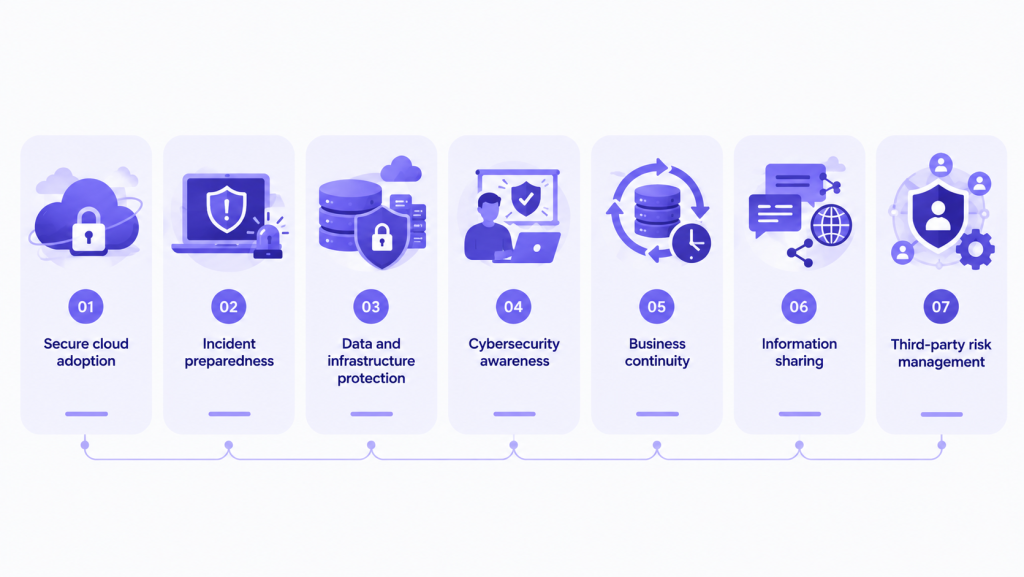
The UAE has also developed a Cyber Security Information Sharing Framework to enable closer and faster sharing of cybersecurity information among stakeholders. The framework is intended to improve collaboration, resilience and responses to cyber threats. For businesses, the practical impact is that cybersecurity should be considered alongside other areas of regulatory and operational planning.
What Is the National Cyber Centre of Excellence?
The UAE has been developing a Cyber Centre of Excellence through a partnership between the Cyber Security Council and Thales.
The initiative includes three main components.
- Space META Security Operations Centre: This capability focuses on cybersecurity for space infrastructure and related systems, supporting specialised monitoring and protection.
- Cyber Evaluation Lab: The lab is designed to evaluate software, hardware and other digital assets in controlled environments while supporting the development of security standards and governance approaches.
- Crypto Lab: This facility focuses on advanced cryptographic technologies, including technologies designed to address future security challenges.
Together, these capabilities are intended to strengthen national cybersecurity expertise, technology evaluation and research while supporting the UAE’s position as a digital and technology hub.
Why Is Cybersecurity Important for Businesses in the UAE?
A cybersecurity incident can affect much more than a company’s IT department. It can interrupt operations, expose customer information, affect payments and damage relationships with clients and suppliers.
Common risks include:
- Cyberattacks and online fraud
- Data breaches
- Ransomware
- Phishing and social engineering
- Cloud security weaknesses
- Third-party and supply-chain attacks
- Business disruption
The UAE’s rapidly expanding digital economy also increases the number of systems and services that businesses depend on. For example, a company may use cloud accounting software, online payment systems, customer databases, remote access tools and external technology providers. A weakness in any of these areas can create a wider business risk.
What Cybersecurity Responsibilities Should UAE Businesses Consider?
The exact UAE national cybersecurity requirements depend on the business and its regulatory environment. However, companies should consider several basic areas.
- Access controls: Restrict system access according to employee roles and responsibilities.
- Data protection: Identify sensitive information and apply appropriate safeguards for storing, processing and sharing it.
- Incident response: Maintain a process for identifying, containing and responding to cybersecurity incidents.
- Employee awareness: Train staff to recognise phishing, social engineering and suspicious activity.
- Cloud security: Review the security practices, contracts and data-handling arrangements of cloud providers.
- Vendor management: Assess cybersecurity risks associated with suppliers and technology partners.
- Business continuity: Consider how operations would continue if critical systems became unavailable.
- Documentation: Maintain relevant policies, security records, risk assessments and incident documentation.
These steps do not automatically make a company compliant with every UAE cyber security regulation. Businesses should identify the specific requirements that apply to their sector and operations.
What Are the UAE Cyber Security Council’s Recent Initiatives?
The Council’s work has expanded into national policies, awareness, technology development and public-private cooperation.
| Initiative | Focus |
| Cyber Security Council establishment | National cybersecurity governance |
| National cybersecurity strategy | Long-term cyber resilience and capability development |
| National Cloud Security Policy | Secure cloud adoption |
| Critical Information Infrastructure Protection Policy | Protection of critical infrastructure |
| Third Party Security Policy | Supply-chain and vendor security |
| AI Cybersecurity Policy | Security of AI systems |
| Information Sharing Framework | Faster cybersecurity information sharing |
| Cyber Centre of Excellence | Advanced cyber, space and cryptographic capabilities |
| Public-private partnerships | Cyber resilience and knowledge sharing |
A notable 2026 development was the Mastercard and Cyber Security Council partnership, announced in February 2026. The two organisations signed an MoU to strengthen the UAE’s digital ecosystem through cybersecurity expertise, global best practices and support for forward-looking cybersecurity policies.
How Does the UAE Cyber Security Council Affect New Businesses?
A new business does not automatically become subject to every national cybersecurity policy. However, founders should consider cybersecurity requirements when establishing and expanding a UAE company.
Key factors include:
- Business activity
- Industry and regulator
- Type of data handled
- Cloud infrastructure
- Customer requirements
- Technology systems
- Third-party providers
- Applicable UAE cybercrime laws
- Relevant cybersecurity standards or certifications
A technology company handling large amounts of customer data, for example, may face different risks and regulatory considerations from a small trading business. The right approach is to identify the business’s regulatory environment first and then determine which cybersecurity requirements apply.
What Should Businesses Do to Improve Cybersecurity Compliance in the UAE?
Businesses can use the following checklist as a starting point:
- Identify applicable regulators and review the requirements relevant to the business.
- Map company data and systems to understand what needs protection.
- Assess cybersecurity risks across internal systems and external providers.
- Establish access controls and remove unnecessary permissions.
- Secure cloud infrastructure and review cloud provider arrangements.
- Prepare an incident response process before a security incident occurs.
- Train employees on common cyber threats.
- Review third-party vendors that have access to systems or data.
- Maintain appropriate documentation of cybersecurity controls and policies.
- Review security measures regularly as the business and technology environment changes.
UAE Cyber Security Council vs Other Cybersecurity Authorities
Several UAE authorities have cybersecurity-related responsibilities, but their roles are different.
| Authority/Body | Main Focus |
| UAE Cyber Security Council | National cybersecurity policy, strategy and coordination |
| Dubai Electronic Security Center | Electronic security and cybersecurity within Dubai’s government environment |
| Telecommunications and Digital Government Regulatory Authority | Telecommunications and digital government regulation |
| Sector regulators | Industry-specific cybersecurity requirements |
| Police and law enforcement | Cybercrime investigation and enforcement |
The UAE Cyber Security Council should therefore not be treated as a general cybersecurity licensing authority for every company.
A business may need to comply with requirements from multiple authorities depending on its activity, location, sector and technology environment.
What Are the Common Mistakes Businesses Make About UAE Cybersecurity?
One common mistake is assuming that one UAE cybersecurity strategy or framework applies identically to every business. In reality, cybersecurity obligations can differ according to the sector and regulator. Another mistake is treating cybersecurity as an IT-only responsibility. Employees, suppliers, contracts, cloud providers and management processes can all affect a company’s cyber risk. Businesses may also assume that their cloud provider handles every aspect of security. However, companies still need to understand their own responsibilities for access, data, contracts and incident management.
Other mistakes include:
- Failing to identify the relevant regulator
- Waiting until after a cyber incident to create an incident response plan
- Assuming a business licence automatically provides cybersecurity compliance
- Ignoring third-party and supply-chain risks
- Using outdated security policies
- Failing to review cybersecurity controls as the business grows
How Can Arnifi Help With UAE Business Setup and Compliance?
Cybersecurity can form part of a company’s wider regulatory planning. Arnifi supports company formation, licence selection, regulatory mapping, compliance coordination, visa services and ongoing corporate requirements. This can help businesses identify relevant requirements early and avoid unnecessary changes later. Technical cybersecurity testing, certification, or specific government approvals should be handled by the relevant authorised providers or authorities.
FAQs
What is the UAE Cyber Security Council?
The UAE Cyber Security Council is a federal body established in 2020 to strengthen national cybersecurity and cyber resilience.
When was the UAE Cyber Security Council established?
The UAE Cabinet established it in November 2020 to strengthen the country’s cybersecurity and infrastructure.
What does the Cyber Security Council do?
It develops cybersecurity strategies, policies and regulations while supporting national readiness and incident preparedness.
Who heads the UAE Cyber Security Council?
It is chaired by the Head of Cyber Security for the UAE Government.
Is Cyber Security Council registration mandatory for businesses?
No general registration is required. Requirements depend on the business, sector and applicable authority.
Does every UAE company need to follow Cyber Security Council requirements?
Not in the same way. Requirements vary by business activity, sector and regulator.
What is the UAE National Cybersecurity Strategy?
It is the UAE’s national framework for strengthening cyber resilience, protecting infrastructure and supporting secure digital transformation.
What is the National Cloud Security Policy?
It provides guidance on cloud governance, data security, access, incident management and resilience.
Does the Cyber Security Council issue cybersecurity licences?
No. Its role focuses on national cybersecurity strategy, policy, coordination and resilience.
What is the National Cyber Centre of Excellence?
It focuses on developing advanced cybersecurity capabilities, technology evaluation and cryptographic research.
How does the Council support UAE businesses?
Through cybersecurity policies, initiatives, awareness, information sharing, partnerships and improved readiness.
What cybersecurity requirements apply to UAE companies?
Requirements depend on the business activity, industry, regulator, data, systems and contracts.
Does cybersecurity compliance differ by industry in the UAE?
Yes. Regulated sectors may have additional requirements from their relevant authorities.
What should startups do to improve cybersecurity?
Startups should protect data, control access, secure cloud systems, train staff, assess third parties and prepare for incidents.
Where can businesses find UAE cybersecurity policies?
Businesses can refer to the UAE Cyber Security Council and official UAE Government platform for relevant policies and initiatives.
Conclusion
The UAE Cyber Security Council plays a key role in strengthening the country’s digital security through national strategies, policies, regulations, and cyber readiness. Its work covers areas such as cloud security, critical infrastructure, AI, and information sharing. For businesses, cybersecurity requirements depend on their activity, industry, data, systems, and regulators. As the UAE continues expanding its digital economy, understanding and addressing these requirements will remain important for secure business operations and long-term growth.
References:
Top UAE Packages


Related Articles



Top UAE Packages
Get in Touch