
How to Invest in Dubai from India: A Step-by-Step Guide for Investors & Founders

Zahira Shaik
SEO Content Writer
Zahira Shaik is an SEO Content Writer and Published Author specializing in research-based content. She excels at analyzing market trends, regulations, and industry developments… Read more

Tulika Saxena
AVP, Sales & Marketing | IIM Nagpur
Tulika Saxena specializes in business finance, sales strategy, and market positioning. Leads growth and partnerships, ensuring seamless business setup experiences and client success across… Read more



Key Fact: Indian nationals can legally invest in Dubai real estate, businesses, and stock markets using the RBI’s Liberalised Remittance Scheme (LRS), which allows outward transfers of up to USD 250,000 per individual per financial year.
Table of contents
- Introduction
- Strategic Appeal: Why Are Indian Investors Choosing Dubai?
- Legal Framework: Can Indians Legally Invest in Dubai?
- Top Investment Opportunities in Dubai for Indians
- How to Invest in Dubai: Step-by-Step Structure
- How Founders Structure a Multi-Asset Dubai Investment
- Required Documents for Indian Investors
- LRS Outward Remittance Guidelines
- Key Risks & Risk Mitigation Strategy
- Strategic Advisory & Implementation
- Frequently Asked Questions
- Conclusion
- References
Introduction
The investment in Dubai provides an opportunity for high net worth Indians (HNIs), entrepreneurs, and small investors to invest in one of the fastest-growing economies in the world. Investing in Dubai will provide Indian investors the opportunity to have international exposure through three main channels: real estate, business setup, and financial markets.
Whereas all the existing tutorials cover mainly acquiring a flat and doing a wire transfer abroad, a successful multi-asset investment process will need foreign exchange regulations, company structure, real estate purchase, taxation considerations, and residency options.
This tutorial will explain the process of structuring compliant multi-asset investments in Dubai and utilizing new-age technology to make this process easier.
Strategic Appeal: Why Are Indian Investors Choosing Dubai?
Given Dubai’s closeness to India, along with the favorable policies in place, it makes it an ideal place for money to be preserved and businesses to be expanded.
- Tax & Currency Advantages: Dubai levies zero personal income tax and zero capital gains tax. The UAE Dirham (AED) is pegged to the US Dollar (1 USD = ~3.67 AED), providing Indian investors with a stable, dollar-hedged asset class against Rupee depreciation.
- 100% Foreign Ownership: With new amendments in commercial company laws of the UAE, 100% foreign ownership is allowed in key mainland sectors and free zones, with no need for local Emirati ownership.
- India-UAE Tax Treaty: A Double Taxation Avoidance Agreement (DTAA) is signed between the two countries, which provides the legal means to avoid double taxation of cross-border income flows. (Note: Residents of India have to report all global assets under Schedule FA and pay Indian taxes on global income, but the DTAA prevents double taxation).
- Residency Pathways: Residency opportunities, like the 10-year Golden Visa program, provide investors and their family members with a chance to reside in UAE.
Legal Framework: Can Indians Legally Invest in Dubai?
Citizens of India who live in India are entitled to make investments in the real estate sector, companies, and stock markets of Dubai in accordance with the Liberalised Remittance Scheme (LRS) of the Reserve Bank of India (RBI):
- Annual Remittance Cap: Up to $250,000 per annum for an individual resident per financial year (April 1 – March 31). A family of four can combine their limits to remit up to $1,000,000 each year for joint acquisition of assets.
- Permissible Allocations: Purchase of overseas real estate property, equity investment, forming subsidiaries, or establishing foreign bank accounts.
- Execution & Reporting: All transactions will have to be done through an AD Category-I bank as per the FEMA regulations, through Form A2 along with PAN declaration. Tax on Collection at Source (TCS) applies to outward investments.
Top Investment Opportunities in Dubai for Indians
| Investment Route | Primary Purpose | Key Considerations | Relevant Regulators / Portals |
| Real Estate | Asset preservation, rental yields (6–8%), property appreciation | Location, maintenance fees, title registration, freehold status | Dubai Land Department (DLD) |
| Business Setup | Operational scaling, market expansion, commercial growth | Licence activity selection, mainland vs. free zone, banking setup | Dubai Economy and Tourism (DET) / Free Zone Authorities |
| Financial Markets | Liquid equity exposure, mutual funds, portfolio growth | Broker selection, investor number (NIN) generation, market volatility | Dubai Financial Market (DFM) / ADX |
| Gold & Alternatives | Physical wealth storage, digital asset ventures | Storage fees, VARA compliance for crypto/digital assets | Virtual Assets Regulatory Authority (VARA) |
Asset Summary
- Real Estate: Provides high rental yield (6%-8%) and total freehold property rights in specified locations such as Downtown Dubai, Business Bay, and Dubai Marina. Investments worth AED 2 million or above provide eligibility for the Golden Visa for 10 years.
- Business Establishment: Provides 100% ownership, no corporate taxes on eligible income, and full capital return.
- Stock & Financial Markets: Non-residents may obtain a National Investor Number (NIN) to deal in shares of the DFM directly.
How to Invest in Dubai: Step-by-Step Structure
- Choose Investment Category: Choose your major target investment asset – either real estate, business creation, stock trading, or alternative investing.
- Determine Ownership Structure: Choose whether to invest as an individual, pool family LRS limits, or buy stock in a newly established Dubai Free Zone company.
- Compile Documentation: Collect your passport, PAN card, last 6 months’ bank statements, evidence of income, and basic KYC documents.
- Execute Remittance via LRS: Remit funds via your Authorised Dealer Bank in India using Form A2 while adhering to FEMA and TCS requirements.
- Complete Dubai Asset Registration: Register real estate transactions through DLD, businesses with DET/Free Zone, or trading account opening on DFM.
- Execute Post-Investment Compliance: Obtain investor visa/Golden Visa, open UAE bank accounts, and file foreign asset declarations (Schedule FA) in your Indian income tax returns.
How Founders Structure a Multi-Asset Dubai Investment
In most cases, the founders of the startups systematically conduct the process of expansion, namely:
- Step 1: Conduct outward remittance following RBI LRS regulations using an AD Category I bank.
- Step 2: Register either a Free Zone or a mainland company with 100% foreign shareholding.
- Step 3: Obtain a trade license, a business bank account, and visas for the founders.
- Step 4: Invest excess cash in commercial real estate or local financial market instruments.
- Step 5: Establish a compliance framework with the help of Arni Organogram for structuring, Arni Docs for KYC, and Ledge for dual taxation.
Required Documents for Indian Investors
| Document | Purpose | Issuing / Verifying Body |
| Passport | Primary identity and citizenship verification | Passport Seva / Ministry of External Affairs |
| PAN Card | Mandatory Indian tax identification for outward remittances | Income Tax Department of India |
| Bank Statements (6 Months) | Proof of source of funds and financial standing | Authorised Dealer Bank |
| Income Proof / ITR Copies | Verification of legal earning capacity | Income Tax Department of India |
| Investment Documents | Sales Agreements (MOU), Allotment Letters, License Applications | DLD / DET / Free Zone Authorities |
| Corporate Documents | Board Resolutions, MOA/AOA (if investing via an entity) | Ministry of Foreign Affairs (MOFA) / MCA |
LRS Outward Remittance Guidelines
- Individual Ceiling: USD 250,000 per financial year per person.
- Family Pooling: More than one member of a family (including minors) can combine individual ceilings for a single property purchase.
- Prohibited Transfers: The LRS ceiling may not be used for margin trading, forex speculation, and lottery/gambling activities.
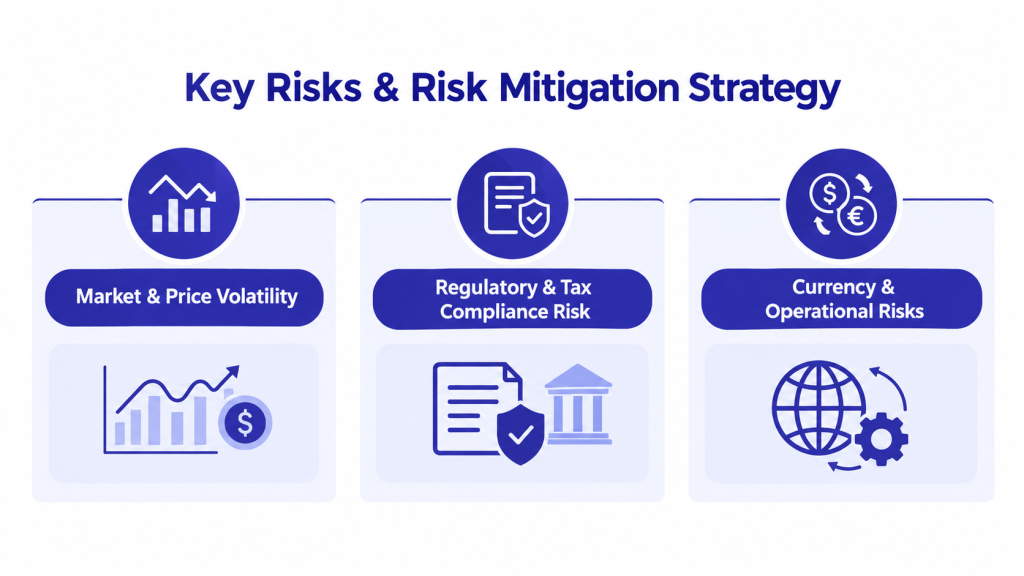
Key Risks & Risk Mitigation Strategy
- Market & Price Volatility: Property prices and equities at a local level change.
Mitigation: Concentrate on quality freehold areas and have independent valuations done on the properties. - Regulatory & Tax Compliance Risk: Non-reporting of overseas property and accounts is a violation of the law in India.
Mitigation: Report all your overseas properties and bank accounts in Schedule FA of your Indian Income Tax Return. - Currency & Operational Risks: Mismatch in business license, lack of approved escrow accounts.
Mitigation: Ensure off-plan real estate purchases are made to DLD-approved escrow accounts.
Strategic Advisory & Implementation
Implementing a Dubai investment strategy involves proper planning of all aspects related to setting up the business, banking, and documentation needs. The professional corporate services platform (like Arnifi) helps in setting up the entities, handling the document process efficiently, and conducting due diligence on properties.
Frequently Asked Questions
Can Indians legally invest in Dubai from India?
Yes. Indian residents can make legal investments in Dubai properties, businesses, or securities within the purview of RBI’s Liberalized Remittance Scheme (LRS) for an amount not exceeding USD 250,000 per financial year.
How much money can an Indian invest in Dubai annually?
An individual Indian resident may transfer up to USD 250,000 in one financial year. Several family members can together use their respective limits for buying or investing in property.
Can Indians buy freehold property in Dubai?
Yes. Non-residents, including Indians, have the right to purchase freehold property in certain areas of Dubai, like Downtown Dubai, Business Bay, Dubai Marina, and Palm Jumeirah.
How do I transfer money from India to Dubai for investment?
Money needs to be sent to Dubai through the Authorised Dealer (AD Category-I) Bank in India through Form A2.
Does buying property in Dubai grant a Golden Visa?
Yes. Acquisition of property in Dubai worth at least AED 2 million qualifies the investor for a 10-year UAE Golden Visa, pending Dubai Land Department compliance.
Is income earned in Dubai tax-free for Indian residents?
Even though there is no personal income tax in the UAE, any income from anywhere in the world that is earned by an Indian tax resident will continue to be taxed in India as per the Income Tax Act. However, tax relief can be availed through the India-UAE DTAA.
Can an Indian company invest in Dubai outside the LRS scheme?
Yes. The USD 250,000 restriction for LRS is only applicable to individuals and not to businesses. Indian businesses and partnership firms have their own set of guidelines for overseas investment (ODI/OI) under FEMA regulations.
What is the TCS (Tax Collected at Source) rate on foreign property investment?
If you are sending funds abroad via the Liberalized Remittance Scheme (LRS) for investment purposes, TCS of 20% applies on the amount above ₹10 lakh per financial year. It should be noted that TCS is not extra tax and will be refunded or set off as income tax credit while filing your Indian ITR.
Do I need a UAE residence visa to open a personal bank account in Dubai?
No. The requirement to open a personal “Savings Account” in any UAE bank is just a valid passport and letters of bank reference, along with 6 months bank statement from your home country. To open a “Current Account” with cheque facility, one would need a UAE Residence Visa and Emirates ID card.
What happens if I sell my Dubai property and want to repatriate the money back to India?
Repatriation of entire capital and profit earned from property sale is possible. However, you should disclose capital gains in your Indian Income Tax Return and pay taxes according to Indian Income Tax rules (tax calculated on short-term/long-term capital gain).
Can an Indian investor form a Dubai Free Zone company without visiting Dubai?
Yes, there are several Dubai Free Zones that provide 100% online incorporation, verification of signatures, and issuance of trading licenses. Nevertheless, a visit to Dubai will be necessary later for biometric processing of your residency visa and opening bank accounts locally.
Conclusion
Investment in Dubai offers a safe and dollar-hedging growth platform for Indian investors and entrepreneurs. Whether you choose to invest to protect yourself from risks with real estate income, scale up globally by incorporating a Dubai Free Zone company, or just diversify your investments, success lies in careful planning. Compliance with Indian regulations (LRS/FEMA) during the Dubai setup process will make your international expansion plan robust.
References
Top UAE Packages


Related Articles



Top UAE Packages
Get in Touch