
Year-End Tax Planning Singapore | 8 Legal Strategies SMEs Use Before December 31
by Anushka Basu May 21, 2026  7 MIN READ


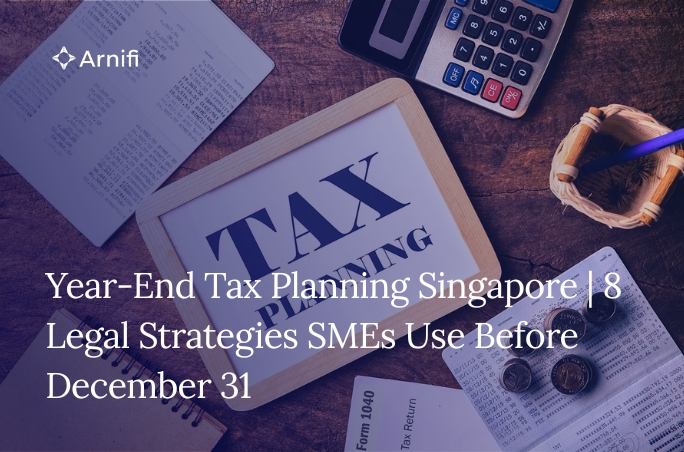
Year-end tax planning Singapore SME work should start before the financial year closes, not after the accountant begins filing. For companies with a 31 December financial year-end December is the last practical window to review deductible costs and fixed asset purchases. It is also a good time to check bad debts, bonuses, grants, tax incentives and cash flow.
Singapore companies are taxed at a flat 17% on chargeable income. The final tax bill still depends on exemptions deductions, capital allowances rebates and timing. A clean review before year-end can help SMEs avoid missed claims and rushed filing adjustments.
Table of contents
- Why Year-End Tax Planning Matters
- 8 Legal Strategies SMEs Should Review Before December 31
- 1. Review Expense Cut-Off Before The Year Closes
- 2. Check Deductible And Non-Deductible Costs
- 3. Claim Capital Allowances Properly
- 4. Use EIS Where The Company Qualifies
- 5. Review DTDi For Overseas Expansion
- 6. Write Off Bad Debts With Evidence
- 7. Plan Bonuses And Director Fees Carefully
- 8. Check Approved Donations And CSR Claims
- What SMEs Should Prepare Before Filing
- Common Mistakes To Avoid
- Conclusion
- FAQs
Why Year-End Tax Planning Matters
Tax planning before the financial year ends in Singapore is not about aggressive tax saving. It is about using legal claims properly and keeping support ready.
A company may have qualifying expenses, old customer debts, unused capital allowance options, or overseas expansion costs that never get reviewed until filing season. By then, some actions cannot be fixed because the year has already closed.
The better approach is simple. Review the numbers early and make clean business decisions. Keep the documents ready for ECI and Corporate Income Tax filing.
8 Legal Strategies SMEs Should Review Before December 31
| Strategy | What To Review | Why It Helps |
| Expense Cut-Off | Supplier bills, accrued costs, staff claims, and unpaid invoices | Keeps the right expenses in the right year |
| Deductible Expenses | Business costs that are revenue in nature and income-producing | Reduces taxable income when valid |
| Capital Allowances | Computers, office equipment, machinery, and low-value assets | Replaces accounting depreciation for tax |
| EIS Claims | R&D, IP, training, innovation projects, and AI-related spend | Can give enhanced deductions if conditions are met |
| DTDi Claims | Overseas market trips, trade fairs, certification, and market studies | Supports international expansion deductions |
| Bad Debts | Old trade debts, recovery proof, and write-off decisions | Avoids leaving unrecoverable income in accounts |
| Bonuses And CPF | Staff bonuses, director fees, CPF timing, and payroll support | Aligns remuneration with business performance |
| Donations And CSR | Approved IPC donations and qualifying corporate volunteering | May give enhanced deduction when valid |
1. Review Expense Cut-Off Before The Year Closes
Singapore SME tax saving strategies December should begin with a cut-off. The company should check supplier bills, accrued professional fees, staff reimbursements, platform charges, subscriptions, and unpaid invoices.
IRAS states that deductible business expenses are costs incurred to run the business, and companies need to know which expenses are deductible and non-deductible. A year-end review helps separate real business costs from personal or capital items.
2. Check Deductible And Non-Deductible Costs
Not every payment reduces taxable income. Some costs may be private, capital in nature, or specifically blocked. Examples include certain private car expenses, penalties, capital purchases, and personal items paid through the company.
A clean tax file should separate normal operating costs, capital purchases, director personal items, related party expenses, and GST accounts. This makes the final tax computation easier and safer.
3. Claim Capital Allowances Properly
Pre-year-end tax review Singapore work should include fixed assets. Accounting depreciation is usually not the same as a tax deduction. For qualifying plant and machinery, companies claim capital allowances instead.
IRAS allows capital allowance claims through different methods, including 1-year write-off for qualifying low-value assets costing not more than S$5,000 each, subject to a S$30,000 cap per YA for all such low-value assets.
This is useful for SMEs buying laptops, printers, office tools, and equipment before year-end. The purchase should still have a real business purpose and proper invoices.
4. Use EIS Where The Company Qualifies
The Enterprise Innovation Scheme can support qualifying innovation and capability-building expenses. IRAS states that EIS can provide 400% tax deductions or allowances on qualifying expenditure for selected activities, subject to caps and conditions.
This can matter for companies spending on qualifying R&D, IP registration, IP licensing, approved training, innovation projects, or qualifying AI expenditure. SMEs should not assume every digital tool qualifies. The claim should match the exact EIS category and keep vendor documents, project notes, and approvals ready.
5. Review DTDi For Overseas Expansion
Singapore corporate tax timing strategies should also include internationalisation costs. The Double Tax Deduction for Internationalisation scheme gives a 200% tax deduction on qualifying overseas expansion expenses. IRAS states that the automatic DTDi cap is S$150,000 per YA for YA 2019 to YA 2026, and this cap increases to S$400,000 per YA starting YA 2027.
Expenses should be grouped by activity, country, vendor, and approval route. Overseas Trade Office and E-Commerce Campaign activities may still need application support, so timing matters.
6. Write Off Bad Debts With Evidence
Old receivables should not stay untouched forever. If a customer debt is genuinely unrecoverable the company should review recovery attempts, customer communication ageing reports and write-off approval before year-end.
IRAS guidance on doubtful debts notes that general provisions are not deductible under some tax treatments. Specific support is needed for stronger claims. The key point is evidence rather than a vague year-end provision.
7. Plan Bonuses And Director Fees Carefully
Bonuses and director fees should match business performance, cash flow, approvals, and payroll records. A company should review staff bonuses, CPF treatment, employment contracts, board approvals, and payment timing before year-end.
This is not only a tax issue. It also affects employee trust, cash flow, and financial statement accuracy. For founder-led companies director remuneration should stay separate from dividends, shareholder loans and personal withdrawals.
8. Check Approved Donations And CSR Claims
Companies that plan donations should check approved Institution of a Public Character status before making payments. IRAS states that qualifying donations to approved IPCs for local causes can receive a 250% tax deduction.
The Corporate Volunteer Scheme can also allow a 250% tax deduction on qualifying expenditure incurred when businesses send employees to volunteer and provide services to IPCs, with the scheme running until 31 December 2026.
What SMEs Should Prepare Before Filing
Companies should prepare these records before the year closes:
- Management accounts, supplier invoices, staff claims, fixed asset schedules, payroll records, CPF records, GST workings, bad debt evidence, and board approvals.
- EIS schedules, DTDi support, donation receipts, loan records, related party balances, capital allowance schedules, and tax adjustment notes.
IRAS states that ECI is due within 3 months after the financial year-end unless the company qualifies for waiver, while Form C-S, Form C-S (Lite), or Form C is due by 30 November each year.
Common Mistakes To Avoid
- Waiting until tax filing season to review deductions.
- Claiming accounting depreciation instead of capital allowances.
- Treating every software or AI purchase as EIS-eligible.
- Forgetting DTDi approval routes for certain overseas activities.
- Making general bad debt provisions without specific support.
- Mixing director personal spending with business expenses.
- Ignoring ECI cash flow until the 3-month deadline arrives.
Conclusion
Year-end tax planning Singapore SME work is most useful when it happens before the accounts close. SMEs should review deductions, capital allowances, incentives, bad debts, payroll timing, donations, and filing deadlines while decisions can still be made cleanly.
A stronger year-end tax process becomes easier when records, schedules, and business decisions are reviewed together. Arnifi’s expert team helps companies build that setup so tax filing stays cleaner, cash flow planning improves, and long-term growth decisions become easier.
FAQs
1. When Should SMEs Start Year-End Tax Planning In Singapore?
SMEs should start before the financial year closes. For companies with a 31 December year-end, December is the final practical month to review costs, claims, incentives, and records.
2. Is Every Business Expense Tax Deductible?
No. Expenses should be business-related, income-producing, and properly supported. Some costs may be non-deductible because they are private, capital in nature, or specifically blocked.
3. Can SMEs Claim Capital Allowances On Equipment?
Yes, if the asset qualifies as plant or machinery used for business. Low-value assets costing not more than S$5,000 each may qualify for 1-year write-off, subject to the S$30,000 cap per YA.
4. What Are The Main Corporate Tax Filing Deadlines?
ECI is generally due within 3 months after the financial year-end unless waiver conditions apply. The Corporate Income Tax Return is due by 30 November each year.
Top Singapore Packages


Related Articles
Top Singapore Packages
Get in Touch