
Cost of Starting a Business in Qatar in 2026

Shethana P
SEO Content Writer
Shethana specialises in creating content that simplifies complex business, compliance, and regulatory topics for global business incorporation. She focuses on SEO strategy, content accuracy,… Read more

Tulika Saxena
AVP, Sales & Marketing | IIM Nagpur
Tulika Saxena specializes in business finance, sales strategy, and market positioning. Leads growth and partnerships, ensuring seamless business setup experiences and client success across… Read more


Key Facts: The cost of starting a business in Qatar depends on the activity, structure, licensing authority, office, visas and approvals. Key costs include registration, licensing, office rent, immigration and compliance. MOCI currently lists QAR 500 annually for commercial registration and QAR 500 for a commercial licence.

Table of contents
- Introduction
- How Much Does It Cost to Start a Business in Qatar?
- What Are the Main Costs of Setting Up a Company in Qatar?
- Does the Business Structure Affect the Cost?
- How Much Does a Qatar Commercial Registration Cost?
- How Much Does a Business Licence Cost in Qatar?
- How Much Does Office Rent Add to the Setup Cost?
- How Much Do Visas and Employee Costs Add?
- Does Qatar Require a Local Partner?
- Is Qatar Mainland or Free Zone Cheaper?
- What Are the Recurring Costs After Starting a Business?
- What Taxes Should Be Included in the Budget?
- Are There Any Incentives That Can Reduce Business Setup Costs?
- What Is the Cheapest Way to Start a Business in Qatar?
- What Documents Are Needed to Start a Business in Qatar?
- What Is the Process for Starting a Business in Qatar?
- What Are the Common Mistakes When Calculating Qatar Business Setup Costs?
- Qatar Business Setup Cost Checklist
- How Can Arnifi Help With Qatar Business Setup?
- Conclusion
- FAQs
Introduction
Qatar has become an attractive location for both local businesses and international investors, supported by its growing economy, infrastructure and business-friendly investment framework. But there is no single cost of starting a business in Qatar that applies to every company. A small service business and a company setting up a warehouse or manufacturing operation can have very different budgets. The final amount depends mainly on the business activity, legal structure, licensing authority, office requirements, number of visas and additional approvals. Qatar also offers different incorporation routes through MOCI, the Qatar Financial Centre (QFC) and Qatar Free Zones Authority (QFZA), so choosing the right route matters.
How Much Does It Cost to Start a Business in Qatar?
There is no universal Qatar business setup cost. Government fees may form only a small part of the total amount, while office space, visas and professional services can add significantly to the first-year budget.
| Cost Component | Typical Consideration |
| Trade name | One-time/application fee |
| Commercial registration | Government fee |
| Business licence | Depends on activity and authority |
| Qatar Chamber | Membership where applicable |
| Office | Depends on location and size |
| Establishment/immigration | Depends on visa requirements |
| Visa costs | Per applicant |
| Professional services | Depends on provider and complexity |
| Additional approvals | Activity-specific |
MOCI’s published fee schedule lists QAR 500 annually for a commercial registration with one main activity and QAR 500 annually for a commercial licence. Additional activities and other services can carry separate charges.
What Are the Main Costs of Setting Up a Company in Qatar?
Government and Registration Fees
These can include:
- Trade name reservation
- Commercial registration
- Commercial licence
- Qatar Chamber membership
- Municipality-related requirements
The exact amount depends on the chosen structure, activity and authority.
Office and Premises
Office costs can include:
- Office rent
- Lease registration
- Fit-out
- Utilities
- Shared or flexible office options where permitted
A business that only needs a basic office will naturally have a different budget from one requiring a retail location, warehouse or specialised premises.
Immigration and Employee Costs
If the company will sponsor founders or employees, budget separately for:
- Establishment-related registrations
- Work permits
- Residence permits
- Medical examination
- Qatar ID
- Employee-related registrations
Family sponsorship, where applicable, adds another layer of immigration costs.
Professional Costs
Businesses may also spend on:
- Company formation assistance
- Legal documentation
- Translation and attestation
- Accounting
- Tax compliance
These are not always government fees, but they can form a meaningful part of the overall business setup cost Qatar investors should plan for.
Does the Business Structure Affect the Cost?
Yes. Different structures come with different registration, licensing and operational requirements.
| Structure | Cost Considerations |
| LLC/WLL | Registration, licence, office and partner/shareholder requirements |
| One-person company | Registration and licensing based on applicable rules |
| Branch office | Parent-company documents, approvals and registration |
| Representative office | Restricted activities and specific requirements |
| QFC company | QFC registration, licence and office requirements |
| Free zone company | QFZA authority fees, premises and activity requirements |
Qatar provides several incorporation platforms, including MOCI, QFC and QFZA. The cheapest option on paper may not necessarily be the most suitable once the company’s activity and operating requirements are considered.
How Much Does a Qatar Commercial Registration Cost?
The Commercial Registration (CR) is the official registration of the business and is separate from the overall company formation cost. MOCI’s current fee schedule lists QAR 500 annually for registration in the commercial register with one main activity. An additional activity is listed at QAR 300 annually, while branch registration carries separate fees. The CR should not be confused with the commercial licence. A company may need both registration and licensing before it can legally operate.
How Much Does a Business Licence Cost in Qatar?
The Qatar business licence cost depends on the activity, licensing authority, location and structure. For businesses licensed through MOCI, the current fee schedule lists QAR 500 annually for a licence for commercial, industrial and similar public establishments or a branch. Activity-specific approvals and other government charges may apply separately. This is why using one generic licence price for every Qatar business can give an inaccurate picture of the actual setup cost.
How Much Does Office Rent Add to the Setup Cost?
Office space can become one of the larger first-year expenses, particularly for businesses that need a central location or specialised premises.
Possible options include:
- Physical office
- Serviced office
- Shared office
- Business centre
- Warehouse
- Retail premises
The acceptable arrangement depends on the business activity and licensing authority. Before signing a lease, confirm that the premises meet the requirements for the intended licence.
How Much Do Visas and Employee Costs Add?
Visa and employee expenses should be calculated separately from company registration fees.
Depending on the business, these can include:
- Investor or owner residency where applicable
- Employee work permits
- Residence permits
- Medical tests
- Qatar ID
- Family sponsorship
The number of employees and sponsored family members can therefore have a noticeable effect on the first-year budget.
Does Qatar Require a Local Partner?
Not necessarily. Qatar’s foreign investment framework allows up to 100% foreign ownership in many sectors, although specific restrictions and approvals can apply. The 100% ownership framework does not automatically cover every activity. Banking, insurance, commercial agencies, natural-resource activities and certain other sectors can have different rules. For this reason, foreign investors should check the specific activity before deciding whether a local partner is required.
Is Qatar Mainland or Free Zone Cheaper?
There is no single cheapest jurisdiction. The better choice depends on what the company plans to do.
| Factor | MOCI/Mainland | Qatar Free Zones | QFC |
| Authority | MOCI | QFZA | QFC |
| Best for | Local/general businesses | Logistics, manufacturing, targeted sectors | Professional/financial and selected services |
| Office | Activity dependent | Zone requirements | QFC requirements |
| Foreign ownership | Depends on activity/approval | Available under zone framework | Available under QFC framework |
| Cost | Activity dependent | Package/zone dependent | Licence and office dependent |
MOCI, QFZA and QFC each serve different types of businesses, so comparing only the registration fee can be misleading.
What Are the Recurring Costs After Starting a Business?
Once the company is operating, budget for recurring expenses such as:
- CR renewal
- Licence renewal
- Qatar Chamber membership
- Office rent
- Employee costs
- Accounting
- Tax compliance
- Insurance
- Visa renewals
- Government registrations
Your first-year setup cost and annual operating cost are not the same. A business may have higher initial expenses because of incorporation, office setup and documentation, while later years may focus more on renewals, salaries and compliance.
What Taxes Should Be Included in the Budget?
Tax planning should be part of the initial business budget.
Consider:
- Corporate income tax
- VAT status
- Withholding tax where applicable
- Customs duties
- Tax registration and compliance
Qatar’s general corporate income tax rate is 10% on taxable income, subject to the applicable rules. Qatar currently does not have a general VAT system in operation.
Businesses involved in imports should also consider customs duties and related clearance costs.
Are There Any Incentives That Can Reduce Business Setup Costs?
Qatar has introduced investment incentives aimed at attracting projects in selected sectors. Invest Qatar’s current incentive programme can provide financial support of up to 40% of eligible local investment expenses over five years for qualifying projects. The programme targets areas including advanced industries, logistics, technology and digital, and financial services. However, eligibility is subject to specific conditions, including investment and project requirements, so it should not be treated as a benefit available to every new company.
What Is the Cheapest Way to Start a Business in Qatar?
There are several practical ways to control the initial budget:
- Choose the correct legal structure
- Avoid unnecessary activities
- Select an appropriate licensing authority
- Start with suitable office space
- Limit visas initially
- Use digital registration where available
- Compare MOCI, QFC and QFZA based on the actual business model
The goal should not simply be to find the lowest advertised licence fee. A slightly higher registration cost may still be more economical if the structure better fits your operations.
What Documents Are Needed to Start a Business in Qatar?
Common documents can include:
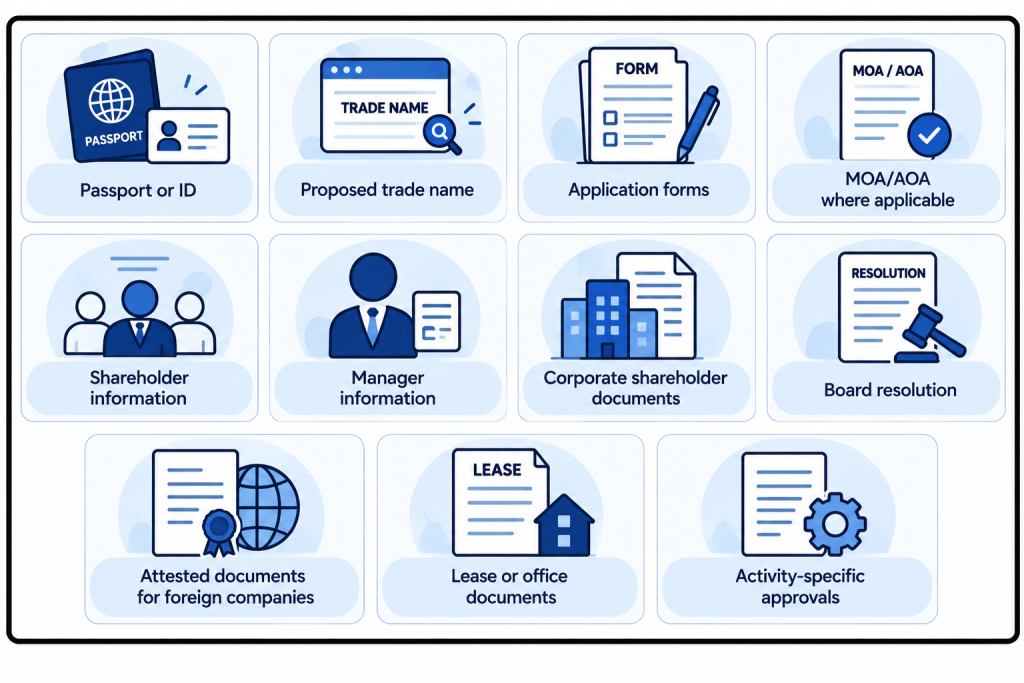
Foreign corporate shareholders may need additional incorporation documents and board resolutions. Attestation and translation requirements can also add to the setup budget.
What Is the Process for Starting a Business in Qatar?
Step 1: Choose the Business Activity
Identify exactly what the company will do and check whether the activity requires additional approval.
Step 2: Select the Legal Structure
Choose an LLC, one-person company, branch or another suitable structure based on the business model.
Step 3: Choose the Licensing Authority
Decide whether MOCI, QFC, QFZA or another platform is appropriate.
Step 4: Reserve the Trade Name
Select and reserve an available business name that meets the applicable requirements.
Step 5: Prepare the Company Documents
Prepare the MOA, shareholder information, identification documents and any corporate resolutions.
Step 6: Apply for Commercial Registration and Licence
Submit the application and pay the applicable government fees.
Step 7: Arrange Office Premises
Secure the office, warehouse, retail space or other premises required for the business.
Step 8: Complete Immigration and Establishment Registrations
Complete the relevant establishment and employee immigration procedures.
Step 9: Open a Corporate Bank Account
Once the company is properly established, apply for a corporate bank account with the required documents.
Step 10: Complete Tax and Ongoing Compliance
Set up accounting, tax registration where applicable and the required recurring compliance processes.
Invest Qatar describes the broader setup journey around building the business case, choosing the structure and licensing platform, registering the company, starting operations and then growing the business.
What Are the Common Mistakes When Calculating Qatar Business Setup Costs?
- Looking only at the licence fee
- Ignoring office rent
- Forgetting visa costs
- Not budgeting for document attestation
- Assuming every activity has the same fees
- Mixing first-year and recurring costs
- Choosing a jurisdiction based only on the cheapest headline price
- Ignoring tax and accounting costs
A realistic budget should include both government charges and the costs required to actually operate the business.
Qatar Business Setup Cost Checklist
☐ Business activity selected
☐ Legal structure selected
☐ Licensing authority selected
☐ Trade name reserved
☐ Registration fees budgeted
☐ Licence fees checked
☐ Office cost estimated
☐ Visa costs estimated
☐ Document attestation budgeted
☐ Tax and accounting costs included
☐ Annual renewal costs included
How Can Arnifi Help With Qatar Business Setup?
Arnifi can help businesses assess the right setup route, select an appropriate structure and manage the Qatar company incorporation process. Support can include licensing, documentation and attestation, office coordination, visa assistance, corporate banking, accounting and tax compliance. This allows founders to plan the full setup budget instead of looking at registration fees in isolation.
Conclusion
There is no single cost of starting a business in Qatar. The actual budget depends on the business activity, legal structure, licensing authority, premises, visas and compliance requirements. For 2026, MOCI’s published fees provide a useful starting point, but government charges are only one part of the total cost. Comparing the complete first-year budget, along with recurring expenses, gives a much more realistic picture of what it will take to establish and operate a company in Qatar.
FAQs
1. How much does it cost to start a business in Qatar?
There is no fixed amount. The cost depends on the activity, structure, authority, office, visas and additional requirements.
2. What is the company registration cost in Qatar?
MOCI currently lists QAR 500 annually for a commercial registration with one main activity.
3. How much is a business licence in Qatar?
MOCI’s current fee schedule lists QAR 500 annually for a commercial licence, with other charges depending on the business.
4. What is the cheapest business to start in Qatar?
Lower-cost options usually have simple activities, limited premises and fewer visa requirements, but there is no universal cheapest setup.
5. Can foreigners start a business in Qatar?
Yes. Foreign investors can establish businesses in Qatar subject to the applicable ownership, activity and licensing rules.
6. Is 100% foreign ownership allowed in Qatar?
Yes, in many sectors. Certain activities remain subject to specific restrictions or approvals.
7. Do I need a local partner in Qatar?
Not necessarily. The requirement depends on the business activity and applicable foreign ownership rules.
8. How much does office rent cost in Qatar?
It varies significantly based on the location, size, type of premises and business activity.
9. How much do Qatar business visas cost?
Visa costs depend on the applicant, visa type and applicable immigration requirements.
10. What taxes do businesses pay in Qatar?
Businesses may be subject to corporate income tax, withholding tax and customs duties depending on their activities and circumstances.
11. Is Qatar cheaper than the UAE for business setup?
It depends on the business. Licence fees, office costs, visas and activity requirements should be compared as a complete package.
12. What are the recurring costs of running a company in Qatar?
Recurring costs can include licence and CR renewals, office rent, employees, accounting, tax compliance, insurance and visa renewals.
References:
Top UAE Packages
Related Articles


Top UAE Packages
Get in Touch
