
Business Setup in the United Kingdom | Corporate Guide

Nishant
Content Writer
Nishant Kumar is a technical content writer, he shares global business insights and bridges the gap between complex regulatory frameworks and actionable growth strategies.… Read more

Tulika Saxena
AVP, Sales & Marketing | IIM Nagpur
Tulika Saxena specializes in business finance, sales strategy, and market positioning. Leads growth and partnerships, ensuring seamless business setup experiences and client success across… Read more



Table of contents
Key Facts
- Business Setup in UK requires the business to have a physical address, but the directors need not be from the UK
- Corporations pay a tax of 19 percent on their profits up to £50,000 and 25 percent on profits above £250,000
- Filing at Companies House and issuing of a Certificate of Incorporation usually takes one to two working days
- Arnifi is a corporate service provider and business infrastructure system that works to make the establishment of a company easier and more efficient across borders
Introduction
The incorporation of a private limited company within the United Kingdom will ensure that one has instant access to the best markets in the world. Regulations for the year 2026 will mean that one has to adhere strictly to Companies House Identity Verification and HM Revenue and Customs Tax requirements. Business setup in UK will only be efficient if done with perfection.
The owners have to go through different corporate tax brackets and economic crime transparency laws before investing.
What Are the 2026 UK Corporation Tax Rates?
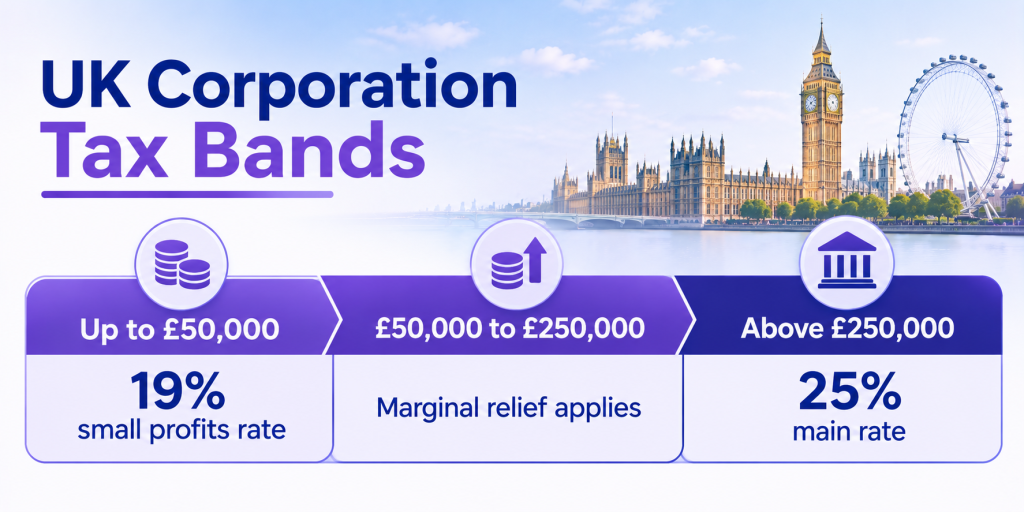
The tax regime applicable to corporate bodies doing business in the UK is that of a graduated tax, where the tax rates depend upon the amount of taxable profits. If the profits of the corporate body do not exceed £50,000, then they come under the category of the small profits tax rate of 19 percent. Those who earn taxable profits beyond £250,000 will have to pay the corporation tax at the rate of 25 percent.
The profits ranging from £50,000 to £250,000 are subject to marginal relief.
What Are the Mandatory Setup Requirements?
A physical address of a registered office within the UK is mandatory to form a private limited company. Although the company needs to keep the address within the country for all communications, it is not mandatory for the director to be a resident of the UK.
In 2026, compliance regulations mandate strict proof. According to the launch of the Economic Crime and Corporate Transparency Act, all directors and PSCs (Persons with Significant Control) need to confirm their identities through Companies House. Failure to acquire the identification code renders new appointments impossible.
How to Execute the Company Formation Process
The entire incorporation process hinges on the accuracy of the submission of the initial document. This is followed by rigorous document collection and due diligence to ensure compliance with the regulations. After that, the submission is forwarded to Companies House for processing.
The incorporation certificate must be acquired before the tax registration process.
| Incorporation Phase | Expected Timeline | Key Actions Required |
| Companies House Filing | 1 to 2 business days | Collecting documents and filing the official application with Companies House |
| Certificate of Incorporation | 1 to 2 business days | Authorities review shareholder details and issue the Certificate of Incorporation |
| HMRC & UTR Registration | 3 to 4 business days | Registering for corporate tax and obtaining the Unique Taxpayer Reference |
| Ongoing Compliance | Annual requirement | Filing annual accounts and a confirmation statement with Companies House |
How We at Arnifi Manage UK Market Entry
At Arnifi, we offer a platform for global expansion that enables founders, startups, SMEs, investors, and corporates to create and run their business across various jurisdictions effectively, efficiently, and with greater clarity. Our platform ensures that rather than going through long and manual consulting processes, there is a more efficient way of doing things.
For entities executing a UK Business Setup, our specialists manage the entire spectrum of regulatory requirements.
Beyond initial formation, our advisory teams execute comprehensive due diligence to secure reliable Banking Services. We also facilitate rapid Visa Services to deploy executive teams without administrative friction.
Conclusion
Setting up a corporate structure within the UK enables unparalleled access to Europe and the world through financial networks. Being ready for operation involves adhering to the stringent rules of Companies House, corporate tax bands, and statutory reporting. Setting up the compliance framework at an early stage ensures that the business does not have its application declined and helps the company make money quickly.
Contact us at Arnifi to engineer a compliant and highly efficient global expansion strategy.
FAQs
Is it necessary to have a resident director in a UK company?
No, corporate laws of UK do not require that the appointed director must be a citizen of Britain or a resident of UK.
What is the minimum tax rate of a UK company?
The small profits rate is 19% for those companies that earn profits up to £50,000.
What is the time required to register a UK company?
One to two days is usually needed to file documents with Companies House to receive the certificate of incorporation of the company.
Is it compulsory to have a registered office?
Yes, every company registered in the UK should have a registered office.
What is a UTR?
The Unique Taxpayer Reference is a ten-digit code provided by HMRC that is needed for filing corporate tax returns and fulfilling federal tax liabilities.
Do founders from other countries have to travel to the UK to establish their company?
No. International founders can register a company in the UK without going there themselves, using the help of corporate services firms.
What are the annual compliance filings of a UK-based company?
UK companies should file their annual financial statements and confirmation statement with Companies House, along with corporate tax returns filed with HMRC.
References
Top UAE Packages
Related Articles
Top UAE Packages
Planning Your Next Business Move?
