
The Substance Requirement for UAE Freezone Tax Benefits | What Counts?

Anushka
Content Writer
Anushka Basu is a business content writer specialised in global business market insights. She aims to simplify complex regulatory, financial, and business concepts into… Read more


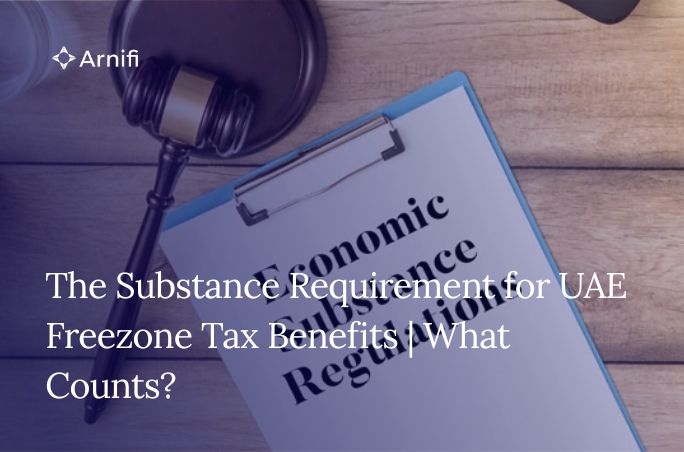
A lot of free zone companies think that if one has a valid licence, then that’s basically all you need and the UAE 0% corporate tax benefit is already secured. But, in practice, the business still needs to show real economic activity happening inside the free zone. So, the substance requirements are now considered extremely vital if you want to keep a Qualifying Free Zone Person (QFZP) status.
Table of contents
- Introduction
- What is the UAE Freezone Substance Requirement?
- What are Core Income-Generating Activities (CIGA)?
- Does a Company Need Physical Office Space?
- How Many Employees are Required?
- Can Activities be Outsourced?
- What Evidence Should Businesses Maintain?
- What Happens if Substance Requirements are Not Met?
- How Arnifi Helps Businesses Meet Substance Requirements
- Conclusion
- FAQs
Introduction
Ever since the UAE Corporate Tax was rolled out, keeping sufficient substance in a free zone has become one of the main gateways to the 0% tax rate.
Many companies get stuck on the qualifying income side and ignore the substance requirements. Still, the UAE freezone substance requirement is one of the core conditions for both getting and continuing QFZP status. If a company fails the substance test, it may lose access to that preferential 0% corporate tax regime, and then it could fall into the usual corporate tax rate.
The tricky part is that the law doesn’t give you one tidy checklist for “substance”. Instead, the business has to show that it has a genuine operating presence that actually matches the nature and the scale of what the company does.
What is the UAE Freezone Substance Requirement?
Under the UAE Corporate Tax rules, a QFZP must maintain adequate substance within a free zone to qualify for the 0% corporate tax rate on qualifying income. This sits next to other obligations like generating qualifying income, keeping audited financial statements, and following transfer pricing rules.
In plain words, the UAE freezone substance requirement means the company must be running real business activities, not just existing on paper, to keep those tax advantages.
The Federal Tax Authority’s direction generally circles three broad areas:
- Core income-generating activities
- Adequate employees
- Adequate assets and expenditure
The exact “how much” depends on the business model and the industry.
What are Core Income-Generating Activities (CIGA)?
One of the centre pieces of the UAE freezone substance requirement is doing and proving Core Income-Generating Activities, also called CIGA. CIGA covers the activities that actually bring in revenue. In most cases, those activities should be carried out inside the free zone where the business is set up. Examples may include:
| Business Activity | Examples of CIGA |
| Trading | Procurement, inventory management, distribution |
| Manufacturing | Production, quality control, supply chain management |
| Logistics | Warehousing, transportation coordination |
| Fund Management | Investment decision-making |
| Holding Company | Strategic management and ownership activities |
The CIGA UAE freezone rules matter a lot as tax authorities are aiming to make sure value creation happens in the free zone, rather than somewhere else.
Does a Company Need Physical Office Space?
Typically, yes, in most situations. A very common myth is that a virtual office, or even just the licence alone, automatically covers substance requirements.
But the UAE freezone office space advantage is tied to demonstrating a genuine business presence. Companies are usually expected to keep office facilities, operational premises or other tangible resources that fit the kind of work they’re doing. That said, office size is not the main measure.
For example, a consultancy with three employees may need noticeably less space than a logistics company that operates a warehouse. The evaluation is really about whether the facilities are suitable for the actual business model.
How Many Employees are Required?
The legislation doesn’t lock in on a fixed number of employees. Instead, businesses need to keep an adequate number of qualified full-time staff, based on the company’s activities and revenue generation. So the QFZP substance criteria UAE really lean on proportionality. For example:
- A holding company might only require a smaller management group.
- A manufacturing company may need a broader operational team.
- A logistics company could require warehousing and distribution staff.
The question is simple, but important: Is the workforce enough to perform the company’s core activities?
Can Activities be Outsourced?
Yes, but not in an unlimited manner. The UAE freezone substance requirement does allow some activities to be outsourced to related entities or third-party service providers in a free zone.
However, the business must also keep proper supervision and control over those outsourced activities. A company cannot just hand over everything, then claim substance. Instead, the company still has to prove:
- Oversight of outsourced responsibilities
- Control over decisions
- Availability of supporting documents
- Ongoing management responsibility
The arrangement should strengthen real operations, not replace them.
What Evidence Should Businesses Maintain?
Substance should be backed by documents. Businesses should keep records that show compliance with the UAE freezone substance requirement. Examples include:
- Office lease agreements
- Employee contracts
- Payroll records
- Board meeting minutes
- Operating expense records
- Service agreements
- Business activity reports
These records could turn out crucial if there are future tax reviews or formal audits.
What Happens if Substance Requirements are Not Met?
The impact can be serious. If a company doesn’t meet the UAE freezone substance requirement, it may lose QFZP status. When that happens, the business can be pushed into the standard 9% corporate tax regime instead of staying with the 0% rate on qualifying income.
Also, companies that lose QFZP status may face limits when trying to regain the benefit for multiple tax periods. That’s why proactive compliance is much more useful than trying to fix things after the fact.
How Arnifi Helps Businesses Meet Substance Requirements
Handling the UAE freezone substance requirement is more than just getting a licence. Businesses need to align day-to-day operations, staffing, premises, and compliance workflows with UAE corporate tax expectations.
Arnifi helps companies evaluate QFZP eligibility, design appropriate operational setups, review substance requirements, coordinate compliance documentation, and support ongoing corporate tax readiness. This helps businesses keep access to free zone tax benefits, while also lowering compliance exposure.
Conclusion
Getting the UAE freezone substance requirement right is really important if a business wants to keep access to the 0% corporate tax benefits. In practice, Arnifi can help a company set up how things actually run, review QFZP eligibility, build a compliant substance structure, and help in managing the ongoing corporate tax obligations, so tax efficiency stays preserved, but remains fully compliant.
FAQs
What is the UAE freezone substance requirement?
It is about keeping genuine economic activity. Ensure employees, assets and real operations are kept within the free zone area.
What are the QFZP substance criteria UAE?
In most cases, you need to meet CIGA, keep enough employees, have adequate assets, and incur operating expenditure.
Do I need office space to qualify?
Usually yes. Companies should keep premises that match their activity level and scale.
Can CIGA be outsourced?
Yes, but only if the activities are still supervised and controlled by the free zone entity.
What happens if I fail the substance test?
One could lose QFZP status and end up under the standard corporate tax regime instead.
Top UAE Packages


Related Articles
Top UAE Packages
Get in Touch