
UAE E-Invoicing Mandate | 2026 Framework Update

Anushka
Content Writer
Anushka Basu is a business content writer specialised in global business market insights. She aims to simplify complex regulatory, financial, and business concepts into… Read more


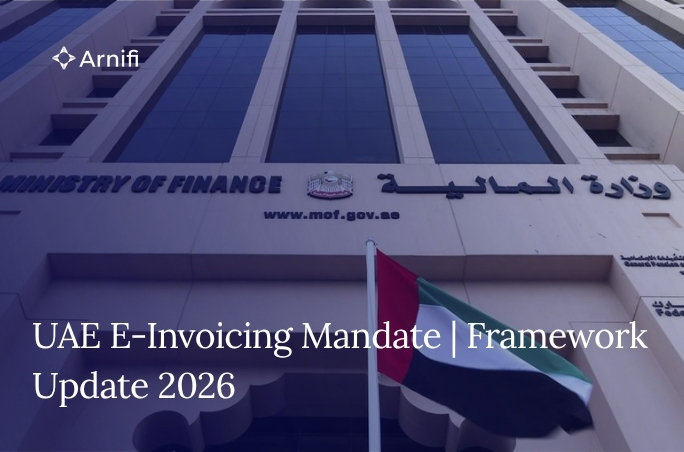
The UAE has taken a major step towards digital tax infrastructure by formalising its national e-invoicing framework. The new ministerial decisions set the direction for phased implementation, clearer compliance obligations and faster business transactions across the private and public sectors.
Table of contents
- Understanding The UAE E-Invoicing Mandate Update
- Strategic Timelines for Seamless Implementation
- Operational Efficiency and Cost Reduction
- Strengthening the UAE’s Global Competitiveness
- Phased Integration Strategy for Small Business Stability
- Alignment with National VAT Compliance Standards
- How Do They Meet Global Technical Standards?
- Conclusion
- FAQs
Understanding The UAE E-Invoicing Mandate Update
The recently issued ministerial decisions provide much-needed clarity on which businesses must integrate with the e-invoicing system. The Ministry selected a phased approach because it creates an easier transition path for all business sizes. This controlled rollout permits companies to enhance their ERP systems while their teams receive training in a gradual manner instead of learning everything in one day.
The scope focuses primarily on Business-to-Business (B2B) and Business-to-Government (B2G) transactions. The UAE developed digital systems to handle high-value trade interactions, which create a trade environment that operates without obstacles. Businesses will no longer need to track physical invoices or deal with missing documents because they will receive digital invoice delivery.
Strategic Timelines for Seamless Implementation
These new decisions bring one of their most beneficial elements through the extended timeline, which permits the first implementation phase to begin. The Ministry has recognised that digital transformation requires careful planning. The government established mid-2026 as the initial go-live date for big enterprises to help the private sector meet national technical requirements within this timeframe.
The budget-efficient IT upgrade system enables CFOs to effectively allocate financial resources for this purpose. It also provides a competitive advantage to firms that move quickly. Companies that implement the UAE e-invoicing mandate early will benefit because the B2G digital integration will become mandatory for government contract eligibility.
Operational Efficiency and Cost Reduction
Traditional invoicing methods, which use paper or PDF formats, create a situation where human mistakes result in payment delays and reconciliation problems. The new centralised system automates the verification process, ensuring that every invoice sent is compliant with UAE VAT regulations from the moment it is generated.
Faster Liquidity: Automated systems cut down the time needed for invoice-to-cash processes, letting business owners receive their capital sooner.
Reduced Audit Risk: The Federal Tax Authority (FTA) receives real-time reports, which create a situation where tax audits become more efficient due to decreased chances of mistakes.
Sustainability Gains: Companies can enhance their environmental, social, and governance (ESG) scores through paperless operations, which boost productivity while fulfilling the UAE’s environmental regulations.
Strengthening the UAE’s Global Competitiveness
The UAE joins elite global economies that have fully digitised their tax and trade systems through the enforcement of these new regulations. They make the country more attractive to international companies that want to establish their operations there. Global firms are already accustomed to e-invoicing standards in Europe and South America; seeing the UAE adopt a similar, high-tech framework provides a sense of familiarity and legal certainty.
The Electronic Invoicing System functions as a seal of quality that verifies the business environment in the UAE. The system shows that the Emirates has developed into a transparent and modern data-driven marketplace. This helps the UAE in attracting high levels of Foreign Direct Investment (FDI) because of its present institutional complexity.
Phased Integration Strategy for Small Business Stability
The UAE e-invoicing mandate was established through a top-down system, which will maintain stability in the market. The Ministry has been very strategic, requiring the largest taxpayers and government suppliers to lead the way initially. This lets smaller SMEs watch the deployment process while they wait for their scheduled time to use advanced technical systems, which are now available at lower costs. This system will provide smaller businesses with all the necessary tools when they join, which will let them continue their daily operations without disruption.
Alignment with National VAT Compliance Standards
The e-invoicing system will become a major technology that helps businesses meet their VAT requirements through its implementation. The system tracks transactions in real-time, which enables automatic data verification and pre-population of essential information needed for VAT returns.
The requirement to file returns remains, but the process of creating spreadsheets and verifying receipts will become unnecessary for most people. The move toward Tax-as-a-Service under the UAE e-invoicing mandate is a major win for corporate efficiency and tax transparency.
How Do They Meet Global Technical Standards?
These ministerial decisions require the implementation of international standards. This allows most international software providers to deliver system updates to their customers who operate in the UAE. Most businesses do not require a complete software replacement to achieve their goals.
Modern ERP and accounting platforms can be updated with an API bridge. It directly connects to the Ministry of Finance’s central hub. The system will establish a platform-agnostic environment that permits all compatible technological solutions to function together. All of it while complying with the UAE e-invoicing mandate.
Conclusion
The UAE’s new e-invoicing framework marks a major step in the country’s broader digital economy agenda. It combines compliance goals with practical efficiency, giving businesses a more modern way to manage transactions and tax data. Arnifi helps businesses adapt to changing UAE regulations, optimise setup structures and prepare for digital compliance frameworks with practical support. Understand upcoming obligations, compare solutions and make faster decisions with confidence. Reach out to Arnifi today!
FAQs
Q) What is the UAE E-Invoicing mandate?
A) It is the UAE’s new framework for structured electronic invoicing and phased digital compliance.
Q) Which transactions are likely affected first?
A) B2B and B2G transactions are expected to be early priorities.
Q) Does this replace VAT filing?
A) No, but it may improve the accuracy and efficiency of VAT processes.
Q) Should businesses prepare now?
A) Yes, reviewing systems and workflows early is the best approach.
Top UAE Packages
Related Articles


Top UAE Packages
Get in Touch
