
UAE Company Share Transfers | Valuation, Tax Consequences, and Registration Steps

Zahira Shaik
SEO Content Writer
Zahira Shaik is an SEO Content Writer and Published Author specializing in research-based content. She excels at analyzing market trends, regulations, and industry developments… Read more

Tulika Saxena
AVP, Sales & Marketing | IIM Nagpur
Tulika Saxena specializes in business finance, sales strategy, and market positioning. Leads growth and partnerships, ensuring seamless business setup experiences and client success across… Read more



Key Fact: The UAE company share transfer includes the transfer of ownership of all existing companies and licenses, and liabilities associated with them, without disrupting the normal business operations of the concerned companies.
Table of contents
- Introduction
- Understanding UAE Company Share Transfers and Legal Framework
- UAE Company Share Transfer Process by Jurisdiction
- Business Valuation for UAE Company Share Transfers
- Tax Consequences of UAE Company Share Transfers
- Corporate Tax Losses and Group Implications
- Post-Transfer Registration and Compliance Requirements
- Share Purchase vs. Asset Purchase
- How Arnifi Helps with UAE Company Share Transfers
- Conclusion
- Frequently Asked Questions (FAQs)
- References
Introduction
The UAE company share transfer is a procedure that includes the sale of shareholdings by existing shareholders to new investors without affecting the identity and other aspects of the entity. The process entails balancing various regulations and considerations such as local laws, free zones, financial hubs, valuation of shares, and corporate tax laws, among others, during the transfer of shareholdings.
Understanding UAE Company Share Transfers and Legal Framework
Ownership change entails clear knowledge of company laws and share transfer agreements.
What Is a Share Transfer Agreement in the UAE?
A share transfer agreement in the UAE is a legal contract involving the transfer of corporate shares from the transferor to the transferee. The contract provides for purchase prices, payment details, warranties, and indemnity. A share transfer changes ownership while not liquidating business assets or canceling workforce visas.
- Entity Continuity: Maintains corporate registration numbers, tax registration, and trade licenses.
- Contractual Rights: Maintains existing client agreements, supplier agreements, and lease contracts.
- Liability Transfer: Involves transfer of past tax liabilities and operational debts to the buyers.
UAE Laws Governing Company Share Transfers
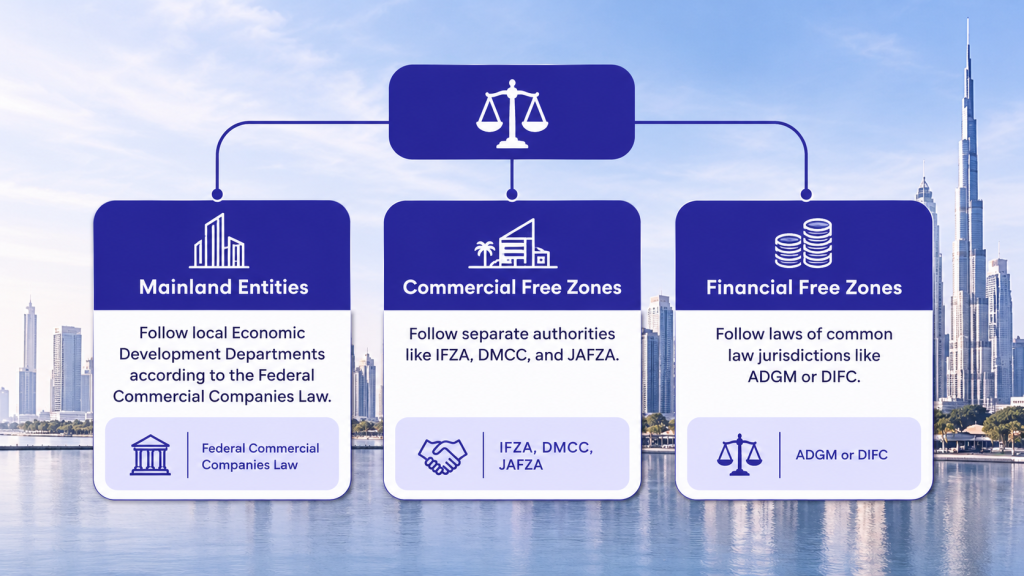
Federal Decree-Law No. 32 of 2021 provides for mainland share transfer in the UAE. Free zones follow separate laws for share transfers:
Shareholder Rights and Modern Corporate Governance
Governance is a means of protecting existing investors and potential investors in restructuring companies.
- Pre-emption Rights: Statutory rights entitle existing partners to first right over equity held in case of external bids.
- Differential Equity: Financial free zones offer options for multiple shares with customized voting rights.
- Exit Protections: Drag-along provision forces minority members into buyouts, whereas tag-along rights safeguard minority members.
UAE Company Share Transfer Process by Jurisdiction
Procedures vary for each jurisdiction, namely for mainland companies, commercial free zones, and financial free zones.
Share Transfer in UAE Mainland LLCs
The procedure for mainland shares follows strictly defined time limits within the UAE company share transfer regulations.
- Notify existing partners according to Article 80.
- Give time of 30 days within the statutory redemption period or secure pre-emption waiver.
- Draft the UAE Share Transfer Agreement and MOA amendments.
- Sign before the notary, pay DET fees, and take back your renewed trade license.
Share Transfers in Commercial Free Zones
Commercial free zones follow streamlined authority portals to complete the share transfer process in the UAE.
- Pass formal board and shareholder resolutions approving equity transfers.
- Submit passport copies and KYC records through authority portals.
- Execute free zone transfer instruments and pay regulatory UAE share transfer fees.
- Download updated shareholder certificates and revised commercial licenses.
Share Transfers in ADGM and DIFC
Financial centers utilize digital common-law registries for corporate updates.
- Draft electronic transfer instruments and updated Articles of Association.
- Submit digital applications via the DIFC Portal or ADGM Access platform.
- File UBO updates and pay portal registration fees.
- Register updated entries in the official Register of Members.
Documents Required for a UAE Share Transfer
Executing a share transfer agreement requires complete compliance documentation:
| Individual Shareholders | Corporate Shareholders |
| Passport Copies & Emirates IDs | Parent Certificate of Incorporation |
| Attested Power of Attorney | Board Resolution Approving Sale |
| Signed Share Transfer Contract | MOA & Articles of Association |
| Updated MOA Amendment | Embassy-Attested Parent Documents |
Business Valuation for UAE Company Share Transfers
Accurate equity value calculations facilitate open buyer negotiations and tax regulation compliance.
Why Is Business Valuation Important During a Share Transfer?
Precise valuation UAE techniques ensure no shareholder disputes and help comply with regulations. Valuations of an independent nature allow for the determination of fair market price in case of buyout, restructuring, or mergers. In addition, the Federal Tax Authority requires arm’s length pricing rules.
Key Business Valuation Methods
Valuation specialists use three major analytical methods:
- Income approach based on the Discounted Cash Flow (DCF) models.
- Market approach comparing transaction multiples such as EV/EBITDA with public multiples.
- Asset-based approach calculating Net Asset Value (NAV) through the difference between liabilities and assets.
Factors That Influence UAE Company Share Valuation
- Presence of stable cash flows and EBITDA margin of 12 months.
- Existing corporate debt, legal issues, and lease commitments.
- Potential for growth in the mainland UAE market and internationally.
- Controlling interest compared to non-controlling shares of stock.
Due Diligence Before Finalizing the Share Transfer
Buyers should undertake financial, operating, and tax due diligence before concluding the share transfer in the UAE:
- Examine prior tax compliance, financial balances, and bank statements.
- Review labor records, visa quotas, and end-of-service gratuity arrangements.
- Validate commercial lease validity, supplier agreements, and intellectual property ownership.
Tax Consequences of UAE Company Share Transfers
Company restructuring involves unique VAT and corporate taxes for the UAE.
UAE VAT Treatment of Share Transfers
The transfer of shares of companies is a VAT-exempt financial transaction in the UAE. Shares alone will have no VAT cost associated with them. However, professional fees incurred by a third party and the valuation report attract 5% VAT.
UAE Corporate Tax on Capital Gains
Gains realized on equity sales are subject to normal 9% UAE corporate taxation except where an exemption applies. Corporate tax on capital gains resulting from the Participation Exemption in Article 23 is exempt if the requirements listed below are met:
- Ownership Threshold: Holding a minimum of 5% in equity shares or an acquisition cost of AED 4,000,000.
- Holding Window: Continuously maintaining equity holdings for a minimum period of 12 months.
- Subject-to-Tax Test: Ensuring that the target entity pays a minimum 9% corporate tax in the host country.
Business Restructuring Relief Under Article 27
Under Article 27, tax-neutral equity transfers are permitted during business restructuring. Entire companies can be sold at net book value, and no immediate tax consequences will arise. Companies need to maintain such restructures for a minimum period of two years.
Qualifying Group Relief Under Article 26
Article 26 permits tax-free asset and liability transfers between qualifying group companies.
| Article 26 Group Relief | Article 27 Restructuring Relief |
| Requires 75% Common Ownership | Applies to Mergers & Division Sales |
| Directs Intragroup Asset Transfers | Transfers Independent Business Units |
| Assets Stay Within Group Structure | Converts Equity for Shares or Cash |
Corporate Tax Losses and Group Implications
Changes in ownership have a direct effect on accumulated tax losses and tax status of free zones.
What Happens to Accumulated Tax Losses After Ownership Changes?
Accumulated tax losses reduce future taxable income by up to 75%. Unutilized tax losses will be available following changes in ownership as long as the same shareholders retain 50% ownership interest or if the business continues carrying out the same commercial operations.
Transferring Tax Losses Between UAE Group Companies
The provisions under Article 38 allow the transfer of tax losses between group entities as long as there is a direct or indirect holding of 75% in the company. The conditions for tax loss transfers include aligned financial years and accounting policies.
Share Transfers Involving Qualifying Free Zone Persons
A change in ownership of a Qualifying Free Zone Person (QFZP) requires planning.
- Substance Rules: The new owners will need to meet the requirements for operating substance and personnel.
- Transfer Pricing: Any intercompany transactions should adhere to arm’s length prices.
- De Minimis Limits: Non-Qualifying income cannot exceed 5% or AED 5,000,000 of total income.
Post-Transfer Registration and Compliance Requirements
UAE Company Share Transfer needs prompt updates in the official state registers.
Updating the Ultimate Beneficial Owner (UBO) Register
The parties involved should update their licensing authority within 15 days of ownership changes as per Cabinet Resolution No. 109 of 2023. Companies should ensure that all individuals who own more than 25% voting equity in the company update themselves in the official UBO register. Failure leads to administrative penalties.
Updating Corporate Licenses and Company Records
Corporate updates should be reflected in the following official documents:
- Get an updated commercial license in accordance with new shareholder percentages.
- Enter transactions in the official minute book and member register.
- Update constitutional documents and board resolutions with the banking partners.
Employee, Visa, and Operational Updates
The new partner should consider checking investor visas, establishment card information, labor documents, and bank signature mandate. Updating the signing profile avoids delays in day-to-day banking operations.
Share Purchase vs. Asset Purchase
Structuring corporate acquisitions dictates future tax liabilities and asset liabilities.
Key Differences Between Share and Asset Purchases
- Share Purchase: Acquirers purchase total corporate equity, inheriting existing contracts, asset titles, and operational debts.
- Asset Purchase: Buyers select specific commercial assets, equipment, and client contracts while excluding historical liabilities.
Tax and Financial Considerations
- Share purchases qualify for capital gains exemptions under Participation Exemption rules.
- Asset sales trigger 5% VAT on asset transfers unless structured under Transfer of Business as a Going Concern rules.
- Asset purchases allow buyers to revalue equipment for future tax depreciation deductions.
Choosing the Right Transaction Structure
Choose a share purchase structure where preserving the history of licenses held, brand reputation, contractual relations, and operational continuity is important. Opt for an asset purchase where target firms have intangible liabilities or unsettled tax obligations.
How Arnifi Helps with UAE Company Share Transfers
Arnifi streamlines company restructuring procedures with the use of automated legal solutions, licensing support, and comprehensive tax handling.
Share Transfer Documentation and Legal Support
Arnifi prepares customized share transfer UAE agreement documents, shareholder resolutions, and bilingual MOA amendments. Arnifi oversees the process of document legalization and embassies’ attestation of foreign companies holding shares in a UAE business entity.
Jurisdiction-Specific Registration and Compliance
Arnifi takes care of filing the required documentation in various DET branches, free zones’ online platforms, and common law jurisdictions like ADGM or DIFC. Arnifi submits all required documentation to authorities for prompt updating of licenses.
Ownership Structuring and Compliance Tools
- Arni Organogram: Visualizes complex shareholder networks, parent entities, and multi-tier group structures.
- Arni AML Checker: Screens incoming investors against global sanctions lists, background registries, and PEP databases.
- Arni Cost Calculator: Estimates governmental license fees, notary charges, and registration expenses across all emirates.
Post-Transfer Corporate and Tax Support
Arnifi is responsible for updating UBO registers, tax registration for corporations, and filing of group relief applications under Articles 26 and 27. Arnifi also offers services in updating corporate bank accounts, visa transfers, and other compliance matters.
Conclusion
The process of executing UAE company share transfers involves precision in legal drafting, proper valuation of the market, and meeting corporate tax criteria. Performing due diligence shields you from taking over any debt obligations or legal issues. Engage professionals in corporate restructuring to ensure smooth regulatory clearance from the mainland and free zones. Talk to Arnifi for all your company share transfer needs.
Frequently Asked Questions (FAQs)
What is a share transfer agreement in the UAE?
The transfer of ownership interest of the company from the existing shareholder to the new purchaser without any interruption in the functioning of the company.
How do I transfer shares in a UAE mainland LLC?
Mainland transfers include informing the shareholder, obtaining a pre-emption waiver, amending the MOA, obtaining notary attestation, and making applications for a trade license in DET.
What documents are required for a UAE company share transfer?
These include the executed share transfer agreement, resolutions from the board of directors, amendments to the MOA, copies of passports, Emirates ID, and attested corporate documents for parent companies.
How long does a share transfer take in the UAE?
In the case of free zones, it takes 3 to 7 business days, while in the case of mainland, it takes 1 to 3 weeks.
Is notarisation required for a UAE share transfer?
For mainland LLC shares, the notarised public signing will be needed, while the commercial and financial free zones will handle the execution process digitally through the authorities’ portal.
Are share transfers subject to VAT in the UAE?
Share transfers fall into the category of exempt financial services; however, advisory services provided by third parties will be subject to 5% VAT.
Is capital gains tax applicable to share transfers in the UAE?
The capital gain is subject to the standard 9% corporate tax, but exemptions are available under the Participation Exemption and restructuring provisions of articles 26 and 27.
What is the Participation Exemption for UAE corporate tax?
Under Participation Exemption, the corporate tax is waived on equity gains if the company owns at least 5% equity or an acquisition value of AED 4,000,000 for one year in a company taxed at 9%.
Can a foreign investor acquire shares in a UAE company?
It is possible for foreign investors to invest up to 100% equity in UAE mainland and free zones, provided that the activities fall under specific commercial practices and regulatory requirements.
What happens to existing liabilities after a share transfer?
All previous liabilities, such as legal liabilities, debts, taxes, and liabilities of the employees, will stay with the company in case of a share transfer.
How much does it cost to transfer company shares in the UAE?
Costs depend on jurisdiction registration fees, public notary charges, trade license amendment fees, and legal preparation expenses.
References
Top UAE Packages

Top UAE Packages
Planning Your Next Business Move?
