
Share Capital in Singapore | Issued Capital, Paid-Up Capital and Shares

Nishant
Content Writer
Nishant Kumar is a technical content writer, he shares global business insights and bridges the gap between complex regulatory frameworks and actionable growth strategies.… Read more

Tulika Saxena
AVP, Sales & Marketing | IIM Nagpur
Tulika Saxena specializes in business finance, sales strategy, and market positioning. Leads growth and partnerships, ensuring seamless business setup experiences and client success across… Read more



Key Facts
- Issued share capital in Singapore represents the capital allocated to shares issued by a company, while paid-up capital is the amount shareholders have actually paid for those shares
- The statutory minimum issued share capital required to incorporate a private limited company in Singapore is S$1
- Founders can incorporate a company with S$0 paid-up capital and update the Accounting and Corporate Regulatory Authority (ACRA) once funds clear the corporate bank account
Table of contents
Introduction
To register a business in Singapore, it is important for the owners of the firm to capitalize the company properly. This allows a lot of flexibility on how you can allocate your share of the business, distribute the voting rights, and infuse the capital into the business. It is very important to appreciate the difference between paid-up and issued capital.
What Is Share Capital in Singapore?
Share capital refers to the amount of money collected from investors who acquire shares of a firm. In the course of incorporating a Singapore company, the founders of the firm distribute the shares in relation to their ownership.
The concept can be divided into two key elements: issued share capital and paid-up capital. Proper management of these factors guarantees that the statutory registers are maintained accurately.
Issued Capital Versus Paid-Up Capital
Issued share capital represents the total monetary value of all shares allotted to shareholders. This figure reflects the full subscription price agreed upon by the investors, regardless of whether the physical money has been transferred. Issued capital can include unpaid amounts if shareholders agree to pay for their allotment at a later date.
Paid-up capital refers strictly to the amount shareholders have actually paid to the company. For example, if a company issues 100,000 shares at S$1 each but shareholders only pay S$50,000 upfront, the issued capital is S$100,000. The paid-up capital stands at S$50,000, and the remaining S$50,000 officially remains outstanding unpaid capital.
How to Determine the Number of Shares?
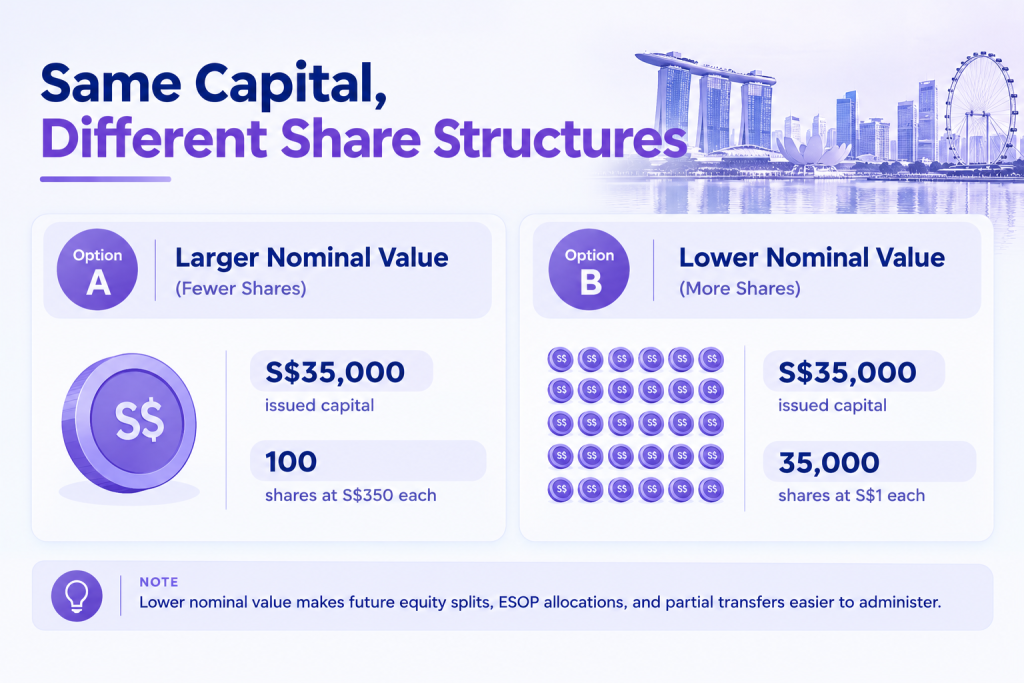
The number of shares can be decided entirely by the shareholders. For example, S$35,000 in issued share capital can be divided into 100 shares at S$350 each, or 35,000 shares at S$1 each. We at Arnifi typically suggest S$1 per share for absolute simplicity.
Assigning a lower nominal value makes future equity distributions, employee stock pools, and partial shareholder transfers significantly easier to manage. A highly divisible share structure prevents the administrative burden of executing a complex share split later in the company’s lifecycle.
How to Structure Capital Before Bank Account Opening?
Corporate bank accounts cannot be opened until the company completes its official incorporation. This creates a logistical timing gap for founders injecting initial capital. Paid-up capital refers to the amount shareholders have actually paid to the company. If founders intend to have S$35,000 in paid-up capital, this exact amount should be deposited into the company’s bank account after it is opened.
As the funds will only be deposited after incorporation, we at Arnifi recommend incorporating with:
- Issued share capital: S$35,000
- Paid-up capital: S$0
- Number of shares: 35,000 ordinary shares issued at S$1 each
This structure allows the company to incorporate legally and proceed with institutional onboarding. Until payment is made, the amount remains a binding legal liability payable by the shareholders.
How to Update Paid-Up Capital Post-Incorporation?
Once the corporate bank account opens, shareholders must deposit the intended funds into the account. Immediately following this transfer, the company must update its paid-up share capital records to ensure statutory compliance.
Once the S$35,000 has been deposited, we can file a notice with ACRA to update the paid-up capital to S$35,000. This electronic filing through the BizFile portal officially updates the paid-up amount on the partially paid shares to reflect the exact cleared funds. Maintaining accurate internal company records prevents compliance breaches and perfectly aligns the statutory register with actual bank deposits.
How We at Arnifi Handle Singapore Incorporation
At Arnifi, we are digital corporate service providers who help corporations grow internationally with complete clarity of operations. When managing a Singapore company incorporation, our specialists prepare all necessary structural details and guide corporate leaders through optimal share capital configurations. Our technology ecosystem replaces manual paperwork, allowing businesses to map holding structures seamlessly.
Beyond initial setup, our team manages ongoing regulatory requirements through dedicated post-setup compliance services. We handle complex accounting and bookkeeping to ensure entities meet ACRA deadlines and maintain accurate audited registers. Founders expanding into Singapore also leverage our specialized banking services for rapid corporate account onboarding.
Conclusion
Understanding the mechanical difference between issued and paid-up capital provides critical flexibility during the incorporation phase. Companies can structure their equity to reflect future capitalization goals without requiring all funds to be physically present on day one. Choosing a highly divisible share structure and recording all subsequent payments accurately prevents administrative friction as the enterprise scales.
Contact us at Arnifi today for a tailored incorporation plan and a clear setup timeline.
FAQs
What is the minimum share capital for a Singapore company?
The statutory minimum issued share capital required to incorporate a private limited company in Singapore is exactly S$1. Paid-up capital can be S$0 at incorporation if the shares are issued but not yet paid.
What is the difference between issued capital and paid-up capital?
Issued capital represents the total value of shares allotted to shareholders, while paid-up capital is the exact portion of that value shareholders have physically transferred to the company.
Can a Singapore company have S$0 paid-up capital at incorporation?
Yes. A company can incorporate with unpaid issued shares, resulting in S$0 paid-up capital, provided the shareholders deposit the owed amount once the corporate bank account opens.
(The S$1 statutory minimum applies to issued share capital, not to the amount actually paid up. While S$0 paid-up capital is permitted, many founders choose to pay the S$1 immediately for administrative simplicity.)
How many shares should a Singapore company issue?
Companies should issue an adequate volume of low-value shares, such as S$1 per share, to make future equity splits and share transfers administratively simple.
Can shareholders pay for their shares after incorporation?
Yes. Shareholders can deposit their capital into the corporate bank account after incorporation and subsequently update the paid-up capital records with ACRA.
How do companies update paid-up capital with ACRA?
An authorized corporate officer or company secretary logs into the ACRA BizFile portal and submits a notice to update paid-up share capital, reflecting the newly cleared funds.
References
Accounting and Corporate Regulatory Authority (ACRA) Singapore
Top Singapore Packages
Related Articles


Top Singapore Packages
Planning Your Next Business Move?
