
PDPA For Accounting Records | What Singapore Firms and SMEs Must Do To Protect Client Data

Anushka
Content Writer
Anushka Basu is a business content writer specialised in global business market insights. She aims to simplify complex regulatory, financial, and business concepts into… Read more


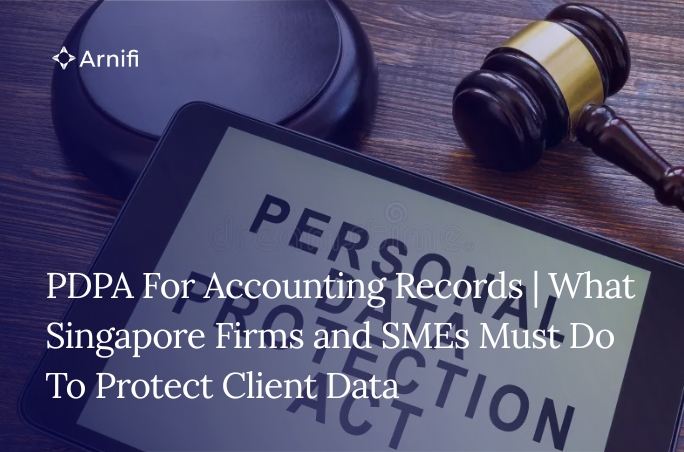
Accounting files often contain personal data, not just numbers, which is why PDPA accounting records Singapore compliance is important for businesses. Payroll records, invoices, CPF details, bank statements, tax schedules, NRIC details, employee claims, and client documents can all expose individuals if handled poorly. The PDPA governs how organisations collect, use, and disclose personal data in Singapore, and the PDPC administers and enforces the law.
Table of contents
- Why Accounting Records Create PDPA Risk
- What The PDPA Expects Companies To Do
- Accounting Records And Retention
- Data Protection Officer SME Singapore Duties
- Cloud Accounting PDPA Compliance
- PDPC Enforcement Penalty Data Breach Singapore
- Common PDPA Mistakes In Accounting Work
- How Arnifi Can Help Manage Accounting Records?
- Conclusion
- FAQs
Why Accounting Records Create PDPA Risk
Accounting records are sensitive because they often stay across several people and systems. A founder may share payroll files with an accountant. The accountant may store them in cloud software. A tax agent may download supporting schedules. A junior staff member may send invoices by email.
That workflow is normal, but it increases exposure. One wrong email attachment or weak cloud login can leak salary data, bank account details, customer addresses, tax identifiers, and vendor contact information. For SMEs, the risk is rarely a complex cyberattack. It is often poor access control, old files kept too long, or documents sent without checking.
What The PDPA Expects Companies To Do
The Personal Data Protection Act SME compliance baseline is simple in principle. Organisations should collect, use, disclose, retain, and protect personal data responsibly. PDPC guidance also makes clear that organisations must appoint a Data Protection Officer and make the DPO’s business contact information publicly available.
For accounting records, this means every company should know what personal data it holds, why it holds it, who can access it, and how long it must be kept. The company should also have policies that staff can actually follow, not a privacy document that nobody reads.
Accounting Records And Retention
Singapore companies must keep accounting records for statutory and tax reasons. IRAS states that companies must retain records for at least 5 years based on the relevant Year of Assessment. ACRA also states that companies must keep accounting records for at least five years after the financial year in which the transactions or operations were completed.
PDPA retention rules add another layer. Personal data should not be kept without a clear business or legal purpose. PDPC guidance warns that keeping personal data for an indeterminate period increases data protection risk.
| Record Type | Why It Contains Personal Data | Practical PDPA Control |
| Payroll Records | Salary, CPF, bank, and employee details | Limit access to payroll staff and authorised accountants |
| Invoices And Receipts | Customer names, addresses, phone numbers, and payment details | Mask personal details where full data is not needed |
| Tax Schedules | Director, shareholder, employee, and contractor information | Store in secure folders with restricted sharing |
| Bank Statements | Names, account numbers, and transaction descriptions | Avoid open email sharing and use encrypted storage |
| Cloud Accounting Files | Combined accounting and client records | Enable MFA, role-based access, and user review |
Data Protection Officer SME Singapore Duties
A Data Protection Officer SME Singapore appointment should not be symbolic. The DPO should help the company build daily controls around data. This can include privacy notices, access rules, vendor checks, breach response steps, and staff training.
For a small company, the DPO can be an existing staff member if that person has enough knowledge and authority. Some SMEs outsource the DPO function. The main point is accountability. Someone must be responsible for helping the company meet PDPA duties and respond when a data issue occurs.
Cloud Accounting PDPA Compliance
Cloud accounting PDPA compliance needs careful vendor and access review. PDPC’s cloud guidance states that an organisation remains responsible for complying with PDPA obligations when a cloud service provider processes personal data on its behalf.
The cloud provider may be treated as a data intermediary when it processes personal data under a written contract and for the organisation’s purposes.
SMEs should check these controls before using cloud accounting software:
- Use multi-factor authentication for owners, accountants, payroll users, and tax agents.
- Give users only the access needed for their role.
- Remove access quickly when employees, vendors, or accountants change.
- Check where data is stored and how overseas transfers are handled.
- Keep written contracts or terms that explain data protection responsibilities.
- Back up records securely and test account recovery steps.
PDPC Enforcement Penalty Data Breach Singapore
This enforcement penalty data breach Singapore risk is now serious enough for directors to treat data protection as a business control. PDPC guidance states that organisations may face financial penalties of up to S$1 million or 10% of annual Singapore turnover if turnover exceeds S$10 million.
Data breach notification rules are also important. PDPC states that a breach may be notifiable if it is likely to result in significant harm or if it affects 500 or more individuals. Organisations must notify PDPC as soon as practicable, and PDPC’s breach reporting page refers to notification within 3 calendar days.
For accounting firms, the reputational cost can be just as painful as the fine. A data leak involving client payroll or tax records can damage trust quickly.
Common PDPA Mistakes In Accounting Work
- Sending payroll files through normal email without password protection.
- Keeping old client records forever after the legal retention period ends.
- Sharing one cloud accounting login across multiple staff members.
- Giving junior staff full access to director, bank, or payroll files.
- Forgetting to remove accountant or employee access after a role change.
- Treating PDPA as an IT issue instead of a management responsibility.
These mistakes are common because accounting teams move fast during month-end and tax deadlines. A short checklist before sharing files can prevent larger problems later.
How Arnifi Can Help Manage Accounting Records?
Arnifi can help Singapore companies keep compliance practical as they grow. Our team can support company setup, accounting coordination, corporate secretarial planning, compliance calendar setup, and data-handling workflow review through suitable specialists. We help founders understand how accounting records, cloud tools, tax files, and PDPA duties connect in daily operations.
Conclusion
PDPA accounting records Singapore compliance should be built into accounting workflows, not added after a breach. SMEs should appoint a DPO, restrict access, secure cloud systems, keep records only as long as required, and prepare a breach response plan. Strong data habits protect clients, reduce enforcement risk, and make financial operations safer.
FAQs
1. Does PDPA Apply To Accounting Records In Singapore?
Yes. PDPA can apply when accounting records contain personal data, such as employee details, payroll data, bank information, customer addresses, or tax records.
2. Must SMEs Appoint A Data Protection Officer?
Yes. Organisations must appoint a DPO and make the DPO’s business contact information publicly available.
3. How Long Should Accounting Records Be Kept?
Companies usually need to retain accounting records for at least 5 years for tax and statutory purposes. 4. Who Is Responsible For Data In Cloud Accounting Software?
The organisation remains responsible for PDPA compliance when a cloud provider processes personal data on its behalf. The cloud provider may also have data intermediary duties under the PDPA.
Top Singapore Packages


Related Articles

Top Singapore Packages
Get in Touch