
Mauritius Tax Treaties: The Complete 2026 Structuring & DTAA Guide

Zahira Shaik
SEO Content Writer
Zahira Shaik is an SEO Content Writer and Published Author specializing in research-based content. She excels at analyzing market trends, regulations, and industry developments… Read more

Tulika Saxena
AVP, Sales & Marketing | IIM Nagpur
Tulika Saxena specializes in business finance, sales strategy, and market positioning. Leads growth and partnerships, ensuring seamless business setup experiences and client success across… Read more



Key Fact: The country boasts an elaborate network of Double Taxation Avoidance Agreements (DTAAs) with other nations throughout the world. Nonetheless, to claim the benefits of any tax treaties in 2026, the requirements of the PPT and the QDMTT must be met.
Table of contents
- Introduction
- What Are Tax Treaties?
- Why Does Mauritius Have a Strong Tax Treaty Network?
- Mauritius Tax Treaty Network: 2026 Snapshot
- How Do Mauritius Tax Treaties Work?
- Key Benefits of Mauritius Tax Treaties
- Role of Mauritius in Global Investment Structures
- Economic Substance: What Businesses Need to Demonstrate
- Substance-Based Income Exclusion: The 2026 Reality Check
- 2026 Tax Updates: What Existing Mauritius Structures Need to Prepare For
- Immediate Action Checklist for Existing Entities
- How TRC, Substance, and Management Support Treaty Access
- Challenges and Considerations When Optimising Tax Treaties
- Common Mistakes Businesses Make
- Professional Guidance and Arnifi Support
- Conclusion
- Frequently Asked Questions
- References
Introduction
The island nation has functioned as an effective financial link between different regions of the world, including Europe, North America, the Middle East, Africa, and Asia. For many years, foreign investors have used DTAAs based on two criteria: reducing withholding taxes at source and eliminating double taxation.
Times have changed. Modern-day use of Mauritius tax treaties is incompatible with following new BEPS principles.
What Are Tax Treaties?
Meaning of a Tax Treaty
Tax treaties refer to Double Taxation Avoidance Agreements (DTAAs), which are bilateral contracts between two independent nations. The main purpose of such agreements is the avoidance of double taxation of international income, overcoming any regulatory obstacles in international business, and defining the rules that would deter tax evasion.
How DTAAs Work
DTAAs help define the jurisdictions of two vital entities:
- The Source Country: In which the source of income or capital gain takes place.
- The Residence Country: Where the taxpayer or corporate entity resides.
DTAAs assign the right to tax the international income or gain between these countries and, therefore, do away with any overlapping taxation. When both nations have a partial taxing right on the international income or gain, the residence country exempts it through the provision of Foreign Tax Credits (FTCs).
Why Tax Treaties Matter for Cross-Border Businesses
In the context of international business operations, private equity funds, and cross-border investors, DTAAs provide the following important benefits:
- Predictable Tax Obligations: Ensures protection of cross-border income from arbitrary or duplicate taxation.
- Lower Financial Friction: Lowering of withholding tax rates applicable to dividends, royalties, and interest.
- Structured Capital Rules: Setting out rules regarding PEs, fees for services, and exit capital gain treatment.
- Investment Stability: Creation of a binding legal regime to ensure foreign direct investments.
Why Does Mauritius Have a Strong Tax Treaty Network?
Global Connectivity
Strategic geographical positioning of Mauritius as a bridge between Africa and Asia in terms of bilateral treaties. Its DTAAs cover developed European countries, emerging African nations, and fast-growing Asian countries, ensuring a reliable center for international capital deployment.
Mauritius as an Investment Platform
International companies use Mauritius as a gateway in light of certain institutional benefits of Mauritius:
- Political stability, common law and civil law system, and judicial reliability.
- Absence of foreign exchange control, ensuring full and free repatriation of income and capital.
- Access to international markets via regional economic integration schemes such as COMESA and SADC.
Mauritius Tax Treaty Network: 2026 Snapshot
Current Treaty Position
Tax Treaty Network of Mauritius is one where there is strict adherence to BEPS standards as laid out by the OECD and the Multilateral Instrument (MLI).
- 45 Treaties in Force: 45 DTAAs are live for Mauritius.
- India Protocol Ratified & In Force: Mauritius has ratified the protocol containing the PPT and anti-abuse provisions in the India-Mauritius DTAA, which came into force in August 2026.
- Jersey Protocol Active: Jersey’s protocol is fully in force with up-to-date anti-abuse provisions and information exchange mechanisms.
- Nepal Treaty Status: DTAA between Nepal and Mauritius is in a transitional phase due to the termination notices received.
- Pending Protocols (Oman & Rwanda): Protocols for Oman and Rwanda pending finalization for complete BEPS anti-abuse compliance.
Key Treaty Partners
| Partner Country | Strategic Focus & Treaty Function |
| India | Core investment corridor; updated with MLI/PPT provisions governing capital gains and dividends. |
| China | Supports bilateral trade, equipment leasing, and infrastructure project funding. |
| South Africa | Primary conduit for sub-Saharan Africa expansion, providing relief on cross-border management and interest fees. |
| United Kingdom | Key commercial framework featuring low withholding tax caps and clear permanent establishment rules. |
| France | Primary route for inbound and outbound European investments, offering broad capital allocation protections. |
| Germany | Robust tax agreement covering industrial joint ventures, technology licensing, and foreign service fees. |
| Singapore | Strategic Asia-Africa trade hub treaty establishing clear jurisdictional rules across holding and operating entities. |
| United Arab Emirates | Facilitates capital flows between the Middle East, Africa, and Asia with low withholding tax caps across income types. |
How Do Mauritius Tax Treaties Work?
Allocation of Taxing Rights
DTAAs allocate taxing rights according to the nature of income as follows:
- Residence-Country Taxation: Confers primary or sole taxing power on the country where the resident lives (for example, certain capital gains or profits of enterprises lacking a presence in the source country).
- Source-Country Taxation: Allows the source country to tax the income received, generally limited to a maximum rate agreed upon by the treaty.
Withholding Tax Reduction
Without a treaty, source jurisdictions frequently charge statutory withholding taxes of 15% to 30% on outbound payments. Mauritius DTAAs limit these rates:
- Dividends: Typically capped between 0% and 8% (depending on corporate holding percentages).
- Interest: Capped between 0% and 10%.
- Royalties: Capped between 0% and 10%.
Foreign Tax Credits and Exemptions
According to the domestic tax law, the country operates the Partial Exemption Regime where, generally, 80 percent of foreign-sourced dividends and interest are exempted subject to meeting substance criteria or uses the complete Foreign Tax Credit (FTC). If foreign tax is paid at the source, the foreign tax amount will be credited against domestic tax liability.
Cross-Border Income Flow
- Investor / Parent Entity: Creates cross-border investment from home jurisdiction.
- Mauritius Operating/Holding Entity: Earns passive income, operates, and meets local substance criteria.
- Foreign Market Entity: Makes operational income, dividends, interest, or royalties.
- Treaty & Domestic Assessment: Uses the withholding cap according to the treaty at source and FTC or partial exemption in Mauritius.
- Net Distribution: Capital repatriated to investors without double-tax drag.
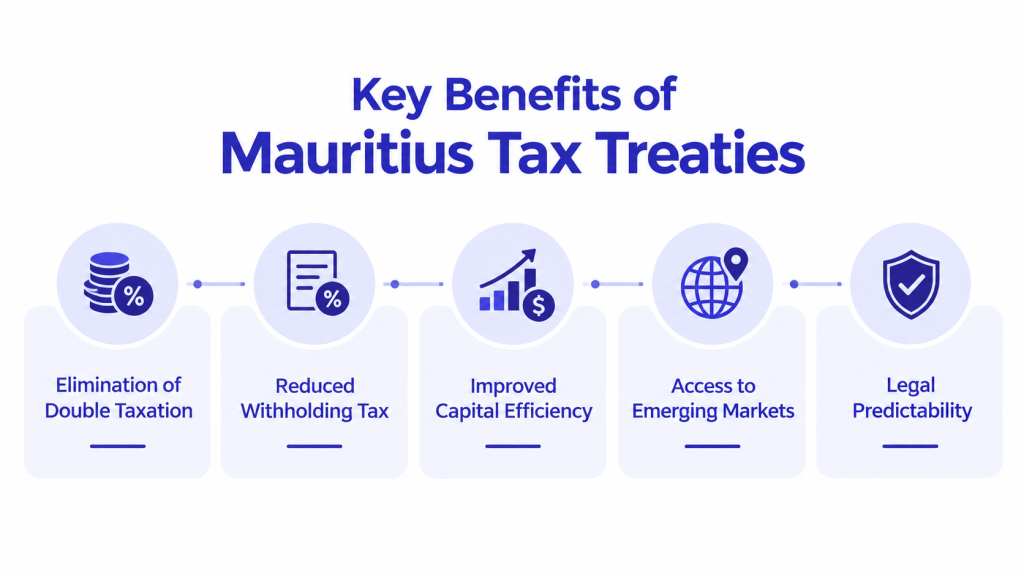
Key Benefits of Mauritius Tax Treaties
- Elimination of Double Taxation: Helps avoid tax duplication between source country and residence country via credits/exemptions.
- Reduced Withholding Tax: Caps withholding taxes levied by source countries on dividends, interest, and royalties.
- Improved Capital Efficiency: Harmonises international tax treatments and simplifies transactions.
- Access to Emerging Markets: Gives a well-tested and compliance-assured gateway to invest in fast-growing African/Asian countries.
- Legal Predictability: Offers a structure for dispute resolution via Mutual Agreement Procedures (MAP).
Role of Mauritius in Global Investment Structures
Mauritius as an Intermediary Platform
Multinationals tend to form intermediaries based in Mauritius that hold regional subsidiaries and manage the flow of money before investing worldwide.
Where Treaty Optimisation Fits Into a Structure
- Global Investor: Invests money in intermediary platform.
- Mauritius Entity: Holds regional equities, earns returns, maintains governance structures and fulfils CIGA conditions.
- Operating Subsidiary: Performs operational activities in target market and transfers earnings in accordance with treaty caps.
Important Distinction
Treaty optimisation is not just about the flow of money through Mauritius bank accounts. The foreign tax authority evaluates the economic substance of the company. Companies lacking substance, local decision-making, and commercial purpose face the danger of losing treaty benefits.
Economic Substance: What Businesses Need to Demonstrate
Why Substance Matters
After changes made by OECD BEPS, companies or conduit entities that lack local operations will not be able to claim any treaty benefits anymore. Notably, having a Tax Residency Certificate is not enough – the company needs to have substance in order to prove it.
Operational Criteria
To have economic substance, the company should meet the following criteria:
- Physical Office Space: Possessing an office or operational premises located in Mauritius.
- Local Governance: Holding regular board meetings in Mauritius using resident directors who make all decisions regarding the company.
- Adequate Staffing: Hiring a sufficient number of local staff (or management firms authorized to do so).
- Domestic Operations: Having sufficient operating expenditure in Mauritius.
Substance-Based Income Exclusion: The 2026 Reality Check
Multinational Enterprise (MNE) groups that have consolidated annual income in excess of €750 million must apply the Substance-based Income Exclusion (SBIE) according to Pillar Two regulations and any country’s own legislation that implements the rules. SBIE gives companies the ability to exclude an amount of their income from top-up tax calculations in accordance with the QDMTT rules.
2026 Tax Updates: What Existing Mauritius Structures Need to Prepare For
September 2026 QDMTT Filing Timeline
The Mauritian government imposes QDMTT regulations in order to ensure that in-scope multinationals (revenue €750M+) are subject to an effective tax rate of 15% or higher for their domestic income.
- Step 1: Check whether group combined revenue was greater than €750 million during two out of four previous fiscal years.
- Step 2: Determine local effective tax rate (ETR) on qualifying income using Pillar Two rules.
- Step 3: Deduct eligible SBIE payroll and tangible asset carve-outs.
- Step 4: Make your first QDMTT submissions and pay any top-up amounts due to MRA by September 2026.
Principal Purpose Test (PPT) Readiness
The PPT is now well incorporated in the DTAAs of Mauritius via the Multilateral Instrument and bilateral protocols. In the context of the PPT, tax benefits shall not be accorded where a principal purpose of the arrangement was to obtain the treaty benefit.
- Arrangement Review: Evaluate whether there are any other business purposes apart from reducing tax in the creation of the business arrangement.
- Documentation: Maintain commercial records, board minutes, and strategy documents explaining the reasoning behind structural arrangements.
- Outcome: Treaties remain accessible to business arrangements that make economic sense; otherwise, benefits are disallowed.
Immediate Action Checklist for Existing Entities
- Verify Tax Residency Status: Ensure that the company has a current and valid Tax Residency Certificate (TRC) from the MRA.
- Audit Core Income-Generating Activities: Make sure that core commercial operations of the company take place physically in Mauritius.
- Review Board Roster & Minutes: Ensure that board meetings are being held physically and that resident directors have attended.
- Run a PPT Assessment: Record the non-tax commercial reasons why the company is holding a Mauritius business.
- Evaluate QDMTT Exposure: Determine whether the company will have to file under QDMTT rules before September 2026.
- Review Intercompany Agreements: Ensure that intercompany agreements are conducted in an arm’s length manner.
How TRC, Substance, and Management Support Treaty Access
A Tax Residency Certificate (TRC), issued by the MRA, is a certificate that shows tax residency in Mauritius. However, the foreign tax authorities carry out audits even after a TRC to determine operational presence.
Arnifi helps companies secure and maintain treaty relief through targeted support:
- TRC Administration: Filing the application and annual renewals with the MRA.
- Substance Setup: Arranging office premises, local payroll, and operational cost administration.
- Governance Support: Ensuring presence of qualified resident directors and management of company documents.
- Compliance Advisory: Doing QDMTT assessment, arranging transfer pricing files and defense files for PPT audit.
Challenges and Considerations When Optimising Tax Treaties
- Misaligned Corporate Structures: Corporate structures which have no operational presence would immediately be disallowed by the foreign revenue authorities.
- Increased Tax Audits: The foreign tax authorities do audit the treaty claim where they demand proof of beneficial ownership and substance.
- Automatic Information Exchange: CRS and FATCA involve systematic information exchange about financial accounts and corporate entities around the globe.
- Evolving Global Tax Frameworks: Implementation of BEPS measures will require continuous compliance of holding arrangements.
Common Mistakes Businesses Make
- Operating Shell Entities: The use of a registered address in the absence of any management, resident directors, and no activities.
- Focusing Only on Nominal Tax Rates: Overlooking domestic withholding tax obligations, anti-abuse domestic measures, and PPT in the targeted market.
- Overlooking Beneficial Ownership Rules: The assumption that having cross-border cash flow constitutes meeting beneficial ownership requirements.
- Neglecting Commercial Documentation: The lack of recording rationale for corporate structures in the books of accounts.
- Missing QDMTT Deadlines: The failure to determine the Pillar Two top-up obligations before the statutory filing deadlines.
Professional Guidance and Arnifi Support
The need for cross-border tax planning is a process of balancing domestic tax laws, treaties that are actually in effect, and international rules of compliance. Relying on outdated structures leads to being exposed to tax adjustments, back taxes, and financial penalties.
Arnifi provides full-service coverage in ensuring compliance of cross-border structures:
- Structure Alignment: Developing structures that meet the needs of a particular DTAA.
- Substance Optimization: Creating real domestic operations, local workspace, and local governance structure.
- Pillar Two & QDMTT Advisory: Checking the group revenue threshold and handling the domestic top-up tax filings.
- Regulatory Compliance: Obtaining TRCs, maintaining board documents, and dealing with MRA reporting obligations.
Conclusion
Mauritius continues to be an important player in the global financial market, providing a comprehensive DTAA regime allowing international businesses to establish connections with developing countries in Africa, Asia, and other regions of the world. However, taking advantage of the DTAA in 2026 would require more than calculating the tax rates.
Successful business would require maintaining economic substance, defining business goals under PPT, and complying with international taxation standards, including QDMTT.
Frequently Asked Questions
What is a Mauritius tax treaty?
A Mauritius tax treaty is a bilateral Double Taxation Avoidance Agreement (DTAA) between Mauritius and another nation. The treaty divides taxing authority between the two, lowers source country withholding tax rates, and avoids double taxation of tax resident firms.
How does a Mauritius DTAA work?
The DTAA functions by specifying the taxing authority that has primary or partial authority to tax income from international transactions such as dividends, interest, royalties, and capital gains. Double taxation is avoided by offering foreign tax credits or total exemptions in the home country.
How many tax treaties does Mauritius have in 2026?
There are 45 Double Taxation Avoidance Agreements (DTAAs) that Mauritius has, covering leading economies in Africa, Europe, Asia, and the Middle East.
Which countries have a tax treaty with Mauritius?
Mauritius has treaties with important countries like India, China, South Africa, the United Kingdom, France, Germany, Singapore, and the United Arab Emirates, among others.
Does Mauritius have a tax treaty with India?
Yes, there is a DTAA between Mauritius and India. It includes anti-abuse provisions of the Base Erosion and Profit Shifting (BEPS) project, like the Principal Purpose Test (PPT).
How does Mauritius reduce withholding tax?
If a source country of the foreign-sourced income has signed a DTAA with Mauritius, statutory withholding taxes on outbound dividends, interest, and royalties become subject to reduced rates from 0% to 10% in many cases.
What is the Principal Purpose Test in Mauritius tax treaties?
The Principal Purpose Test (PPT) is an anti-abuse provision of the OECD Multilateral Instrument (MLI). A tax benefit in question shall not be granted if obtaining such benefit was one of the main purposes of making the arrangement.
What is QDMTT in Mauritius?
QDMTT is Qualified Domestic Minimum Top-Up Tax. It is intended to ensure that all Mauritius constituents of MNE groups with revenues above €750 million would pay a top-up tax rate of 15%.
Do Mauritius companies need economic substance to claim treaty benefits?
Yes. The authorities usually contest entities with no physical presence. There must be physical presence, residents in Mauritius acting as directors, competent personnel, and decision-making conducted in Mauritius to be able to enjoy treaty benefits.
What is the Substance-Based Income Exclusion?
The Substance-Based Income Exclusion (SBIE) is a Pillar Two tool enabling MNEs to exclude a certain percentage of their income that is derived from payroll expenses in the host jurisdiction as well as tangible assets from the top-up tax calculation using QDMTT.
What changed for Mauritius tax treaties in 2026?
Some important changes include mandatory QDMTT compliance filing by large MNEs, increased implementation of PPT, new treaty protocols such as the one between Jersey and India, and increased focus on beneficial ownership and domestic economic substance.
Can a Mauritius holding company claim treaty benefits?
A Mauritius holding company may benefit from treaties if it has the required Tax Residency Certificate (TRC), meets the criteria for beneficial ownership, and passes the PPT test.
What is a Tax Residency Certificate in Mauritius?
The Tax Residency Certificate (TRC) is a certificate that attests to the tax residency of the entity in Mauritius and entitles the holder to benefit from the DTAA network of the country. This certificate is issued by the Mauritius Revenue Authority (MRA).
How can businesses optimise Mauritius tax treaties compliantly?
The best way for businesses to maximize treaty utilization is by setting up proper infrastructure locally, employing local workers, conducting their board meetings locally, demonstrating clear intent to conduct business, and working with Arnifi.
References
- Mauritius Revenue Authority (MRA): Official portal for Tax Residency Certificates, DTAA texts, and QDMTT guidelines.
https://www.mra.mu - Economic Development Board (EDB) Mauritius: Operational guidelines for setting up Global Business Companies and establishing local substance.
https://edbmauritius.org - OECD BEPS & Pillar Two Portal: Complete specifications on the Multilateral Instrument (MLI), Principal Purpose Test (PPT), and QDMTT frameworks.
https://www.oecd.org/tax/beps/
Top UAE Packages
Related Articles



Top UAE Packages
Get in Touch
