
How to Start a Manufacturing Business in Dubai | Step-by-Step Guide

Zahira Shaik
SEO Content Writer
Zahira Shaik is an SEO Content Writer and Published Author specializing in research-based content. She excels at analyzing market trends, regulations, and industry developments… Read more

Tulika Saxena
AVP, Sales & Marketing | IIM Nagpur
Tulika Saxena specializes in business finance, sales strategy, and market positioning. Leads growth and partnerships, ensuring seamless business setup experiences and client success across… Read more


Key Fact: The industrial sector in Dubai is responsible for generating over AED 27.4 billion ($7.46B USD), forming 8.3% of GDP in the emirate. Setting up a manufacturing business in Dubai will give you zero percent personal income tax and direct access to international export routes.
Table of contents
- Introduction
- What Should You Know About Dubai’s Manufacturing Sector?
- What Are the Benefits of Starting a Manufacturing Business in Dubai?
- Which Manufacturing Industries Offer Opportunities in Dubai?
- Free Zone vs. Mainland | Which Is Better for a Manufacturing Business in Dubai?
- What Is an Industrial Manufacturing License in Dubai?
- What Is the Step-by-Step Process to Start a Manufacturing Business in Dubai?
- Documentation Required for a Manufacturing Business Setup in Dubai
- Compliance and Legal Considerations for Manufacturing Businesses in Dubai
- Costs and Investment Requirements for Manufacturing Business Setup in Dubai
- Marketing and Growth Strategies for Manufacturing Businesses in Dubai
- What Are the Common Challenges of Starting a Manufacturing Business in Dubai?
- How Can AI Tools Simplify Manufacturing Business Setup in Dubai?
- Conclusion
- Frequently Asked Questions (FAQs)
- References
Introduction
Setting up a manufacturing business in Dubai is not only about obtaining an industrial license. It involves many other important factors such as selecting the right jurisdiction, renting proper industrial property, receiving environmental permits, and estimating expenses on equipment and employees.
Because of national initiatives such as Operation 300bn, setting up production facilities in Dubai will help replace imported goods with “Made in UAE” products. In this guide, you will learn how to set up your own manufacturing company in Dubai.
What Should You Know About Dubai’s Manufacturing Sector?
Dubai has developed into a manufacturing powerhouse that is interconnected worldwide. The manufacturing industry forms 8.3% of Dubai’s GDP (amounting to AED 27.4 billion).
Key Sector Highlights
- Diverse Industrial Activities: Heavy industries, chemicals, machinery, electronics, and food and beverages (F&B) constitute the primary areas of industrial activity in Dubai.
- Industrial Free Zone Hubs: Specific industrial free zones such as Dubai Industrial City (DIC) (with six specialized sub-sector zones) and Jebel Ali Free Zone (JAFZA) (which houses more than 790 manufacturers in 73 countries) provide already developed infrastructure and efficient logistics.
- Localization Advantage: A manufacturing business can save on time, logistics costs, and hassles when setting up its localized manufacturing business operation in Dubai.
What Are the Benefits of Starting a Manufacturing Business in Dubai?
- Growing Demand for Manufactured Goods: Extensive infrastructure development creates a sustained need for the manufacture of local building materials, consumer products, and industrial supplies.
- Strategic Location and Global Market Access: Proximity to major shipping routes and airports makes it possible for manufacturers to import their raw materials and transport their products easily.
- Tax and Business Advantages: The zero percent income tax and other business benefits include reduced corporate taxes, customs duties on approved raw materials, and 100 percent capital repatriation.
- Access to Industrial Infrastructure: The availability of purpose-built zones that have heavy-duty power connections, warehouses, yards, and worker accommodation.
- Simplified Administration: Comprehensive setup support simplifies company registration, visas, banking, and accounting compliance.
Which Manufacturing Industries Offer Opportunities in Dubai?
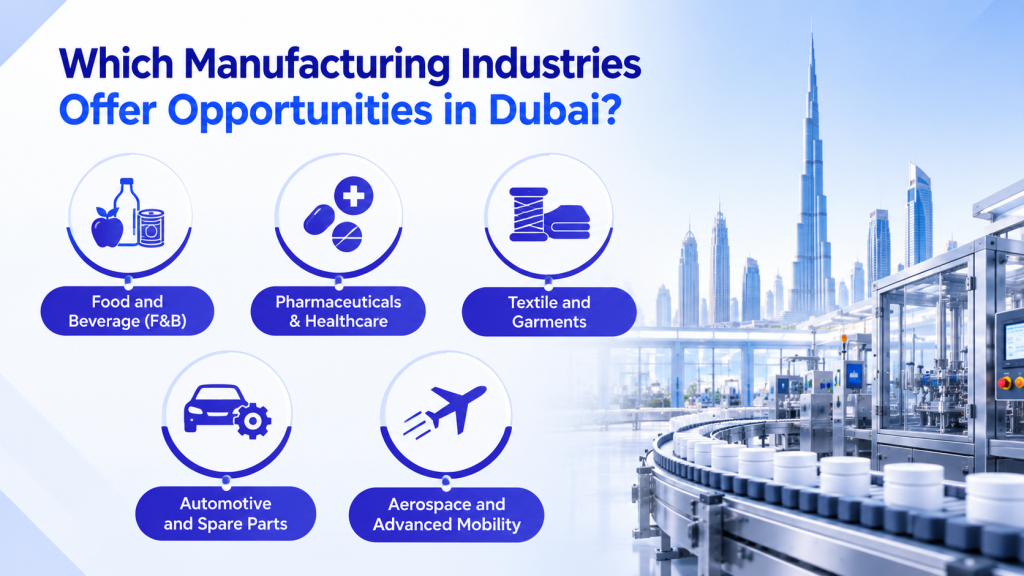
There are some highly promising industries with respect to growth opportunities for a manufacturing business startup in Dubai, such as:
- Food and Beverage (F&B): Due to growing population and tourism, the foodservice industry in the UAE is estimated to grow up to AED 161.51 billion by 2029.
- Pharmaceuticals & Healthcare: Increasing healthcare requirements and governmental initiatives ensure that the market of medical consumables and pharmaceuticals is among the fast-growing industries (expected to reach AED 1.64 billion by 2028).
- Textile and Garments: There is strong demand for fashion garments, safety garments, curtains, suitcases, and industrial textiles.
- Automotive and Spare Parts: Increasing regional demand for OEM spare parts and transitioning to electric and hybrid cars in the UAE.
- Aerospace and Advanced Mobility: Supported by top-notch aviation hubs, big airlines, and urban air taxis.
Free Zone vs. Mainland | Which Is Better for a Manufacturing Business in Dubai?
Choosing between a Free Zone and a Mainland jurisdiction is a crucial decision when establishing a manufacturing business setup in Dubai.
| Feature | Free Zone (e.g., DIC, JAFZA) | Mainland (DET Licensed) |
| Foreign Ownership | 100% foreign ownership | Up to 100% foreign ownership (activity-dependent) |
| Market Access | Direct trade in Free Zone & International; local sales via local distributor | Unrestricted direct access to the entire UAE local market |
| Government Contracts | Limited eligibility | Full eligibility to bid on government tenders |
| Premises Location | Restricted to designated free zone plots/warehouses | Anywhere on Dubai mainland designated for industrial use |
| Customs Duty | Exemption on imports inside the zone | Standard customs procedures apply |
How to Choose the Right Jurisdiction
- Choose a Free Zone if your primary business strategy involves international export/import, operating within a dedicated hub, or utilizing specific warehouse infrastructure.
- Choose the Mainland if you intend to supply products directly to the UAE domestic market or bid on government infrastructure tenders.
What Is an Industrial Manufacturing License in Dubai?
Industrial Manufacturing License is the licensing document that must be obtained in order to establish and run any manufacturing unit in Dubai.
The license, which is provided by the Department of Economy & Tourism (DET) or Free Zone Authorities (JAFZA or DIC for mainland units), assures the following:
- Regulatory compliance and the right to manufacture products.
- Eligibility for government incentives, utility subsidies, and allocation of industrial land.
- Increased credibility as an investor while seeking finance or setting up corporate bank accounts.
What Is the Step-by-Step Process to Start a Manufacturing Business in Dubai?
Step 1: Select Your Manufacturing Activity
Clearly identify the specific goods you will be manufacturing and link them to the recognized activity codes for industrial manufacturing.
Step 2: Choose the Right Jurisdiction
Ascertain which jurisdiction – either mainland or an exclusive free zone (DIC/JAFZA) – is most suitable for your targeted market.
Step 3: Register Your Trade Name
Register a distinct trade name that will adhere to UAE company naming policies.
Step 4: Prepare the Required Documents
Prepare the necessary documentation such as passport copy, shareholders’ information, business plans, and corporate documents.
Step 5: Secure Industrial Premises
Acquire physical facilities, warehouses, or land that will be used for the manufacturing operations.
Step 6: Apply for the Industrial Manufacturing License
Submit your application together with the file to either DET or FZA, along with necessary municipality/environmental clearances.
Step 7: Complete Post-Licensing Formalities
Open a corporate bank account, employee visa/labor permit, taxation, and registration of industrial goods with MoIAT.
Documentation Required for a Manufacturing Business Setup in Dubai
Requirements vary based on your specific activity and location, but generally include:
1. Company Registration Documents
- Completed trade license application form.
- Passport copies and photographs of all shareholders and managers.
- Trade name reservation certificate.
2. Premises & Facility Documents
- Lease agreement (Ejari for Mainland or Free Zone Lease Agreement).
- Site layout plan and industrial facility schematics.
3. External & Regulatory Approvals
- Environmental clearance certificates.
- Dubai Civil Defence safety approval.
- Sector-specific clearances (e.g., Dubai Municipality F&B approvals or Ministry of Health approvals for pharma).
Compliance and Legal Considerations for Manufacturing Businesses in Dubai
- Labor Law Compliance: The employer is supposed to sign MOHRE standard contracts, pay salaries via the Wage Protection System (WPS), follow a 48-hour working week, and handle statutory leave rights for employees.
- Environmental Regulations: Environmental licenses should be obtained based on initiatives such as UAE Green Agenda 2030.
- Industry-Specific Approvals: For advanced goods, testing and standardization, along with “Made in UAE” certification from MoIAT, would be required.
- Tax & Customs Compliance: Registrations for 9% Corporate Tax (only when applying over the limit of AED 375,000) and VAT are necessary.
- Ownership & Counterparty Screening: Appropriate Anti-Money Laundering (AML) and Sanctions screening for owners, directors, and ultimate beneficial owners (UBO) is mandatory per UAE federal laws.
Costs and Investment Requirements for Manufacturing Business Setup in Dubai
Note: The figures below are indicative estimated ranges from historical market averages. Official government and lease fees should be confirmed directly before incorporation.
- Industrial License Fees: Typically range between AED 25,000 and AED 50,000, depending on the activity scope and jurisdiction.
- Initial Setup & Registration Costs: Administrative registration fees average AED 5,555 to AED 12,000.
- Capital Requirements: Free Zone setups often require minimal starting share capital (from AED 10,000+), whereas complex Mainland manufacturing setups generally require AED 50,000 to AED 300,000+.
- Variable Operational Expenses: Warehouse/land leases, specialized machinery, utility connectivity, labor visas, and third-party safety audits.
Marketing and Growth Strategies for Manufacturing Businesses in Dubai
- Build Industry Relationships: Participate in B2B business fairs, collaborate with logistics firms within the GCC region, and form agency partnerships in the GCC countries.
- Establish a Strong Digital Presence: Create an SEO-enabled online presence, well-defined online product catalogs, and Google Business Page optimization for driving relevant B2B leads.
- Targeted Digital Advertising: Conduct digital marketing campaigns using LinkedIn and visual channels to highlight the production capabilities, certifications, and scale of operations of your business.
- Participate in Regional Trade Shows: Attend important industrial trade fairs like Gulfood and Big 5 to network with the regional procurement teams.
What Are the Common Challenges of Starting a Manufacturing Business in Dubai?
- Energy & Operational Expenses: Energy-dependent industries should budget for operating costs based on regional subsidization that meets industry standards.
- Regional Competition: As regional production increases, there is a need to ensure high production standards, automation, and efficiency in the logistics process.
- Skilled Labor Recruitment: Hiring technical personnel in many cases calls for international recruitment and visa sponsorship.
- Navigating Multi-Agency Clearances: Obtaining clearance from municipal authorities, civil defense organizations, and environmental groups can take time when documentation is inadequate.
How Can AI Tools Simplify Manufacturing Business Setup in Dubai?
Arnifi employs AI-specific solutions to optimize the entire setup process:
- Structure Optimization: AI organogram solutions enable an investor to plan a complicated ownership structure, analyze tax implications in multiple countries, and assess different ownership models before submitting the documents.
- Automated Document Generation: Digital document solutions create customized Articles of Association, resolution templates, and paperwork for MoIAT.
- Integrated AML & Partner Screening: Automated screening processes ensure that background checks for directors and shareholders are conducted on the go.
- Unified Operations Management: A digital dashboard consolidates all setup processes, licensing processes, visa management, and corporate banking into one system.
Conclusion
Setting up a manufacturing business in Dubai will provide a great platform for expanding the business in the region and internationally. Selecting a proper location (Mainland or specialized hub such as DIC and JAFZA) and maintaining your licensing, labor, and environmental requirements will allow your business to establish its own manufacturing facilities.
Digital solutions and business setup professionals will help you in structuring your business, preparing documentation, and official submissions.
Frequently Asked Questions (FAQs)
How do I start a manufacturing business setup in Dubai?
In order to establish a manufacturing business setup in Dubai, one needs to select his/her particular manufacturing activity, decide between Free Zone and Mainland, register their trade name, acquire an approved industrial facility, get the necessary environmental clearance and apply for the Industrial Manufacturing License.
What license is required to start a manufacturing business in Dubai?
One needs to acquire an Industrial Manufacturing License from either the Dubai Department of Economy and Tourism (DET) for mainland companies or the Free Zone Authority (DIC, JAFZA).
How much does a manufacturing license cost in Dubai?
The cost of obtaining an industrial manufacturing license in Dubai is usually between AED 25,000 and AED 50,000, excluding facility lease, machinery, and other environmental permits.
Is a free zone or mainland setup better for manufacturing in Dubai?
Free zones are best suited for businesses that have an international focus, 100% foreign ownership, and special infrastructure. On the other hand, the mainland is preferred when the company intends to sell its products directly to the local UAE market without using distributors or bidding for government projects.
What documents are required for a manufacturing license in Dubai?
These documents include a filled-out trade license application form, shareholder/director passport copy, lease contract for the industrial facility, facility plan, and environmental & safety clearance from outside sources.
Can foreigners fully own a manufacturing business in Dubai?
Yes, foreign individuals are able to retain 100% ownership in their manufacturing company within the Free Zone and for most types of Mainland industrial business establishment.
Which manufacturing industries offer opportunities in Dubai?
The industries include: Food & Beverages, Pharmaceutical products, Textile & Safety Wear, Automotive Parts, and Aerospace & Advanced Mobility Components.
Do manufacturing businesses in Dubai require environmental approvals?
Yes, industrial and production processes require an environmental compliance permit from the respective environmental protection authority and municipal body.
What are the main compliance requirements for manufacturing businesses in Dubai?
These include the following: compliance with labor law of MOHRE, Wage Protection System (WPS) wage payments, corporate tax/vat registration, environmental standards compliance, and regular safety audits.
How can AI tools help with manufacturing business setup in Dubai?
AI business setup tools ease the process by creating business ownership models, preparing application forms for multiple authorities, conducting AML background checks, and handling compliance processes.
References
- Federal Industrial Authority: Ministry of Industry and Advanced Technology (MoIAT)
- Mainland Business Licensing: Dubai Department of Economy and Tourism (DET)
- Industrial Free Zones: Dubai Industrial City (DIC) & Jebel Ali Free Zone (JAFZA)
Top UAE Packages
Related Articles
BVI vs Cayman Company Formation (2026) | Entity Ty...
Key Fact Both jurisdictions provide English common law frameworks for international business. BVI offers cost-efficient corporate management for private asset...

Top UAE Packages
Get in Touch
