
How to Open a Supermarket in Saudi Arabia

Anushka
Content Writer
Anushka Basu is a business content writer specialised in global business market insights. She aims to simplify complex regulatory, financial, and business concepts into… Read more


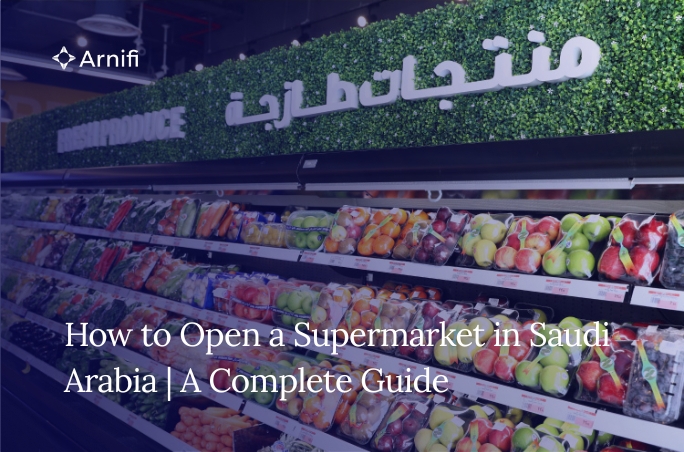
If you’re thinking of running a supermarket in Saudi Arabia, you’re looking at a pretty specific list of steps. There’s the commercial registration from the Ministry of Commerce, followed by the Municipal commercial licence through the Balady platform. After that, you handle food safety clearances from SFDA and are also required to line up with Saudization quotas.
If you’re a foreign investor, you can’t really jump into any of that right away; you first need a MISA investment licence. Only after that, all the rest of the steps start to make sense, and together they become the legal groundwork for any retail food work in the Kingdom.
Table of contents
Introduction
Saudi Arabia’s retail food market is one of the steadier spaces in the Gulf. You’ve got a population that’s over 36 million, plus a growing expatriate community, and on top of that, the government is pushing urban expansion across Riyadh, Jeddah, and the Eastern Province.
So demand stays pretty consistent for supermarkets that are actually well run. The Kingdom also backs the retail sector with policies and initiatives, which make it easier for both local players and international supermarket operators to set up shop.
What type of supermarket licence do you need?
There are multiple licence options, and the right one depends on the size and what you plan to sell:
Baqala licence: For small neighbourhood stores that focus on essentials, like rice, milk, bread, and other packaged staples
Grocery store licence: For mid-sized locations that sell frozen food, dairy, beverages, and household items
Supermarket licence: For bigger retail spaces with a broader assortment, including dedicated food sections, beverages, frozen items, plus non-food products. This one usually means extra health and regulatory clearances compared with a normal grocery licence
Hypermarket or mall licence: For large standalone outlets or mall anchor setups. You’ll see extra permissions and regulatory checks here
Picking the category early is important because it determines which approvals you’ll need and which authorities will be pulled in later.
How to start a supermarket in Saudi Arabia?
The licensing process moves across several government authorities in sequence:
1) MISA licence (foreign investors only)
Foreign investors need an MISA investment licence first. That authorises the investment itself, and it becomes the entry point before you submit anything else. Most of it is electronic, and it typically takes one to two working days once the documents are uploaded correctly through MISA’s portal.
2) Commercial Registration (CR)
Register your business name and activity through the Saudi Business Centre at business.sa. You’ll select the right retail activity code. This CR defines the legal identity of your store, so it has to be in place before further approvals can be applied for.
3) Municipal commercial licence (Balady)
Now apply via the Balady platform: you enter the establishment record, specify the retail activity and the area, then pick the store location. For eligible activities, you can get an instant licence after paying the fees. For other activities, the municipality reviews the application.
4) SFDA food establishment registration
If your supermarket sells food and beverages, you must register with the Saudi Food and Drug Authority. Frozen and chilled products usually require temperature-control documentation to show compliance.
5) Civil Defence safety permit
A safety permit from the General Directorate of Civil Defence is required for commercial activities. And usually it’s issued alongside the municipal licence through the Balady platform.
6) ZATCA registration
VAT registration with the Zakat, Tax and Customs Authority (ZATCA) comes right after CR issuance. The standard VAT rate is 15%, and e-invoicing compliance is mandatory for businesses that are registered.
7) Chamber of Commerce registration
After CR issuance, you also complete Chamber of Commerce registration based on your store location.
What location and operational rules apply?
In Saudi Arabia, supermarkets can only be set up in areas that are already zoned for commercial or mixed-use retail. Residential-only zones are not allowed, and in some municipalities, there are extra limits, like stores being placed too close to schools or hospitals.
Approvals and even footfall tend to lean on practical things like whether there’s enough parking, whether signage is visible, and whether entrances are easy to access for everyone. Then, on the operational side, it gets more specific:
- Frozen and dairy products must be kept in temperature-controlled environments compliant with SFDA standards.
- A waste disposal contract with an authorised service provider is mandatory
- Staff must be trained in food safety; clean uniforms, gloves, and hairnets are required during food handling
- Imported food products require additional import and health certifications from the relevant authorities
- Saudization quotas apply. The larger the store, the higher the required percentage of Saudi national employees
How does Arnifi help?
Opening a supermarket in Saudi Arabia usually means juggling multiple authorities such as MISA, the Ministry of Commerce, Balady, SFDA, Civil Defence, and ZATCA, often at the same time, but also in the right sequence.
Arnifi handles Saudi company formation and licensing end-to-end, so each authority’s conditions are met in the proper order without any delays. Whether you’re a foreign investor entering the Saudi retail space for the first time or you’re expanding something already running, Arnifi can help get your supermarket set up compliantly from day one.
FAQs
Q1. How do I start a supermarket in Saudi Arabia?
You register a CR via the Saudi Business Centre, then get a Balady municipal licence, and finish SFDA food safety registration before opening.
Q2. Can foreigners open a supermarket in Saudi Arabia?
Yes. With a MISA foreign investment licence, 100% ownership is possible within the right commercial framework.
Q3. Is Saudization mandatory for supermarkets?
Yes, all retail companies have to meet Saudization quotas, and the percentage goes up with store size.
Q4. How long does supermarket licensing take in Saudi Arabia?
Usually around three to four weeks for straightforward applications, assuming the documentation is complete for all relevant authorities.
Q5. Does a supermarket need SFDA registration?
Yes, if you sell food and beverages in Saudi Arabia, SFDA registration is required.
Conclusion
Saudi Arabia’s retail food market is open for investment in 2026, and under Vision 2030, the regulatory setup has become much simpler. At the same time, demand keeps rising across the big cities.
What hasn’t changed, though, is that the licensing process still runs across several authorities, each with its own submission requirements, and yes, the order matters. If founders map the sequence correctly, the setup can move along in weeks.
If not, you can end up losing time by going back to redo earlier steps. For a clean and compliant supermarket setup in Saudi Arabia, connect with our team at Arnifi before your first application is submitted!
REFERENCES:
Top Saudi Arab Packages


Related Articles


Top Saudi Arab Packages
Get in Touch