
Food Product Registration in Dubai: Requirements, Cost & Process

Zahira Shaik
SEO Content Writer
Zahira Shaik is an SEO Content Writer and Published Author specializing in research-based content. She excels at analyzing market trends, regulations, and industry developments… Read more

Tulika Saxena
AVP, Sales & Marketing | IIM Nagpur
Tulika Saxena specializes in business finance, sales strategy, and market positioning. Leads growth and partnerships, ensuring seamless business setup experiences and client success across… Read more


Key Fact: The process of registering food products in Dubai is a mandatory process that is conducted by Dubai Municipality through the Montaji/FIRS system to ensure that the food product is in compliance with health, labeling, and safety guidelines. Generally, government charges may range between AED 110 and AED 240 per SKU.
Table of contents
- What Is Food Product Registration in Dubai?
- Do You Need to Register Your Food Product in Dubai?
- Which Dubai Municipality System Is Used for Food Product Registration?
- Food Product Registration Requirements in Dubai
- Documents Required for Food Product Registration in Dubai
- Dubai Food Product Label Requirements
- How to Register a Food Product in Dubai: Step-by-Step Process
- How Much Does Food Product Registration Cost in Dubai?
- How Long Does Food Product Registration Take in Dubai?
- How to Check Food Product Registration in Dubai
- Does Every Food Product SKU Need Separate Registration?
- Food Product Registration for Imported Products
- Food Product Registration for Local Manufacturers
- Food Product Registration for Private-Label Brands
- Special Food Categories and Additional Requirements
- Why Is a Food Product Registration Rejected in Dubai?
- What Happens After Food Product Registration?
- Dubai Food Product Registration vs Other Emirates
- Dubai Food Product Registration Checklist
- Common Food Product Registration Mistakes to Avoid
- Food Product Registration Example: From Manufacturer to Dubai Market
- Food Product Registration Laws and Standards in the UAE
- Frequently Asked Questions About Food Product Registration in Dubai
- References
The process of registering food products in Dubai is a mandatory process that ensures that all food products which are being distributed, sold or imported to Dubai meet some specific safety standards. Whether you are a food company operating in Dubai or an international company looking for a market in Dubai, this process will make your entry into Dubai Customs easy.
What Is Food Product Registration in Dubai?
The registration of a food product is the official approval process that takes place with Dubai Municipality. It shows that the composition of a food item, its shelf life, packaging, and nutrition label meet the national regulations of the UAE, issued by the Ministry of Industry and Advanced Technology (MoIAT) and the municipal regulations as well.
Do You Need to Register Your Food Product in Dubai?
Yes. All companies planning to introduce packaged or processed food products into Dubai’s market must register their food products. That includes:
- Importers & Distributors: Bringing food through sea, air, or land ports into Dubai.
- Local Food Manufacturers: Producing packaged goods within Dubai-based facilities.
- Private-Label Brands: Selling branded food products contract-manufactured by third parties.
- E-Commerce Vendors & Retailers: Direct-to-consumer businesses selling packaged foods online or in brick-and-mortar stores.
Which Dubai Municipality System Is Used for Food Product Registration?
Dubai Municipality utilizes dedicated digital platforms for product clearance:
- FIRS (Food Import and Re-export System) / ZAD Portal: Primarily used for food items, batch import approvals, re-export clearances, and ingredient assessments.
- Montaji System: The unified consumer product platform used for regulatory approvals, cosmetic registrations, and specialized health food/supplement classification.
Food Product Registration Requirements in Dubai
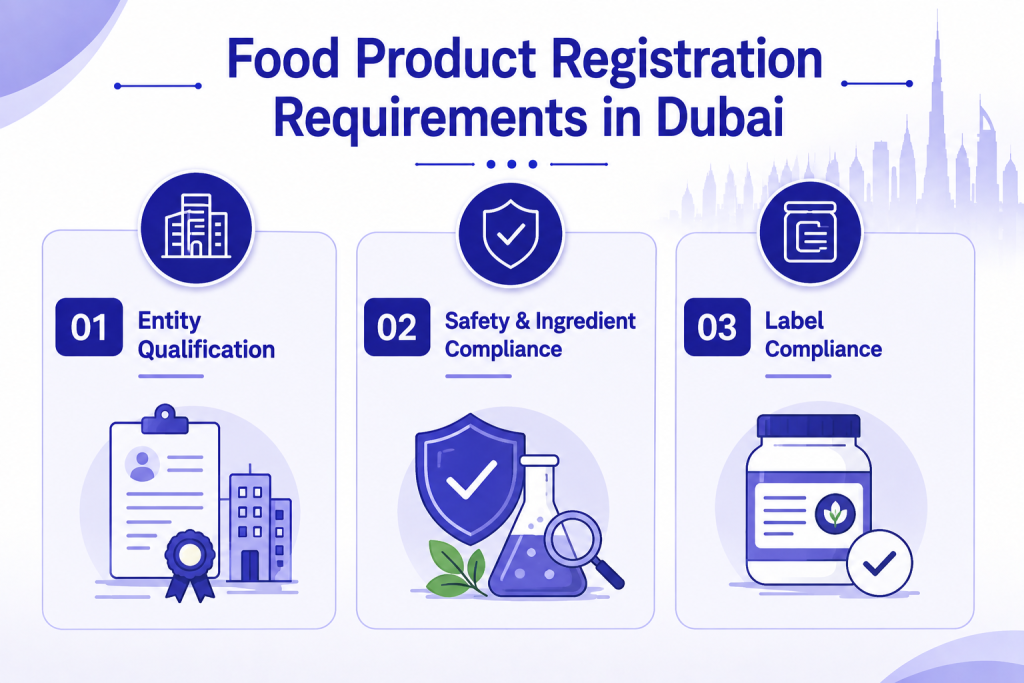
To successfully register a food product, businesses must satisfy three baseline regulatory pillars:
- Entity Qualification: A valid UAE Commercial Trade License with a relevant food trading, importing, or manufacturing activity.
- Safety & Ingredient Compliance: Pure ingredient composition free of prohibited, non-halal, or unauthorized chemical additives/preservatives.
- Label Compliance: Physical packaging design that complies with standard UAE labeling laws (including bilingual requirements).
Documents Required for Food Product Registration in Dubai
- Trade License Copy: Must explicitly mention food trading, import, or manufacturing activities.
- High-Resolution Product Visuals: Clear images showing the front and back of physical packaging.
- Compliant Label Artwork: Digital artwork file displaying complete bilingual (Arabic & English) details.
- Free Sale Certificate: Issued by the health or agricultural authority in the country of origin (for imported goods).
- Health / Phytosanitary Certificate: Valid certificate issued by competent origin authorities confirming fitness for human consumption.
- Certificate of Analysis (COA) / Composition Sheet: Laboratory test breakdown showing ingredient percentages, chemical tests, and microbiological parameters.
- Halal Certificate: Mandatory for products containing meat, poultry, animal fats, or gelatin, issued by an accredited Halal certification body.
Dubai Food Product Label Requirements
Packaging artwork rejections are the leading cause of registration delays. Labels must adhere to GSO/UAE standards:
- Bilingual Text: All mandatory text must appear in clear Arabic and English.
- Product & Brand Name: Clear naming that accurately represents the nature of the product.
- Full Ingredient List: Declared in descending order by weight, including standard E-numbers for additives and explicit allergen declarations.
- Nutritional Panel: Per serving or per 100g/ml metrics (calories, fats, saturated fats, sugars, protein, sodium).
- Date Formatting: Production and Expiry dates (DD/MM/YYYY or MM/YYYY) must be prominently declared or printed directly on the container.
- Traceability Data: Net weight/volume, batch/lot number, country of origin, and distributor/manufacturer details.
How to Register a Food Product in Dubai: Step-by-Step Process
1. Establish Company Profile: Prerequisite Setup.
Register your UAE business on the Dubai Municipality / FIRS portal using a valid UAE Trade License with active food business codes.
2. Document & Label Verification: Pre-Submission Preparation.
Verify that your product label artwork features required Arabic translations, correct date formats, and an accurate list of ingredients.
3. Submit Online Application: Portal Submission.
Log into the portal (FIRS/Montaji), select the product category, upload product artwork, ingredient certificates, Free Sale Certificates, and COAs.
4. Pay Application Fees: Initial Processing.
Pay the non-refundable government processing fee to initiate technical label assessment and compliance evaluation.
5. Technical Review & Lab Testing: Compliance Assessment.
Dubai Municipality food safety officers review documentation. If parameters are flagged, sample collection and Dubai Central Laboratory (DCL) testing may be requested.
6. Certificate Issuance: Final Approval.
Upon successful technical clearance, pay the certificate generation fee to receive your official registration approval status.
How Much Does Food Product Registration Cost in Dubai?
| Fee Component | Estimated Cost (AED) | Notes |
| Initial Application Fee | ~AED 10-20 per submission | Non-refundable portal fee |
| Certificate Issuance Fee | ~AED 100-220 per product variant | Paid upon technical approval |
| Lab Testing Fees (If requested) | ~AED 500-2,500+ | Depends on tests required by DCL |
| Total Official Government Cost | ~AED 110-240+ | Per basic SKU (excluding third-party lab testing) |
How Long Does Food Product Registration Take in Dubai?
- Standard Approval: 1 to 3 weeks for straightforward packaged products with fully compliant documentation.
- Complex/Tested Approval: 4 to 8 weeks if physical laboratory sample testing or label modification resubmissions are required.
How to Check Food Product Registration in Dubai
Check the food product’s registration status with Dubai Municipality to ensure that you are legal, prevent fake stocks, and make sure that you have cleared all safety checks before customs clearance or marketing of your products.
- Step 1: Access the Digital Portal or App: Visit the Digital Portal/App: Go to the official Dubai Municipality portal (FIRS/ZAD) or download the official Dubai Municipality App (Alef, Montaji).
- Step 2: Input Identifying Search Criteria: Enter the unique GTIN/code of the product, the Dubai Municipality Registration Number, or the Brand Name.
- Step 3: Review System Status: The following status will be available on screen:
Approval: Details of product, variant, shelf life, and expiry date of product are matching the information at Dubai Municipality.
Pending/Uncertain: Document check, labelling check, or laboratory test in process.
Rejected/Expired: Registration has been rejected or needs to be renewed after 5 years.
- Step 4: Download Verification Records: Download the certificate of assessment of food product digitally from Dubai Municipality.
Does Every Food Product SKU Need Separate Registration?
Yes, each separate SKU with unique physical properties, formula, or barcode will have to be registered individually. Any combination of different variants in one application will not be accepted.
- Flavor Variations: Vanilla, Chocolate, and Strawberry flavors of the same protein shake.
- Net Weight or Volume Differences: 250g, 500g, and 1 kg packages of the same brand of rice.
- Packaging Type Variations: Canned, glass bottle, or PET package drinks.
- Recipe & Dietary Formulations: “Original,” “Zero Sugar,” “Gluten-free,” and “Keto” variants.
- Private-Label / Brand Line Changes: Same food recipe sold under two different brand names.
Food Product Registration for Imported Products
Foreign goods must go through a comprehensive pre-shipment clearing process to avoid any possibility of the goods getting delayed, re-exported, or disposed of during UAE clearance process.
- Step 1: Onboard Importer Account: The importer based in UAE needs to login to the Dubai Municipality FIRS/ZAD system by making use of a valid food trading license.
- Step 2: Collect Country-of-Origin Documents: Get authenticated documents from overseas manufacturers, such as the Free Sale Certificate, Health Certificate, COA, and Halal Certificate (in case of meat, poultry, or gelatin).
- Step 3: Pre-Arrival FIRS Data Entry & Label Upload: Submit the application online before the shipment is made and input product data and label artwork with approved Arabic/English translation.
- Step 4: Label Assessment & Sampling: Municipal officials review product ingredients for compliance with UAE standards; in case there is any issue, physical sampling is done at Dubai ports and sent to Jebel Ali / DCL for testing.
- Step 5: Final Clearance & Import Release: Once approved, the status is changed to “registered”.
Food Product Registration for Local Manufacturers
The process of certification that a food manufacturer needs to complete in Dubai involves two separate approvals, of the factory itself and the specific products manufactured within it.
- Step 1: Facility & Layout Clearance: A valid manufacturing or industrial license is required first; then a food safety department layout and hygiene approval (including HACCP/GMP installation) is completed at the Dubai Municipality.
- Step 2: Raw Material Verification: All raw materials and food additives used or imported for manufacturing are to be verified according to UAE safety standards in advance.
- Step 3: Laboratory & Shelf-Life Testing: Shelf-life stability testing and microbiological testing of the product are done in approved UAE laboratories.
- Step 4: FIRS Submission & Artwork Approval: The packaging design, composition ratio, batch information, and lab test results are uploaded through the FIRS portal.
- Step 5: Inspection & Commercial Clearance: The Municipality inspection team might carry out a factory inspection before granting the product commercial approval certificates.
Food Product Registration for Private-Label Brands
When a brand owner manufactures his/her food products using a different manufacturing plant, then he/she needs to register for private label registration.
- Step 1: Establish Commercial Authority: Verification of Commercial Establishment: It must be ensured that the brand owner has a valid UAE trade license for trading in food or managing the brands.
- Step 2: Co-Packing & Manufacturing Authorization: The brand owner must have an official Authorization Letter from the co-packer allowing him/her to register and distribute the recipe.
- Step 3: Facility Accreditation Check: It should be verified whether the manufacturing facility in the UAE or abroad has any certification regarding food safety (HACCP, ISO 22000, GMP, etc).
- Step 4: Label Alignment: The labels should be such that it clearly mentions the name of the brand owner as well as the manufacturer in both Arabic and English.
- Step 5: Portal Application & Final Approval: Finally, the brand owner will need to submit the authorization letter, lab specifications, and label artwork through his/her FIRS account.
Special Food Categories and Additional Requirements
- Health Supplements & Fortified Foods: Strict boundary classification is required between Dubai Municipality and the Ministry of Health and Prevention (MOHAP). Health claims should be scientifically backed up.
- Organic Foods: Should have an official certificate for organic compliance from MoIAT/ESMA along with label approval.
- Energy Drinks & Specialized Formulas: May need health warning labels and may need restrictions on caffeine levels and excise taxes.
Why Is a Food Product Registration Rejected in Dubai?
- Lack of Arabic Translation: Lack of translation or translation error of important nutrient information or ingredients.
- Illegal Ingredients: Use of illegal colorants, too many chemical preservatives, or nonconforming additives.
- False Claims: Using unapproved medical claims (“cures high blood pressure”) on standard food labels.
- Misinformation: Discrepancy between laboratory reports uploaded and ingredient percentages on physical package.
What Happens After Food Product Registration?
After registration of your product, the period of clearance will remain valid for 5 years. Post-registration criteria include maintaining the same physical packaging as the digital one in the clearance process, notifying the concerned authority in case of a change in ingredients, and matching the barcode of each shipment.
Dubai Food Product Registration vs Other Emirates
Even though Dubai utilizes its indigenous FIRS / Montaji system, registering food products in Dubai automatically covers you with basic compliance requirements in the whole UAE. If your product is cleared in Dubai, then it can easily be shipped into other Emirates (Abu Dhabi through ADAFSA) under national MoIAT rules.
Dubai Food Product Registration Checklist
- UAE Commercial Trade License active with Food Activity
- FIRS / Dubai Municipality Registered Account
- Images of Packaging (front & back)
- Label Artwork in Arabic & English
- Free Sale & Health Certificate of Original Country
- Certificate of Analysis (COA) / Ingredient Percentage Listing
- Halal Certificate (for meat or gelatin if required)
Common Food Product Registration Mistakes to Avoid
- Shipping Before Registration: Importing goods prior to obtaining FIRS approval leads to costly port demurrage fees.
- Using Machine Translation: Using literal online translation tools for Arabic labels often creates terminology errors that trigger rejection.
- Group SKU Submissions: Attempting to submit multiple flavors or weight variants under one fee application.
Food Product Registration Example: From Manufacturer to Dubai Market
Day 1–3: Document Preparation
Phase 1
Overseas manufacturer compiles Free Sale Certificates, COAs, and sends artwork files to the Dubai importer.
Day 4–7: Portal Application
Phase 2
Dubai importer uploads translated bilingual artwork and specifications to the FIRS platform and pays application fees.
Day 8–14: Municipal Review
Phase 3
Food Safety Department reviews label artwork and ingredient compliance.
Day 15: Registration Issued
Phase 4
Approval certificate is issued; product is authorized for import, customs clearance, and retail distribution.
Food Product Registration Laws and Standards in the UAE
- UAE Federal Law No. 10 on Food Safety: Governs national food standards, hygiene, and supply chain integrity.
- GSO 9 / UAE.S 9: Mandatory standard detailing labeling requirements for prepackaged food items.
- MoIAT / ESMA Standards: Regulates national conformity assessment schemes (ECAS) and Halal certifications.
Frequently Asked Questions About Food Product Registration in Dubai
How much does food product registration cost in Dubai?
Dubai Municipality official charges start from AED 110 and go up to AED 240 for each product SKU. Overall expenses may be higher in case of the necessity to conduct tests in third parties or consult professionals.
What government fees apply to food product registration?
Main government charges include the charge for submission (approx. AED 10–20) and the charge for certificate issuance (approx. AED 100–220).
Are laboratory testing fees included in food registration costs?
No. In case the Dubai Central Laboratory (DCL) requests physical sample tests, charges will be extra according to test parameters.
What additional costs should importers expect?
Importers need to pay for Arabic translation, laboratory test certificates, legalization of origin certificates, and customs clearance duties.
Does the cost change for multiple food products or SKUs?
Yes. Each SKU, variant, or flavor requires its own registration application and corresponding government fee.
How long does Dubai Municipality food product registration take?
Standard registrations take 1 to 3 weeks.
How long does label assessment take?
Initial municipal label and document assessments typically take 3 to 7 working days.
How long does laboratory testing take if required?
If samples are requested for DCL testing, it adds 1 to 3 weeks to the overall timeline.
What can delay food product registration in Dubai?
Delays arise mostly due to Arabic labels being inaccurate, origin certificates not being provided, or the use of food additives that have not been approved.
How long does it take to get a food product ready for import and sale?
Considering the process of redesigning labels and getting municipal approval, 3 to 5 weeks is the appropriate period..
References
- Dubai Municipality – Official Portal, Official portal for food safety regulations and municipal clearance systems.
- Ministry of Industry and Advanced Technology (MoIAT), UAE federal authority setting national standards, ECAS, and Halal guidelines.
- Montaji System Portal, Official product registration and verification platform.
Top UAE Packages
Related Articles


Top UAE Packages
Get in Touch
