
Singapore Fintech License Guide (2026): MAS Requirements, Pathways & Process

Zahira Shaik
SEO Content Writer
Zahira Shaik is an SEO Content Writer and Published Author specializing in research-based content. She excels at analyzing market trends, regulations, and industry developments… Read more

Tulika Saxena
AVP, Sales & Marketing | IIM Nagpur
Tulika Saxena specializes in business finance, sales strategy, and market positioning. Leads growth and partnerships, ensuring seamless business setup experiences and client success across… Read more


Key Fact: A Singapore fintech license is an activity-specific MAS authorisation for payments, investments or crypto, which demands incorporation, capital and high standards of AML compliance. The approval process includes IPA and operational compliance.
Table of contents
- Introduction
- What Is a Singapore Fintech License?
- Before Applying for a Singapore Fintech License
- Types of Fintech Licenses in Singapore
- Singapore Fintech License Requirements
- Singapore Fintech License Application Process
- What Happens Between In-Principle Approval and Full Licensing?
- MAS Regulatory Sandbox for Fintech Companies
- How Long Does a Singapore Fintech License Take?
- Documents Required for a Singapore Fintech License
- Post-October 2025 Payment Services Licensing Changes
- Common Reasons Singapore Fintech License Applications Face Delays
- Recent Enforcement Lessons Fintech Companies Should Know
- Compliance Requirements After Getting a Fintech License
- Future of Finance Institute & Ecosystem Support
- Common Challenges When Applying for a Singapore Fintech License
- Singapore Fintech License vs. Regulatory Sandbox
- How Arnifi Supports Singapore Fintech Licensing
- Frequently Asked Questions
- Conclusion
Introduction
Singapore has established itself as a fintech hub that combines rapid growth and development of technology with solid regulation. The Monetary Authority of Singapore plays a crucial role in this process, providing strict rules that will protect consumers and ensure financial stability while promoting innovative business models.
Nevertheless, fintech startups often commit a common mistake: they think that fintech licenses are just one general plug-and-play authorisation. Actually, Singapore uses the activity-based model, where the requirements of the regulation will vary depending on your financial activities, transaction volumes, and the products you have. Making mistakes in selecting the right licence type, considering the necessary operational prerequisites, and the post-approval stage may result in huge application delays or refusal.
This guide provides you with an overview of the Singapore fintech licensing process in its entirety. Apart from definitions, it will also help you identify your licence type, get through IPA to authorisation, use MAS Sandbox and set up a compliance framework.
What Is a Singapore Fintech License?
Meaning & Regulatory Authority
A Singapore Fintech License is a legal authorization from the Monetary Authority of Singapore. The Monetary Authority of Singapore is Singapore’s central bank and financial regulator overseeing all firms functioning in banking, payments, capital markets, and financial advisory.
Who Needs a Licence?
If you are a firm that carries out any of the following financial services, then you will need an MAS licence or registration:
- Payment Service Providers: Intra-city, domestic, or foreign transactions, electronic wallets, and merchant acquiring services.
- Digital Asset Businesses: Activities in buying or exchanging Digital Payment Tokens (cryptocurrency/DPTs) or digital asset custody services.
- Lending Platforms: P2P lending or debt crowdfunding firm dealing in capital market instruments.
- Investment & Wealth Platforms: Robo-advisors, investment management, or online trading platforms.
- Financial Advisory Businesses: Financial product advice through a digital medium, portfolio advice, or insurance planning advice.
Why Licensing Depends on Your Business Model
Singapore doesn’t issue licenses for fintech companies. Rather, MAS regulates the financial activity itself. The range of licensing, amount of financial transactions, and other limitations are determined by:
- Services Offered: If you are working with fiat currencies, issuing stored value, or managing clients’ investments.
- Transaction Volumes: The monthly amount determines the type of regulation you will need.
- Customer Funds: Holding, safeguarding, or transferring customer money introduces higher regulatory scrutiny.
- Risk Exposure: Digital asset risk and international money transfer mean AML regulations are stricter.
Before Applying for a Singapore Fintech License
1. Identify Your Exact Fintech Activity
Before filling out any applications, lay out each of the technical and financial processes taking place in your product. Include:
- What financial services you are offering to your users.
- If your product comes into contact with, pools, or protects customer money.
- If payment movements are cross-border in nature.
- If investment advice, securities execution, or digital tokens are in play.
Practical Note: Fintech companies tend to begin the licensing journey before locking down their product’s characteristics. As the way to regulatory compliance is defined by facts, not company strategy, changing the product midway through the process may mean starting from scratch.
2. Choose the Correct Licence Path
Map your activities to one of Singapore’s primary regulatory frameworks:
- Payment Services Act (PS Act): For payment processing, e-money issuance, merchant acquisition, and crypto/DPT services.
- Securities and Futures Act (SFA) / Capital Markets Services (CMS) Licence: For capital raising, fund management, and securities trading.
- Financial Advisers Act (FAA) / Financial Adviser (FA) Licence: For distributing financial products and digital advisory services.
3. Decide Whether You Need a Sandbox Pathway
Consider whether your business model demands immediate licensing or falls under the category of being tested within the framework of the MAS Regulatory Sandbox, which offers opportunities for launching innovative financial services in a real market environment with customized relaxation in regulations.
Practical Note: The MAS Regulatory Sandbox is meant for innovative financial ideas for which regulatory treatment is still ambiguous; it is not a loophole to bypass licensing procedures.
Types of Fintech Licenses in Singapore
1. Payment Services Licence
Governed by the Payment Services Act (PS Act), this licence covers core electronic payments and digital asset activities. It offers two main operational tiers:
Standard Payment Institution (SPI) vs. Major Payment Institution (MPI)
| Criteria | Standard Payment Institution (SPI) | Major Payment Institution (MPI) |
| Transaction Limits | ~S$3M monthly for a single payment service; ~S$6M monthly for two or more payment services. | Exceeds ~S$3M monthly for a single service or S$6M monthly for two or more services. |
| E-Money Daily Float | ~S$5M of daily outstanding e-money. | Exceeds ~S$5M of daily outstanding e-money. |
| Base Capital | ~S$100,000. | ~S$250,000. |
| Security Deposit | ~S$100,000. | ~S$200,000. |
| Regulatory Burden | Lighter ongoing reporting requirements suited for early-stage fintechs. | Comprehensive oversight, strict customer fund safeguarding, and daily float management. |
2. Capital Markets Services (CMS) Licence
Regulated by the Securities and Futures Act (SFA), a CMS licence is needed for firms conducting business in:
- Security trading and futures dealing.
- Asset management services (like artificial intelligence wealth managers or private equity technological portal).
- Corporate finance advice and custody.
- Robotic investment platforms and automated advisory systems.
3. Financial Adviser (FA) Licence
Regulated by the Financial Advisors Act (FAA), a Financial Advisor licence is compulsory for firms which:
- Provide investment product or financial structure advice to customers.
- Generate research reports or analyses of investment products.
- Provide digital arrangements of life insurance or structured investment policies.
Singapore Fintech License Requirements
MAS assesses candidates according to fundamental operational, financial, and risk-based criteria:
Local Incorporation & Presence
- The applicant must be a locally incorporated Singapore company that has a fixed place of business in Singapore.
- It must have at least one executive director who is a Singapore Citizen or Permanent Resident (or Employment Pass holder) working in tandem with a resident director.
Qualified Leadership & Fit/Proper Criteria
- The executive officers and directors must satisfy the MAS’ Guidelines on Fit and Proper Criteria (integrity, financial prudence, competency, and reputation).
- The key personnel must have industry experience in regulated financial services.
Financial Capital Requirements
- SPI Applicants: Minimum base capital of ~S$100,000.
- MPI Applicants: Minimum base capital of ~S$250,000.
- Capital buffers should comfortably cover 6 to 12 months of operational expenditure.
Compliance & Risk Frameworks
- Enterprise-wide AML/CFT policies for anti-money laundering and combating financing of terrorism.
- Automation of customer due diligence (CDD) and know your customer (KYC) processes.
- Transaction monitoring systems and Suspicious Transaction Reporting (STR).
Technology & Operational Readiness
- Adherence to the Technology Risk Management (TRM) guidelines by MAS.
- Controls on cybersecurity, network resiliency, pen testing, and incident response plans.
- Data protection regime consistent with the Personal Data Protection Act (PDPA).
Singapore Fintech License Application Process
- Step 1: Assess Your Business Model: Perform a product, volume, and money flow assessment.
- Step 2: Select the Appropriate Licence: Identify if your model falls under the requirement for an SPI, MPI, CMS, or FA licence or sandboxing route.
- Step 3: Prepare Application Documents: Gather your corporate resolutions, business plan, financial model, AML policies, legal opinions, and compliance audit report from third parties.
- Step 4: Submit the Application: File through the MAS online portal (MAS-Tx), and pay application fees. MAS will review the documents and issue clarifications.
- Step 5: In-Principle Approval (IPA): Receive your IPA letter confirming that your application has been approved in principle, but with some conditions.
- Step 6: Meet Final Operational Conditions: Fulfill Your Final Operating Requirements: Perform technology security audits, deposit capital in local banks, appoint local compliance officers, and establish control procedures.
- Step 7: Receive Full Licence: The MAS will make its final review, convert IPA into a licence and add you to the Financial Institutions Directory.
What Happens Between In-Principle Approval and Full Licensing?
Getting In-Principle Approval (IPA) means your business idea has been approved by MAS, but that is not the permission to go live with operations.
The Operational Transition Phase
In this stage (usually 3 to 6 months), applicants need to turn the theory of compliance policies into working operations:
- Capital Verification: Transfer the required capital into a Singapore bank account.
- Technology Audits: Complete independent penetration testing and vulnerability assessment of all live production systems.
- Staffing Execution: Onboard important local management, compliance officials, and executive directors.
- Vendor & Custody Setup: Make all the arrangements with the banks for safeguarding, liquidity provider, and cloud hosting.
Experience Box: In-Principle Approval (IPA) means that your business idea is approved by MAS, but you cannot go live until MAS finishes the verification of your business idea.
MAS Regulatory Sandbox for Fintech Companies
What Is the MAS Regulatory Sandbox?
The MAS Regulatory Sandbox allows fintech firms to test innovative financial products and services in a live market environment with temporary regulatory relaxations.
When Should a Fintech Use the Sandbox?
Use the sandbox approach in case:
- It involves novel technology or business model for services.
- No regulation covers the product in question.
- The applicant needs to validate the market under controlled conditions without making the full regulatory capital commitment.
Sandbox-to-Permanent Licence Pathway
- Pre-Engagement: Explain the idea to MAS to establish the parameters of testing.
- Application & Approval: Specify boundaries and exit strategy (for instance, maximum transaction value or maximum number of clients).
- Live Testing: Launch the services for selected consumers, keeping strict customer protection standards.
- Transition: Once all the testing KPIs have been achieved, transition from sandbox directly into a standard licensing scheme such as SPI, MPI, CMS, or FA.
Sandbox Rejection & Cooling-Off Considerations
A sandbox application will be rejected by MAS if it does not involve novel technology or fails certain requirements. Moreover, the applicant may have to wait up to 3 months before resubmission due to cooling off issue.
How Long Does a Singapore Fintech License Take?
Licensing timelines vary based on business model complexity, documentation quality, and regulatory responsiveness.
Why Some Applications Face Delays
- Incomplete Documentation: Lack of legal opinion and inadequate AML manuals.
- Vague Product Models: Unable to give clear explanations of money flow and transaction structure.
- Weak Risk Frameworks: Standardized compliance programs that do not consider Singapore-specific AML/ CFT requirements.
- Unclear Outsourcing Arrangements: Lack of control over external technology or KYC service providers.
Documents Required for a Singapore Fintech License
| Document | Purpose |
| Comprehensive Business Plan | Outlines target markets, product features, fund flow diagrams, and 3-year financial projections. |
| Legal Opinion | External legal assessment confirming exact regulatory classifications under the PS Act or SFA. |
| External Auditor Assessment | Independent audit report evaluating proposed AML/CFT policies and consumer protection controls. |
| AML/CFT Policy Manual | Outlines customer screening, ongoing transaction monitoring, and suspicious activity reporting processes. |
| Technology Risk Management (TRM) Plan | Details cybersecurity policies, data encryption standards, and system recovery plans. |
| Corporate Governance Documents | Shares corporate ownership, board structure, and key executive CVs. |
| PDPA Compliance Assessment | Outlines data collection, consent handling, and cross-border transfer protocols. |
Post-October 2025 Payment Services Licensing Changes
Between late 2024 and early 2025, the Monetary Authority of Singapore (MAS) introduced updates to its regulatory guidelines PS-G01 for Payment Service Providers. Important updates include:
- Mandatory Independent Legal Opinions: Applicants should provide an independent legal opinion on regulation and exceptions from a qualified Singapore law firm.
- Independent External Auditor Assessments: Submissions require an external auditor’s review of the proposed AML/CFT framework and consumer protection framework before the MAS review.
- Expanded Technology Risk Mandates: Increased technology risk guidelines have been introduced for all digital assets and payment tokens service providers.
- Enhanced Capital & Expense Buffers: The base capital should be supported with appropriate monitoring and contingency plans of 6–12 months of expenses.
Common Reasons Singapore Fintech License Applications Face Delays
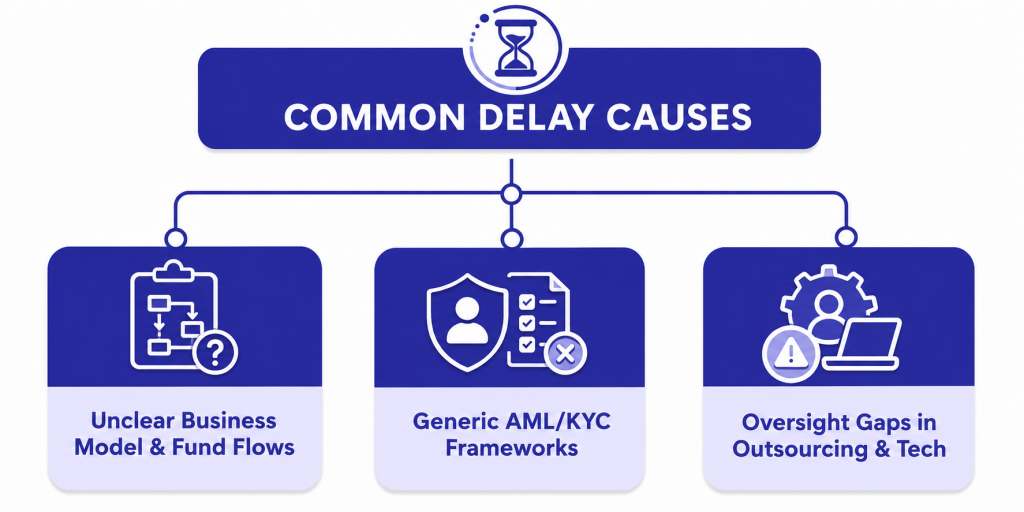
- Unclear Business Models: Very broad assertions lacking a detailed process for asset and fiat transfer.
- Generic AML Frameworks: Ready-made systems failing to consider high-risk profiles or country risk.
- Governance Gaps: Non-executive members of the board who do not have control over the day-to-day operations.
- Inadequate Outsourcing Controls: Partnering with third parties like cloud vendors or screening engines that are not subject to oversight plans.
- Slow Responses to MAS Clarifications: Inadequate response to clarifications by MAS authority.
Recent Enforcement Lessons Fintech Companies Should Know
Strict adherence to regulatory expectations characterizes MAS’s approach to both applicants and existing licensees:
- False or Misleading Disclosures: Making misleading statements regarding the readiness for operations or availability of funds may lead to refusal to grant licenses or investigations.
- Governance Breakdown: The members of the board and executive directors are responsible for any risks associated with internal controls.
- Outsourcing Vulnerabilities: Banks are liable for any operational issues caused by the third party.
- Post-Licensing Violations: Failure to meet the necessary base capital requirements or lack of AML oversight leads to license cancellation.
Compliance Requirements After Getting a Fintech License
Receiving MAS licensing is just the start of a commitment to continuous compliance:
- Capital Maintenance: Regularly preserve capital and security deposits as needed.
- Customer Fund Safeguarding: Major Payment Institutions have to protect customer funds via trust accounts or bank guarantees at approved banks.
- Regulatory Reporting: Submit financial reports, volume reports, and annual audited statements to MAS.
- Cybersecurity Audits: Conduct annual penetration testing and regular technology risk assessment.
- Ongoing AML/CFT Screening: Ensure that your sanctions list screening remains current and submit suspicious transaction reports.
Future of Finance Institute & Ecosystem Support
The fintech startups in Singapore enjoy an excellent business ecosystem that supports their growth. The sources of support are:
- Innovation Grants & Co-Funding: Innovation funding and co-funding of proof of concept from MAS Financial Sector Technology initiatives.
- Ecosystem Hubs: Incubators and Technical networks, including Singapore FinTech Association (SFA).
Important Distinction: Engaging in any local fintech association or seeking innovation grants is not part of the MAS licensing process.
Common Challenges When Applying for a Singapore Fintech License
- Translating complex technical structures into simple legal and regulatory disclosures.
- Maintaining balance between base capital locking up and early-stage runway.
- Finding suitable resident executive directors and skilled compliance officers.
- Optimizing MAS clarification cycles with several rounds.
Singapore Fintech License vs. Regulatory Sandbox
| Dimension | Full Fintech Licence | MAS Regulatory Sandbox |
| Primary Purpose | Full commercial deployment in regulated activities. | Live market testing for novel or unclassified models. |
| Regulatory Requirements | Complete compliance across all statutory rules. | Tailored relaxations on select rules (e.g., lower capital thresholds). |
| Duration | Permanent (subject to ongoing compliance). | Time-limited testing window with a mandatory exit plan. |
| Operational Scale | Unrestricted transaction limits within licence scope. | Strict boundaries on customer numbers and transaction volumes. |
How Arnifi Supports Singapore Fintech Licensing
Arnifi provides advisory support across every stage of the licensing lifecycle:
- Business Model Mapping: Examining the operating model for the selection of SPI, MPI, CMS, or Sandbox process.
- Documentation & Audit Preparation: Preparing legal opinion letters, business plan, and independent audit reviews.
- MAS Engagement: Coordinating regulatory submissions and clarification queries.
- Post-Licensing Operations: Developing AML workflow and reporting processes.
Frequently Asked Questions
Do fintech companies need a licence in Singapore?
Yes, if your platform deals with payment processing, manages client funds, provides digital wallets, offers financial advice, deals with trading securities, or deals with cryptocurrency transactions, you need to be licensed by MAS, unless you fall under certain statutory exemptions.
What licence does a payment fintech need in Singapore?
A payment fintech requires a licence under the Payment Services Act (PS Act). Based on the monthly volume thresholds, the fintech applies for either the Standard Payment Institution (SPI) or the Major Payment Institution (MPI).
What is the difference between SPI and MPI in Singapore?
The SPI licensee deals with lower monthly volumes of transactions (~S$3M per month for one payment service), and the minimum requirement for base capital is ~S$100,000. MPI licensees deal with higher volumes; the requirement for base capital is S$250,000, and they have stricter customer funds safeguarding requirements.
How long does it take to get a fintech licence from MAS?
The simple model takes 6 to 9 months to obtain; more complicated models that include digital payment token, cross-border remittance, or fund management can take from 12 to 18 months or more.
What is In-Principle Approval (IPA) from MAS?
In-Principle Approval (IPA) is a conditional approval letter from MAS, indicating that your application meets the theoretical requirements and gives you a period within which to meet other operational requirements such as paying the base capital, tech security, and hiring of staff members.
Can a fintech operate live transactions after receiving an IPA?
No. The IPA is not a go-ahead for any commercial activity. Live operations can only be initiated after meeting all IPA requirements and receiving your license approval.
What is the MAS Regulatory Sandbox?
The MAS Regulatory Sandbox is a testing environment in which fintechs are allowed to test innovative financial products on live customers with minimal regulatory constraints and certain safety measures in place.
Does a fintech need to be incorporated in Singapore before applying?
Yes. MAS requires applicants to be a locally incorporated company in Singapore.
Conclusion
Getting a fintech license in Singapore entails ensuring that your business strategy is in accordance with the regulations provided by the MAS. Getting the correct licensing class, fulfilling the capital requirements, undergoing the transition to IPA, and implementing controls are some of the measures you can take to ensure success.
Credible Resources & References
- Monetary Authority of Singapore (MAS): MAS Guidelines on Licensing for Payment Service Providers (PS-G01)
- Monetary Authority of Singapore (MAS): FinTech Regulatory Sandbox Guidelines Framework
- Singapore Statutes Online: Payment Services Act 2019 Legislation
Top Singapore Packages
Related Articles

Top Singapore Packages
Get in Touch
