
Documents Required for Business Setup in Dubai (2026 Guide)

Zahira Shaik
SEO Content Writer
Zahira Shaik is an SEO Content Writer and Published Author specializing in research-based content. She excels at analyzing market trends, regulations, and industry developments… Read more

Tulika Saxena
AVP, Sales & Marketing | IIM Nagpur
Tulika Saxena specializes in business finance, sales strategy, and market positioning. Leads growth and partnerships, ensuring seamless business setup experiences and client success across… Read more


Key Fact: Having accurate paperwork prepared in advance saves 80% of the time on company registration and eliminates application rejection costs.
Table of contents
- Introduction
- General Documents Required for Business Setup in Dubai
- Jurisdiction Comparison: Mainland vs. Free Zone vs. Offshore
- Jurisdiction-Specific Requirements
- Activity-Specific Regulatory Approvals
- Requirements for Foreign & Corporate Shareholders
- The Step-by-Step Business Registration Workflow
- Post-Licence Documentation & Compliance Requirements
- Master Setup Checklist
- How Arnifi Simplifies Dubai Business Setup
- Frequently Asked Questions (FAQs)
- Conclusion
- References
Introduction
The possibility of setting up a business in Dubai is one that provides endless opportunities, full profit returns, and access to an exciting international market. Administrative delays and application rejection can be linked to one problem: improper paperwork.
Though most of the manuals contain a list of standard requirements, the actual documents needed for starting a business in Dubai depend on the jurisdiction you select (Dubai Mainland, Free Zone, or Offshore), the structure of shareholders, and the nature of the business.
General Documents Required for Business Setup in Dubai
No matter whether you start your business in the Mainland or in a Free Zone, all applicants should gather the main set of basic documents.
A. Personal Identification Documents (Individual Shareholders)
- Valid Passport Copy: Must have a minimum validity of 6 months.
- UAE Entry Visa or Stamp: Copy of entry page if you are currently in the UAE on a visit or tourist visa.
- Emirates ID & Residence Visa Copy: Required only if you are currently a UAE resident.
- Passport-Sized Photograph: High-resolution digital photo with a white background.
- Proof of Residential Address: Recent utility bill or bank statement (frequently requested for non-resident foreign investors).
Note: A UAE residence visa is not a must for business establishment. Foreign investors can officially register a company in Dubai through their foreign passport.
B. Core Corporate Documents
- Completed Application Form: Submitted to the respective authority.
- Proposed Trade Name Certificate: Official reservation proof for the company name.
- Detailed Business Activity Breakdown: Clear specification of licensed activities.
- Memorandum of Association (MOA) and Articles of Association (AOA): Drafted and notarized constitutional documents.
- Business Plan: Mandatory for high-risk, specialized, or specific Free Zone activities.
C. Conditional & Supporting Documents
- No Objection Certificate (NOC): Required from a current employer if a UAE resident employee is establishing a business on the side.
- Power of Attorney (POA): Required if a legal representative processes registration on your behalf.
- External Regulatory Approvals: Pre-approvals for specialized sectors.
Jurisdiction Comparison: Mainland vs. Free Zone vs. Offshore
The specific documents required for business setup in Dubai change based on where your company is registered.
| Document / Requirement | Mainland (DET) | Free Zone (e.g., DMCC, IFZA) | Offshore (e.g., JAFZA) |
| Passport Copies | Required | Required | Required |
| Trade Name Reservation | Required via DET | Required via Free Zone | Depends on jurisdiction |
| MOA / AOA | Required (e-MOA) | Required | Required |
| Office Lease Proof | Required (Ejari tenancy) | Flexi-desk / Physical Lease | Registered Agent / Office only |
| Business Plan | Activity-dependent | Authority-dependent | May be required |
| External Approvals | Activity-dependent | Activity-dependent | Activity-dependent |
Jurisdiction-Specific Requirements
Mainland Company Documentation
Establishment of a Mainland company through the Dubai Department of Economy & Tourism (DET) entails documentation that provides unrestricted access to trade straight within the local UAE market:
- Copy of the shareholders’ passports and residence visas (if any).
- Certificate of Trade Name Reservation from DET.
- Certificate of Initial Approval from DET.
- Ejari Registration Certificate: Legal office tenancy agreement registered with Dubai Land Department.
- Memorandum of Association (MOA) executed electronically or with the help of a public notary.
Free Zone Company Documentation
There are more than 40 Free Zones in Dubai catering to industry clusters:
- Passport copies of the shareholders and directors.
- Filled Free Zone application form.
- Flexi-desk or office allocation agreement.
- Board Resolution (for corporate bodies).
- Business plan in detail (mandated in case of top-level free zones such as DMCC or DIFC).
Offshore Company Documentation
Offshore companies act as a vehicle for holding assets or international trading purposes:
- Copy of the passport and residence proof for all directors/beneficiaries.
- Bank reference letter of each shareholder.
- Documentation for Registered Agent appointment.
- Proof of registered address in the jurisdiction.
Activity-Specific Regulatory Approvals
Specialized business activities require external approvals from relevant governing authorities before DET or Free Zone authorities issue a licence:
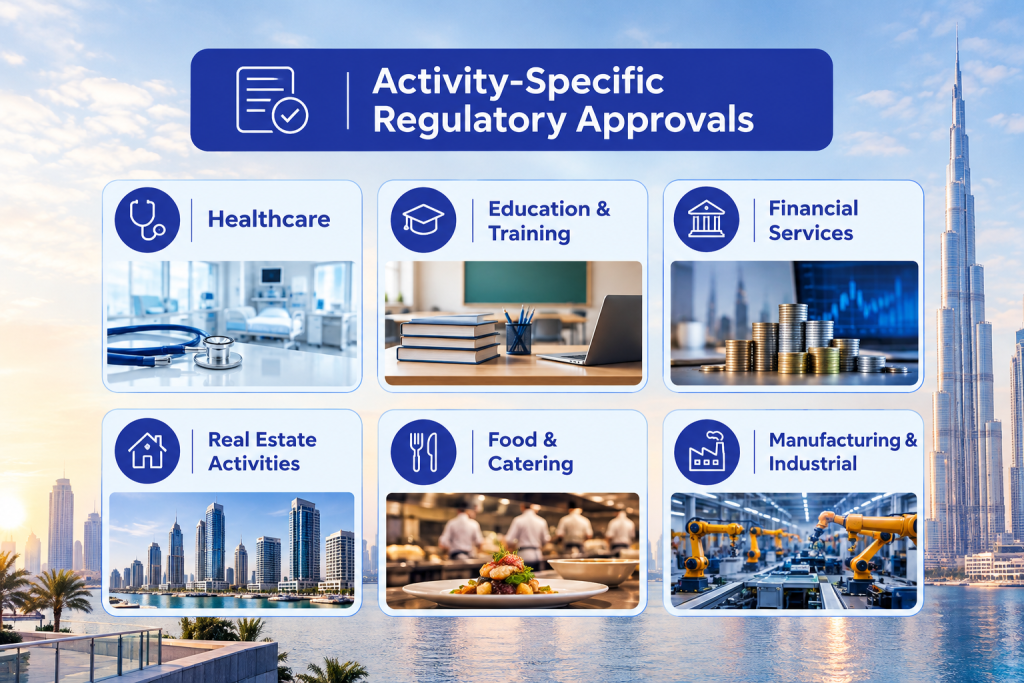
- Healthcare: Approval from the Dubai Health Authority (DHA).
- Education & Training: Approval from the Knowledge and Human Development Authority (KHDA).
- Financial Services: Approval from the Central Bank of the UAE or Dubai Financial Services Authority (DFSA).
- Real Estate Activities: Approval from the Real Estate Regulatory Authority (RERA).
- Food & Catering: Approvals from Dubai Municipality and Sector Safety Authorities.
- Manufacturing & Industrial: Approvals from the Ministry of Industry and Advanced Technology (MoIAT) and Environmental Authorities.
Requirements for Foreign & Corporate Shareholders
Foreign Individual Shareholders
In case of setting up a company by foreign investors, it is important that the foreign identification is clearly defined. Passports should have sufficient validity, and proof of an international residential address is mandatory.
Corporate Shareholders (Parent Companies)
In case of a company being owned by a foreign company or local corporate body as shareholders, then the foreign company will have to provide:
- Certificate of Incorporation or Trade Licence of the parent entity.
- Memorandum & Articles of Association (MOA/AOA) of the foreign entity.
- Board Resolution authorizing the establishment of the Dubai subsidiary and appointing a legal representative.
- Certificate of Good Standing (or equivalent official registry extract).
- Ultimate Beneficial Owner (UBO) Declaration: Full ownership tree details down to individual natural persons.
- Power of Attorney (POA) in favor of the authorized signatory.
Legalisation and Attestation
All foreign corporate documents need to pass through several stages of the legalisation process as follows:
- Notarisation of documents in the country of issuance.
- Attestation of documents by MOFA (Ministry of Foreign Affairs) in the home country.
- Attestation of documents by the UAE Embassy in the home country.
- Attestation of documents by MOFA UAE.
The Step-by-Step Business Registration Workflow
- Select Business Activity: Choose activities from the official DET or Free Zone activity list.
- Choose Jurisdiction & Structure: Select Mainland, Free Zone, or Offshore LLC/Branch.
- Reserve Trade Name: Submit proposed names for validation against UAE naming conventions.
- Submit Initial Application: File identification copies and basic details for preliminary security clearance.
- Draft & Legalize Paperwork: Sign the electronic MOA/AOA or notarized agreements.
- Obtain Third-Party Approvals: Secure required sector-specific clearances.
- Secure Physical Facility: Register Ejari for Mainland or secure a flexi-desk lease for Free Zones.
- Licence Issuance: Settle licensing fees to receive the official Trade Licence.
Post-Licence Documentation & Compliance Requirements
Step one involves securing the business license. To be legal, companies are required to undertake these compulsory processes after incorporation:
- Establishment Card (Immigration Card): Obtained from the General Directorate of Residency and Foreigners Affairs (GDRFA) to facilitate issuance of visas.
- Investor and Employee Visas: Need entry permits, medical fitness tests, Emirates ID Biometric test, and health insurance.
- Corporate Bank Account Opening: Financial institutions have strict customer due diligence processes and will require the trade license, MOA, Ejari, six months’ bank statements, and UBO documents.
- VAT Registration: Compulsory for those whose taxable supplies are above AED 375,000 (voluntary threshold at AED 187,500) through the Federal Tax Authority (FTA).
- Corporate Tax Registration: Compulsory for all business organizations in the UAE with corporate taxes having been introduced.
- UBO & Statutory Registers: Companies need to keep updated registers and corporate files according to Anti-Money Laundering (AML) rules.
Master Setup Checklist
Pre-Incorporation Checklist
- Passport copies (valid for 6+ months)
- 3 Proposed trade name options
- Business activity selection & detailed description
- Completed setup application form
- Drafted Memorandum of Association (MOA)
- Business plan (if required by jurisdiction)
- Lease agreement (Ejari or Free Zone facility contract)
- External regulatory pre-approvals (if applicable)
- Attestation of foreign corporate documents (for corporate shareholders)
Post-Incorporation Checklist
- Establishment Card copy
- Investor/Employee Visa and Emirates ID copies
- Corporate Bank Account details
- Federal Tax Authority TRN (Corporate Tax Registration)
- VAT Registration Certificate (if threshold met)
- Register of Ultimate Beneficial Owners (UBO)
How Arnifi Simplifies Dubai Business Setup
Finding your way through the huge number of documents needed for business setup in Dubai may prove to be challenging. Arnifi offers efficient corporate services aimed at avoiding mistakes and facilitating incorporation:
- Jurisdiction & Activity Mapping: Advice on the proper choice of incorporation (Mainland or Free Zone depending on your activities).
- End-to-End Document Execution: Preparation of MOA documents, their translation, and MOFA attestation.
- Licensing & Regulatory Approvals: Direct dealing with DET, Free Zones, and third-party ministries for prompt licensing.
- Post-Licence Support: Special help with obtaining Establishment Cards, Golden Investor Visas, and setting up corporate banking accounts.
Frequently Asked Questions (FAQs)
What documents are required for business setup in Dubai?
The primary documents required for business setup in Dubai include shareholder passport copies, proposed trade name details, a completed application form, an MOA/AOA, and an Ejari tenancy contract (or Free Zone facility allocation).
Can a foreigner set up a company in Dubai without a residence visa?
Yes. A foreign non-resident national is allowed to incorporate a business and hold 100% share capital using his international passport in the absence of a UAE residence visa.
Are the documents different for Mainland and Free Zone companies?
Yes. While a Mainland company needs an Ejari office contract registered with the Dubai Land Department and DET approvals, a Free Zone company requires an internal lease package (flexi desk) and a zone application form.
What documents are required for a corporate shareholder in Dubai?
Corporate shareholders must provide an attested Certificate of Incorporation, MOA/AOA, a Board Resolution authorizing investment, a Certificate of Good Standing, UBO disclosures, and a Power of Attorney.
Do foreign-issued documents need attestation?
Yes. Foreign company documents or certificates should be certified in the respective foreign country first, and then attested by the Home Ministry of Foreign Affairs, the UAE Embassy, and the UAE Ministry of Foreign Affairs.
Is a business plan mandatory for company formation in Dubai?
No. Although a business plan is not required for basic Mainland business activities, Free Zones such as DMCC and DIFC and specialized industries do need a formal business plan.
What documents are required after receiving a business licence?
Post-licence documentation includes the Establishment Card, investor/employee visa paperwork, Emirates IDs, corporate bank account setup files, VAT certificates, and Corporate Tax registration records.
Do regulated business activities require additional approvals?
Yes. Some business sectors include healthcare (DHA), education (KHDA), financial services (DFSA/Central Bank), and real estate (RERA). Third-party approvals need to be obtained before issuing the license.
What are the UBO documentation requirements for Dubai companies?
Organizations have to maintain an Ultimate Beneficial Owner (UBO) list for the individuals who own more than 25 percent of the shares or votes.
What documents are required to open a corporate bank account in Dubai?
Banks require the Trade Licence, MOA/AOA, Establishment Card, shareholder passport copies, Emirates ID/visa copies, proof of address, 6-month personal or corporate bank statements, and customer supplier contracts.
Conclusion
Being aware of all the documentation that you need for the incorporation process of your business in Dubai will help you have a trouble-free process of business incorporation without any delays. Finding out your jurisdiction in advance, obtaining any third-party approvals, and completing post-incorporation formalities like tax registration will ensure your business will have a good legal standing right from the beginning.
References
Top UAE Packages
Related Articles
BVI vs Cayman Company Formation (2026) | Entity Ty...
Key Fact Both jurisdictions provide English common law frameworks for international business. BVI offers cost-efficient corporate management for private asset...


Top UAE Packages
Get in Touch
