
Business Setup Cost in Dubai: A Comprehensive Budgeting Guide

Zahira Shaik
SEO Content Writer
Zahira Shaik is an SEO Content Writer and Published Author specializing in research-based content. She excels at analyzing market trends, regulations, and industry developments… Read more

Tulika Saxena
AVP, Sales & Marketing | IIM Nagpur
Tulika Saxena specializes in business finance, sales strategy, and market positioning. Leads growth and partnerships, ensuring seamless business setup experiences and client success across… Read more


Introduction
Setting up a business in Dubai is perhaps one of the most strategic decisions any entrepreneur or multinational corporation can make. Nevertheless, one of the biggest challenges that most founders will have to face during early-stage planning will be the actual business setup costs in Dubai.
Most agency services offer low-cost base licenses ranging from ~AED 5,000 to AED 12,000. While this may be accurate for a base-level license, it does not necessarily represent the total amount of money needed to get a business up and running.
In terms of total budget for the first year, there are several different layers of expenses involved:
- Quotas and Visa Processing
- Office space / Flexi-desks
- External Regulatory Approvals
- Banking
This comprehensive guide covers all the financial implications behind starting a business in Dubai. In addition to setup costs, we will take a look at structural differences between costs per jurisdiction, unexpected operational costs, upcoming 2026-2027 compliance obligations like E-Invoicing, and cost-saving solutions.
Why Dubai Is an Attractive Business Destination
Dubai is still attracting international entrepreneurs, investors, and business organisations as a result of its forward-thinking economic policies and infrastructure that is not equalled elsewhere.
- Strong Economy: A healthy and diverse economy, powered by a healthy property market, trade, tourism, and technology industry.
- Supportive Business Regulations: Simplified government procedures aimed at attracting foreign direct investment (FDI).
- Competitive Tax Advantages: Tax structures strategically planned, featuring no personal income tax, low corporate taxes, and tax exemptions in certain areas.
- 100% Foreign Ownership Opportunities: Complete freedom of foreign ownership, possible in Dubai’s Free Zones and most businesses on the Mainland, without the need for an Emirati partner.
- World-Class Infrastructure & Connectivity: State-of-the-art infrastructure (Dubai International Airport, Jebel Ali Port) allowing companies to connect to the rest of the world (Europe, Asia, and Africa).
Practical Context: What Determines Your Final Budget?
Despite the fact that Dubai itself is already a business-oriented environment, the cost of starting a business depends greatly on many aspects. There is no such thing as a standard amount of money needed to establish an organization. This budget depends on:
- Business Activity: Typical business operations versus regulated industries (healthcare, finance, education, etc.)
- Jurisdiction Selection: Mainland, Free Zone, or Offshore.
- Office Requirements: Virtual flexi-desk or real office space.
- Visa Quotas: Investor visa, partner visa, and employment visa.
- Long-Term Operational Plans: Operating in the UAE market or abroad only.
What Is Included in the Business Setup Cost in Dubai?
Expanding businesses usually make the error of taking the advertised license fee to be the true first-year set-up fee.
Advertised License Price ≠ Total First-Year Setup Cost
The advertised package includes just the initial registration and state licensing costs. Actual setup demands consideration of budget in relation to five essential expenditure categories:
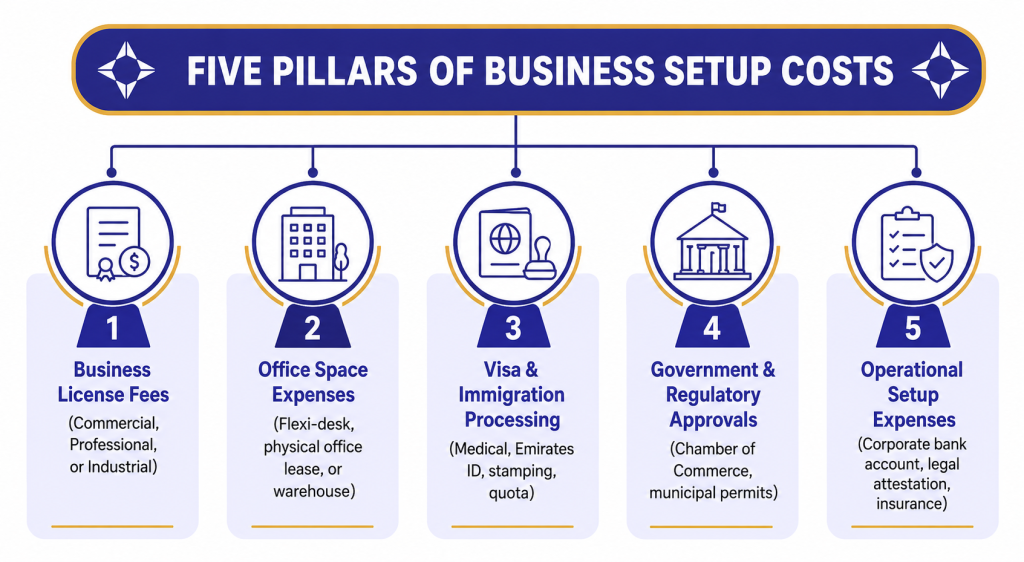
Note on Cost Budgeting: You should always work out your Total Cost of Operation (TCO) in Year 1 and not go by the advertised price of a formation package.
Business Setup Cost in Dubai: Mainland vs. Free Zone vs. Offshore
Choosing the correct jurisdiction is the most impactful financial and operational decision you will make.
Quick Jurisdiction Comparison
Here is the comparison table summarizing the setup costs for Mainland, Free Zone, and Offshore companies in Dubai:
| Entity Type | Regulating Authority | Major Cost Component | Estimated Cost Range (AED) |
| Mainland Company | Dubai Department of Economy and Tourism (DET) | Trade License Fee | ~10,000 to ~50,000 (Varies by Professional, Commercial, or Industrial license) |
| Office Space Rent | ~15,000 to ~100,000+ (Annual) | ||
| Visa Costs | ~3,000 to ~6,000 (Per individual) | ||
| Govt. & Registration Fees | ~10,000 to ~20,000 | ||
| Free Zone Company | Specific Free Zone Authorities (e.g., IFZA, DAFZA, DMCC, Fujairah) | License & Registration Fees | ~5,000 to ~20,000 |
| Office Space / Workspace | ~10,000 to ~50,000 | ||
| Visa Fees | ~3,000 to ~5,000 (Per visa) | ||
| Offshore Company | Offshore Registries (e.g., JAFZA Offshore, RAK ICC) | Initial Registration Cost | ~5,000 to ~15,000 |
| Annual Renewal Cost | ~3,000 to ~10,000 |
Which Dubai Business Jurisdiction Is the Cheapest?
There is no such thing as the cheapest for all businesses. Financial feasibility would entirely depend on the needs of the business operation:
- For Solopreneurs & Remote Businesses: A Free Zone license coupled with a flexi-desk or virtual office gives the most affordable means of setting up a business.
- For Businesses Trading Locally in the UAE: The business has to set up under the Mainland structure. Although costly in its initial setup because of the need for office space, this allows full business freedom within the UAE market.
- For International Holding Companies: An Offshore company is the least expensive to run if there is no need for UAE-based operations or a residence visa.
Key Factors Affecting Business Setup Cost in Dubai
1. Nature of Business
The actual nature of the business operations is what defines your licensing system. There are usual fees for regular business transactions and consulting services. In highly regulated industries, you need to get approval from an external entity. This would increase costs and delays:
- Healthcare: Requires Dubai Health Authority (DHA) clearance.
- E-Commerce & Retail: Requires Telecommunications and Digital Government Regulatory Authority (TDRA) alignment or custom approvals.
- Web3, Crypto, & Financial Services: Requires Virtual Assets Regulatory Authority (VARA) or Central Bank approvals.
2. Office Selection
Commercial real estate costs vary widely across Dubai:
- Virtual Offices / Flexi-Desks: ~AED 5,000 to AED 12,000/year (ideal for startups).
- Shared Workspaces: ~AED 12,000 to AED 25,000/year.
- Private Executive Offices (e.g., Business Bay, Downtown, DIFC): ~AED 40,000 – AED 150,000+/year.
3. Number of Visas Required
Every residence visa incurs direct government processing and medical check fees:
- Investor / Partner Visas: Mandatory for company owners seeking UAE residency.
- Employee Visas: Scaled according to headcount requirements.
- Dependent Visas: For family members sponsored by the business owner.
4. Regulatory Approvals & Government Permissions
In addition to primary licensing fees, businesses must budget for secondary permissions:
- Dubai Municipality clearances (sanitation, safety, land use).
- Sector-specific security approvals or approvals from the Ministry of Economy.
- Document attestation and legal translation services.
5. Corporate Banking Requirements
Opening a business bank account in the UAE involves stringent Anti-Money Laundering (AML) and Know Your Customer (KYC) compliance reviews. Potential financial factors include:
- Minimum Balance Requirements: Ranging from AED 20,000 to AED 200,000+ depending on the banking tier.
- Account Maintenance Fees: Monthly maintenance or transaction charges.
- Compliance Review Delays: Administrative costs associated with complex corporate structuring paperwork.
How to Plan Your Business Setup Budget Before Registration
This systematic process will help avoid any sudden lack of funds at the time of business launch:
Step 1: Identify Business Activity & Scope
Establish your unique business activities. Your business activities will have an influence on your licensing category and its cost.
Step 2: Determine Target Market
Make sure you understand whether you are targeting the local UAE market or you will be operating internationally.
Step 3: Select Jurisdiction
Pick your location of incorporation: the Mainland, the Free Zone, or the Offshore jurisdiction.
Step 4: Calculate Base License & Registration Fees
Summarize the base license and company registration expenses – the trade name reservation, approvals, MoA drafting, and state licensing.
Step 5: Factor in Office Space & Visa Allocations
Include office space leasing expenses depending on what kind of office lease it is and visa expenses related to medical exam, Emirates ID, visa stamping, and quota limitations.
Step 6: Account for Third-Party Regulatory Approvals
Consider any additional permit fees in case you need special regulatory approval from the government of the UAE.
Step 7: Budget for Banking Compliance & Operational Reserves
Consider minimum balances and bank maintenance fees, and also company document attestation costs.
Step 8: Plan for Year 2 Renewals, E-Invoicing & Compliance
Plan for recurring annual license renewal, Corporate Tax, and compliance with E-Invoicing digital software.
Step 9: Consolidate into Total First-Year Operating Budget
Add all startup costs with 10% – 15% contingency to calculate total budget for Year 1 operation.
How Arni AI Can Help Plan Business Setup Costs and Risks
Manual company registration usually results in unnecessary costs, errors in legal documents, rework on the legal process, and bank refusal. Arni AI offers AI-powered corporate tools that simplify the expansion process and reduce related risks:
- Organogram: Illustrates complicated multi-entity ownership structures and parent/subsidiary connections when planning strategically.
- AML Checker: Performs early pre-screening of compliance risks in order to identify them prior to filing a corporate bank application.
- Docs: Helps draft and structure all legal paperwork, Articles of Association (MoA), and board resolutions in order not to be rejected upon submission.
- Assistant: Provides real-time advisory on business formation in the UAE, its activity permissions, and laws.
- Calculator: Calculates costs of business registration under different scenarios for Mainland and Free Zones.
How to Reduce Business Setup Costs in Dubai
Effective structuring can help businesses maximize their budgets when launching their operations:
- Select the Right Free Zone: Align yourself with the appropriate free zone that is specialized in your business to save extra costs.
- Utilize Bundled Setup Packages: Benefit from bundled packages including licensing services, flexi-desk facility, and visa processing.
- Opt for Virtual or Shared Workspaces: Make use of virtual or shared office space at the time of business launch instead of leasing commercial property.
- Leverage Government SME Incentives: See whether you are eligible for government incentives offered by some economic departments in the UAE or not.
- Avoid Over-Procuring Initial Allocations: There is no need for booking maximum visa allocations or office space initially as per the requirement of your business activities.
E-Invoicing Costs and Timelines for New Dubai Businesses
Budget planning for business setup needs to include future statutory compliance requirements. In the UAE, the Ministry of Finance is implementing an E-Invoicing system in a mandatory manner.
E-Invoicing Rollout Roadmap
- Phased Implementation (2026): Technical infrastructure development, reporting standards, and integration guidelines.
- Mandatory Obligations (2027): Mandatory integration through B2B and B2G transactions following a centralized 5-corner model.
Associated Compliance Costs
In new business setups, such digital compliance requirements need to be planned in the mid-term budgets of the organizations:
- Integration with accounting/ERP solutions that comply with the requirements of E-invoicing.
- Integration fees with certified E-Invoicing Service Providers (EISPs).
- Training costs and compliance record-keeping.
The Ongoing Costs of Running a Dubai Company
To run a Dubai company, you have to spend money on top of the initial set-up cost to maintain its existence legally and ensure business continuity:
- License Renewal Fees: Annual payments required by the Department of Economy and Tourism (DET) or the relevant free zone body for renewal of your trade license.
- Commercial Office Lease Renewals: Annual rent payments for your office or flexi desk space, as well as any associated Ejari updates and utility maintenance costs.
- Residence Visa Renewals: Government, medical examination, and Emirates ID costs paid once every 2-3 years for your residence visa renewal.
- Corporate Banking Fees: Regular monthly payments needed for bank account maintenance and keeping your business account balance at a required level.
- Mandatory Health Insurance Coverage: Legally mandated health insurance plans in the UAE for all company visa holders and their dependents.
- Statutory Auditing & Tax Filing Fees: Regular professional costs associated with accounting services, annual auditing, Corporate Tax filing, and VAT compliance.
Can You Operate Without Setting Up a Full Entity?
Establishing a traditional company is not necessarily the most expedient course of action, particularly for those gauging market interest or sourcing remote workers from the UAE.
Arnifi HR & Entity-as-a-Service (EaaS)
For businesses looking for expedient market entry without making lengthy legal arrangements, Arnifi HR and Entity-as-a-Service provide a more nimble solution:
- Employer of Record (EOR): Source, recruit, and manage local talent through UAE labor regulations without having your own business in place.
- Market Entry Validation: Conduct sales campaigns in a trial run and conduct product tests in-country before investing in establishment.
- Risk Reduction: Avoid paying immediate years-long rental fees on offices and entity management fees.
How Global Compliance Costs Affect Your Business Budget
For organizations that are growing, being in Dubai is usually part of a larger multi-region strategy. Multi-jurisdiction compliance is very cumbersome, complex, and results in wastage of money.
Managing Multi-Jurisdiction Compliance
Poorly coordinated compliance will result in late filings, surprise corporate fines, and redundant service charges. By adopting a central mechanism for handling compliance requirements, organizations can be able to handle their main compliance requirements well.
Unified compliance helps in monitoring all the renewals, statutory audits, tax filings, and management of legal documents.
Business Setup Cost: One-Time vs. Long-Term Expenses
| Expense Category | One-Time Initial Setup Costs | Recurring Long-Term Costs |
| Licensing & Registration | Initial name reservation, trade license issuance, MoA registration | Annual trade license renewals, activity amendment fees |
| Real Estate & Workplace | Initial office deposit, lease setup, Ejari registration | Annual rent, utility bills, municipality housing fees |
| Immigration & Visas | Establishment card, entry permits, medical checks, Emirates ID | Visa renewals (every 2–3 years), quota updates |
| Banking & Finance | Initial account setup, corporate document attestations | Monthly maintenance charges, minimum balance reserves |
| Tax & Compliance | Initial VAT/Tax registration, system integration | Annual financial audits, corporate tax filings, E-invoicing software |
Business Setup Cost Calculator: What Should You Include?
When using a setup cost calculator or building a financial model, ensure your inputs include all operational variables:
Total Setup Budget = License + Office Lease + Visas + Approvals + Banking Reserves + Year 1 Compliance
Essential Inputs for an Accurate Projection
- Target Jurisdiction: Mainland, Free Zone, or Offshore.
- Specific Business Activity: General commercial vs. specialized/regulated.
- Visa Allocations: Number of investor and employee visas required.
- Facility Preferences: Virtual desk vs. physical office lease.
- Government Approvals: Estimated third-party permissions.
- Year 1 Recurring Reserve: 10%-15% buffer for ongoing compliance and administrative costs.
Frequently Asked Questions
How much does it cost to start a business in Dubai?
Basic Free Zone structure with virtual offices will cost you between AED 5,000 and AED 15,000. A Mainland setup with a physical office and visa will cost you between AED 35,000 and AED 90,000+ per year.
What is the cheapest business setup option in Dubai?
Setting up a Free Zone license along with a virtual office or flexi-desk in a Free Zone like Fujairah Creative City or IFZA would be your most economical option, assuming that your business will not have to work onshore in the UAE.
Is Mainland or Free Zone cheaper in Dubai?
Free Zones are usually more economical as they have virtual office options and do not require a commercial lease. The downside is that you will have restricted access to the local UAE market as opposed to Mainland companies.
Do I need a physical office to start a company in Dubai?
It depends. Some Free Zones provide legal flexi-desk or virtual office services. But there is an obligatory requirement for the existence of a physical office for Mainland and some regulated sectors.
Can I start a Dubai business with AED 5,000?
AED 5,000 will be sufficient to pay only for license registration at certain Free Zones. It will not pay for the procedure of issuing visas, medical checks, Emirates ID, office, or other requirements of a corporate bank.
What are the hidden costs of business setup in Dubai?
Hidden costs might be: document attestation, translation into Arabic, Dubai Municipality fee (5% of office rental), bank account management, VAT registration, and compliance requirements.
Can I hire employees in Dubai without setting up a full company?
Yes. You can use an Employer of Record or Entity-as-a-Service model through such companies as Arnifi HR for hiring and sponsoring your employees in the UAE without opening a company.
Conclusion
To understand the real business formation cost in Dubai, one needs to move past just the advertised low-cost entry license to consider the total Year 1 cost, which takes into account registration fees, along with operation costs, office costs, visa requirements, third-party permissions, compliance with the corporate bank, and renewal for the year. It is vital to align the right jurisdiction with your operational strategy and choose a Free Zone if you want low-cost and international business, or choose a Mainland structure to go directly into the UAE local market. Companies need to get ready for statutory digital reporting obligations, such as Corporate Tax and mandatory E-Invoicing, and use modern tools, such as Arni AI for auto-documentation, AML pre-screening, and cost calculation. Lastly, if you are doing test-market entry or hiring locally prior to committing to the UAE, it makes sense to assess alternative market-entry strategies such as Entity-as-a-Service.
Credible Resources & Governing Authorities
For official guidelines, regulatory frameworks, and statutory compliance updates, consult these official UAE authority portals:
Top UAE Packages
Related Articles
BVI vs Cayman Company Formation (2026) | Entity Ty...
Key Fact Both jurisdictions provide English common law frameworks for international business. BVI offers cost-efficient corporate management for private asset...


Top UAE Packages
Get in Touch
