
Cayman Venture Capital Fund Setup | Cayman Venture Capital Fund Guide

Anushka
Content Writer
Anushka Basu is a business content writer specialised in global business market insights. She aims to simplify complex regulatory, financial, and business concepts into… Read more

Tulika Saxena
AVP, Sales & Marketing | IIM Nagpur
Tulika Saxena specializes in business finance, sales strategy, and market positioning. Leads growth and partnerships, ensuring seamless business setup experiences and client success across… Read more


Key Fact: A Cayman venture capital fund may fall within the Private Funds Act if it pools investor funds for investment and meets the statutory definition of a private fund. The structure should therefore be assessed alongside CIMA registration, fund documentation, governance and ongoing compliance requirements.
Table of contents
- What is a Cayman venture capital fund?
- Why set up a venture capital fund in the Cayman Islands?
- What Cayman structure is commonly used for venture capital funds?
- Does a Cayman venture capital fund need CIMA registration?
- How do you set up a Cayman venture capital fund?
- What documents are required for a Cayman VC fund?
- What service providers does a Cayman venture capital fund need?
- What are the ongoing compliance requirements?
- What are the cost categories when setting up a Cayman venture capital fund?
- How long does Cayman VC fund setup take?
- How is a Cayman venture capital fund taxed?
- What are the common mistakes in Cayman VC fund setup?
- How can Arnifi help with Cayman VC fund setup?
- FAQs
- Conclusion
What is a Cayman venture capital fund?
A Cayman venture capital fund pools capital from investors and uses that capital to invest in startups, early-stage businesses and growth companies. Investors typically participate through partnership interests, shares or other investment interests, while the fund’s investment strategy determines how capital is deployed.
A typical structure separates the fund vehicle from the entities and professionals responsible for managing it. Limited partners provide capital, while the general partner oversees the fund’s partnership-level responsibilities and an investment manager may make or advise on investment decisions.
The portfolio companies are separate from the fund. The fund owns or acquires interests in those businesses; the businesses themselves do not become part of the Cayman fund entity.
Venture capital funds are also commonly structured as closed-ended vehicles, meaning investors generally commit capital for a defined investment period rather than receiving routine redemption rights.
Why set up a venture capital fund in the Cayman Islands?
Cayman is an established international investment-fund jurisdiction with a developed network of fund administrators, auditors, legal advisers and corporate service providers. Its legal framework also supports several structures that can be adapted to different investment strategies and investor requirements.
Private-fund activity remains significant in the jurisdiction. CIMA’s 2026 statistics reported more than 18,000 registered private funds by the end of the first half of 2026.
The attraction of Cayman should, however, be considered in terms of legal infrastructure, investor familiarity and operational support rather than assuming that establishing a fund there removes tax obligations in other countries. Investor and portfolio-company taxation can still arise in the relevant jurisdictions.
What Cayman structure is commonly used for venture capital funds?
Several structures can be considered when establishing a Cayman venture capital fund:
| Structure | Main characteristics | Potential use |
| Exempted Limited Partnership (ELP) | General partner and limited partners | Common for private investment and venture capital strategies |
| Exempted company | Corporate entity with shareholders | May suit strategies requiring a corporate structure |
| Segregated Portfolio Company (SPC) | Separate segregated portfolios within one company | Useful where legally segregated portfolios are required |
| Master-feeder | Master fund with one or more feeder vehicles | Can accommodate different investor groups or access requirements |
An ELP is particularly relevant to venture capital because it can separate the general partner’s responsibilities from the limited partners’ economic interests.
The appropriate structure depends on the investment strategy, investor base, target jurisdictions and operational requirements.
Does a Cayman venture capital fund need CIMA registration?
The Cayman Private Funds Act applies to qualifying private funds. The statutory definition generally covers a company, unit trust or partnership that issues investment interests and pools investor funds to enable investors to participate in profits or gains from investments, where investors do not have day-to-day control and the investments are managed as a whole by or on behalf of the fund’s operator.
This means a venture capital fund should be assessed against the statutory definition rather than assuming that every Cayman investment vehicle automatically has the same regulatory treatment.
For a qualifying private fund, registration with CIMA is required. The registration application is submitted electronically through CIMA’s REEFS platform.
The distinction between incorporation and registration is important. A Cayman entity can be legally incorporated without that step alone completing the fund’s regulatory requirements.
How do you set up a Cayman venture capital fund?
A typical Cayman venture capital fund setup involves the following stages:
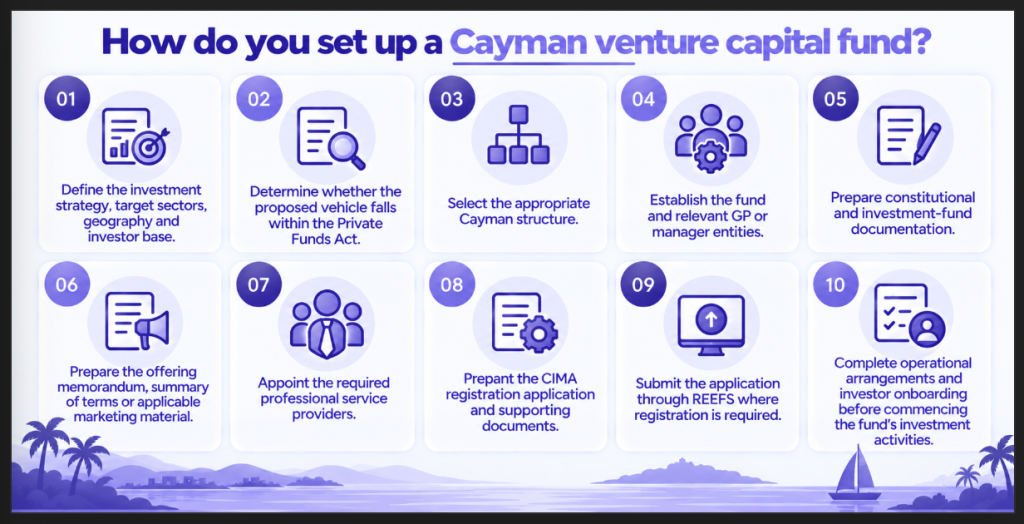
For a fund required to register, the legislation provides a 21-day registration window following acceptance of capital commitments, subject to the applicable statutory requirements. A fund required to register must also comply with the relevant requirements before accepting capital contributions for investments.
What documents are required for a Cayman VC fund?
CIMA’s private-fund registration requirements include the following, depending on the structure:
- REEFS application
- Certificate of incorporation, registration or formation
- Constitutional documents, such as memorandum and articles or partnership documentation
- Offering memorandum, summary of terms or applicable marketing material
- Auditor’s letter of consent
- Fund administrator’s letter of consent, where applicable
- Structure chart
- Applicable registration and filing fees
The structure chart may need to identify the fund, GP, investment management company, trustee, special-purpose entities, alternative investment vehicles and master-feeder relationships where relevant.
The fund documentation should also clearly describe the investment strategy, operators, investment manager or adviser, valuation arrangements, service providers, risks, conflicts of interest, accounting principles and AML measures.
What service providers does a Cayman venture capital fund need?
The exact appointments depend on the fund structure and applicable requirements, but the operating framework may include:
- General partner
- Investment manager or investment adviser
- Fund administrator
- Cayman auditor
- Cayman legal counsel
- Registered-office or corporate-services provider
- Registrar and transfer agent, where applicable
- Valuation or NAV calculation provider, where applicable
- AML/KYC and investor due diligence support
- Custodian or other asset-related service providers where appropriate
CIMA’s current registration materials specifically identify roles such as the auditor, administrator, registrar and transfer agent and NAV calculation agent within the registration process.
What are the ongoing compliance requirements?
Registration is only one part of running a Cayman venture capital fund. Ongoing requirements can include:
- Annual audited financial statements
- Fund Annual Return (FAR)
- CIMA regulatory filings through REEFS
- Accounting and fund records
- Investor and ownership records
- Appropriate valuation procedures
- Safekeeping of fund assets
- Cash monitoring
- AML/CFT and investor due diligence
- Regulatory notifications for relevant changes
- Governance and oversight of appointed service providers
The Private Funds Act requires asset valuations at least annually, subject to the statutory framework and applicable valuation arrangements. It also addresses safekeeping and cash monitoring.
CIMA requires regulated private funds to submit audited financial accounts and the Fund Annual Return within six months of the fund’s financial year-end.
What are the cost categories when setting up a Cayman venture capital fund?
The total cost depends on the structure, fund size, number of investors, documentation, service providers and complexity of the investment strategy.
Typical cost categories include:
| Cost category | What it may cover |
| Entity formation | Fund, GP and related entities |
| CIMA fees | Registration, annual fees and applicable sub-fund/AIV fees |
| Legal | Fund documents, structuring and regulatory advice |
| Administration | Investor records, accounting and fund administration |
| Audit | Annual audit and related reporting |
| Corporate services | Registered office and corporate administration |
| Compliance | AML/KYC, reporting and regulatory support |
| Operations | Banking, technology and other fund expenses |
CIMA’s fee framework changed from 1 January 2026. The annual fee for registered private funds increased to US$5,030.49, while the non-refundable registration application fee is also US$5,030.49; additional fees can apply to sub-funds or AIVs.
Professional and operational costs are separate from these regulatory fees.
How long does Cayman VC fund setup take?
There is no single timeline that applies to every Cayman venture capital fund.
The process can involve strategy and structural planning, entity formation, preparation of fund documentation, service-provider onboarding, CIMA registration and investor onboarding.
Timing may be affected by:
- Complexity of the fund structure
- Number and type of investors
- Documentation readiness
- Service-provider onboarding
- Regulatory information requirements
- Fitness and propriety considerations
- Whether master-feeder, SPC or other additional structures are involved
CIMA notes that incomplete documentation and adverse findings can affect registration processing.
How is a Cayman venture capital fund taxed?
The Cayman Islands uses an indirect, consumption-based taxation model and does not generally impose an additional layer of Cayman Islands income tax on investment funds in the manner described by the Cayman Government’s financial-services framework.
However, this should not be interpreted as meaning that investors or portfolio companies are automatically tax-free.
Tax consequences may arise in:
- The investor’s country of residence
- Countries where portfolio companies operate
- Countries where investments generate income
- Jurisdictions involved in management or investment activities
Cross-border tax advice is therefore important when establishing the fund, particularly where investors and portfolio companies are located in different jurisdictions.
What are the common mistakes in Cayman VC fund setup?
Common issues include:
- Selecting a structure before defining the investment strategy
- Treating incorporation as the entire fund setup
- Failing to assess Private Funds Act applicability
- Delaying CIMA registration planning
- Submitting incomplete or inconsistent documents
- Failing to coordinate the GP, manager and fund entities
- Underestimating annual audit and reporting obligations
- Weak investor KYC/AML processes
- Not establishing appropriate valuation and cash-monitoring procedures
- Failing to maintain accurate regulatory and accounting records
CIMA specifically identifies incomplete attachments, inconsistent fund information and issues concerning an investment manager’s regulatory status among potential causes of registration problems.
How can Arnifi help with Cayman VC fund setup?
Arnifi can support international founders and fund managers with Cayman venture capital fund structuring and setup coordination. This can include assistance with entity formation, CIMA registration requirements, fund documentation coordination and professional service-provider appointments.
Support can also extend to accounting, compliance and ongoing administrative requirements, helping coordinate the different components of the fund structure from initial planning through ongoing operations.
FAQs
What is a Cayman venture capital fund?
A Cayman venture capital fund pools investor capital to invest in startups, growth companies or other venture investments.
Why do venture capital funds use Cayman structures?
Cayman offers established fund infrastructure, flexible legal structures and an extensive ecosystem of professional fund-service providers.
What is the most common Cayman structure for a VC fund?
An Exempted Limited Partnership is commonly considered for private investment structures, although suitability depends on the fund’s circumstances.
Does a Cayman venture capital fund need CIMA registration?
A fund that meets the statutory definition of a private fund generally needs to register with CIMA under the Private Funds Act.
What documents are required to register a Cayman VC fund?
Typical documents include constitutional documents, offering materials, an auditor’s consent, applicable administrator consent and a structure chart.
How much does it cost to set up a Cayman venture capital fund?
Costs depend on structure, fund size, professional fees, service providers, CIMA fees and ongoing operating requirements.
How long does Cayman VC fund setup take?
Timing varies according to structure, documentation, service-provider onboarding, investor requirements and CIMA processing.
What are the ongoing compliance requirements for a Cayman VC fund?
They can include annual audit, FAR filing, valuation, cash monitoring, asset safekeeping, AML/KYC and regulatory updates.
What is the role of a Cayman general partner?
The general partner typically performs the partnership-level management and governance functions assigned to it under the fund documents.
Is a Cayman venture capital fund tax neutral?
Cayman generally does not impose an additional layer of income tax on investment funds, but investor and portfolio-company tax obligations can arise elsewhere.
Conclusion
A Cayman venture capital fund can use structures such as an ELP, exempted company, SPC or master-feeder arrangement depending on its strategy and investor requirements. Establishing the fund involves more than incorporation: documentation, service providers, CIMA registration, governance and ongoing compliance all need to be coordinated. Proper planning can provide a structured framework for international fundraising and venture investments while meeting applicable Cayman requirements.
Official references
Top UAE Packages
Related Articles
Top UAE Packages
Get in Touch
