
Cayman Islands for Hedge Funds | Cayman Hedge Fund Jurisdiction Guide

Anushka
Content Writer
Anushka Basu is a business content writer specialised in global business market insights. She aims to simplify complex regulatory, financial, and business concepts into… Read more

Tulika Saxena
AVP, Sales & Marketing | IIM Nagpur
Tulika Saxena specializes in business finance, sales strategy, and market positioning. Leads growth and partnerships, ensuring seamless business setup experiences and client success across… Read more


Key Fact: Hedge funds established in the Cayman Islands commonly fall within the mutual fund framework, with CIMA regulating applicable funds under the Mutual Funds Act. The appropriate vehicle, registration category and ongoing obligations depend on the fund’s structure and circumstances.
Table of contents
- Why is Cayman a popular jurisdiction for hedge funds?
- What are the common Cayman hedge fund structures?
- How does a Cayman hedge fund structure work?
- Is a Cayman hedge fund regulated by CIMA?
- What is the difference between a Cayman mutual fund and private fund?
- How do you set up a Cayman hedge fund?
- What documents are required for a Cayman hedge fund?
- What service providers does a Cayman hedge fund need?
- What are the ongoing compliance requirements for Cayman hedge funds?
- What are the cost components to set up a Cayman hedge fund?
- How long does it take to set up a Cayman hedge fund?
- What are the benefits and considerations of a Cayman hedge fund?
- What are the common mistakes when setting up a Cayman hedge fund?
- How can Arnifi help?
- FAQs
- Conclusion
Why is Cayman a popular jurisdiction for hedge funds?
The Cayman Islands has an established investment-fund ecosystem supported by flexible legal vehicles, specialist service providers and a regulatory framework familiar to international fund managers and investors.
Cayman also offers company, partnership and trust structures that can accommodate different fund models. The jurisdiction has a large network of fund administrators, auditors, legal advisers, corporate-service providers and other professionals supporting investment funds.
The Cayman tax framework is another consideration when structuring an international fund. However, Cayman-level tax treatment should not be confused with the tax position of investors, managers or portfolio investments in other jurisdictions.
For an international hedge fund, the decision therefore involves more than choosing a jurisdiction. The fund vehicle, investor requirements, regulatory category, service providers and cross-border tax considerations need to work together.
What are the common Cayman hedge fund structures?
Cayman provides several vehicles for investment funds, including the exempted company, segregated portfolio company, unit trust and exempted limited partnership.
Exempted company
An exempted company can issue shares to investors and can operate as an open-ended corporate fund where its shares are redeemable or repurchasable.
This structure can be suitable for hedge funds where investors require regular subscription and redemption arrangements.
Segregated portfolio company
A Segregated Portfolio Company (SPC) allows multiple segregated portfolios to operate within one legal entity. Each portfolio can be used for a different strategy or investor grouping, subject to the applicable legal requirements.
The SPC structure can therefore provide a way to separate assets and liabilities between portfolios while maintaining a common corporate framework.
Exempted limited partnership
An Exempted Limited Partnership (ELP) has a general partner and limited partners. It is particularly associated with private equity and other closed-ended structures, although its suitability depends on the proposed fund model.
For a conventional open-ended hedge fund, an exempted company may be more appropriate where the structure requires redeemable investor interests.
Unit trust
A unit trust is another available Cayman investment-fund vehicle. It may be considered where a trust-based structure aligns with the fund’s legal, investor or jurisdictional requirements.
How does a Cayman hedge fund structure work?
A typical arrangement can involve several separate parties:
Investors
↓
Cayman Hedge Fund
↓
Portfolio Investments
↑
Investment Manager / GP / Directors
↕
Administrator + Auditor + Custodian / Prime Broker
The exact structure depends on the vehicle selected.
The fund holds the investment interests, while the investment manager makes investment decisions under the applicable management arrangements. Directors, a general partner or other operator may have governance responsibilities depending on the structure.
The administrator supports accounting, NAV and investor administration. An auditor handles the annual audit, while a custodian or prime broker may provide asset custody, execution, financing or other services depending on the strategy.
The fund, investment manager and service providers therefore have distinct roles and should not be treated as one entity.
Is a Cayman hedge fund regulated by CIMA?
CIMA regulates Cayman investment funds under the applicable investment-fund legislation. Although Cayman legislation uses the term “mutual fund”, hedge funds commonly fall within this regulatory framework.
The Mutual Funds Act provides different regulatory routes, including:
| Fund category | General characteristics |
| Registered Fund | A common route for qualifying funds meeting the statutory requirements |
| Administered Fund | Operates with a CIMA-licensed mutual fund administrator providing the required principal office function |
| Licensed Fund | Subject to the licensing requirements under the Mutual Funds Act |
| Master Fund | A regulated master vehicle associated with regulated feeder-fund structures |
The appropriate category depends on the fund’s characteristics and applicable statutory requirements. CIMA provides separate application forms for registered, administered, licensed and master funds.
What is the difference between a Cayman mutual fund and private fund?
The Mutual Funds Act and Private Funds Act regulate different types of investment arrangements.
A hedge fund with redeemable investor interests will commonly be considered under the mutual-fund framework. A private fund is separately defined and regulated under the Private Funds Act.
The distinction should be assessed from the fund’s actual characteristics rather than simply its marketing description.
This matters because the registration process, ongoing reporting and regulatory obligations can differ between the two regimes. CIMA maintains separate registration processes and reporting forms for mutual funds and private funds.
How do you set up a Cayman hedge fund?
A typical setup process involves:
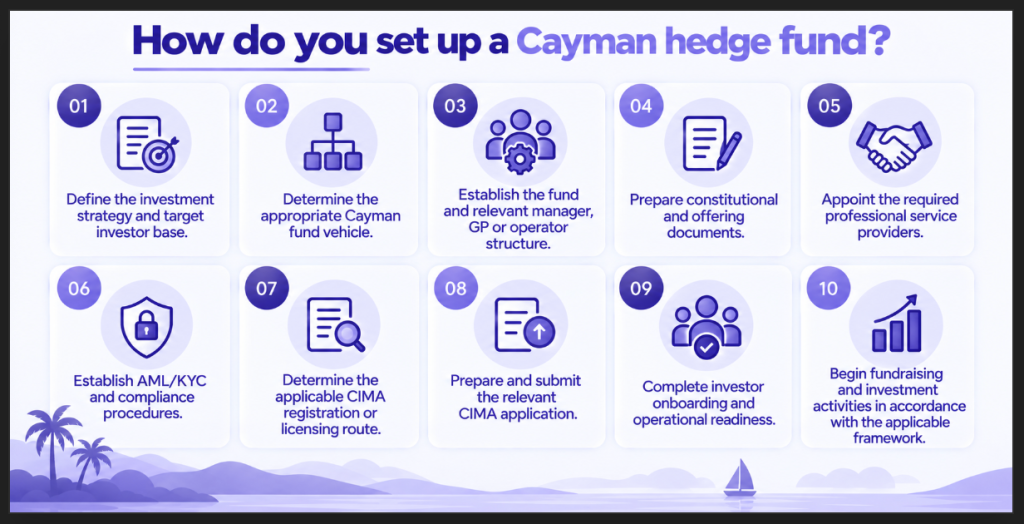
Incorporating the fund vehicle and completing its regulatory registration are separate steps. CIMA requires the relevant application, supporting documentation and prescribed fees before processing a mutual-fund registration or licence application.
What documents are required for a Cayman hedge fund?
The exact requirements depend on the fund category, but CIMA’s mutual-fund application process can require:
- Certificate of incorporation, registration or formation
- Memorandum and articles or applicable partnership/trust documents
- Offering document
- Auditor’s letter of consent
- Fund administrator’s letter of consent
- Applicable CIMA application form
- Structure and operator information
- MLRO application documentation
- Personal questionnaires and supporting information for applicable directors or operators
- Prescribed regulatory fees
CIMA provides the relevant mutual-fund application forms through its website and REEFS, including forms for registered, administered, licensed and master funds.
Applications are submitted electronically through CIMA’s REEFS system, subject to the applicable process.
What service providers does a Cayman hedge fund need?
The appointments depend on the fund’s structure, strategy and regulatory category.
Common providers include:
- Fund administrator
- Auditor
- Cayman registered office or corporate services provider
- Investment manager
- Legal adviser
- Custodian or prime broker, where applicable
- AML and compliance professionals
- Accounting and tax advisers, where required
The administrator and auditor play particularly important roles in supporting the fund’s regulatory and financial reporting infrastructure.
What are the ongoing compliance requirements for Cayman hedge funds?
Cayman hedge-fund compliance continues after registration.
Depending on the applicable framework, ongoing requirements can include:
- Annual regulatory filings
- Audited financial statements
- Fund Annual Return (FAR)
- Accounting and corporate recordkeeping
- Investor records and AML/KYC documentation
- NAV and valuation procedures
- Regulatory notifications
- Governance requirements
- Service-provider oversight
- CIMA reporting
CIMA’s current reporting framework requires regulated funds to submit the applicable annual reporting information through REEFS. Mutual-fund and private-fund reporting processes are maintained separately.
The operating calendar should therefore incorporate regulatory filing dates, audit work, investor reporting and other compliance obligations from the beginning.
What are the cost components to set up a Cayman hedge fund?
The total cost depends on the fund vehicle, regulatory category, investment strategy, service providers and operating complexity.
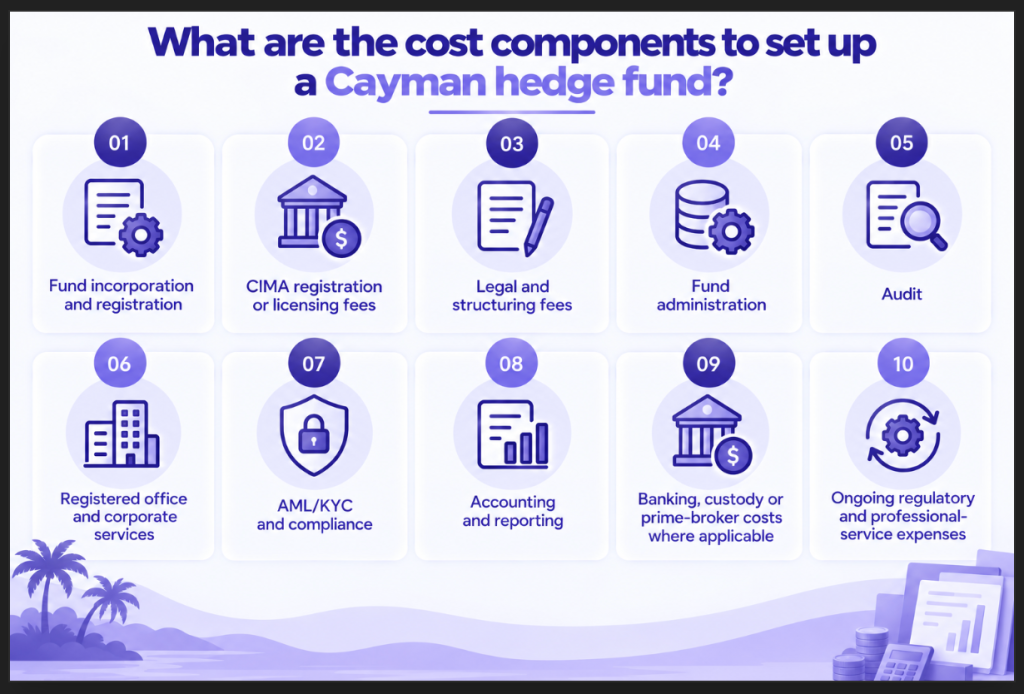
CIMA revised certain fees for regulated mutual funds and private funds effective 1 January 2026. The current annual fee for registered, administered and licensed mutual funds is CI$4,125, while the annual fee for master funds is CI$3,075. A registered mutual fund sub-fund attracts a separate CI$750 fee, and the applicable filing also carries a CI$300 administrative fee.
These are regulatory fees only and should not be treated as the total cost of establishing or operating a hedge fund.
How long does it take to set up a Cayman hedge fund?
No single setup timeframe applies to every Cayman hedge fund.
The timeline can depend on:
- Complexity of the investment strategy
- Choice of fund vehicle
- Preparation of constitutional and offering documents
- Availability of directors and other operators
- Service-provider onboarding
- CIMA application requirements
- AML/KYC readiness
- Investor onboarding
- Whether a master-feeder or multi-vehicle structure is involved
CIMA states that applications must be complete, including the required documentation and payments, before processing begins.
It is therefore more useful to treat the timeline as a project involving several workstreams rather than rely on a universal two-to-six-week estimate.
What are the benefits and considerations of a Cayman hedge fund?
A Cayman hedge fund structure can offer:
- Established investment-fund infrastructure
- Multiple legal-vehicle options
- Familiarity among international investors
- Access to specialist service providers
- A recognised regulatory framework
- Infrastructure for cross-border investment structures
Managers must also plan for:
- CIMA regulatory obligations
- Annual audit and reporting
- Professional-service costs
- AML/KYC requirements
- Investor reporting
- Governance and operational controls
- Cross-border tax and regulatory considerations
The advantages therefore need to be assessed alongside the fund’s specific operating requirements.
What are the common mistakes when setting up a Cayman hedge fund?
Several issues can create unnecessary delays or compliance problems:
- Choosing the vehicle before defining the investment strategy.
- Assuming every hedge fund follows the same CIMA registration route.
- Confusing the Mutual Funds Act with the Private Funds Act.
- Treating incorporation as the complete regulatory setup.
- Using outdated CIMA fees or application requirements.
- Preparing incomplete offering documentation.
- Delaying administrator or auditor appointments.
- Establishing weak AML/KYC procedures.
- Underestimating annual reporting and audit obligations.
- Failing to distinguish the fund from its investment manager.
How can Arnifi help?
Arnifi can support international fund managers with Cayman hedge-fund formation and operational setup, including:
- Cayman fund-structure planning
- Fund-vehicle selection
- Incorporation coordination
- CIMA registration support
- Fund documentation coordination
- Administrator and auditor coordination
- AML/KYC and compliance support
- Accounting and administrative support
- Ongoing regulatory and operational assistance
The appropriate support depends on the fund’s strategy, structure, investor base and regulatory requirements.
FAQs
Why are hedge funds set up in the Cayman Islands?
Cayman offers established fund infrastructure, flexible vehicles, specialist service providers and a regulatory framework used by international investment funds.
Are Cayman hedge funds regulated by CIMA?
Qualifying hedge funds commonly fall within CIMA’s mutual-fund regulatory framework, subject to the applicable statutory requirements.
What is the most common structure for a Cayman hedge fund?
An exempted company is commonly used for open-ended hedge-fund structures, although other permitted vehicles may be appropriate.
What is the difference between a Cayman mutual fund and private fund?
They are governed under separate regulatory frameworks, with the applicable regime depending on the fund’s characteristics.
What documents are required to set up a Cayman hedge fund?
Requirements vary, but can include constitutional documents, offering documents, service-provider consents, CIMA forms and supporting operator information.
How much does it cost to set up a Cayman hedge fund?
Costs vary according to the structure, regulatory category, service providers, strategy and operating complexity.
How long does Cayman hedge fund setup take?
There is no universal timeframe; documentation, service-provider onboarding, CIMA processing and fund complexity can affect the schedule.
What are the ongoing CIMA compliance requirements?
They can include annual returns, audited accounts, regulatory filings, recordkeeping, valuation and applicable AML/KYC requirements.
Does a Cayman hedge fund need a fund administrator?
The requirement depends on the regulatory category and structure. Certain mutual-fund categories specifically involve a CIMA-licensed administrator.
Are Cayman hedge funds tax neutral?
Cayman has a tax-neutral framework for many fund structures, but investors, managers and portfolio investments may have tax obligations elsewhere.
Conclusion
Cayman provides several legal vehicles and an established regulatory framework for international hedge funds. The appropriate structure depends on the investment strategy, investor base and operating model. Hedge funds commonly fall within the Mutual Funds Act framework, while private funds are regulated separately. Formation therefore involves more than incorporation: CIMA registration, documentation, service providers, AML/KYC, audit and ongoing reporting all need to be planned together.
Official references
Top Cayman Island Packages


Related Articles
BVI vs Cayman Company Formation (2026) | Entity Ty...
Key Fact Both jurisdictions provide English common law frameworks for international business. BVI offers cost-efficient corporate management for private asset...

Top Cayman Island Packages
Get in Touch