
Cayman Annual Return and Annual Government Fees | The 31 March / Anniversary Calendar
by Ishika Bhandari Jun 18, 2026  8 MIN READ


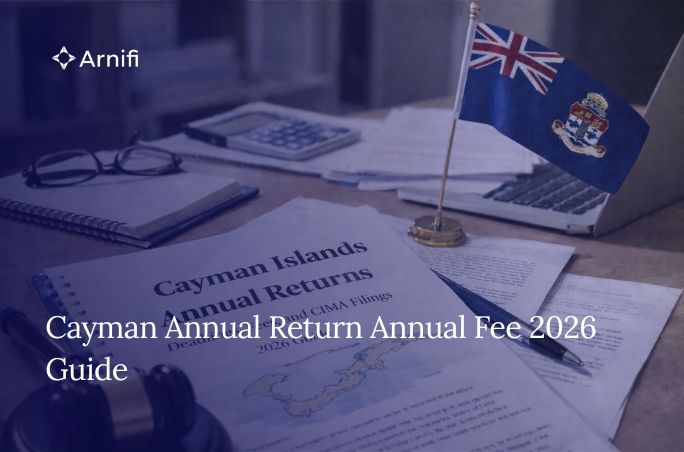
Cayman annual return annual fee 2026 planning should not be left until the last week of March. Cayman companies and partnerships often rely on registered office providers to handle filings, but directors, fund operators and managers still need to understand the annual cycle.
The main issue is timing. Cayman annual returns and government fees are generally part of the January to March compliance calendar. The filing may feel routine, but a missed deadline can affect good standing, create penalties and delay other filings or transactions.
Table of contents
- Why The Annual Return Calendar Matters?
- Quick View Of Cayman Annual Filing Checks
- 1. Start With The Cayman Entity Type
- 2. Understand The January To March Filing Window
- 3. Cayman Exempted Company Annual Fee Tier
- 4. General Registry CAP Annual Return Filing
- 5. Cayman ELP Annual Fee Partnership Rules
- 6. Late Annual Return Penalty Cayman Timeline
- 7. Do Not Confuse Annual Return With Other Regulatory Filings
- 8. The 31 March / Anniversary Calendar
- Conclusion
- FAQs
Why The Annual Return Calendar Matters?
Cayman entities often have several yearly compliance dates. Some are tied to the calendar year. Some are linked to regulatory filings. Some internal reminders may be based on the entity’s incorporation or registration anniversary.
For the General Registry annual return and annual government fee, companies should focus on the January to March window. Annual fees and returns are due in January of each year after registration, and the General Registry deadline is the last business day of March before 5PM.
This is why the 31 March calendar matters. If the annual return and annual fee are not handled by the end of March, the late annual return penalty Cayman exposure can begin from 1 April.
Quick View Of Cayman Annual Filing Checks
| Entity Or Filing Area | What To Check | Why It Matters |
| Exempted company | Annual return and annual government fee | Keeps company filing status current |
| Share capital tier | Registered capital band | Determines annual fee tier |
| CAP filing | Annual return submission route | Helps registered office prepare filing |
| ELP | Regulated or unregulated status | Affects annual fee amount |
| Foreign company | Annual fee requirement | Different fee rules may apply |
| Late filing | 1 April penalty trigger | Avoids avoidable surcharge |
| Good standing | Registry filings and fee payment | Needed for transactions and certificates |
| Internal calendar | January, March and anniversary reminders | Prevents missed renewals |
1. Start With The Cayman Entity Type
The first step is to identify the entity type. A Cayman exempted company, ordinary non-resident company, foreign company, LLC or exempted limited partnership may have different annual fee rules.
This matters because one group may hold several Cayman entities. A fund structure may include an exempted company, an exempted limited partnership, a general partner and one or more foreign registered entities.
A clean compliance tracker should show the entity name, registration number, registered office provider, entity type, fee category and filing owner.
2. Understand The January To March Filing Window
The Companies Act states that every exempted company must file its annual return in January of each year after the year of registration. The annual fee is also paid in January and should be tendered with the annual return.
The General Registry FAQ also states that annual fees and returns are due in January of each year commencing the first January after registration. It further states that the deadline for annual fees and returns is the last business day of March before 5 PM
For practical planning, January is the internal target. March is the final deadline. Waiting until the last business day of March is risky because payment, approval or portal delays can create problems.
3. Cayman Exempted Company Annual Fee Tier
Cayman exempted company annual fee tier planning depends on registered capital. Under the Companies Act 2026 Revision, the annual fee for an exempted company with no registered capital or registered capital not exceeding $42,000 is $925.
The next bands increase with registered capital.
- The annual fee is $1,225 where registered capital exceeds $42,000 but does not exceed $820,000.
- It is $2,209 where registered capital exceeds $820,000 but does not exceed $1,640,000.
- It is $2,793, where registered capital exceeds $1,640,000.
This is why share capital should be reviewed before renewal. A company with a higher authorized or registered capital may fall into a higher annual fee tier.
4. General Registry CAP Annual Return Filing
General Registry CAP annual return filing is part of the practical workflow. The General Registry FAQ states that the annual return forms are available for use on CAP on the General Registry website.
For many Cayman entities, the registered office provider handles the filing. Still, the company should review the information before submission. The annual return should match the company records, entity status and capital information.
Directors should not treat the CAP filing as only a provider task. If the company has changed name, capital, registered office, director information or business status, the registered office provider should be told early.
5. Cayman ELP Annual Fee Partnership Rules
Cayman ELP annual fee partnership planning depends on the partnership category. The General Registry fee schedule lists annual fees for exempted limited partnerships.
For a regulated exempted limited partnership, the annual fee is CI$1,300. For an exempted limited partnership that is unregulated, the annual fee is CI$2,100
This matters for fund structures. A regulated ELP and an unregulated ELP may not have the same annual government fee. The registered office provider should confirm the correct status before payment.
6. Late Annual Return Penalty Cayman Timeline
Late annual return penalty Cayman exposure starts after the March deadline. Under the Companies Act, an exempted company that defaults in submitting its annual return or paying its annual fee incurs penalties based on the timing of payment.
The penalty is 33.33% of the annual fee if the return is submitted or the fee and penalty are paid between 1 April and 30 June.
The penalty increases to 66.67% if payment happens between 1 July and 30 September. It increases to 100% if the return is submitted or the fee and penalty are paid between 1 October and 31 December.
This makes late filing expensive. It can also affect good standing and transaction readiness.
7. Do Not Confuse Annual Return With Other Regulatory Filings
The annual return and annual government fee are not the only Cayman compliance tasks. Funds, registered persons, economic substance entities and tax-reporting entities may have additional filings.
For example, a CIMA-regulated fund may have CIMA annual fees or fund annual return obligations. An entity with economic substance obligations may also need to file an ESN before certain Registry filings can move forward.
The annual return calendar should therefore sit inside a wider compliance calendar. The company should not assume that paying the Registry fee completes every Cayman obligation.
8. The 31 March / Anniversary Calendar
The phrase “31 March/anniversary calendar” is useful because Cayman entities need both types of reminders.
For the Registry annual return and annual fee, the key calendar is January to the last business day of March. For internal governance, the entity should also track its incorporation anniversary, registered office renewal date, fund launch date, service provider renewal date and board approval cycle.
This avoids a common issue where the government filing is completed, but registered office fees, CIMA matters, audit planning or service provider renewals are missed.
Conclusion
Cayman annual return and annual fee compliance is simple when the calendar is controlled early. The key is to know the entity type, fee tier, filing route and March deadline before penalties begin. Arnifi’s expert team helps businesses organise offshore compliance records, track annual obligations and keep Cayman entity files transaction-ready.
FAQs
What is the Cayman annual return annual fee 2026 requirement?
It is the yearly filing and government fee process for Cayman entities. Companies generally file the annual return and pay the annual government fee in the January to March annual cycle.
When is the Cayman annual return deadline?
The General Registry states that annual fees and returns are due in January, with the deadline being the last business day of March before 5PM. Late filings after that can create penalties.
How is the Cayman exempted company annual fee tier decided?
The annual fee tier is based on registered capital. Higher registered capital can place an exempted company into a higher annual fee band.
What is the Cayman ELP annual fee partnership rule?
The annual fee depends on the ELP category. The General Registry fee schedule lists separate annual fees for regulated and unregulated exempted limited partnerships.
What happens if the annual return or annual fee is late?
Late filing or payment can trigger penalties. For exempted companies, the penalty can start at 33.33% of the annual fee after March and increase in later quarters.
Top UAE Packages


Related Articles

Top UAE Packages
Get in Touch