
BVI Vs Singapore Company Formation

Shethana P
SEO Content Writer
Shethana specialises in creating content that simplifies complex business, compliance, and regulatory topics for global business incorporation. She focuses on SEO strategy, content accuracy,… Read more

Tulika Saxena
AVP, Sales & Marketing | IIM Nagpur
Tulika Saxena specializes in business finance, sales strategy, and market positioning. Leads growth and partnerships, ensuring seamless business setup experiences and client success across… Read more


Key Fact: BVI is commonly used for international holding and investment structures, while Singapore suits active operating businesses. Tax treatment, reporting obligations and local requirements should guide the choice.
Table of contents
- Start With The Business Purpose, Not The Jurisdiction
- The Core Difference In One Line
- A Side-By-Side Comparison That Actually Helps
- Tax Is Important, But Tax Should Not Be The Only Lens
- Where BVI Usually Makes More Sense
- Where Singapore Usually Has The Stronger Case
- Holding Company Decisions Need Extra Care
- Conclusion
- FAQs
- References
Start With The Business Purpose, Not The Jurisdiction
A lot of founders begin with the wrong question. They ask which jurisdiction is better in general. That sounds sensible, but it leads nowhere useful.
The better question is simpler: what is this company supposed to do?
If the entity will hold shares, sit above group companies, or act as a private investment structure, BVI often enters the conversation quickly. If the company will hire people, sign customer contracts, and build a visible operating base in Asia, Singapore usually has a stronger case.
That difference matters because the legal form is only one part of the decision. Banking, reporting, tax filings, and investor comfort all sit right behind it.
The Core Difference In One Line
BVI is often chosen for clean offshore holding structures. Singapore is often chosen for active business operations with stronger onshore credibility. That is the short version, and honestly, it gets your business surprisingly far.
Still, the details matter. A founder can make the wrong call if they focus only on incorporation speed and ignore tax treatment, annual obligations, and the signal each structure sends to banks and counterparties.
A Side-By-Side Comparison That Actually Helps
| Factor | BVI | Singapore |
| Typical use case | Holding company, SPV, private investment structure | Trading company, regional HQ, operating business |
| Corporate income tax | No corporate income tax or capital gains tax on companies in BVI | Headline corporate income tax rate is 17% |
| Regulatory and reporting requirements | Beneficial ownership filings, annual financial returns and other statutory compliance obligations | Annual returns, financial reporting, tax filings and local corporate governance requirements |
| Tax filing and compliance | No general corporate income tax, but annual financial return, economic substance and other applicable reporting obligations remain | Corporate income tax filings, including ECI where applicable, and annual corporate filings |
| Investor and banking perception | Familiar for holding vehicles, but banking can still require strong justification | Often stronger for active commercial operations and institutional comfort |
| Best fit | Cross-border ownership and offshore holding | Substance-led businesses operating in or through Asia |
This is where many founders pause. At first they may think BVI is always the cheaper and easier answer. Actually, that is not quite right. It can be cheaper and simpler for the right use case. For the wrong use case, it creates friction later.
Tax Is Important, But Tax Should Not Be The Only Lens
A company’s place of incorporation does not automatically determine where all its income is taxed. Tax residency, management and control, business operations, income sources and applicable international tax rules can affect the final tax position. Businesses should assess the wider group structure before choosing BVI or Singapore solely for tax reasons.
Singapore’s 17% is the headline corporate income tax rate, with exemptions and rebates available to qualifying companies. But tax cannot be looked at in isolation.
A Singapore company may still make more commercial sense for those who need contracts, staff, office presence, local credibility, and a cleaner banking story. A BVI company may look tax-efficient on paper, yet become awkward if the business is actually operating in a way that needs stronger substance somewhere else.
That is the part founders sometimes miss. A low-tax setup does not automatically mean a low-friction setup.
Where BVI Usually Makes More Sense
The Singapore vs BVI tax benefits comparison tends to lean toward BVI when the entity is mainly there to hold assets or sit at the top of a group. In those cases, simplicity can be the real advantage, not just tax.
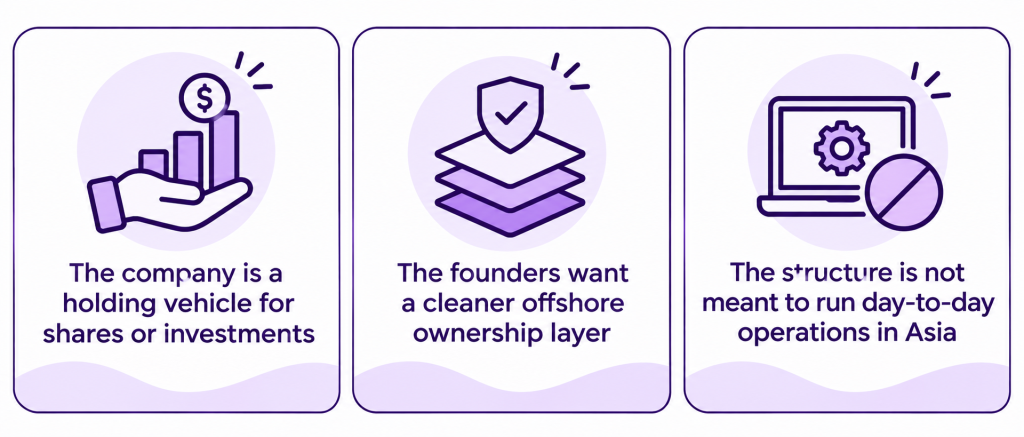
BVI often fits better when:
BVI incorporation does not remove ongoing reporting obligations. Since 2nd January 2025, BVI Business Companies have been required to file beneficial ownership information with the Registry of Corporate Affairs. Companies must also maintain applicable statutory records and meet annual financial return requirements.
Where Singapore Usually Has The Stronger Case
Singapore earns its place when the company is expected to do real operating work. If there will be customers, invoicing, payroll, tax computation, and a visible commercial footprint, the framework is often easier to justify.
The BVI vs Singapore company registration decision often swings toward Singapore for founders building a regional business, especially if they expect banks, investors, and partners to ask for a more substance-led setup.
Singapore companies must also appoint at least one director who is ordinarily resident in Singapore and a company secretary within six months of incorporation. These local governance requirements should be considered when estimating the cost and administration involved in setting up a Singapore entity.
Talking about the Cost comparison BVI vs Singapore, A BVI company may cost less to maintain in a simple holding context. A Singapore company may cost more, yet save time and friction if the company is operating actively and needs institutional trust.
Holding Company Decisions Need Extra Care
The Singapore vs BVI offshore holding question is common for founders with multi-country businesses. The decision should also account for beneficial ownership disclosure, annual reporting, banking due diligence and the tax treatment of the wider corporate group.
Part of you may think BVI is the obvious answer because it is widely used for holding structures. Another part should ask what the group will need in two years.
Will investors join? Will there be a sale? Will the holding entity need banking access? Will profits move through several jurisdictions? Those questions change the answer fast.
A useful rule of thumb is this: if the top company mainly holds assets and ownership, BVI can work very well. If the top company is also expected to be visibly strategic, staffed, and commercially active, Singapore may hold up better.
How Can Arnifi Help WIth BVI Vs Singapore Company Formation
Arnifi provides tailored BVI company formation services that turn a complex jurisdiction decision into a practical setup plan. If you are weighing BVI against Singapore, Arnifi can support incorporation, structuring advice, compliance coordination, and ongoing business setup needs in line with your company’s real purpose. That makes the choice clearer, smoother, and far more confident.
Conclusion
There is no universal winner in BVI vs Singapore. BVI often works better for offshore holding and simpler ownership structures. Singapore often works better for operating businesses that need tax clarity, credibility, and stronger institutional comfort. The smart move is matching the jurisdiction to the company’s real job. That is usually what saves money, time, and restructuring pain later.
FAQs
Is BVI cheaper than Singapore for company formation?
BVI may be more cost-effective for a straightforward holding structure, but registered agent fees, annual returns, beneficial ownership filings and other compliance costs must be considered. Singapore has additional local governance and tax administration expenses.
Does Singapore always beat BVI for investor comfort?
Not always. Investors are familiar with BVI holding structures. Still, Singapore often feels stronger for active businesses that need operating credibility, local substance, and a clearer commercial story.
Is BVI better for tax than Singapore?
BVI does not impose general corporate income tax or capital gains tax. Singapore has a headline corporate income tax rate of 17%, with applicable exemptions and rebates. The overall tax outcome depends on the company’s activities and wider group structure.
Which setup is better for a regional operating business?
Singapore is often the stronger fit for a regional operating company. It offers a more established onshore framework for hiring, contracts, tax compliance, and day-to-day commercial activity.
What are the compliance requirements for a BVI company?
BVI companies must maintain statutory records, file beneficial ownership information and meet applicable annual financial return and economic substance requirements.
References
- BVI FSC: Beneficial Ownership Filing Requirements: https://www.bvifsc.vg/news/industry-updates/industry-circular-12-2025-beneficial-ownership-filings-implementation-update
- BVI FSC: Annual Financial Return Guidance, November 2026: https://www.bvifsc.vg/news/industry-updates/industry-circular-31-2026-guidance-completing-annual-financial-returns
- IRAS: Corporate Income Tax Rates and Exemptions: https://www.iras.gov.sg/quick-links/tax-rates/corporate-income-tax-rates
Top Singapore Packages
Related Articles



Top Singapore Packages
Planning Your Next Business Move?
