
How to Execute an Ajman Free Zone Business Closure in 2026 | Step-by-Step Liquidation Guide

Nishant
Content Writer
Nishant Kumar is a technical content writer, he shares global business insights and bridges the gap between complex regulatory frameworks and actionable growth strategies.… Read more

Tulika Saxena
AVP, Sales & Marketing | IIM Nagpur
Tulika Saxena specializes in business finance, sales strategy, and market positioning. Leads growth and partnerships, ensuring seamless business setup experiences and client success across… Read more


An Ajman Free Zone Business closure requires formal liquidation through the AFZ portal, not license abandonment. The process follows a fixed sequence: settle FTA tax registrations, close corporate bank accounts, secure facility clearances, then initiate the main cancellation Service Request. After the customer care interview, appoint a liquidator and publish a newspaper notice. Submit all clearance certificates for final audit. Complete Corporate Tax and VAT deregistration with the Federal Tax Authority to avoid penalties up to AED 10,000. Standard timelines range from three to six weeks depending on visa cancellations, facility handovers, and bank closures.
Table of contents
- Key Facts
- Introduction
- What Is Ajman Free Zone Business Closure?
- What Must Be Completed Before Starting the Closure Process?
- How Does the Ajman Free Zone Business Closure Process Work?
- Which Execution Pathway Best Serves the Enterprise?
- Why Do Some AFZ Closure Applications Experience Delays?
- What Documents Are Required for Business Liquidation?
- How to Reclaim Security Deposits and Secure Final Tax Clearance?
- How Can Arnifi Accelerate Corporate Deregistration and Setup?
- Conclusion
- FAQs
- References:
Key Facts
- Mandatory Dissolution: Abandoning a trade license triggers compounding renewal penalties, and immigration freezes. Formal liquidation remains legally required.
- Federal Tax Deregistration: Entities must deregister for UAE Corporate Tax and VAT with the Federal Tax Authority. Late tax deregistration incurs penalties of up to AED 10,000.
- External Clearances: Final authority sign-off requires bank closure letters, utility handovers, and customs clearances.
Introduction
Exiting a regional free zone requires the same procedural rigour as initial corporate incorporation. Corporate entities liquidating operations within the Ajman Free Zone (AFZ) often face unexpected operational delays and portal lockouts. These bottlenecks occur because standard liquidation guides focus solely on generic document checklists rather than the exact digital and physical sequence of approvals.
Shutting down an enterprise demands coordinated actions across the free zone authority, federal immigration databases, the Federal Tax Authority, and commercial banking institutions. Understanding these interrelated workflows ensures a clean legal exit, protects shareholder capital from compounding penalties, and preserves future commercial eligibility within the United Arab Emirates.
What Is Ajman Free Zone Business Closure?
An Ajman Free Zone business closure represents the formal, legally binding dissolution and deregistration of a licensed entity from the official registry. This process permanently extinguishes the commercial entity, halts recurring administrative liabilities, and nullifies corporate sponsorship obligations.
Types of Corporate Dissolution:
- Voluntary Liquidation: Initiated by shareholders via board resolution
- Involuntary Cancellation: Triggered by regulatory non-compliance or expiry
- Court-Ordered Dissolution: Mandated by judicial decree following unresolved disputes
Leaving a commercial license to simply lapse does not constitute a legal business closure under UAE law. Abandoning a trade license causes renewal penalties to compound monthly, prompts immigration freezes, and eventually leads to administrative blacklisting of company shareholders.
What Must Be Completed Before Starting the Closure Process?
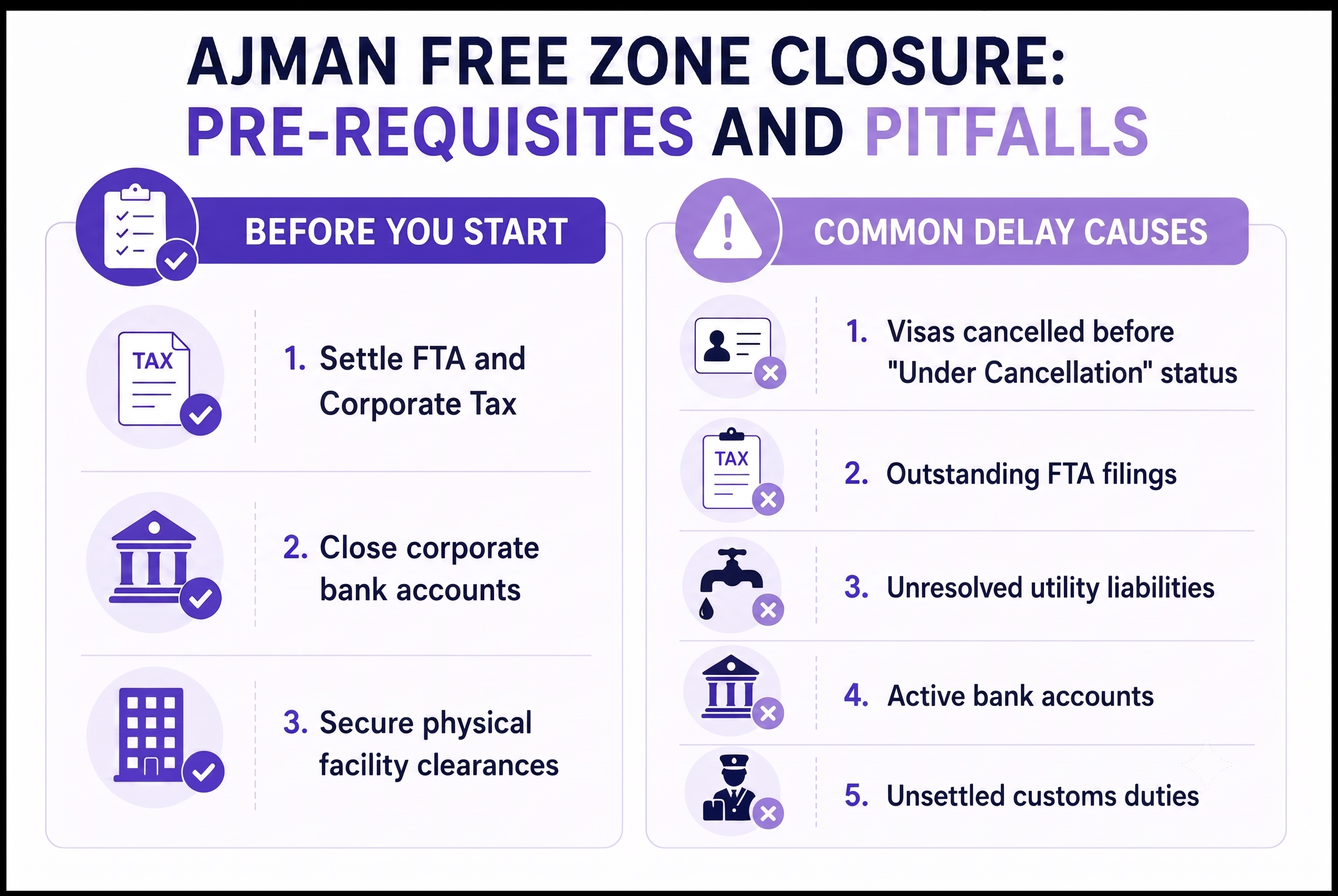
Corporate officers must clear three foundational hurdles before initiating the formal cancellation service request on the digital portal. Attempting to launch the primary cancellation workflow without these external clearances creates procedural deadlocks that stall the liquidation timeline.
1. Settle FTA and Corporate Tax Obligations
Cancelling the AFZ trade license does not automatically close corporate tax records with the Federal Tax Authority (FTA). Entities must formally apply for Corporate Tax deregistration, and Value Added Tax (VAT) deregistration (if the entity was previously registered for VAT), within statutory deadlines. Failing to deregister with the FTA within the mandated timeframe triggers severe federal penalties up to AED 10,000 per violation.
2. Close Corporate Bank Accounts
Commercial banking institutions typically require a formal, notarized Board Resolution explicitly approving the dissolution of the company and the closure of all associated accounts. Financial controllers must settle all outstanding credit facilities, cancel corporate credit cards, and obtain an official Bank Closure Confirmation Letter (NOC).
3. Secure Physical Facility Clearances
Operational facilities require customized clearance letters depending on the lease category:
- Warehouses and Industrial Plots: May require physical inspections and clearance confirmations from relevant utility and customs authorities. Verify specific requirements with AFZ.
- China Mall Units and Retail Outlets: Demand specialized management clearance certificates verifying the complete surrender of commercial premises.
- Executive Offices and Flexi-Desks: Require key return confirmations and standard internal facility clearances.
Securing these physical approvals prior to digital filing prevents service request rejections on the central authority system.
How Does the Ajman Free Zone Business Closure Process Work?
Dissolving an entity follows a rigid administrative sequence. Navigating the official UAE Free Zone closure framework requires precise synchronization between online service requests and physical clearance milestones.
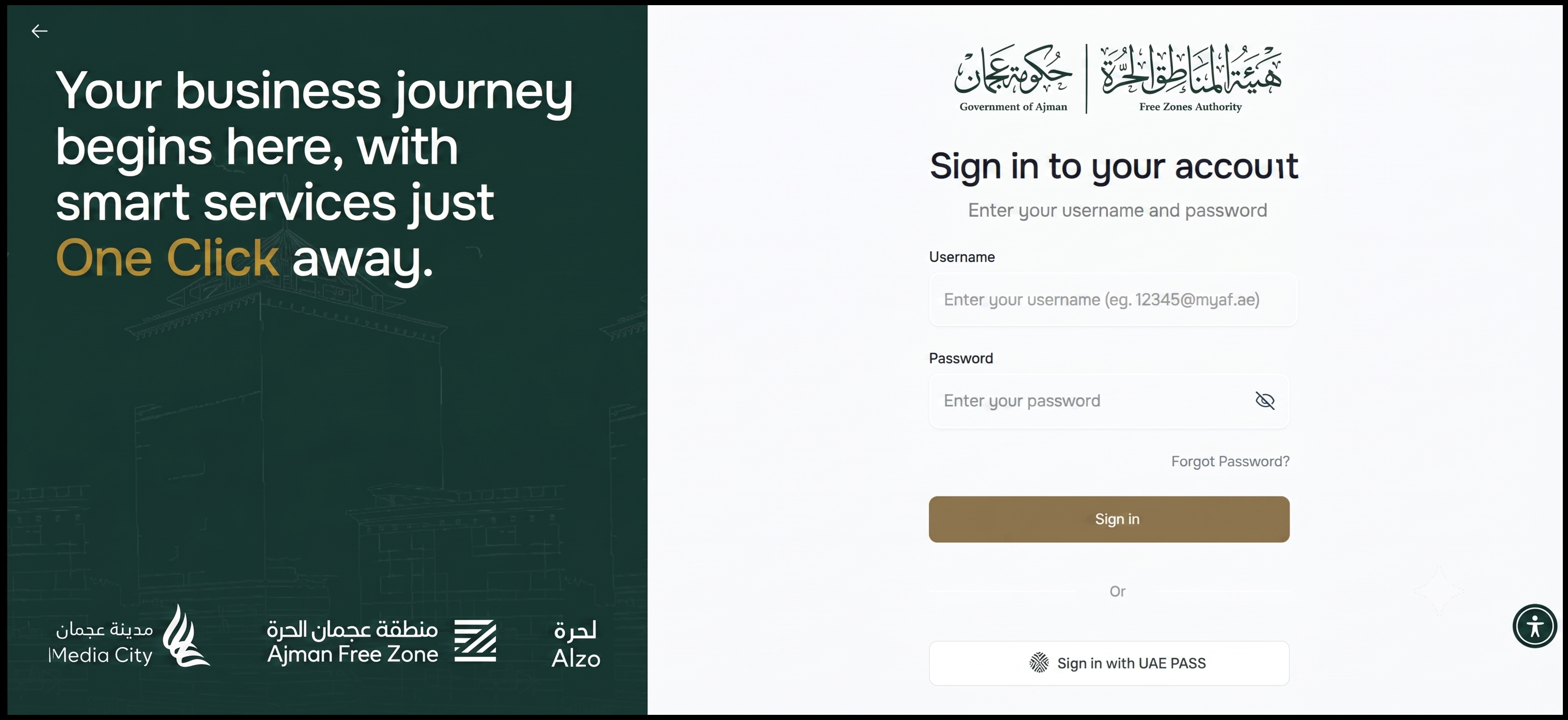
- Step 1: Initiate Main Cancellation SR: The company representative logs into the AFZ portal and submits the primary Service Request (SR) for company cancellation alongside the shareholder resolution.
- Step 2: Customer Care Interview: The AFZ compliance department schedules a virtual or physical exit interview to confirm the commercial rationale for termination.
- Step 3: Appoint a Liquidator & Publish Newspaper Notice: Upon initiating the cancellation, the company must pass a Board Resolution to appoint a registered liquidator. A public notice of the company’s dissolution must then be published in a local newspaper (or as required by AFZ) to initiate the mandatory creditor notice period.
- Step 4: Wait for “Under Cancellation” Status: The portal updates the corporate file to “Under Cancellation,” which initiates the government verification process before immigration actions can proceed.
- Step 5: Cancel Visas and Establishment Card: All active employee, partner, and dependent visas must be cancelled or transferred through the Federal Authority for Identity, Citizenship, Customs and Port Security (ICP), followed by the formal cancellation of the AFZ Establishment Card.
- Step 6: Submit Clearances and Final Verification: The applicant uploads the utility clearances, bank closure letters, customs NOCs, and visa cancellation proofs to the portal for final audit.
Completing this chronological sequence triggers the final fee invoice and concludes the legal existence of the entity.
Which Execution Pathway Best Serves the Enterprise?
Founders can execute an Ajman Free Zone business dissolution independently through digital portals or via an authorized Public Relations Officer (PRO) and registered liquidator.
OPERATIONAL EXPERIENCE NOTE: While the AFZ portal allows digital initiation, physical utility handovers, customs inspections, and multi-agency tax clearances frequently require on-the-ground representation. Engaging an authorized corporate services representative prevents technical portal freezes and delays.
The table below outlines the operational differences between both execution methods:
| Operational Variable | Direct Online Application | Execution via PRO / Liquidator |
| Management Involvement | High internal administrative effort | Minimal executive involvement |
| Physical Clearance Handling | Handled manually by company officers | Managed entirely by local representative |
| Logistics and Attestations | Applicant coordinates Zajel courier | Courier and document attestations included |
| FTA & Customs Alignment | Managed separately via tax portals | Coordinated alongside free zone workflow |
| Best-Fit Profile | Zero-visa flexi-desk entities | Complex entities with staff, warehouses, or debts |
Selecting the appropriate execution pathway prevents unnecessary administrative drain and ensures all statutory deadlines are satisfied.
Why Do Some AFZ Closure Applications Experience Delays?
While the AFZ customer portal provides a streamlined digital interface, liquidation files frequently stall when external clearances or tax deregistrations remain unresolved. The primary causes for administrative delays include:
- Attempting to process visa cancellations before the main Service Request reaches the verified “Under Cancellation” status.
- Outstanding corporate tax or VAT filings with the Federal Tax Authority that block final tax deregistration.
- Unresolved utility liabilities or missing meter removal certifications from Etihad Water and Electricity (EtihadWE) and telecom providers.
- Retaining active corporate bank accounts that prevent the issuance of a final Bank Clearance Letter.
- Unsettled customs duties or unclosed transit declarations with regional customs bureaus.
Resolving these external prerequisites systematically before initiating the final deregistration request eliminates procedural bottlenecks.
What Documents Are Required for Business Liquidation?
Submitting complete, certified corporate records ensures swift processing by the AFZ legal and licensing departments.
| Document Description | Mandatory Status | Issuing Authority / Source |
| Original Trade License | Mandatory | Ajman Free Zone Authority |
| Original Establishment Card | Mandatory | Federal Authority for Identity, Citizenship, Customs and Port Security (ICP) / AFZ |
| Shareholder Passports and Emirates IDs | Mandatory | Corporate Shareholders |
| Notarized Board Resolution for Liquidation | Mandatory | Company Board of Directors |
| Utility Clearance Certificate | Facility-Dependent | EtihadWE / Etisalat / Du |
| Customs Clearance NOC | Activity-Dependent | Department of Port & Customs (AJMAN) |
| Official Bank Closure Confirmation Letter | Mandatory | Commercial Banking Institution |
| Final Liquidation Audit Report | Mandatory | Appointed Registered Liquidator |
| Proof of Visa Cancellations | Mandatory | ICP Immigration Portal |
Having all physical and digital records fully attested prior to submission prevents repetitive portal rejections.
How to Reclaim Security Deposits and Secure Final Tax Clearance?
Businesses must submit the final liquidation balance sheet to the FTA and secure an official Tax Deregistration Certificate before the free zone issues the final company cancellation certificate.
(Note: FTA Deregistration and Tax Clearance must be completed during the liquidation phase)
Once the company is legally dissolved, the corporate closure workflow concludes with this final financial recovery step:
Security Deposit Retrieval: The corporate representative contacts the AFZ Finance Department with the final Free Zone Deregistration Certificate and deposit receipts to request a refund of visa and facility deposits.
How Can Arnifi Accelerate Corporate Deregistration and Setup?
Are complex regulatory workflows and multi-agency clearances stalling critical corporate transitions? Navigating an Ajman Free Zone business closure requires precise statutory coordination and direct government liaison. We at Arnifi manage the entire corporate liquidation lifecycle, ensuring complete elimination of compliance liabilities.
Our corporate advisory teams handle everything from initial board resolutions to physical utility clearances and bank account closures. Furthermore, enterprises restructuring their regional presence leverage our seamless solutions for Company Formation in the UAE.
Expanding organizations maintain total regulatory alignment across all Emirates through our comprehensive Post Setup Compliance infrastructure. For actionable insights into regional operational and liquidation strategies, decision-makers regularly consult dedicated blogs related to business in the UAE.
Conclusion
Executing an Ajman Free Zone business closure demands rigorous planning, sequential portal navigation, and proactive settlement of external liabilities. Simply allowing a trade license to expire generates compounding monthly fines, freezes corporate bank accounts, and risks shareholder blacklisting across the UAE. Corporate decision-makers must settle federal tax registrations, cancel visas systematically, and secure the official Deregistration Certificate to achieve absolute legal finality. Engaging specialized corporate compliance advisors eliminates administrative friction and protects executive timelines.
Contact Us at Arnifi today to execute a rapid, error-free corporate liquidation and protect future market eligibility.
FAQs
1. Can an entity let an Ajman Free Zone license simply expire instead of executing a formal closure?
No. Abandoning a trade license results in automatic monthly renewal penalties, immigration blacklisting, and portal freezes that prevent shareholders from establishing new corporate entities in the UAE.
2. What does the “Under Cancellation” status mean on the AFZ portal?
It is the mandatory administrative status indicating that the free zone authority has approved the initial dissolution request, which unlocks the system permissions required to cancel visas and the establishment card.
3. Is Corporate Tax deregistration mandatory when closing an AFZ company?
Yes. Entities must formally deregister for Corporate Tax (and VAT, if applicable) with the Federal Tax Authority to avoid statutory non-compliance fines up to AED 10,000.
4. How long does the complete Ajman Free Zone business liquidation process take?
A standard closure typically requires three to six weeks, though timelines vary by entity complexity, depending on the speed of employee visa cancellations, facility handovers, and corporate bank account closures.
5. Can an AFZ company closure be completed while shareholders are outside the UAE?
Yes. Shareholders can execute the closure remotely by issuing a notarized and legalized Power of Attorney to an authorized corporate services provider or PRO.
References:
Federal Tax Authority (FTA) – UAE
UAE Free Zone Closure Framework
Federal Authority for Identity, Citizenship, Customs and Port Security (ICP)
Top UAE Packages
Related Articles

Top UAE Packages
Get in Touch
