
How to Start a Sole Proprietorship in Dubai, UAE | Setup, Costs & Compliance

Zahira Shaik
SEO Content Writer
Zahira Shaik is an SEO Content Writer and Published Author specializing in research-based content. She excels at analyzing market trends, regulations, and industry developments… Read more

Tulika Saxena
AVP, Sales & Marketing | IIM Nagpur
Tulika Saxena specializes in business finance, sales strategy, and market positioning. Leads growth and partnerships, ensuring seamless business setup experiences and client success across… Read more



Key Fact: Formation of a sole proprietorship in Dubai ensures 100% control and profits with no minimum capital requirement. However, sole proprietors face unlimited personal liability, a requirement for an office space lease, and corporate taxes.
Table of contents
- Introduction
- What Is a Sole Proprietorship in Dubai, UAE?
- Who Can Start a Sole Proprietorship in Dubai?
- Benefits of Starting a Sole Proprietorship in Dubai
- Key Considerations Before Starting a Sole Proprietorship
- Step-by-Step Process for Sole Proprietorship Business Setup in Dubai
- How Long Does It Take to Set Up a Sole Proprietorship in Dubai?
- Cost and Fees for Sole Proprietorship Business Setup in Dubai
- Taxation for Sole Proprietorships in Dubai
- Regulatory Compliance for Sole Proprietorships
- Banking Challenges for Sole Proprietorships in Dubai
- Common Mistakes to Avoid
- Frequently Asked Questions
- Conclusion
- References
Introduction
Formation of a sole proprietorship business in Dubai is easy for individual entrepreneurs who wish to create their own business in the UAE. While many books provide information on the process of obtaining licenses, there is not much discussion about the tasks after the license, such as handling unlimited personal liability, registration for corporate tax, UBO disclosure, and corporate banking.
This article provides you with a guide on how to form a sole proprietorship business in Dubai with all the necessary information about finances, regulations, and taxes.
What Is a Sole Proprietorship in Dubai, UAE?
A sole proprietorship (known as a sole establishment in business) is an independent business enterprise where all rights belong to the sole proprietor. Here, the trade license and business legal form are issued in the name of one person, providing 100% ownership and right to all profits earned.
Key Characteristics:
- Single Ownership & Control: All decisions in this business are taken only by the owner and do not require board approval or approval from shareholders.
- No Legal Separation: In contrast to the LLC (limited liability company), a sole establishment is not legally separated from its owner. The owner alone bears all the obligations and debts.
- Jurisdictional Options: Registration can be carried out both on the Dubai Mainland via the Department of Economy and Tourism (DET) or in special free zones.
Who Can Start a Sole Proprietorship in Dubai?
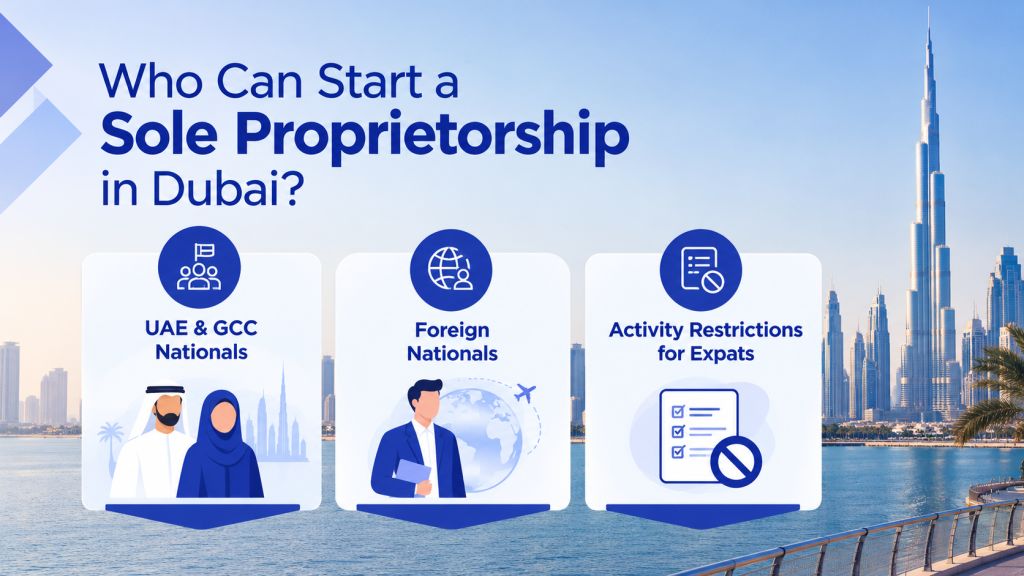
The eligibility criteria to form a sole proprietorship business in Dubai depend upon nationality and nature of business operations:
- UAE & GCC Nationals: Eligible to form commercial and professional businesses, without any restrictions on shareholding.
- Foreign Nationals: Can own 100% of the sole proprietorship firm but can only engage in professional services such as IT, management consultancy, marketing, design, education, and engineering.
- Activity Restrictions for Expats: Foreign individuals cannot form a sole proprietorship to carry out commercial trading, import/export, and manufacturing of goods.
Benefits of Starting a Sole Proprietorship in Dubai
The benefits associated with setting up a sole proprietorship for an individual entrepreneur include:
- 100% Ownership and Control: Get full control over all operations, business strategies, and the division of profits.
- No Mandated Minimum Capital: You do not have to mandatorily put in minimum capital to obtain a business license.
- Streamlined Setup Process: The process is less complicated and involves fewer steps compared to firms with multiple shareholders.
- Startup Ecosystem Access: Get access to government-sponsored incubation centers, workspaces, and accelerators located in Dubai.
Key Considerations Before Starting a Sole Proprietorship
1. Understand Personal Liability
There is no legal difference between the individual and the business; hence, sole proprietors have unlimited personal liability. Any business liability or debt could be claimed against your personal assets and property.
2. Choose the Right Business Activity and Jurisdiction
Make sure the business activity you choose qualifies as a professional service if you are an individual from overseas countries. Evaluate the advantages of having your business in Mainland (where you can trade freely in the whole of the UAE) versus Free Zones (with specialized zones and taxation policies).
3. Arrange Physical Office Space
For obtaining licenses in the case of a sole proprietorship in Mainland Dubai, physical office space premises are compulsory; no virtual office address is allowed to obtain any kind of license.
4. Check External Approvals
Regulated sectors require secondary approvals from relevant UAE government authorities before license issuance. Examples include:
- Healthcare: Dubai Health Authority (DHA)
- Education: Knowledge and Human Development Authority (KHDA)
- Legal/Engineering: Legal Affairs Department or Dubai Municipality
5. Understand Employee Registration Requirements
If you intend to employ people, then it is necessary to register your business unit with the Ministry of Human Resources and Emiratisation (MOHRE) in order to handle employment contracts and other matters.
Step-by-Step Process for Sole Proprietorship Business Setup in Dubai
Step 1: Select Your Business Activity and Jurisdiction
Determine the permitted activity and whether to register for a mainland entity under DET or a free zone authority.
Step 2: Reserve a Trade Name
Select a valid trade name that should be in line with DET regulations. This should avoid any offensive language, trading on existing protected trademarks, and using an acronym of the full name without authorization.
Step 3: Prepare Documents and Obtain Initial Approvals
Submit a passport copy, Emirati ID (for resident individuals), business proposal (if applicable), and obtain initial approval. In case of certain activities, enter into a Local Service Agent Agreement.
Step 4: Obtain the Business License
Make payment of initial registration charges to DET or the chosen free zone authority and get your business or professional service license.
Step 5: Arrange Office Space and Register Ejari
Layout your office space or get approval for your flexi-desk and complete your Ejari registration through Dubai’s Ejari portal to complete setup requirements.
Step 6: Open a Corporate Bank Account
Supply necessary documents such as company paperwork, office proof, business plan, and personal bank statements to comply with KYC regulations of your chosen bank.
Step 7: Apply for Visas
Get your entry visas done, undergo fitness tests, and complete Emirates ID registration for you (investor visa) and your future employees.
How Long Does It Take to Set Up a Sole Proprietorship in Dubai?
The initial setup timeline for acquiring a trade license generally takes 2 to 4 weeks. However, overall completion depends on specific operational milestones:
- License & Trade Name: 3 to 7 business days.
- Office Lease & Ejari Approval: 2 to 5 business days.
- Visa Processing & Emirates ID: 7 to 14 business days.
- Corporate Bank Account: 3 to 6 weeks, depending on compliance and background verification checks.
Cost and Fees for Sole Proprietorship Business Setup in Dubai
When calculating a budget for a sole proprietorship business setup in Dubai, account for government fees, real estate, and banking criteria:
| Expense Category | Estimated Cost Range (AED) | Notes / Details |
| Initial Starting Capital | AED 5,000+ | Basic operational setup threshold |
| Annual License Fee | AED 10,000 – AED 50,000 | Varies by jurisdiction and activity |
| Incorporation Charges | AED 9,000 – AED 12,000 | One-time administrative & registration costs |
| Office Space (Flexi-desk) | AED 16,000 / year | Entry-level physical office solution |
| Office Space (Private) | AED 25,000 – AED 100,000+ / year | Based on size, location, and building class |
| Visa Costs (Per Person) | AED 3,500 – AED 7,000 | Covers medical test, visa stamping, & Emirates ID |
| Bank Minimum Balance | AED 50,000 – AED 500,000 | Required average monthly balance by UAE banks |
Taxation for Sole Proprietorships in Dubai
Understanding tax obligations is crucial for maintaining compliance under UAE tax law.
Corporate Tax Structure
Under UAE Federal Decree-Law No. 47 of 2022, corporate tax applies to business entities. Personal income (salaries, personal real estate investments, personal dividend yields) remains untaxed.
- Standard Rates:
- 0% on net taxable profits up to AED 375,000.
- 9% on net taxable profits exceeding AED 375,000.
Who Is the Taxable Person?
In the case of a sole establishment, the individual owner is the Taxable Person in the view of the Federal Tax Authority (FTA). Since there is no separate legal person involved here, all income obtained through the commercial/professional activities performed through sole establishment licenses belongs to the individual.
Important (Turnover Aggregation): In case an individual possesses several sole establishment licenses, then all licenses are combined together when the threshold levels of corporate taxation are being considered. The licenses are not reviewed separately to establish the tax relief threshold level.
Tax Registration & Small Business Relief
- Natural Persons Threshold: Natural persons performing business activities are obliged to register for Corporate Tax in case of having total annual turnover higher than AED 1,000,000 per calendar year.
- Small Business Relief (SBR): Resident taxable persons eligible for SBR whose revenue is less than AED 3,000,000 during one tax period have the right to choose this tax relief and consider their taxable income equal to zero.
Regulatory Compliance for Sole Proprietorships
1. Local Service Agent (LSA) Agreement
Any foreign natural person establishing a sole establishment on the mainland should sign an LSA agreement with a UAE resident natural person or an agent company. LSA does not take an equity or profit share; it operates only in an administrative role to arrange for local government permits.
2. Ultimate Beneficial Owner (UBO) Declaration
Any sole establishment should submit a declaration of its ultimate beneficial owner (UBO). As there is one owner of a sole establishment, he or she should be indicated as an UBO.
- Updating Details: Any changes to the UBO position and owner identity data should be reported to the relevant authority within 15 days to avoid administrative penalties.
3. Anti-Money Laundering (AML) Compliance
Sole proprietors should comply with UAE AML/CFT regulations. It involves keeping transaction records, carrying out CDD, and reporting any suspicious transactions to the goAML platform where applicable.
4. Annual Renewals and Accounting Records
- Annual renewals are required for the trade license, Ejari, and visa.
- Owners are required to keep accounting documents and records for at least 5 years.
Banking Challenges for Sole Proprietorships in Dubai
The process of opening a corporate bank account for a sole proprietorship business setup in Dubai can be tricky owing to the stringent KYC norms followed by the banks:
- Rigorous KYC & Source of Wealth Checks: The banks need extensive background checks for the individual owners, their banking history, and any existing supplier/clients agreement.
- Minimum Balance Standards: The UAE corporate bank accounts may have minimum balance requirements of AED 50,000 to AED 500,000.
- Common Rejection Triggers: Any incomplete business documentation, unclear business description, lack of proof of a physical office, or inadequate funding sources.
- Best Approach: It is always better to confirm with the bankers about the eligibility requirements and balance standards.
Common Mistakes to Avoid
- Ignoring Activity Restrictions: Undertaking commercial trading or imports/exports as a foreign entrepreneur in a licensed system.
- Underestimating Personal Liability: Not obtaining professional liability insurance or not assessing personal asset exposure.
- Miscalculating Setup Budgets: Not considering Ejari for office space, visa renewal charges, and minimum balance requirements for the bank account.
- Delaying Tax & UBO Registration: Missing the deadlines for FTA corporate tax registration or the 15-day deadline for UBO registration.
- Assuming Separate Tax Exemption Per License: Not combining the total turnover for different licenses of sole establishments owned by one person.
- Inadequate Banking Preparation: Not providing sufficient proof of the business and invoices.
Frequently Asked Questions
What is a sole proprietorship in Dubai?
A sole proprietorship is a business entity that is wholly owned and managed by one person. The person will assume complete responsibility and control.
Can a foreigner start a sole proprietorship in Dubai?
Foreigners can register a sole proprietorship in Dubai, but the business activities of the sole proprietorship must be consultancy or professional services.
Can a foreigner operate a trading business as a sole proprietor?
No. It is not allowed for foreigners to conduct trading activities in sole proprietorships. This applies to all foreigners except UAE and GCC citizens. Foreign individuals from outside should create a Limited Liability Company (LLC) or Free Zone Establishment (FZE) in order to conduct trade transactions.
How much does it cost to set up a sole proprietorship in Dubai?
License and registration costs for setting up a business range from AED 10,000 to AED 50,000, and additional costs include leasing office space, which is at least AED 16,000 per annum, and visa processing, which costs AED 3,500 – AED 7,000.
How long does sole proprietorship registration take?
It takes 2 to 4 weeks to set up the trade license. An additional 3 to 6 weeks may be taken by banks to open a corporate bank account.
Is a physical office mandatory for a mainland sole proprietorship?
Yes, DET requires physical office space that needs to be Ejari registered. You cannot use a virtual address for setting up your sole proprietorship business in Dubai.
Does a sole proprietorship pay corporate tax in the UAE?
Yes, if its turnover surpasses AED 1,000,000 within a year. Net taxable profits above AED 375,000 are taxable at 9%.
Who is the taxable person for a sole establishment?
The natural person who is the owner of the sole establishment will be considered as the Taxable Person by the Federal Tax Authority.
Is turnover aggregated across multiple sole-establishment licenses?
Yes. In case an individual has more than one sole-establishment license, the turnover needs to be consolidated.
Is a UBO declaration required for a sole proprietorship?
Yes, sole establishments have to file the Ultimate Beneficial Owner declaration with their licensing authority. The individual owner will be considered the UBO.
How quickly must UBO information be updated?
Changes in the information regarding the UBO or the ownership need to be submitted to the concerned authority within 15 days.
What minimum balance is required to open a corporate bank account?
For most banks in the UAE, the minimum average monthly balance required to be maintained for opening a corporate bank account ranges between AED 50,000 and AED 500,000.
Can a sole proprietor hire employees in Dubai?
A sole proprietorship can employ people in Dubai through sponsorship of their visa through MOHRE.
What are the risks of unlimited personal liability?
If unlimited personal liability applies, then there is nothing that protects your personal bank accounts, property, or assets from the business liabilities of the company.
Conclusion
Starting a Sole Proprietorship company in Dubai offers a streamlined process for entrepreneurs to become complete owners of their businesses in the UAE. Nevertheless, this can only be achieved through striking a balance between operational efficiency and compliance issues such as unlimited personal liability, corporate tax limits, UBO updates, and KYC requirements from banks.
Professional services provided by business setup consultants like Arnifi will aid entrepreneurs in addressing all these aspects effectively.
References
Top UAE Packages
Related Articles
BVI vs Cayman Company Formation (2026) | Entity Ty...
Key Fact Both jurisdictions provide English common law frameworks for international business. BVI offers cost-efficient corporate management for private asset...


Top UAE Packages
Planning Your Next Business Move?
