
DIFC vs ADGM vs Singapore for Investment Fund Setup

Nishant
Content Writer
Nishant Kumar is a technical content writer, he shares global business insights and bridges the gap between complex regulatory frameworks and actionable growth strategies.… Read more

Tulika Saxena
AVP, Sales & Marketing | IIM Nagpur
Tulika Saxena specializes in business finance, sales strategy, and market positioning. Leads growth and partnerships, ensuring seamless business setup experiences and client success across… Read more


Table of contents
Key Facts
- Assessment of DIFC vs ADGM vs Singapore fund setup covers three major English common law jurisdictions regulated by the DFSA, FSRA, and MAS, respectively
- As of 16 September 2026, ADGM’s FSRA introduced Sub-Threshold Fund Manager (STFM) and Institutional Fund Manager (IFM) light tracks in addition to the revised Venture Capital and Foreign Fund Manager provisions
- In Singapore, the Variable Capital Company (VCC) goes hand-in-hand with Section 13O, 13OA, and 13U tax reliefs up to 31 December 2029, whereas MAS Circular FDD Cir 05/2026 eliminated year-end annual AUM maintenance checks for non-SFOs (though initial entry AUM thresholds still apply)
Introduction
Fund sponsors targeting capital across the Middle East and Asia-Pacific typically weigh DIFC vs ADGM vs Singapore fund setup before finalising a domicile. They all provide English common law courts, institutional banking, and internationally reputable fund management oversight.
In addition to this, the regulatory changes made in 2026 have increased the disparities between them. 2026 highlights include the fund manager licensing amendments made by ADGM in September 2026, the Consultation Paper No. 173 of DIFC, and the new fund tax circular issued by MAS.
How Do Licensing and Fund Frameworks Compare?
The regulation of fund managers depends on the classification and investment strategy of the investors in each jurisdiction as follows:
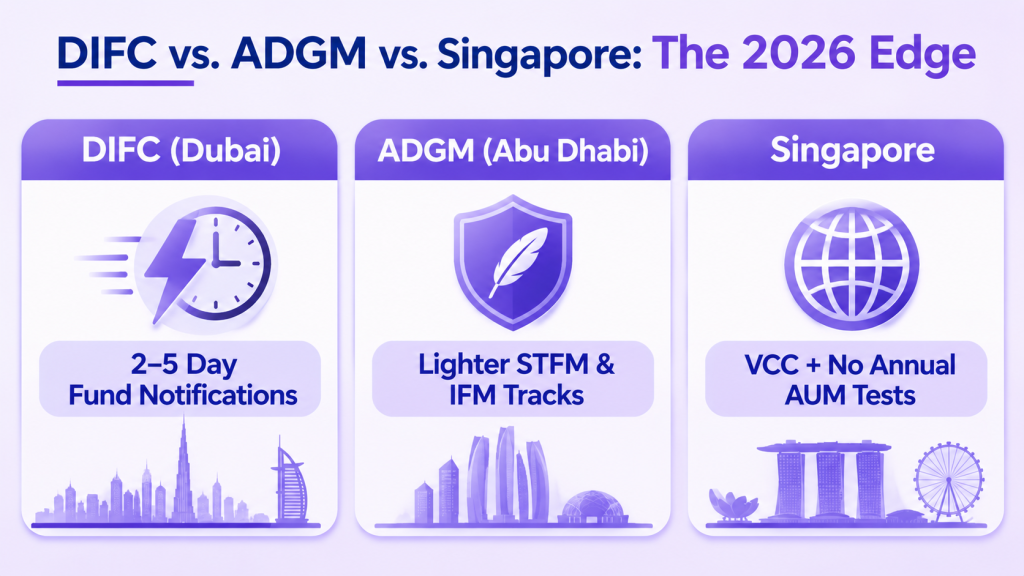
- DIFC (DFSA): Controls public, exempted, and qualified investor funds (QIFs), with accelerated two- to five-business-day notification of private fund formation, while July 2026 Consultation Paper No. 173 proposes replacing prescriptive specialist fund classes (like Credit Funds) with a unified risk-based framework
- ADGM (FSRA): Controls public, exempted, and QIF structures, and introduced a more relaxed Sub-threshold (STFM) and Institutional Fund Managers (IFM) licensing categories, effective 16 September 2026, eliminating the requirement for Finance Officers and internal audits for eligible managers
- Singapore (MAS): Implements a single Securities and Futures Act regulatory framework; post August 2024 RFMC repeal, commercial managers will need a Capital Markets Services (CMS) license (A/I LFMC, Retail LFMC, or VCFM)
Aligning the fund investors’ characteristics with these licensing regimes can ensure minimal governance costs going forward.
DIFC vs ADGM vs Singapore Fund Setup Comparison
Regulatory pathways, flagship vehicles, and taxes provide insight into how each hub helps in supporting various asset classes.
| Factor | DIFC (Dubai) | ADGM (Abu Dhabi) | Singapore |
| Regulator | DFSA | FSRA | MAS (licensing) & ACRA (VCC) |
| Core Manager Routes | Category 3C Domestic Manager, VC Manager, External Manager (under CP 173 review) | Full-Scope Category 3C, STFM, IFM, VCFM, Foreign Fund Manager | CMS Licence (A/I LFMC, Retail LFMC, VCFM) |
| Fund Categories | Public Fund, Exempt Fund, QIF | Public Fund, Exempt Fund, QIF | Authorised/Recognised Retail, Restricted, Exempt Private Funds |
| Key Fund Vehicles | Investment Company, Partnership, Trust, PCC/ICC | Investment Company, LP, Trust, PCC/ICC | Variable Capital Company (VCC), Unit Trust, LP |
| Fund-Level Tax Relief | UAE Qualifying Investment Fund (QIF) exemption | UAE Qualifying Investment Fund (QIF) exemption | Section 13O, 13OA, and 13U exemptions (through 2029) |
| Manager-Level Tax | 0% QFZP rate on qualifying income; 9% standard | 0% QFZP rate on qualifying income; 9% standard | 17% headline; 10% under FSI-FM (through 2028) |
How Do Tax Incentives and Fund Vehicles Differ?
Tax neutrality in the three hubs is dependent upon compliance with substance and governance requirements rather than the use of passive vehicles.
- DIFC & ADGM Tax Schemes: Both hubs operate on the same UAE federal taxation rules through Federal Decree-Law No. 47 of 2022. The Qualifying Investment Fund Corporate Tax Exemption applies to eligible funds according to Cabinet Decision No. 34 of 2025, while 0% corporate tax for Qualifying Free Zone Persons on their qualifying income, together with 0% personal income tax, applies to those running regulated fund management
- Singapore VCC & Tax Schemes: ACRA’s Variable Capital Company (VCC) supports standalone and umbrella sub-fund segregation as well as inward re-domiciliation. Sections 13O, 13OA, and 13U exempt qualifying fund income through 2029, while MAS Circular FDD Cir 05/2026 confirms designated investment rules, multi-manager co-management, and the removal of annual year-end AUM maintenance tests for non-SFO funds (while keeping entry AUM thresholds)
- Commercial Positioning: DIFC is at the forefront in the Dubai private wealth and credit landscape, ADGM matches perfectly with Abu Dhabi sovereign capital and debut or institutional sponsors according to 2026 STFM/IFM guidelines, and Singapore is the hub in ASEAN and North Asia institutional mandates
Selecting a vehicle based on the geographical location of the targeted investors and the substance requirements of the relevant jurisdiction preserves the tax benefit.
How We at Arnifi Support Multi-Jurisdiction Fund Setup
Arnifi provides a technology-based platform for international expansion where asset managers, founders, and institutions can create cross-border structures with efficiency, visibility, and clarity.
For sponsors comparing regional hubs, our specialists coordinate end-to-end Fund Setup in DIFC and Fund Setup in ADGM alongside institutional onboarding through dedicated Banking Services, keeping regulatory filings and fund launches on schedule.
Conclusion
Deciding on DIFC vs ADGM vs Singapore fund setup requires matching regulatory agility, fund vehicle design, and tax substance with investor geography.
DIFC is quick on DFSA Exempt Fund and QIF licenses in the Dubai business district, while the ADGM September 2026 STFM and IFM classifications allow for proportionate governance right next to the sovereign Abu Dhabi allocator base. In Singapore, MAS authority is combined with ACRA’s Variable Capital Company structure and tax exemptions under Section 13O, 13OA, and 13U until 2029.
Contact us at Arnifi to evaluate jurisdictions and launch a compliant investment fund seamlessly.
FAQs
1. Who regulates DIFC, ADGM and Singapore funds?
DIFC is regulated by DFSA, ADGM is regulated by FSRA, while Singapore is regulated by the Monetary Authority of Singapore (MAS).
2. What changes have been made in ADGM’s fund management regime in September 2026?
FSRA amended its fund manager categories to include STFM and IFM, along with the existing VCFM and Foreign Fund Managers.
3. What is the turnaround time for notifications of private funds in DIFC via DFSA?
DFSA’s service target is five business days for Exempt Funds and two business days for QIF notifications.
4. Why do international managers prefer using the VCC format in Singapore?
The VCC format facilitates an umbrella structure with ring-fenced sub-funds, flexible capital redemptions, and inward re-domiciliation.
5. Is there any automatic exemption from UAE corporate tax for DIFC and ADGM funds?
No. They have to meet the conditions set out in Cabinet Decision No. 34 of 2025 and obtain approval from the Federal Tax Authority under the Qualifying Investment Fund regime.
6. Can new fund managers register as RFMC in Singapore?
No. The RFMC framework was repealed by MAS as of 1 August 2024; new commercial fund managers are required to get the CMS license.
7. What is new about MAS Circular FDD Cir 05/2026 for Singaporean funds?
Issued in July 2026, this circular eliminated the annual year-end minimum AUM maintenance requirement for non-SFO Section 13O/13OA/13U funds, though initial entry AUM thresholds (S$5 million for 13O/13OA and S$50 million for 13U) still apply at application.
References
Dubai Financial Services Authority (DFSA), Collective Investment Funds
UAE Federal Tax Authority (FTA)
Monetary Authority of Singapore (MAS), FAQs on Licensing of Fund Management Companies
Accounting and Corporate Regulatory Authority (ACRA), Setting Up a Variable Capital Company (VCC)
Top Singapore Packages
Related Articles
Top Singapore Packages
Planning Your Next Business Move?
