
UAE vs Singapore for International Fund Management Companies

Nishant
Content Writer
Nishant Kumar is a technical content writer, he shares global business insights and bridges the gap between complex regulatory frameworks and actionable growth strategies.… Read more

Tulika Saxena
AVP, Sales & Marketing | IIM Nagpur
Tulika Saxena specializes in business finance, sales strategy, and market positioning. Leads growth and partnerships, ensuring seamless business setup experiences and client success across… Read more



Table of contents
Key Facts
- UAE vs Singapore fund management compares the UAE’s multi-regulator framework (onshore federal supervision by the CMA alongside separate financial free zones) with Singapore’s single-regulator regime overseen by the Monetary Authority of Singapore (MAS)
- As per Federal Decree-Laws No. 32 and 33 of 2025, the UAE’s CMA took over the SCA as the regulator of the onshore fund managers on 1 January 2026
- In Singapore, RFMC was abolished on 1 August 2024, and new commercial managers require MAS’s CMS license
Introduction
International asset managers expanding in the Middle East and Asia tend to weigh the UAE vs Singapore Fund Management regimes prior to setting up their regional hub. Both the UAE and Singapore provide institutional banking services and are part of extensive treaty agreements and effective regulation.
However, deciding which one to pick depends on assessing existing laws in 2026. Specifically, the shift of the UAE from the SCA to the CMA regime, along with Singapore’s RFMC termination and changes in fund taxes, has a direct impact on licensing and structuring decisions.
How Do Regulatory Frameworks Compare?
Singapore employs a single regulator system based on MAS under the Securities and Futures Act (SFA). In light of the August 2024 RFMC Repeal, the commercial managers will need a CMS license to be an Accredited/Institutional LFMC, Retail LFMC, or Venture Capital Fund Manager (VCFM).
UAE is one of the states that have a multi-regulator system. The Onshore UAE (on the mainland and non-financial free zones) is regulated federally by CMA under Federal Decree-Laws No. 32 and 33 of 2025, whereas independent financial free zones operate a parallel common law system. Through the UAE Funds Passporting regime, eligible UAE-domiciled funds licensed by one authority may be marketed across the UAE upon completing a passporting notification and fee (with private funds restricted to Professional Clients via private placement).
UAE vs Singapore Fund Management: Key Differences
Examining laws, investment vehicles, and taxation systems makes clear how each country suits certain investment mandates.
| Factor | UAE (Onshore & Financial Free Zones) | Singapore |
| Regulators | CMA onshore; independent regulators in financial free zones | Monetary Authority of Singapore (MAS) |
| Legal System | Federal civil law onshore; English common law in financial free zones | Unified national English common law |
| Manager Licence | CMA licence onshore; dedicated licences in financial free zones | CMS Licence (A/I LFMC, Retail LFMC, or VCFM) |
| Fund Vehicles | Onshore public/private funds; corporate, LP, trust, and cell vehicles in free zones | Variable Capital Company (VCC), Unit Trusts, LPs |
| Fund Tax Relief | Qualifying Investment Fund exemption (Cabinet Resolution No. 34 of 2025) | Section 13O, 13OA, and 13U exemptions (through 2029) |
| Manager Tax | 9% onshore (above threshold); 0% QFZP rate on qualifying free zone income | 17% headline rate; 10% under FSI-FM (through 2028) |
How Do Tax Incentives and Substance Rules Differ?
Both are characterized by competitive taxation alongside mandatory local substance requirements, as opposed to the use of shell structures.
- UAE Federal Tax Treatment: Pursuant to Federal Decree-Law No. 47 of 2022, Qualifying Free Zone Persons (QFZPs) located in DIFC and ADGM are eligible for the 0% corporate tax rate on qualifying income, with the default taxable profits rate standing at 9%. The funds that qualify for the Cabinet Decision No. 34 of 2025 requirements are eligible to apply for Qualifying Investment Fund exemption by means of EmaraTax, with respect to the application process governed by the FTA Decision No. 15 of 2026
- Singapore Tax Schemes: Fund managers may qualify for a 10% concessionary tax rate (down from 17%) on qualifying fee income under the Financial Sector Incentive – Fund Management (FSI-FM) scheme until 31 December 2028.
At the fund level, tax exemptions under Sections 13O, 13OA, and 13U apply until 31 December 2029, subject to minimum AUM, local business spending, and Singapore-based investment professionals
Choosing Between the UAE and Singapore
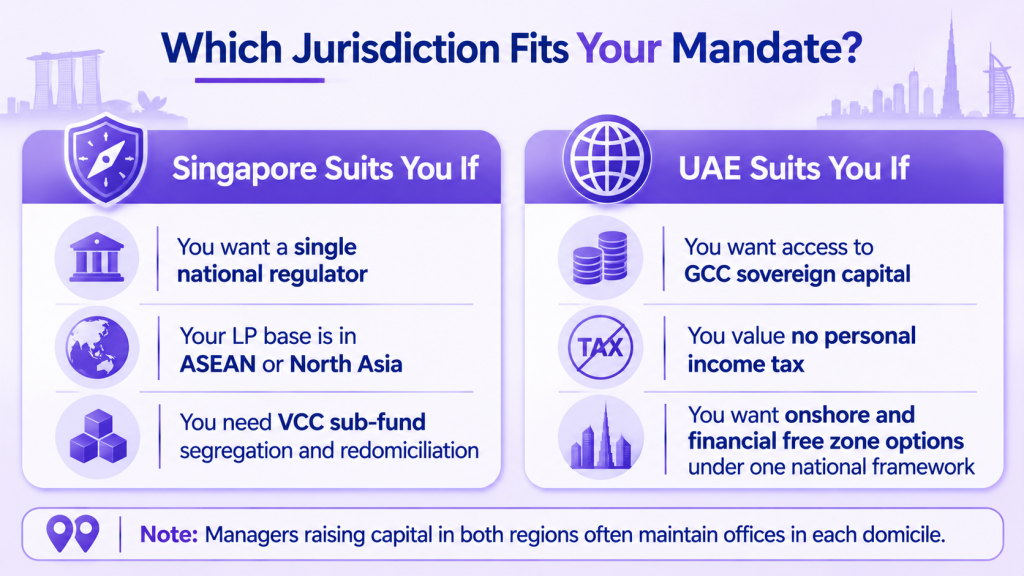
Domicile selection depends on geography and priorities. Singapore is appropriate for managers who desire only one national regulator, access to capital from both ASEAN and North Asia, and the ACRA Variable Capital Company (VCC) for sub-fund segregation and redomiciliation.
UAE provides the advantages of multi-jurisdictional domiciles by combining the regulatory access of an onshore CMA jurisdiction with common law financial free zones, in addition to sovereign capital from the GCC region and no personal income tax. Managers raising capital in both jurisdictions often maintain complementary offices in each domicile.
How We at Arnifi Support Cross-Border Fund Structuring
Arnifi provides an innovative digital platform for global expansion that allows entrepreneurs, asset managers, and corporations to set up cross-border corporate structures with efficiency, transparency, and ease of operation. Our digital CSP platform ensures all the steps in the process are streamlined.
For firms evaluating Middle Eastern expansion alongside Asian hubs, our specialists coordinate end-to-end Fund Setup in the UAE and institutional onboarding through dedicated Banking Services.
Conclusion
Comparing UAE vs Singapore fund management requires that the regulatory framework, tax benefits, and geographical location of LPs be matched to the long-term capital plan. The advantage of Singapore is the predictability of its one-regulator regime, including MAS, ACRA’s flexible Variable Capital Company structure, and Sections 13O, 13OA, 13U until 2029. On the other hand, the UAE offers CMA regulation, independent financial zones, UAE-wide Qualifying Investment Fund exemption, and the absence of personal income taxes.
Contact us at Arnifi to evaluate jurisdictions and structure compliant fund entities seamlessly.
FAQs
1. Who oversees fund management in the UAE?
Onshore UAE fund management is overseen by the Capital Market Authority (CMA), while the financial free zones have separate regulators.
2. Is it possible to continue registering as an RFMC in Singapore?
No. The MAS revoked the RFMC scheme on 1 August 2024; new commercial managers should get a CMS license.
3. Is it possible to market a UAE fund nationally?
Yes. According to the UAE Funds Passporting Scheme, eligible domestic funds licensed by an authority can be marketed throughout the UAE through a notification procedure (subject to investor-type restrictions, private funds remain limited to Professional Clients).
4. What is a Variable Capital Company (VCC) in Singapore?
Variable Capital Company (VCC) is a corporate structure regulated by ACRA for single funds and umbrella funds with segregated sub-funds.
5. Do Investment Funds receive an exemption from corporate tax in the UAE?
Yes. The qualifying Investment Funds satisfying Cabinet Resolution No. 34 of 2025 standards are eligible for federal corporate tax exemption.
6. What is the term for Singapore’s Section 13O and 13U allowances?
The Section 13O, 13OA, and 13U fund tax allowances in Singapore have been granted until 31 December 2029.
7. What is the difference in corporate tax at the manager level?
In the UAE, the corporate tax rate for managers is 9% onshore over AED 375,000 (or 0% as QFZPs), while the rate in Singapore is 17% (or 10% FSI-FM).
References
Capital Market Authority (CMA) UAE, Official Portal
UAE Legislation Portal, Cabinet Resolution No. 34 of 2025 (Qualifying Investment Funds)
UAE Federal Tax Authority (FTA), Corporate Tax Legislation
Monetary Authority of Singapore (MAS), Licensing of Fund Management Companies
Accounting and Corporate Regulatory Authority (ACRA), Variable Capital Company (VCC)
Top UAE Packages
Related Articles


Top UAE Packages
Planning Your Next Business Move?
