
UK Private Equity Fund Structures | Cross-Border Execution

Zahira Shaik
SEO Content Writer
Zahira Shaik is an SEO Content Writer and Published Author specializing in research-based content. She excels at analyzing market trends, regulations, and industry developments… Read more

Tulika Saxena
AVP, Sales & Marketing | IIM Nagpur
Tulika Saxena specializes in business finance, sales strategy, and market positioning. Leads growth and partnerships, ensuring seamless business setup experiences and client success across… Read more



Key Fact: More than 80 per cent of the UK-based private equity funds have opted for tax-transparent limited partnership structures using the Private Fund Limited Partnership (PFLP) regime.
Table of contents
- Introduction
- Core Legal Entities in a UK Private Equity Fund Structure
- The PFLP Regime: Modernising LP Protections and Operations
- Fund Economics: Management Fees, Carried Interest, and Distribution Waterfalls
- UK Tax Efficiency and Regulatory Framework
- Measuring Private Equity Fund Performance
- How Arnifi Simplifies Cross-Border Fund Management and Compliance
- Conclusion
- Frequently Asked Questions (FAQs)
- References
Introduction
UK Private equity fund structure refers to the institutional structure used to raise money from global investors with the aim of investing in, building, and divesting private enterprises. This structure uses the tax-transparent limited partnership structure in order to harmonise the incentives and safeguard assets. Private equity funds in the UK raise money from institutional investors in order to invest directly in the portfolio firms through specific operational vehicles. It features high regulatory stability, a predictable legal framework, and good access to global money.
It uses the limited partnership structures in order to allow direct flow of profits to investors without double taxation. Managers have used these architectural structures in order to combine the limited liability protection with effective governance control. Asset managers have chosen the UK as the base for launching because of its sophisticated legal environment and flexible investment regime.
Core Legal Entities in a UK Private Equity Fund Structure
A separation of duties in the operation between distinct corporate bodies is a key component of each fund in order to secure capital and ensure proper governance.
| Entity | Legal Personality | Core Role & Responsibilities | Key Operational Advantage |
| English Limited Partnership (ELP) | No | Default vehicle; partners hold underlying fund assets directly. | Standard, widely understood UK fund structure. |
| Scottish Limited Partnership (SLP) | Yes (under Scots Law) | Holds property, enters contracts, and sues/is sued in its own name. | Ideal for complex asset holding and master-feeder setups. |
| Private Fund Limited Partnership (PFLP) | Varies (ELP/SLP based) | Modernized 2017 UK regime tailored for collective investment schemes. | Streamlined admin filings and flexible LP protections. |
| General Partner (GP) | Yes (corporate entity) | Oversees compliance, executes strategy, and bears unlimited liability. | Complete administrative control and governance oversight. |
| Limited Partners (LPs) | Yes/No (varies by investor) | Institutional investors committing capital without managing operations. | Strict limited liability protection for passive capital. |
| Fund Manager | Yes | Handles daily fund operations and receives management fees directly. | Professional investment execution and portfolio oversight. |
| Carried Interest Partner (CIP) | Yes | Dedicated entity created to collect and distribute performance returns. | Efficient and tax-aligned carried interest distribution. |
| SPVs & Holding Companies | Yes | Sits between the fund and target assets to hold underlying investments. | Isolates liabilities and simplifies cross-border exit deals. |
The PFLP Regime: Modernising LP Protections and Operations
The Legislative Reform (Private Fund Limited Partnerships) Order 2017 replaced the old laws regarding partnerships for the benefit of private funds.
The new system allowed for eliminating the obligation to contribute capital and thus made it possible for the LPs to finance investments purely through capital loans. It also made it possible to eliminate the restriction on the refund of the capital within the operational life of the fund.
What is more important, the new system created a statutory “white list” of the actions that were allowed to LPs. LPs have the right to agree with the decisions of the GP, give advice, and join advisory committees while still keeping their limited liability status.
Fund Economics: Management Fees, Carried Interest, and Distribution Waterfalls
Private equity fund economics align investor financial goals with fund manager incentives across long-term investment cycles.
Private Equity Fund Lifecycle and Management Fees
The lifecycle of closed-ended funds is for 8 to 10 years that comprise an investment stage and a realization stage. The managers charge an annual fee of 1.5% to 2% of the total committed capital during the active investment stage. After the investment stage, the fees generally reduce and are charged based on net invested capital.
Understanding Carried Interest and the 80/20 Profit Split
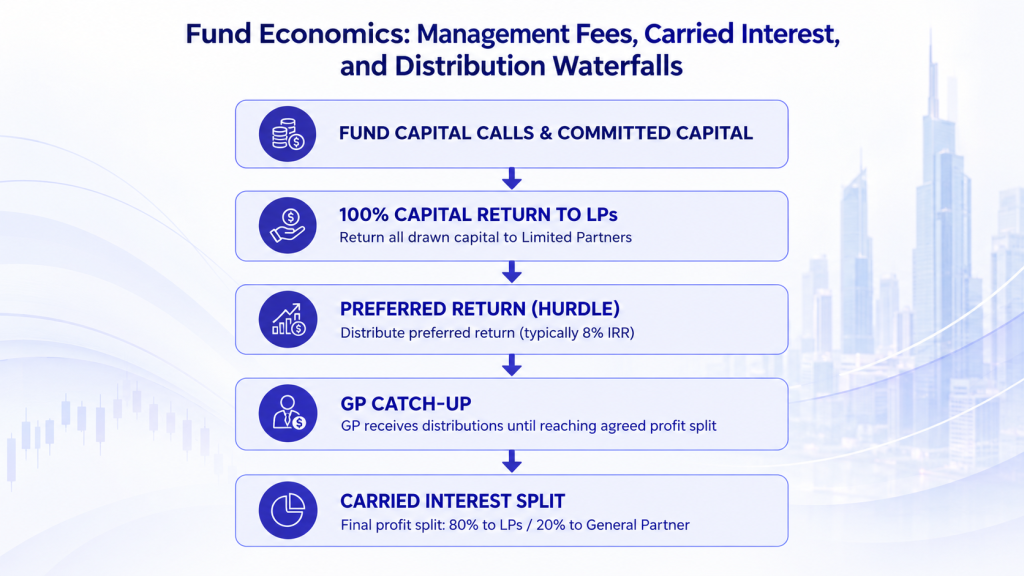
Carried interest acts as the major performance driver for private equity fund managers. Managers should meet the predetermined preferred return, which is normally 8% per year, before earning any carry from their efforts. When the fund exceeds this return, 80% of the profit goes to LPs and 20% to the fund manager.
European vs. American Distribution Waterfalls
The European whole-of-fund waterfall requires the GP to return all capital and preferred return of investors from the whole fund before any carried interest. The American deal-by-deal waterfall gives the managers the ability to take carried interest even when a particular investment is profitable within the fund.
This is to protect the LPs in case of excess carry due to an early successful deal that causes loss of capital in future deals. Escrow mechanisms lock up a portion of performance distributions until final fund liquidation to ensure complete repayment if necessary.
UK Tax Efficiency and Regulatory Framework
The UK offers a clear tax and regulatory environment for institutional private equity funds.
Tax Transparency in UK Limited Partnerships
In UK limited partnerships, there is full fiscal transparency in income and capital gains tax matters. There is no corporate tax paid by the partnership, and the income goes to individual partners, who will take care of it in their home countries.
Carried Interest Tax Treatment
The UK offers special tax treatment for performance allocations, and the carry is taxed according to the prescribed rate. Holding periods have to be well structured to avoid paying high employment income tax rates.
SPVs, Holding Companies, and Tax Considerations
The fund managers use local UK holding companies to take advantage of the large number of international double taxation agreements. Where applicable, fund structures can take advantage of the UK Substantial Shareholding Exemption (SSE) to avoid corporate gains tax on qualifying subsidiary disposals.
FCA Regulation and Investor Compliance
UK investment managers should obtain regulatory approval from the Financial Conduct Authority (FCA). The managers have to be very strict in their anti-money laundering (AML) and know-your-customer (KYC) screening of LPs.
Measuring Private Equity Fund Performance
The investors measure the performance of the private equity funds using standardized returns, time-weighted returns, and cash-based returns.
Internal Rate of Return (IRR)
Internal Rate of Return measures the compound annual growth rate of fund cash flows. Since IRR takes into account cash timing, fast cash flows yield high returns at the beginning of the fund life cycle.
Distributed to Paid-In Capital (DPI) and Total Value to Paid-In Capital (TVPI)
- DPI: Measures total realized cash returns generated relative to total capital drawn from LPs.
- TVPI: Combines realized cash distributions with remaining unrealized asset values against drawn capital.
Since-Inception Returns and Public Market Equivalents (PMEs)
Since inception return measures look at the performance trend for the whole period of operation of the fund. PMEs measure the cash flow from private equity investments against indices such as the FTSE All-Share.
How Arnifi Simplifies Cross-Border Fund Management and Compliance
Expansion into multiple jurisdictions necessitates solid management tools and comprehensive legal infrastructure.
Cross-Border Entity Setup and Fund Structuring
Arnifi provides complete services for entity creation in different financial hubs around the world. The manager uses our services to create multiple entity structures smoothly with statutory compliance in all the jurisdictions.
Visualising Complex Ownership Structures with Arni Organogram
It is important to maintain proper visual documentation when managing GP, LP, and holding companies. The Arni Organogram is used for creating complex chains of equity ownership structures visually.
LP Onboarding and AML Screening with Arni AML Checker
Onboard your LPs efficiently while adhering to FCA regulatory requirements. Utilize the Arni AML Checker for automated sanctions checking, background verification, and risk identification for limited partner onboarding.
Post-Setup Compliance, Accounting, and Documentation
Corporate governance demands organized documentation and corporate filings. ArniFi takes care of statutory compliance, accounting, and documentation through its digital platforms.
Global Team Expansion with Arnifi HR
Grow your fund management business operations smoothly into your desired international destinations. Arnifi HR provides EOR solutions for global payroll, visas, and employment compliance.
Conclusion
A resilient structure for a UK private equity fund involves striking the right balance between taxes, LP protections, and operational ease. Adopting the PFLP structure makes routine compliance much easier while ensuring proper governance standards.
Ensuring that the waterfalls, manager incentives, and compliance requirements all align from the start protects the future stability of your fund. Partnering with knowledgeable corporate administration specialists helps you operate smoothly in any jurisdiction.
Ready to deploy your funds or set up an investment vehicle spanning multiple borders? Contact Arnifi now to help you establish your corporate entity and onboard your LPs.
Frequently Asked Questions (FAQs)
1. What is a UK private equity fund structure?
It represents an institutional investment structure that leverages limited partnerships to raise capital from international investors in order to acquire and develop private businesses.
2. How does a UK limited partnership work for private equity funds?
The limited partnership structure divides functions between a General Partner, managing all operations and activities of the business and Limited Partners that invest money and have limited financial liability.
3. What is the difference between an English Limited Partnership (ELP) and a Scottish Limited Partnership (SLP)?
The key difference is that an ELP does not have separate legal entity status, while an SLP has it and can perform transactions.
4. What is a Private Fund Limited Partnership (PFLP) in the UK?
It represents a modern partnership regime for private funds that does not impose mandatory capital requirements and provides administrative flexibility.
5. What are the roles of a General Partner (GP) and Limited Partners (LPs)?
The General Partner manages the fund operations and bears full liability, whereas the Limited Partners are passive investors who have limited liability.
6. How does tax transparency work in a UK private equity fund?
The fund vehicle does not pay any tax but passes the tax responsibility directly to the individuals based on their residence.
7. What is carried interest in private equity?
It is the profit-sharing of the net gains earned by the managers after achieving a certain return preference of the fund.
8. What is the difference between a European and an American distribution waterfall?
In the European waterfall system, the fund capital has to be paid back to the investors before earning any carry, but in the American system, the carry gets paid deal by deal.
9. What is a GP clawback provision, and why is it important?
The clawback makes the managers give back the carried interest that exceeded their target returns if investment losses reduce overall returns below the pre-agreed targets.
10. How can Arnifi help with cross-border private equity fund structuring and compliance?
Arnifi digitizes multi-jurisdictional incorporation, onboarding of LPs, AML checks, and corporate compliance management all at once.
References
Top UAE Packages
Related Articles



Top UAE Packages
Planning Your Next Business Move?
