
UK Fund Administration | Services, Fees and Responsibilities

Zahira Shaik
SEO Content Writer
Zahira Shaik is an SEO Content Writer and Published Author specializing in research-based content. She excels at analyzing market trends, regulations, and industry developments… Read more

Tulika Saxena
AVP, Sales & Marketing | IIM Nagpur
Tulika Saxena specializes in business finance, sales strategy, and market positioning. Leads growth and partnerships, ensuring seamless business setup experiences and client success across… Read more


Key Fact: The outsourcing of operations to expert administrators greatly reduces fixed operating costs for fund managers while strictly meeting the FCA compliance guidelines.
Table of contents
- Introduction
- What Does Fund Administration Include?
- UK Fund Administration Costs: What Influences the Fees?
- In-House vs. Outsourced Fund Administration
- Key Challenges in UK Fund Administration
- The Role of Technology in Fund Administration
- Fund Formation vs. Ongoing Fund Administration
- How Arnifi Supports Fund Setup, Compliance, and Cost Management
- How to Choose the Right Fund Administration Partner
- Frequently Asked Questions
- Conclusion
- References
Introduction
UK fund administration includes all the operations, accounting, and servicing of investors of investment funds while keeping operations efficient and transparent. Proper administration is necessary for fund managers as they have to adhere to certain regulations.
Administration costs will impact the net gain of the fund; hence, it is critical to have visibility of the cost of UK fund administration when creating a plan of operation.
What Does Fund Administration Include?
Fund administration is responsible for back-office activities that allow investment teams to concentrate on portfolio growth.
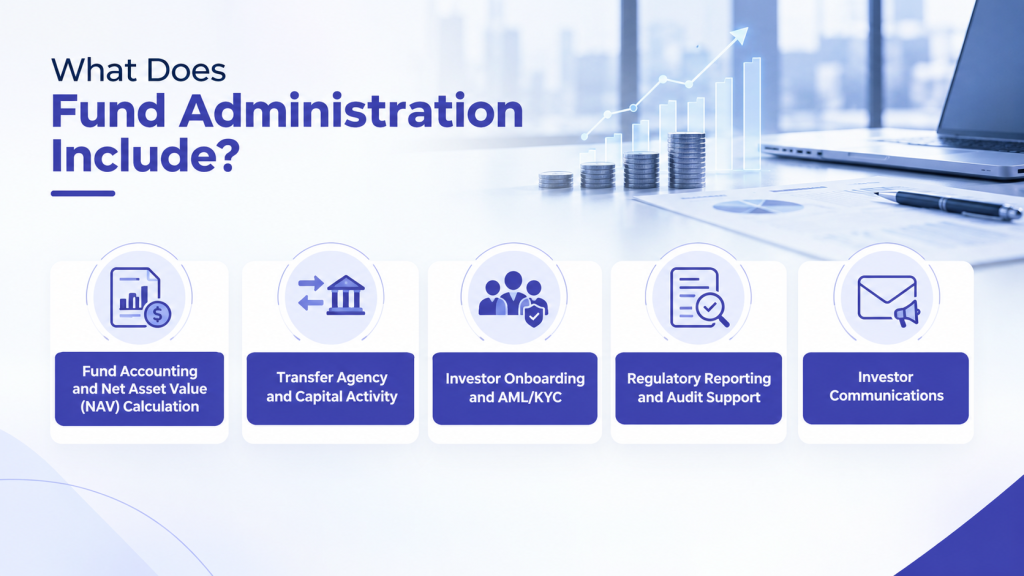
Fund Accounting and Net Asset Value (NAV) Calculation
They keep the general ledger, record income and expenses, reconcile bank and custody accounts, and accurately calculate Net Asset Value (NAV) or unit pricing.
Transfer Agency and Capital Activity
This service provides support for investor commitments, subscriptions, capital calls, distributions, share transfers, and investor redemptions.
Investor Onboarding and AML/KYC
The administration reviews subscription documentation, conducts investor identification, performs source of funds checks, sanctions screening, and provides secure portal access to the investor.
Regulatory Reporting and Audit Support
The service provider keeps the financial records, coordinates external audits, and files statutory required reports.
Investor Communications
Fund administrators send periodic account statements, performance reporting, and tax documentation to limited partners.
UK Fund Administration Costs: What Influences the Fees?
Knowledge about how UK fund administration costs scale will help managers set up an appropriate budget for operations.
Scope of Services
The retainers for all-around services that include fund accounting, transfer agency, and regulatory reporting are higher than those for simple accounting services.
Fund Structure and Complexity
The complexity of the structure of the fund, including such factors as master/feeder structures, several SPVs, multi-currency classes, or international assets, adds to operational overheads.
Technology and Infrastructure
Modern administrative software, reporting portal, and data pipelines add to the cost of technology licensing.
Regulatory and Compliance Requirements
Cross-border reporting requirements, FATCA/CRS, and other types of compliance add to the administrative hours spent.
In-House Staffing and Expertise
Hiring in-house specialists involves considerable costs of hiring, high salaries, managing staff turnover, training, and software user licences.
Transparent Pricing and Cost Planning
The fund manager should calculate additional costs, like out-of-pocket costs, audit support or per-investor onboarding fees before signing a contract.
In-House vs. Outsourced Fund Administration
Fund managers have to take into consideration that the need for operational control comes with a price tag of increased overhead.
Building an In-House Administration Team
Creation of an in-house team means engaging specialized accountants, buying license keys for software, and implementing backup systems, thus having considerable fixed overheads.
Benefits of Outsourcing
Outsourcing offers immediate access to highly experienced professionals, pre-made technology, cost savings on common infrastructure, and scalable operations.
The Hybrid Administration Model
Managers have a possibility to retain in-house control of funds while entrusting specific tasks such as fund accounting or NAV calculations to outside experts.
| Feature | In-House Model | Outsourced Model | Hybrid Model |
| Fixed Cost Overhead | High | Low | Moderate |
| Operational Control | Direct | Indirect / SLA-based | Shared |
| Scalability | Resource Constrained | Rapid | Flexible |
| Technology Burden | Internal Maintenance | Provider Managed | Mixed |
Choosing the Right Model
Model selection is determined by the total size of the fund, complexity of the strategy, available internal capacity, and future projections regarding fundraising.
Key Challenges in UK Fund Administration
Contemporary management of funds confronts increasing regulatory requirements and operational issues.
- Increasing Compliance Costs: Changing regulatory standards bring about additional costs and prolonged operational processes.
- Manual Data Processing: Outdated spreadsheet-based processes bring in the risk of human errors and delays in reconciliation processes.
- Fragmented Service Providers: Coordination of multiple disconnected service providers results in information barriers, duplicative efforts, and operational difficulties.
- Talent and Retention Challenges: Intense competition for skilled fund accountants makes internal staffing hard to ensure.
- Maintaining Reporting Accuracy: Mismatches in data affect investor reporting and the auditing process.
The Role of Technology in Fund Administration
Software automates processes that were previously done manually.
Integrated Administration Platforms
Software packages integrate accounting, transactions, and bookkeeping for better visibility of information.
Automation and Reconciliation
Automation makes cash reconciliation and transaction matching easy and reduces errors.
Digital Investor Portals
Web portals provide an interface where investors can access statements and review portfolio activity.
AI-Assisted Workflows
Artificial Intelligence helps in extracting information from unstructured data, completing subscription forms, and responding to investors’ queries.
Technology Evaluation
Integration flexibility, report accuracy, security, and scalability must be checked by managers.
Fund Formation vs. Ongoing Fund Administration
Setup and administration of the entity are two different processes.
Understanding Fund Formation
Fund formation refers to the process of legal formation of corporations, holding companies, GPs, feeder funds, and regional SPVs.
Cross-Border Fund Structuring
Often, investment structures are created across different jurisdictions such as the UK, Cayman Islands, British Virgin Islands, UAE, Singapore, Luxembourg, and Ireland.
Understanding Ongoing Fund Administration
Ongoing administration deals with activities such as portfolio accounting, calculation of NAV, communication with investors, and regulatory reporting on a periodic basis.
Corporate Compliance vs. Specialized Administration
Corporate compliance ensures that the entities remain compliant with regulations, while fund administrators perform specific accounting and transfer agency work.
Why the Distinction Matters
Distinguishing between formation and ongoing administration helps managers plan budgets, select suitable vendors, and avoid operational coverage gaps.
How Arnifi Supports Fund Setup, Compliance, and Cost Management
Arnifi streamlines fund operations by managing multi-jurisdiction entity formation, corporate compliance, and banking setup. Tools like Arni Organogram and Arni Cost Calculator assist with structure visualization and UK fund administration cost planning. Furthermore, Arnifi provides corporate bookkeeping, automated AML checks, standardized legal documentation via Arni Docs, and international staffing support through Arnifi HR.
How to Choose the Right Fund Administration Partner
The selection of an administration service provider should be based on readiness according to several criteria:
- Asset-Class Expertise: Providers with experience in the type of asset class you are dealing with – private equity, venture capital, real estate, or private credit.
- Service Scope: Confirmation that the scope encompasses your accounting, investor service, and reporting needs.
- Technology Infrastructure: A system with secure investor portals, advanced automation capabilities, and easy data integration.
- Regulatory Expertise: Providers with good knowledge of the regulatory requirements of the jurisdictions you will operate in.
- Fee Transparency: Request a detailed fee schedule to uncover any potential hidden fees or additional costs.
- Scalability: Make sure that the administrator can handle additional funds and investors.
- Service Consolidation: The consolidation of corporate formation and administration services with reliable providers eliminates vendor management issues.
Frequently Asked Questions
1. What is fund administration in the UK?
Fund administration refers to operational, accounting, investor servicing, and compliance-related activities related to UK-domiciled or managed funds.
2. What services does a fund administrator provide?
The most important services include fund accounting, NAV calculation, transfer agency, investor onboarding, AML/KYC screening, regulatory reporting, and financial audit services.
3. What factors influence UK fund administration costs?
Costs depend on the fund structure, complexity of the strategy, volume of transactions, number of investors, IT requirements, and extent of regulatory reporting.
4. How much does fund administration cost in the UK?
Prices vary greatly depending on the fund’s size, strategy, and scope. Service providers use both a fixed annual retainer and a basis point fee calculated based on Net Asset Value.
5. Is outsourced fund administration cheaper than an in-house team?
Yes. Outsourcing removes the cost of internal overheads such as salaries of executives, license fees for software, and other office costs.
6. What is the difference between a fund administrator and a fund manager?
The fund manager determines portfolio investments. The fund administrator deals with back-office accounting, NAV calculation, investor accounts, and administration.
7. What is included in fund accounting and NAV calculation?
It covers booking of portfolio transactions, reconciliation of bank and custody books, expense tracking, NAV calculation, and unit pricing.
8. Do all funds need a third-party fund administrator?
Although certain private structures handle operations within their internal structure, institutional clients normally need an independent third-party administrator.
9. How can Arnifi help with fund setup and ongoing corporate compliance?
Arnifi provides multi-jurisdiction entity establishment, corporate bookkeeping, compliance, organogram development, and bank account opening.
10. Does Arnifi provide NAV calculation and transfer agency services?
Not really. Arnifi is responsible for entity establishment and accounting support but not fund-level NAV calculations and transfer agency services.
Conclusion
It takes a balance of in-house skills and external specialist services to develop an efficient fund operations process. The clear knowledge about the cost of UK fund administration will allow managers to choose partners based on the specifics of the fund, targeted asset class, and business growth strategy.
Ready to simplify the process of setting up your operations? Discover Arnifi’s Entity Setup Solutions for a smooth establishment of multi-jurisdictional structures. Plan your corporate costs beforehand using the Arni Cost Calculator or draw your corporate structure using Arni Organogram.
References
Top UAE Packages
Related Articles



Top UAE Packages
Planning Your Next Business Move?
