
Setting Up a UK Hedge Fund: A Complete Guide to FCA Authorisation

Zahira Shaik
SEO Content Writer
Zahira Shaik is an SEO Content Writer and Published Author specializing in research-based content. She excels at analyzing market trends, regulations, and industry developments… Read more

Tulika Saxena
AVP, Sales & Marketing | IIM Nagpur
Tulika Saxena specializes in business finance, sales strategy, and market positioning. Leads growth and partnerships, ensuring seamless business setup experiences and client success across… Read more


Key Fact: Creating a hedge fund in the UK involves both structuring, which means creating a UK investment management entity and a dedicated fund vehicle, in order to comply with FCA requirements and achieve the most efficient tax planning.
Table of contents
- Introduction
- Understanding the Dual-Entity Structure of a UK Hedge Fund
- How to Obtain FCA Authorisation for a UK Hedge Fund
- Choosing Between a UK LLP and a Limited Company
- Understanding Hedge Fund Structures and Offshore Domiciles
- Building a Hedge Fund’s Core Team and Service Provider Network
- UK Hedge Fund Setup Costs and First-Year Operating Budget
- How Arnifi Supports UK Hedge Fund Setup and Global Operations
- Conclusion: Planning Your UK Hedge Fund Launch
- References
Introduction
Creating a hedge fund in the UK implies having a solid background that will distinguish an investment management entity from the fund vehicle. The process of creating such a hedge fund requires going through the procedure of getting authorisation from the Financial Conduct Authority (FCA), as well as doing the right structuring and tax planning. In addition, it is important to be operationally ready in terms of prime brokerage, legal, administration, and compliance services. This guide gives comprehensive information on regulatory processes, management structures, offshore structures, and other aspects of launching a competitive global hedge fund business in the UK.
Understanding the Dual-Entity Structure of a UK Hedge Fund
The typical hedge fund structure for the UK involves a dual entity structure aimed at segregating operational risk and defining the parties’ responsibilities.
The UK Investment Management Entity
The UK investment management entity acts as an operating company that hires investment staff, oversees office space, makes investment decisions and executes business development activities.
The Fund Vehicle
The fund vehicle is responsible for collecting money from institutional and qualified investors. The fund vehicle holds the portfolio assets and takes the liability while protecting the operating company from trade risks.
How the Manager and Fund Vehicle Work Together
The manager and the fund vehicle are bound by an Investment Management Agreement (IMA), where the manager provides investment decisions and execution, and in turn the fund provides fees to the manager.
How to Obtain FCA Authorisation for a UK Hedge Fund
Getting regulatory authorisation is an important step in establishing a UK hedge fund.
Direct FCA Authorisation
Those who want to obtain authorisation directly have to make a Part 4A permission application through the FCA Connect portal, stating their operational resilience, financial resources, and compliance systems.
Small Authorised UK AIFM vs. Full-Scope AIFM
If the Assets Under Management (AUM) are below €100m (leveraged) or €500m (unleveraged with a 5-year lock-up period), a manager may register himself/herself as a Small Authorised UK AIFM. However, managers who exceed these thresholds are subject to the Full-Scope AIFM category, which involves higher capital requirements, appointment of the depositary and rules on remuneration.
UK Mind and Management Requirements
The FCA demands that there should be real “mind and management” in the UK. Key persons, senior management and compliance officers should be physically located in the UK and exercise their functions under the SMCR regime.
FCA Application Timelines
Review periods under the law can extend from 3 to 6 months for complete applications, although incomplete applications can take up to 12 months.
Using a Regulatory Host or Umbrella Platform
New fund managers can establish their hedge funds in the UK by employing a regulatory host or sandbox. This way, they can conduct trading as an appointed representative during the review of their complete application.
Choosing Between a UK LLP and a Limited Company
Determining the structure of the management entity requires deciding whether to form a Limited Liability Partnership (LLP) or Limited Company (Ltd).
Setting Up a Limited Liability Partnership (LLP)
LLPs have a tax-transparent nature that enables direct income distribution among partners and their personal taxation without corporate-level tax payment.
Setting Up a UK Limited Company (Ltd)
Ltd companies have the obligation to pay Corporation Tax on company income and keep the money within the business by using it as salary, bonus, or dividend payments to employees.
Tax Considerations and HMRC Anti-Avoidance Rules
HM Revenue and Customs regulate such rules as Salaried Member Rules (capital contributions, variable remuneration, and management) and Mixed Membership Rules in order not to avoid taxation inappropriately between the individual member and the corporate member.
How to Choose the Right Management Entity
LLP is beneficial for the partnership equity model, while Ltd is appropriate for managers who want to keep the money in the business.
Understanding Hedge Fund Structures and Offshore Domiciles
Structuring the fund vehicle depends on target investor tax status and geographical location.
Master-Feeder Fund Structure
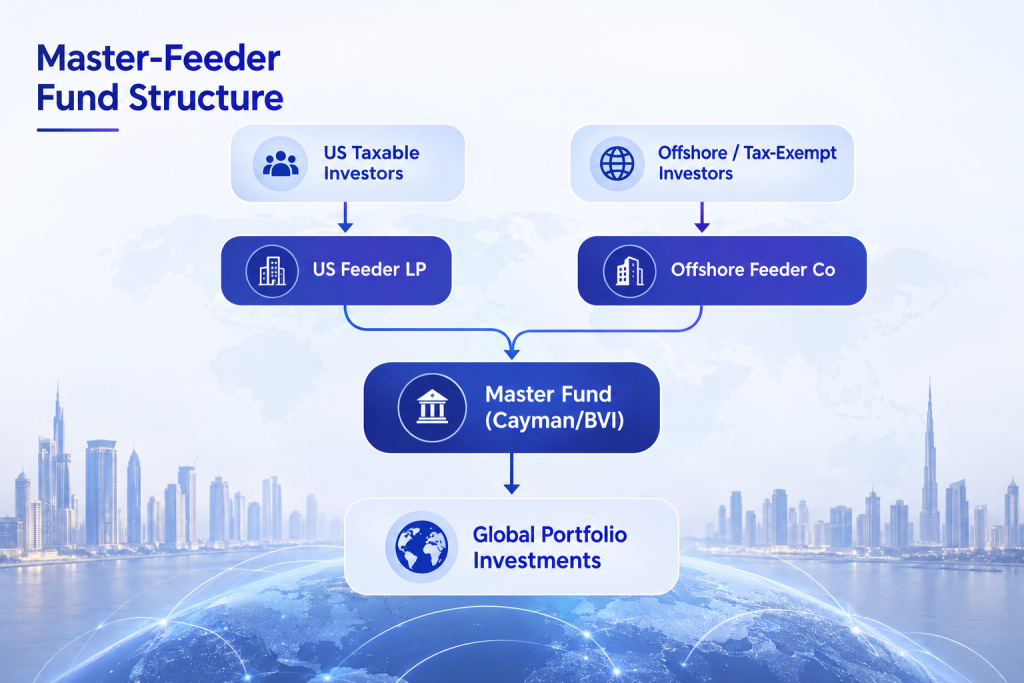
The master-feeder structure allows investment capital to be raised from various categories of investors like US taxable investors (through US Feeder) and offshore/US tax-exempt investors (through Offshore Feeder) to feed into a single master fund.
Stand-Alone and Parallel Fund Structures
Stand-alone funds are applicable to one-jurisdiction approaches, while parallel funds operate side by side to meet certain needs of sovereigns or institutions.
Choosing a Fund Jurisdiction
Favored jurisdictions include the Cayman Islands and British Virgin Islands (BVI) for international flexible pooling, and Ireland and Luxembourg for EU-compliant UCITS or AIFMD distribution.
Factors Influencing Jurisdiction Selection
Jurisdiction selection is influenced by target investor preference, tax treaties, regulatory costs, and the asset class approach.
Building a Hedge Fund’s Core Team and Service Provider Network
The ideal UK hedge fund structure is one with good internal governance and credible external service providers.
Key Internal Roles
Internal positions are usually those of the Chief Investment Officer (CIO) for strategy implementation, Chief Operating Officer (COO) for infrastructure support, and other positions of Compliance Officers (CF10/CF11).
Legal Counsel and Prime Brokers
Legal advisors provide offering memorandums (PPM), whereas prime brokers are involved in trade execution, margin financing, securities lending, and clearing.
Fund Administrators
A fund administrator calculates the independent Net Asset Value (NAV), maintains the investor registry, and performs the Anti-Money Laundering (AML) process for new investors.
Auditors and Tax Advisors
Auditors independently review the annual statements of the funds, whereas tax advisors provide advice on reporting in line with UK & cross-border FATCA/CRS regulations.
Operational Due Diligence
Institutional investors go through ODD on internal controls, IT infrastructure, and stability of vendors before committing money to the fund.
UK Hedge Fund Setup Costs and First-Year Operating Budget
Securing adequate capitalization is vital for a smooth operational runway.
Initial Legal and Regulatory Setup Costs
Establishment costs normally fall between £100,000 and £250,000+, including legal structuring, regulatory consulting, FCA fee structure, and incorporation.
Recurring Operating Expenses
These recurring costs include salaries of staff, compliance monitoring software, market data, auditing fees, funds administration, and minimum prime brokerage.
Understanding Break-Even Assets Under Management (AUM)
Based on fee structure (for example, a 1.5% management fee), the majority of UK hedge funds need $50M to $100M AUM to achieve break-even.
Planning the Fund’s Financial Runway
Hedge fund founders will require 18 to 24 months of financial runway for the fund before increasing AUM.
How Arnifi Supports UK Hedge Fund Setup and Global Operations
Arnifi simplifies the corporate and administrative structure of your UK hedge fund business.
- Multi-Jurisdictional Entity Formation: Manage the incorporation process smoothly within the UK, Cayman Islands, BVI, Luxembourg, and UAE.
- Corporate Ownership Mapping: Leverage Arni Organogram to draw out and keep track of complicated ownership and management structures of funds.
- AML Screening and Document Support: Make use of Arni AML checker and Arni Docs for investor due diligence and international document certification.
- Ongoing Corporate Compliance and Accounting: Manage the corporate health of your entity through automated filings, accounting, and registrations.
- International Hiring and Mobility: Hire trading and technical personnel internationally through Arnifi HR and Employer of Record services.
Note: FCA authorization, regulated fund management, and investment advice need the assistance of a professional who is directly authorized by the regulators and the financial authorities.
Conclusion: Planning Your UK Hedge Fund Launch
Establishing a hedge fund in the UK entails the intricate interplay of regulation by the FCA, choice of entity, choice of domicile for the fund, and selection of vendor partners.
Planning to be successful in the long run? This entails aligning your regulatory and tax approach with your specific fund and investor strategies.
Set up your fund? Check out our global incorporation and compliance services.
Frequently Asked Questions
Q: How long does FCA authorisation take for a UK hedge fund?
Authorisation for the FCA typically takes 3 to 6 months for a complete application, and 12 months for an incomplete one.
Q: What is the main difference between an LLP and a Ltd company?
LLP offers tax transparency to partners, whereas a Ltd company pays corporation tax and retains profits.
Q: What is the AUM threshold for a Full-Scope AIFM?
The AUM threshold is €100 million for leveraged AIFMs or €500 million for unleveraged 5-year locked-up AIFMs.
Q: What is a Master-Feeder fund structure?
This structure pools investments from distinct US and offshore feeder entities into one master entity.
Q: What is the typical break-even AUM for a UK hedge fund?
The typical break-even AUM of a UK hedge fund is $50 million to $100 million.
Q: Why use a regulatory host for launching a hedge fund?
Using the regulatory host enables managers to set up their own hedge fund as an appointed representative.
References
- Financial Conduct Authority (FCA): fca.org.uk – UK financial regulator governing Part 4A permissions and AIFM registrations.
- HM Revenue & Customs (HMRC): gov.uk/government/organisations/hm-revenue-customs – UK tax authority governing LLP partnership tax, Salaried Member rules, and corporate taxes.
- Cayman Islands Monetary Authority (CIMA): cima.ky – Regulatory body for Cayman Islands fund vehicles.
- European Securities and Markets Authority (ESMA): esma.europa.eu – EU authority regulating cross-border fund distribution and AIFMD frameworks.
Top UAE Packages
Related Articles


Top UAE Packages
Planning Your Next Business Move?
