
Complete Guide to Launching a VC Fund in the UK | Legal Architecture and Operations

Zahira Shaik
SEO Content Writer
Zahira Shaik is an SEO Content Writer and Published Author specializing in research-based content. She excels at analyzing market trends, regulations, and industry developments… Read more

Tulika Saxena
AVP, Sales & Marketing | IIM Nagpur
Tulika Saxena specializes in business finance, sales strategy, and market positioning. Leads growth and partnerships, ensuring seamless business setup experiences and client success across… Read more



Key Fact: In excess of 80% of venture capital funds established in the UK rely on Private Fund Limited Partnerships (PFLP), and it will likely take from 3 to 12 months just to navigate FCA regulatory path and set up a proper venture capital fund in the UK.
Table of contents
- 1. Pre-Launch Readiness: The 5 Questions Every Emerging GP Must Answer
- 2. The 5-Part UK Fund Structure: PFLP Architecture Explained
- 3. Navigating FCA Regulatory Pathways: Direct Authorisation vs. Host AIFM
- 4. Fundraising Compliance: Financial Promotion Rules (Section 21 FSMA)
- 5. Fund Economics, Distribution Waterfalls and Carried Interest Tax
- 6. Investor Tax Incentives: EIS, SEIS and VCT
- 7. Operational Build, Investor Onboarding and AML Compliance
- 8. How Arnifi Simplifies UK VC Fund Setup and Global Operations
- 9. UK VC Fund Launch Timeline, Cost Breakdown and Final Checklist
- 10. Frequently Asked Questions (FAQs)
- References
1. Pre-Launch Readiness: The 5 Questions Every Emerging GP Must Answer
There are five questions that any emerging GP should ask themselves before setting up legal entities or filing anything with regulators:
- Evaluating Deal Track Record: Any GP must have a credible track record in deal sourcing, execution, and exiting with angels, founder liquidity, or prior VC experience.
- Management Fee Arithmetic: 2% management fees based on early closes may not suffice to cover salary, legal expenses, and regulatory fees. It will be important for GPs to know if there is any way in which PPS or fee offset is enough.
- Funding Pre-Close Build and GP Commitment: Founders need to budget £50,000 to £150,000+ as a reserve for 6-12 months of pre-fund close work along with 1%–2% GP commitment.
- Testing Cornerstone Investor Demand: Soft commitments do not hold water. New GPs must have written soft commitments or non-binding LOI from cornerstone LPs.
- Blind-Pool Fund vs. SPVs: For an inexperienced track record, it would make sense to use an SPV model before launching a blind pool.
2. The 5-Part UK Fund Structure: PFLP Architecture Explained
Why Choose a UK Onshore Structure?
UK onshore fund structures offer tax transparency, statutory LP protection, greater institutional familiarity, and reduced administration hassle than any offshore structures.
The Fund Vehicle (PFLP)
Private Fund Limited Partnership (PFLP) represents the typical vehicle for the UK venture capital fund structure.
- English LP vs. Scottish LP: Though English LP is commonly adopted, Scottish LP has distinct legal identity, making it possible to hold assets, contract, and act as feeder or carry vehicle in its own right.
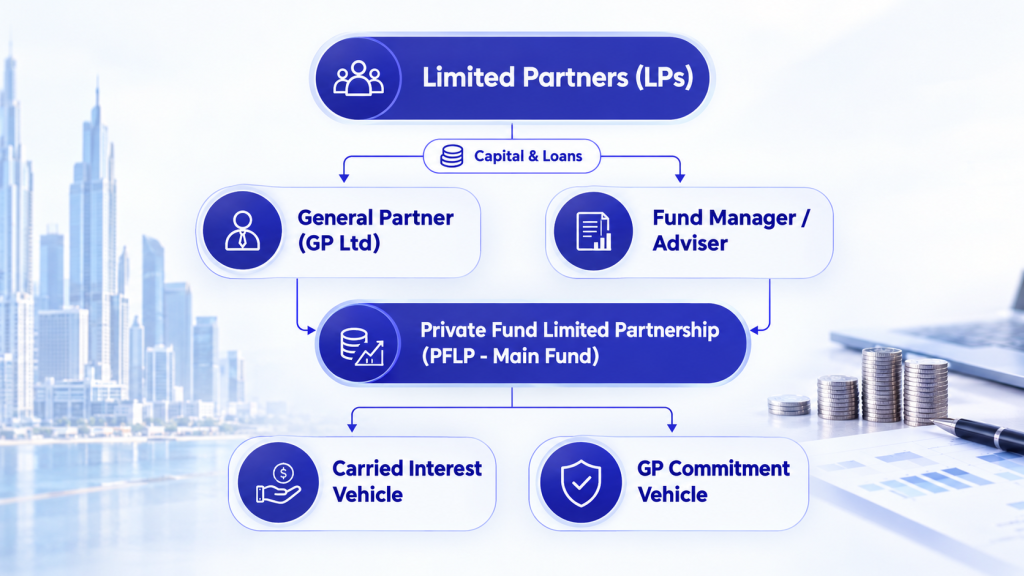
Capital vs. Partnership Loans
In order to make capital repayments without any statutory restrictions on capital reductions, LP contributions are divided into nominal capital (e.g., 0.01%) and partnership loans (99.99%).
The Statutory “White List”
The Legislative Reform (Private Fund Limited Partnerships) Order 2017 includes a “white list” of activities allowed by LPs without losing their limited liability protection. An LP may participate in advisory committees, approve valuation, and vote on important issues of the fund without losing its limited liability.
The Four Supporting Entities
- General Partner (GP): The UK limited company solely responsible for unlimited liability of the partnership.
- Fund Manager / Investment Adviser: The operating company (Ltd/LLP) which employs the team and manages investment strategy.
- Carried Interest Vehicle (Carry LP): The partnership used to pool and distribute performance profit among the team members.
- GP Commitment Vehicle: The entity holding the founding team’s co-investment capital.
3. Navigating FCA Regulatory Pathways: Direct Authorisation vs. Host AIFM
Amongst the many decisions that need to be made when setting up a venture capital fund in the UK is deciding how the investment management function will adhere to FCA regulations.
| Feature | Direct Authorisation (Small Authorised AIFM) | Host AIFM / Appointed Representative (AR) |
| Launch Timeline | 6–12 months | ~3–4 months |
| FCA Direct Oversight | Full direct regulatory relationship | Principal firm oversees AR activities |
| Upfront Cost | Higher legal and FCA filing fees | Lower upfront, recurring principal fees |
| Operational Control | Complete autonomy over compliance | Subject to principal framework & monitoring |
FCA Application Timelines
FCA authorization will be contingent on submission of a comprehensive regulatory business plan, a compliance monitoring regime and a fit-and-proper assessment. It takes about 3 to 6 months for statutory assessment when it is considered complete.
Upcoming Regulatory Reforms
The FCA and HM Treasury’s pending reforms aim to phase out the traditional “small versus full-scope” classification system and introduce a three-tier framework for classification based on the NAV:
- Small AIFM: NAV up to £750M
- Medium AIFM: NAV £750M to £5B
- Large AIFM: NAV exceeding £5B
4. Fundraising Compliance: Financial Promotion Rules (Section 21 FSMA)
The promotion of a venture capital fund within the UK is covered by the financial promotion regime outlined in Section 21 of the Financial Services and Markets Act 2000 (FSMA). Any pitch decks, term sheets, and teaser emails are considered restricted communications and can be issued or approved only by an authorized firm by the FCA, or exclusively to exempt persons under the FSMA (Financial Promotion) Order 2005 (FPO).
Qualifying Investor Exemptions (FPO 2005)
- Investment Professionals (Article 19): Authorised firms, financial institutions, and professional investors.
- High Net Worth Companies/Trusts (Article 49): Corporate entities with share capital or net assets of at least £5M (or £500,000 for entities with more than 20 members).
- Certified High Net Worth Individuals (Article 48): Individuals confirming annual income of £170,000+ or net assets of £430,000+ (excluding primary residence and pensions).
- Self-Certified Sophisticated Investors (Article 50A): Investors who meet criteria such as serving as a director of a company turning over £1.6M+ or having made prior unlisted private equity investments.
Cross-Border Marketing
The raising of capital outside the UK will involve compliance with National Private Placement Regimes (NPPRs) for each jurisdiction within the EU under the AIFMD or use of private placement exemption provisions in regions like the US or GCC.
5. Fund Economics, Distribution Waterfalls and Carried Interest Tax
Priority Profit Share (PPS) Mechanics
Management expenses are always paid via a Priority Profit Share paid to the GP from profits of the fund as opposed to taxable management service fees, thus avoiding VAT leakage from the fee payments.
Distribution Waterfalls: European vs. American
- European (Whole-of-Fund) Waterfall: The LP gets back its entire invested capital and a negotiated preferred return (usually 6% to 8% per annum) on the entire portfolio before the GP is paid its 20% carry.
- American (Deal-by-Deal) Waterfall: It is measured on a deal-by-deal basis for each exiting company in the portfolio, which means that clawback is usually involved in order to guarantee that the returns for the entire fund are safe.
The UK Carried Interest Tax Regime
It is regarded as part of the income taxation system and considered as deemed trading profit.
- Qualifying Rate: For qualifying carry, there is a 72.5% multiplier; hence, the resulting effective tax rate is about 34.1% (Class 4 NICs included) for additional rate taxpayers.
- Average Holding Period (AHP): To qualify, the holding period should be at least 40 months. Carry-on assets which are held for less than 36 months are fully taxed as trading income (47%).
6. Investor Tax Incentives: EIS, SEIS and VCT
Tax relief incentives help high-net-worth individuals within the UK become invested in growth assets at an early stage:
- Seed Enterprise Investment Scheme (SEIS): Gives up to 50% tax relief from UK income tax on investments in qualifying early-stage firms, as well as capital gains tax relief when reinvesting the gains.
- Enterprise Investment Scheme (EIS): Gives up to 30% tax relief from UK income tax, deferred capital gains tax, and tax-exempt gain on exit from investments in qualifying growth-stage firms.
- Venture Capital Trusts (VCTs): Publicly quoted, tax-efficient investment vehicles giving retail investors 30% tax relief from UK income tax, as well as tax-exempt dividends when purchasing shares in qualifying growth platforms.
Fund managers planning on setting up a UK venture capital fund will likely tailor their fund mandates to invest in SEIS/EIS qualifying rounds.
7. Operational Build, Investor Onboarding and AML Compliance
Customer Due Diligence (CDD) Under MLR 2017
Under the UK Money Laundering Regulations 2017, GPs are required to conduct thorough onboarding checks for each LP before taking capital:
- Identity verification and source-of-funds verification.
- Ultimate Beneficial Owner (UBO) identification for corporate structures (>25% ownership threshold).
- Politically Exposed Persons (PEP) checks, global sanctions screening, and adverse media monitoring.
Essential Fund Service Providers
- Fund Administrator: Manages capital calls, distribution calculations, and NAV accounting.
- Auditor & Tax Adviser: Prepares partnership tax returns and annual audited financial statements.
- Corporate Banking Provider: Manages ring-fenced client capital and fund operating accounts.
Companies House Requirements
Under the Economic Crime and Corporate Transparency Act, GPs will need to identify directors and officers and ensure that their PSC (Persons with Significant Control) registers are up to date at Companies House.
8. How Arnifi Simplifies UK VC Fund Setup and Global Operations
Cross-border entity formation, compliance processes, and administration across jurisdictions could make the establishment of a UK venture capital fund complex. But Arnifi makes this process simple by:
- Visualising Fund Structure Architecture: By using Arni Organogram, visualise the complex structure architecture, such as a multi-layered GP/LP governance structure, holdco structure, and carry structure.
- Investor Screening and Due Diligence: By using Arni AML Checker, perform automatic investor screening, UBO identification, and regular sanctions checks.
- Offshore Feeders and SPVs: Foreign feeders or SPV structures for each deal in jurisdictions such as the Cayman Islands, BVI, Luxembourg, and Singapore.
- Corporate Services and Banking Support: Helping with corporate bank account opening in the UK, accounting and finance support, and compliance support.
- Global Hiring and Visa Support: Utilising Arnifi HR services for Employer of Record (EOR) payroll management, hiring globally, obtaining visas, and document verification.
- Setup Budgeting and Cost Transparency: Estimating budget costs of legal establishment and maintenance by using Arni Cost Calculator.
9. UK VC Fund Launch Timeline, Cost Breakdown and Final Checklist
Realistic Launch Timeline (9–12 Months Total)
Estimated Setup Costs
These fees are generally around £50,000 – £150,000+. Depending on the LP Agreement, such expenses could be recovered by the GP from the fund’s capital as part of the First Close.
Common Setup Mistakes to Avoid
- Improper Financial Promotion: Conducting financial promotion to non-qualifying retail investors when not exempted from having an FPO document.
- Unclear GP Commitments: Not understanding the amount of co-investment funds needed by the GP.
- Inadequate Working Capital Runway: Not providing enough duration for the GP working capital (at least 12 months).
- Neglecting Carried Interest Holding Periods: Not monitoring the 40-month average holding period.
Final Pre-Launch Checklist
- Finalised LP agreement terms, PPM, and subscription booklets.
- Incorporated PFLP, GP Ltd, Carry LP, and Management Ltd at Companies House.
- Secured FCA Direct Authorisation or completed Host AIFM / AR onboarding.
- Established ring-fenced fund bank accounts.
- Integrated automated investor AML/CDD screening workflows.
10. Frequently Asked Questions (FAQs)
1. How do you set up a venture capital fund in the UK?
The creation of a VC fund requires selection of a fund structure, usually a PFLP; setting up of GP and management companies; obtaining FCA regulatory approvals (either directly or via Host AIFM); creating fund documents; and completion of investor AML checks.
2. How much does it cost to launch a VC fund in the UK?
Costs for legal, regulatory, and fund establishment are normally between £50,000 and £150,000+, depending on the level of complexity of the structure and the chosen route of regulation.
3. How long does it take to launch a UK venture capital fund?
Time required for a full launch is normally 9 to 12 months (via direct FCA approval), or about 3 to 4 months (via Host AIFM).
4. What is a Private Fund Limited Partnership (PFLP)?
It is an advanced form of the UK limited partnership providing flexibility to limited partners and simplified rules for its administration.
5. Does a UK VC fund manager need FCA authorisation?
Yes, management or marketing of an Alternative Investment Fund in the UK requires direct authorization from the FCA or an operation as an Appointed Representative via a Host AIFM.
6. What is the difference between direct FCA authorisation and a Host AIFM arrangement?
Direct authorization provides an independent licence issued by the FCA, whereas the Host AIFM enables the manager to work as an Appointed Representative under the existing licence of the host platform.
7. Can you launch a UK VC fund without a proven investment track record?
Yes, it is possible, but those managers who do not have such experience usually start with SPVs or cornerstone LPs.
8. What is the difference between a blind-pool fund and an SPV?
A blind pool fund collects money for making unknown future investments according to a certain strategy. The SPV collects the money to make an investment in a specific company.
9. What are the financial promotion rules for raising capital in the UK?
Under the FSMA 21, marketing literature should only be made available to qualified investors (High Net Worth Individuals or Sophisticated Investors via FPO 2005 exemptions).
10. How are management fees and carried interest structured in a UK VC fund?
Management fees, which average 2% p.a., are paid out via a Priority Profit Share to finance fund operations. Carried interest, which averages 20%, is used to share profits based on fund performance after repaying capital and preferred returns.
11. What is the difference between European and American distribution waterfalls?
The European waterfall returns the entire fund capital and preferred returns first before distributing any carry. The American waterfall distributes the carry in each deal as each investment company exits the fund.
12. What AML and CDD checks are required when onboarding investors?
According to MLR 2017, the manager is required to perform identity verification, identify and verify UBOs (>25% shareholding), perform PEPs and sanctions screening, and source of wealth verification.
13. Can a UK VC fund use offshore feeder funds or SPVs?
Yes. Offshore feeder funds (such as in the Cayman Islands, BVI, Luxembourg, etc.) are often used by UK investment funds to cater to non-UK institutional investors.
14. How can Arnifi help with UK fund structuring, incorporation, and ongoing compliance?
Arnifi can offer assistance in the establishment of entities, visual entity structure mapping (Arni Organogram), investor AML verification (Arni AML Checker), cross-border SPV structuring, and corporate banking.
References
- Financial Conduct Authority (FCA): fca.org.uk
- HM Revenue & Customs (HMRC) – Carried Interest Manual: gov.uk/hmrc
- Companies House (UK Government): gov.uk/companieshouse
- British Private Equity & Venture Capital Association (BVCA): bvca.co.uk
Top UAE Packages
Related Articles


Top UAE Packages
Planning Your Next Business Move?
