
Setting Up Funds in GIFT City | A Complete Guide

Anushka
Content Writer
Anushka Basu is a business content writer specialised in global business market insights. She aims to simplify complex regulatory, financial, and business concepts into… Read more

Tulika Saxena
AVP, Sales & Marketing | IIM Nagpur
Tulika Saxena specializes in business finance, sales strategy, and market positioning. Leads growth and partnerships, ensuring seamless business setup experiences and client success across… Read more


Key Fact: GIFT IFSC has a dedicated framework for fund management overseen by IFSCA. The current framework is the IFSCA (Fund Management) Regulations, 2025, as amended through September 2026.
Table of contents
- Introduction
- Why Are Fund Managers Setting Up Funds in GIFT City?
- What Is a Fund Management Entity (FME) in GIFT City?
- What Types of Fund Management Entities Can Be Established in GIFT City?
- What Types of Funds Can Be Set Up in GIFT City?
- Who Can Invest in a GIFT City Fund?
- What Are the Minimum Investment and Corpus Requirements?
- How Do You Set Up a Fund in GIFT City?
- What Documents Are Required to Set Up a Fund in GIFT City?
- What Is a Private Placement Memorandum (PPM)?
- What Are the Tax Benefits of Setting Up a Fund in GIFT City?
- What Regulatory and Compliance Obligations Apply to GIFT City Funds?
- What Service Providers Does a GIFT City Fund Need?
- Why Choose GIFT City for Fund Setup in India?
- GIFT City vs Traditional Indian Fund Setup | What Is Different?
- Common Mistakes When Setting Up a Fund in GIFT City
- How Can Arnifi Help With Fund Setup in GIFT City?
- FAQs
- Conclusion
Introduction
GIFT City has become an important destination for fund managers looking to operate from India’s International Financial Services Centre. GIFT IFSC provides a regulatory framework specifically designed for international financial services, including fund management.
However, setting up a fund in GIFT City involves more than incorporating a company. Managers need to consider the Fund Management Entity (FME), applicable IFSCA registration, fund structure, investor eligibility, governance, documentation and ongoing compliance.
The right structure depends on the fund’s strategy, target investors and proposed activities. This guide explains the key fund structures, setup process, regulatory requirements, documentation and tax considerations involved in establishing a fund in GIFT IFSC.
Why Are Fund Managers Setting Up Funds in GIFT City?
GIFT IFSC provides a dedicated international financial-services framework within India. IFSCA acts as the unified regulator for financial products, services and institutions operating in an IFSC.
For fund managers, the framework offers:
- Access to international investors and cross-border opportunities
- A dedicated fund-management regulatory framework
- Multiple permitted fund and scheme structures
- An expanding financial-services ecosystem
- India-based infrastructure for international investment strategies
- Potential tax efficiencies for qualifying structures and transactions
The fund-management ecosystem has also expanded. IFSCA reported 177 registered FMEs and 272 funds as of June 30, 2025, with investors from more than 50 jurisdictions participating across schemes.
GIFT IFSC should not, however, be described as a blanket tax-free jurisdiction. Tax benefits depend on the relevant entity, transaction, investor and statutory conditions.
What Is a Fund Management Entity (FME) in GIFT City?
A Fund Management Entity, or FME, is the regulated entity responsible for undertaking permitted fund-management activities in an IFSC.
The FME and the fund itself are separate components of the structure:
FME → establishes/manages scheme → raises capital → invests according to the mandate
An entity therefore cannot simply incorporate in GIFT IFSC and begin managing funds. It must obtain the appropriate IFSCA registration or authorisation for its proposed activities.
What Types of Fund Management Entities Can Be Established in GIFT City?
The current framework provides different FME categories based on the activities and fund structures the manager intends to operate.
| FME category | Broad purpose | Typical scope |
| Registered FME – Retail | Broad fund-management activities | Retail schemes, non-retail schemes, VC/Angel schemes, ETFs and permitted PMS |
| Registered FME – Non-Retail | Non-retail fund management | Non-retail schemes, PMS and specified investment-management activities |
| Authorised FME | Specified activities under a lighter-touch framework | Certain start-up/early-stage venture and Angel/Venture Capital activities |
The appropriate category should be selected after defining the proposed fund strategy, investor base and activities.
What Types of Funds Can Be Set Up in GIFT City?
GIFT IFSC supports several fund and scheme structures under the current IFSCA framework. The framework provides for Venture Capital/Angel Schemes, Restricted Schemes and Retail Schemes, subject to the applicable regulatory requirements.
| Scheme type | Broad focus | Key consideration |
| Venture Capital Scheme | Start-ups and early-stage ventures | Specific investment and eligibility requirements |
| Angel Scheme | Angel investments | Subject to the applicable venture/angel framework |
| Restricted Scheme | Alternative and private-market strategies | Investor eligibility and minimum investment requirements |
| Retail Scheme | Retail-oriented investment products | Additional investor-protection and disclosure requirements |
The appropriate scheme depends on the intended investment strategy and the type of investors the manager plans to onboard.
Who Can Invest in a GIFT City Fund?
Investor eligibility varies according to the fund or scheme.
Potential investor categories can include:
- Non-resident investors
- NRIs and OCIs, where permitted
- Institutional investors
- Family offices
- Sovereign wealth funds
- Pension funds
- Accredited investors
- Other eligible investors under the relevant scheme
Managers should establish the intended investor profile before finalising the fund structure because different schemes can have different eligibility and minimum-investment requirements.
What Are the Minimum Investment and Corpus Requirements?
Fund managers should distinguish between the minimum commitment expected from an individual investor and the minimum corpus applicable to the fund or scheme. Under the 2025 framework, the minimum corpus for non-retail schemes was reduced from USD 5 million to USD 3 million. Certain open-ended Category III Restricted Schemes may commence investment activity after raising USD 1 million, subject to achieving the prescribed corpus within the applicable period.
The applicable requirements can vary depending on:
- Fund or scheme type
- Investor category
- Accreditation status
- FME category
- Applicable IFSCA requirements
Older GIFT City guides may contain thresholds that no longer reflect the current framework. The applicable requirements should therefore be checked against the latest regulations before launch.
How Do You Set Up a Fund in GIFT City?
The fund setup process generally moves from strategy and structuring to regulatory registration and operational readiness.
| Step | What happens |
| 1. Define the strategy | Determine the asset class, geography, investment mandate and target investors |
| 2. Select the FME category | Choose the appropriate FME registration category |
| 3. Establish IFSC presence | Arrange the required GIFT IFSC presence and infrastructure |
| 4. Incorporate the entity | Establish the legal entity under the applicable framework |
| 5. Prepare regulatory documents | Compile ownership, governance, business-plan and compliance information |
| 6. Apply to IFSCA | Submit the relevant FME registration or authorisation application |
| 7. Establish the scheme | Prepare the applicable fund and scheme documentation |
| 8. Prepare the offering document | Develop the PPM or relevant disclosure document |
| 9. Appoint service providers | Arrange administration, custody, audit, legal and other required functions |
| 10. Complete operational setup | Establish banking, accounting, reporting and compliance systems |
| 11. Raise capital | Onboard eligible investors |
| 12. Begin investment activity | Deploy capital according to the fund’s mandate |
The precise process can vary depending on the FME category and proposed scheme.
What Documents Are Required to Set Up a Fund in GIFT City?
The documentation will depend on the proposed structure, but may include:
- Incorporation and constitutional documents
- Promoter and shareholder information
- KYC documents
- Business plan
- Investment strategy
- Governance framework
- Key managerial personnel details
- Compliance policies
- Financial information
- Scheme documentation
- PPM or applicable offering document
- Service-provider arrangements
- Other documents requested by IFSCA
Managers should prepare the documentation around the proposed fund structure rather than relying on a generic incorporation checklist.
What Is a Private Placement Memorandum (PPM)?
For non-retail funds, the Private Placement Memorandum provides investors with information about the proposed investment vehicle.
It generally covers:
- Investment objective and strategy
- Target assets and sectors
- Risk factors
- Fees and expenses
- Investor rights
- Governance arrangements
- Conflicts of interest
- Exit or redemption provisions, where applicable
- Other material disclosures
The PPM should therefore be prepared alongside the regulatory and operational structure of the fund.
What Are the Tax Benefits of Setting Up a Fund in GIFT City?
Certain GIFT IFSC entities and transactions may qualify for tax benefits under Indian law.
Areas that may need to be assessed include:
- Section 80LA benefits for eligible IFSC units
- Tax treatment applicable to qualifying investment funds
- Withholding-tax provisions
- Capital-gains treatment for specified transactions
- GST treatment for qualifying IFSC transactions
- Customs benefits for authorised operations, where applicable
The availability of a particular benefit depends on the fund structure, transaction, investor and applicable statutory conditions. Businesses should therefore assess tax treatment on a case-by-case basis rather than treating GIFT IFSC as universally tax-free.
What Regulatory and Compliance Obligations Apply to GIFT City Funds?
Registration is only the beginning of a fund’s regulatory obligations. Ongoing requirements may cover:
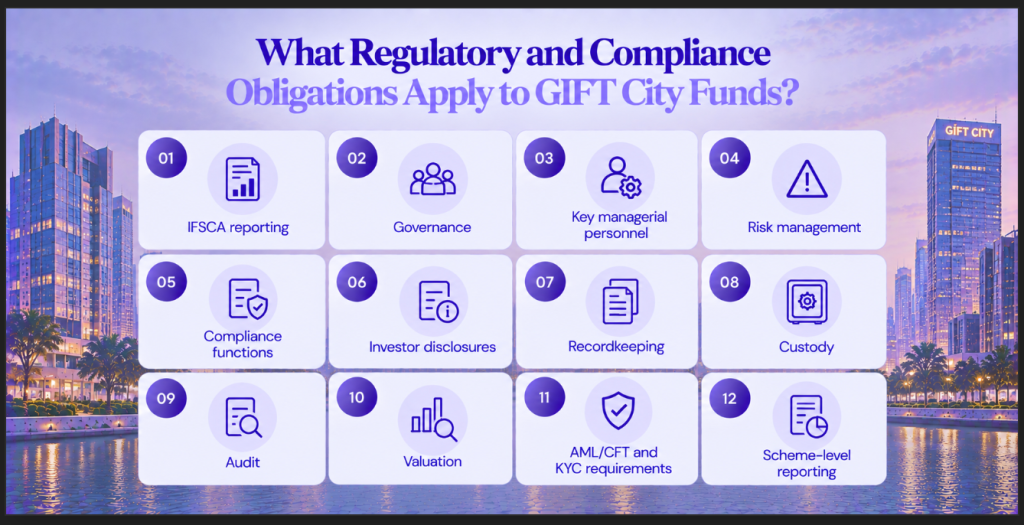
The regulatory framework continues to develop, with IFSCA issuing further circulars and directions during 2026 covering areas such as KMP certification, distribution, placement memoranda and FME-related requirements.
What Service Providers Does a GIFT City Fund Need?
Depending on the fund structure, managers may need:
- Fund administrator
- Custodian
- Auditor
- Legal counsel
- Tax adviser
- Compliance or company-secretarial support
- Banking partner
- Valuation provider
- Other specialist advisers
The exact appointments should be determined from the fund structure and applicable regulatory requirements.
Why Choose GIFT City for Fund Setup in India?
GIFT IFSC provides fund managers with an India-based platform specifically designed for international financial activity.
Key considerations include:
- Dedicated IFSC regulator
- Access to international investors
- Multiple fund-management structures
- International financial infrastructure
- Potential tax efficiencies for qualifying arrangements
- Ability to pursue Indian and international strategies subject to applicable regulations
- Growing fund-management ecosystem
IFSCA reported 272 funds/schemes and cumulative commitments of approximately USD 22.11 billion as of June 30, 2025.
GIFT City vs Traditional Indian Fund Setup | What Is Different?
| Factor | GIFT IFSC | Domestic Indian structure |
| Regulator | IFSCA | Relevant domestic regulator/framework |
| Regulatory environment | IFSC-specific framework | Domestic financial-services framework |
| Investment scope | International and Indian opportunities, subject to applicable rules | Depends on the relevant domestic structure |
| Fund structures | IFSCA-permitted schemes | Applicable Indian fund structures |
| Tax treatment | Specific IFSC incentives may apply | Domestic tax framework |
| Factor | GIFT IFSC | Domestic Indian structure |
The choice between structures should be based on the manager’s strategy, investors and proposed transactions.
Common Mistakes When Setting Up a Fund in GIFT City
Fund managers should avoid:
- Choosing the fund structure before defining the investor base
- Confusing the FME with the fund
- Using outdated IFSCA requirements
- Assuming every fund receives identical tax treatment
- Overlooking corpus or investor-level requirements
- Delaying governance and KMP planning
- Treating the PPM as a formality
- Underestimating ongoing compliance
- Assuming incorporation automatically permits fund management
How Can Arnifi Help With Fund Setup in GIFT City?
Arnifi can help fund managers assess the appropriate GIFT IFSC structure and support the incorporation and regulatory-registration process. Assistance can also cover documentation, coordination with relevant service providers, accounting, tax and ongoing compliance requirements.
For international fund managers entering India, this support can help coordinate the corporate, regulatory and operational requirements involved in establishing a GIFT IFSC presence.
FAQs
How do you set up a fund in GIFT City?
The process generally involves selecting an FME category, establishing the IFSC entity, obtaining the required IFSCA registration, creating the appropriate scheme, preparing offering documents, appointing service providers and completing operational requirements.
What is an FME in GIFT City?
An FME, or Fund Management Entity, is the regulated entity authorised by IFSCA to undertake permitted fund-management activities in an IFSC.
What types of funds can be established in GIFT City?
The current framework provides for Venture Capital Schemes, Angel Schemes, Restricted Schemes and Retail Schemes, subject to the applicable regulatory requirements.
Who can invest in a GIFT City fund?
Investor eligibility depends on the scheme. Depending on the structure, eligible investors may include institutional investors, family offices, sovereign wealth funds, NRIs, OCIs, accredited investors and other permitted investors.
What are the tax benefits of setting up a fund in GIFT City?
Eligible IFSC entities and transactions may qualify for specific tax benefits under Indian law. The applicable treatment depends on the fund structure, income, transaction and statutory conditions.
Conclusion
Setting up a fund in GIFT City involves two connected but distinct components: the Fund Management Entity and the fund or scheme itself. Both need to fit within the applicable IFSCA framework.
The right structure depends on the investment strategy, investor profile, fund type and regulatory requirements. Tax incentives may also be available to qualifying structures, but they should be assessed individually rather than assumed.
With the IFSCA (Fund Management) Regulations, 2025, as amended up to September 10, 2026, together with subsequent circulars and directions, forming the current regulatory framework, fund managers should work from the latest requirements before beginning the setup process.
Arnifi can support businesses with fund structuring, incorporation, regulatory documentation and ongoing compliance requirements for establishing a presence in GIFT IFSC.
References
Top UAE Packages


Related Articles


Top UAE Packages
Get in Touch