
Business License in Oman: Types, Requirements, and Costs

Zahira Shaik
SEO Content Writer
Zahira Shaik is an SEO Content Writer and Published Author specializing in research-based content. She excels at analyzing market trends, regulations, and industry developments… Read more

Tulika Saxena
AVP, Sales & Marketing | IIM Nagpur
Tulika Saxena specializes in business finance, sales strategy, and market positioning. Leads growth and partnerships, ensuring seamless business setup experiences and client success across… Read more


Key Fact: While a Commercial Registration (CR) establishes a company’s legal identity in Oman, a Business License grants the operational authorization required to legally perform specific commercial, industrial, or professional activities within the Sultanate.
Table of contents
- Introduction
- What is a Business License in Oman?
- Main Categories of Business Licenses in Oman
- Before Starting Your Business License Application
- Business License Application Process in Oman
- Business License Requirements Checklist
- Estimated Business License Costs in Oman
- Business License Validity & Renewal
- Oman Chamber of Commerce & Industry (OCCI) Membership
- Foreign Ownership & Business Licensing
- Free Zone vs. Mainland Business Licenses
- How Arnifi Helps With Business Licensing in Oman
- Frequently Asked Questions
- Conclusion
- References
Introduction
Establishing a corporate presence in the Sultanate of Oman provides access to the Middle East’s growing markets, strategic trade routes, and modern infrastructure. Yet, taking up residence in Oman entails a number of regulatory compliance prerequisites.
One critical differentiation that often puzzles foreign investors is the distinction between company establishment and operational authorization. In brief, a Commercial Registration (CR) simply certifies a company’s legal existence, whereas a Business License is required in order to actually operate in the Sultanate, conducting specific commercial, industrial, or professional activities.
This article explains everything you need to know about the Omani licensing framework, from categories of licenses (in both mainland and free zones), required documentation, costs and application procedures, as well as renewal processes.
What is a Business License in Oman?
A Business License in Oman is a special permit issued by the regulatory authorities that allows a legal entity to carry out a particular set of approved activities. Moreover, any commercial entity conducting some economic operations without a valid license issued for its activity scope is subject to severe penalties or closures as per Omani business law.
Issuing Authorities
- Mainland Entities: Issued by the Ministry of Commerce, Industry, and Investment Promotion (MoCIIP).
- Free Zone Entities: Issued directly by the relevant Free Zone Authority operating under the overall governance of the Public Authority for Special Economic Zones and Free Zones (OPAZ).
Business License vs. Commercial Registration (CR)
A Commercial Registration (CR) is a company’s basic registration document that describes the legal entity’s form, ownership structure, capital, and company name. Meanwhile, a Business License is a legal permit specifying what activities the company can undertake. Simply put, without a valid Business License, your company exists but cannot operate.
Why Both Matter: A CR without a valid Business License leaves your company legally recognized but functionally frozen, unable to sign commercial contracts, import goods, or invoice clients. Both documents are required for ongoing, compliant business operations.
Main Categories of Business Licenses in Oman
1. Mainland Business License Categories
- Commercial License: Covers trading activities including retail shops, distribution, general trading, import/export approvals, and product circulation.
- Industrial License: Designed for manufacturing entities, including processing of raw materials, producing goods at large-scale manufacturing facilities, assembling, or processing plants.
- Professional / Service License: Refers to specialized business activities including consulting, management, engineering, legal services, medical practice, or IT services.
- Tourism License: Intended for tourism-related businesses such as hotels, restaurants, travel agencies, and tour operating companies.
- Contractor License: Mandatory for construction-related entities including general civil works contractors, commercial building contractors, turnkey contractors, or fit-out contractors.
- E-Commerce License: Covers online business activities including webshops, e-commerce marketplaces, and online services.
- Creative & Media License: Meant for media and advertising agencies, graphic design companies, or any promotional business.
2. Free Zone Business License Categories
These include General Trading, Trading, Industrial, and Service licenses issued by local Free Zone authorities, including Sohar Freezone, Salalah Free Zone, and Special Economic Zone at Duqm (SEZAD) under OPAZ supervision:
- General Trading License: Covers the buying/selling/import/export of any goods not subject to restrictions, with the provision of any goods handling and distribution services.
- Trading License: Includes particular trading activities for goods listed in the license agreement.
- Industrial License: Issued for warehousing, light/heavy manufacturing, assembly, product packaging, and chemical or material processing.
- Service License: Covers logistics, general services, consultancies, and professional service provision within the Free Zone.
Before Starting Your Business License Application
Before submitting your Business License application, make sure to complete the following:
- Secure a Valid Commercial Registration (CR): Incorporate your company via the Oman Business Platform (Invest Easy). You must have a valid Commercial Registration when applying for an operational license.
- Prepare Commercial Premises: Find an office space, shop, or warehouse, and make sure to have a valid lease contract for the property registered with local municipality authorities.
- Prepare Required Corporate Documents: Collect all corporate documentation that confirms compliance with Oman business regulations, including Memorandum and Articles of Association (M&AoA), passport/Civil ID copies of shareholders, manager appointments, and Ultimate Beneficial Ownership (UBO) filings.
- Identify Sector-Specific Approvals: Make sure your intended business activities do not require any additional approvals from competent authorities.
- Check Foreign Investment Requirements: Make sure your company is not subject to additional restrictions and requirements under the Foreign Capital Investment Law (FCIL). If your company is foreign-owned, you may also need a separate Foreign Investment License. Check the negative list of activities reserved exclusively for Oman nationals.
Business License Application Process in Oman
1. Reserve Trade Name & Select Legal Form:
Check your desired company name availability and reserve it with the Oman Business Platform. Select your preferred company legal form (i.e., LLC) and choose the activities you want to include in your company’s activity scope.
2. Register the Commercial Registration (CR):
Submit your company constitutive documentation, register ownership details, remit state duties, and obtain an active Commercial Registration via the Oman Business Platform.
3. Prepare Commercial Premises & Lease:
Lease an appropriate office space, shop, or warehouse and make sure to register your lease contract with local municipality authorities. Also, make sure to pass all required municipal inspections, including health and safety audits.
4. Submit Corporate & UBO Information:
Provide detailed company information including the fully executed Memorandum and Articles of Association (M&AoA), identification documents of managers and shareholders, and signatories’authorization documents, and UBO declarations.
5. Obtain Sector-Specific Approvals:
Depending on your business activity, you may need to apply for additional sector-specific approvals under the jurisdiction of competent authorities.
6. Apply for Foreign Investment License (If Applicable):
If your company is subject to the Foreign Capital Investment Law (FCIL), you will need to apply for a Foreign Investment License via the portal. Your application will include a detailed business plan, banking references, experience in the selected industry, lease contracts, among others.
7. Pay Government Fees & Issue License:
On approval, pay off the final government authority licensing fees to issue your official Business License digitally.
Business License Requirements Checklist
| Document / Requirement | Mandatory Status |
| Valid Commercial Registration (CR) | Yes |
| Commercial Lease / Premises | Yes |
| Municipality-Registered Tenancy Contract | Yes |
| Memorandum & Articles of Association (M&AoA) | Yes |
| Passport / Civil ID Copies | Yes |
| UBO Disclosure Details | Yes |
| Sector-Specific Approvals | Conditional (Depends on chosen activity) |
| Foreign Investment License | Conditional (Required for foreign-owned entities) |
| Feasibility Study & Bank Statement | Conditional (For Foreign Investment License application) |
| OCCI Membership Certificate | Yes |
Estimated Business License Costs in Oman
Government licensing fees vary depending on the chosen business activity, risk classification, legal structure, and location. Below are general estimates for government fees:
- Commercial License: ~OMR 50 to OMR 200 (Validity: 1 year)
- Industrial License: ~OMR 100 to OMR 500 (Validity: 1–3 years)
- Professional / Service License: ~OMR 50 to OMR 300 (Validity: 1 year)
- Tourism License: ~OMR 200 to OMR 1,000+ (Validity: 1 year)
- Contractor License: ~OMR 150 to OMR 600 (Validity: 1 year)
Practical Note: Total setup expenses will include municipal lease registration fees, Chamber of Commerce membership fees, translation costs, and potential sector-specific inspection fees.
Business License Validity & Renewal
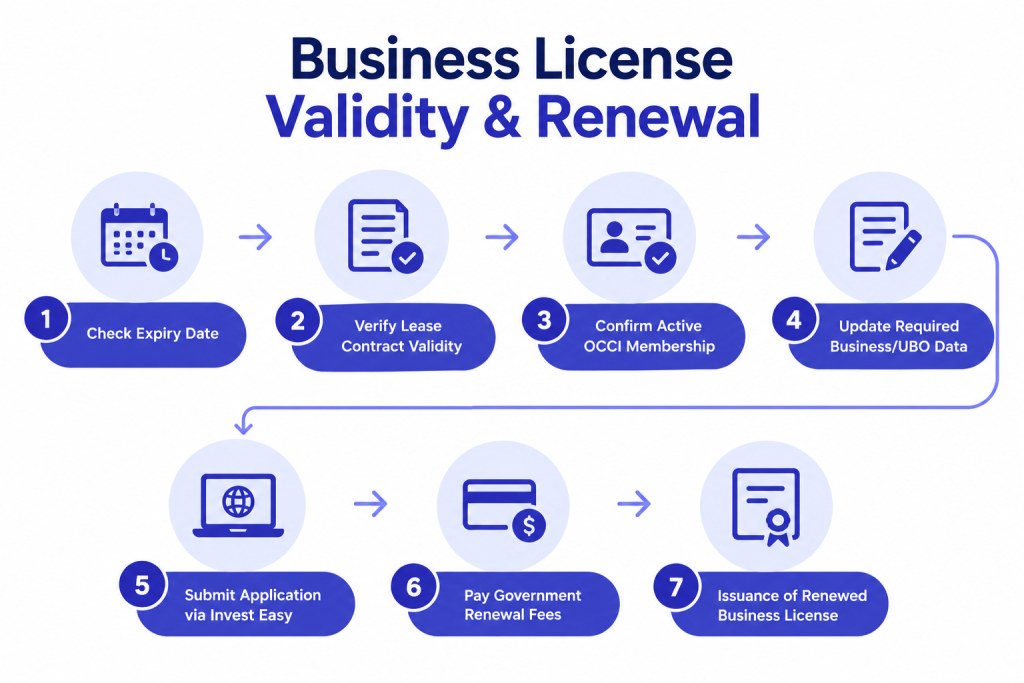
Standard mainland business licenses are valid for 1 year and must be renewed annually. Certain industrial licenses offer extended options valid for up to 3 years.
Why Renewal Applications Get Blocked
- Expired Municipal Lease: If your registered tenancy agreement has lapsed, the system automatically blocks license renewal.
- Lapsed OCCI Subscription: Unpaid Oman Chamber of Commerce annual dues freeze portal services.
- Outdated UBO Filings: Failure to update corporate beneficiary records triggers automatic compliance holds.
- Unfulfilled Regulatory Conditions: Expired sector-specific safety certificates (e.g., Civil Defence clearance) prevent processing.
Oman Chamber of Commerce & Industry (OCCI) Membership
Every company incorporated and registered within Oman’s territory must maintain an active OCCI membership.
A company’s OCCI membership is directly tied to its Commercial Registration and Business License.
Without a valid OCCI certificate, businesses are unable to perform any corporate banking operations, renew employee visas, clear customs duties on imported goods, or renew business licenses.
Foreign Ownership & Business Licensing
According to Oman’s foreign capital investment law (FCIL), foreign ownership of 100% in any corporation is permitted without a local Omani partner, across all sectors and industries.
Key Considerations for Foreign Investors:
- Foreign Company licenses require an additional Investment License on top of the standard Business License.
- Some commercial activity codes are reserved for Oman-born nationals only, according to the national restricted list.
- Before any capital commitments, check whether your preferred business activity codes fall under the restricted list or not using online databases.
Free Zone vs. Mainland Business Licenses
| Comparison Point | Mainland Oman | Free Zones (Sohar, Salalah, SEZAD) |
| Primary Authority | Ministry of Commerce, Industry, and Investment Promotion (MoCIIP) | Respective Free Zone Authority under OPAZ oversight |
| License Categories | Commercial, Industrial, Service, Tourism, E-Commerce, Media, Contracting | General Trading, Specific Trading, Industrial, Service |
| Regulatory System | Standard Oman Corporate Laws & Municipal rules | Specialized Free Zone Regulations & Tax incentives |
| Premises Location | Physical presence anywhere in Oman mainland | Mandatory office/warehouse within designated zone boundaries |
| Market Access | Direct access to the local Omani domestic market | Primarily designed for export, re-export, and zone trading |
How Arnifi Helps With Business Licensing in Oman
Navigating bureaucratic requirements and regulatory frameworks across foreign markets can be complex. Arnifi offers comprehensive platform solutions to streamline business operations in Oman:
- Business Formation & License Management: End-to-end guidance for legal entity setup, trade name reservation, MoCIIP licensing, and automated renewal management.
- Visas, Attestation & Legal Services: Complete support for investor visas, corporate document attestation, legal advisory, and corporate bank account opening.
- Financial & Workforce Solutions: Accounting, VAT compliance, bookkeeping, and Arnifi HR (Employer of Record) solutions to hire staff in Oman without establishing a dedicated local entity immediately.
- Digital Compliance Tools: Access Arni Cost Calculator to estimate setup costs, Arni Organogram for mapping shareholder structures, Arni AML Checker for compliance screening, and the Arni Docs AI Assistant for legal document generation.
Frequently Asked Questions
What is a Business License in Oman?
A Business License in Oman is a document issued by MoCIIP or a Free Zone authority, certifying the company’s right to pursue a particular commercial, industrial or professional activity.
What is the difference between a Commercial Registration and a Business License in Oman?
A Commercial Registration is a company’s official registration with the Ministry of Commerce and Investment to establish its legal structure in the state records. A Business License is a permit to carry out a specific type of commercial, industrial, or professional activity issued under a Commercial Registration.
What are the different types of Business Licenses in Oman?
Mainland types include Commercial, Industrial, Professional/Service, Tourism, Contracting, E-Commerce, and Media licenses. Free Zones issue General Trading, Trading, Industrial, and Service licenses.
How much does a Business License cost in Oman?
Government fees for Business Licenses in Oman range from OMR 50 to more than OMR 1,000+, depending on the company’s nature and size, company structure, and risk category. Separate municipal and OCCI registration fees apply.
How long is a Business License valid in Oman?
A regular Business License is valid for one year and should be renewed annually. Some Industrial licenses have an option of 1-3 years of validity.
What documents are required for a Business License in Oman?
Commercial Registration, tenancy contract, Memorandum of Association (M&AoA), manager’s/shareholders’ passport copies, Ultimate Beneficial Owner (UBO), OCCI certificate, and sector-specific approvals (if any).
Do I need a physical office to obtain a Business License in Oman?
Yes, a company limited in Oman must have an office, shop, or industrial warehouse registered with the local authority. A business in a Free Zone must have an approved lease contract within the Free Zone’s premises.
Do foreign investors need an Investment License in Oman?
Yes, foreign investors must apply for an Investment License under the Foreign Capital Investment Law in addition to a regular license for an authorized activity.
Can foreigners own 100% of a business in Oman?
Foreign companies may own 100% of a business in Oman, unless it is on the restricted activity list.
Do all business activities require sector-specific approval in Oman?
Not all activities. A general Commercial or Professional Activity may be approved automatically through the Oman Business Platform. Activities requiring approval from a state agency include healthcare, education, tourism, oil & gas, and others.
What is the role of OCCI membership in obtaining a Business License?
OCCI is a mandatory membership for any business in Oman. It is required to obtain a license to operate and renew it, as well as to clear goods in customs and apply for a visa.
Can I obtain a Business License in an Oman Free Zone?
Yes, a Business License in Oman Free Zones may be obtained from the competent authority in the SOFAZ, Sohar Airport Free Zone, Duqm Special Economic Zone, Salalah Free Zone, and other Free Zones.
What is the difference between a General Trading License and a Trading License in Free Zones?
A trading license in a Free Zone may be general (covers a wide range of goods) or specific (a set of particular goods). A General Trading License is a general permit covering a broad range of goods that a trader deals with.
How do I renew my Business License in Oman?
Once the company has submitted an application on the Oman Business Platform, it renews a Business License in Oman by entering the lease contract, ensuring that the OCCI membership is valid, and that the UBO information is up-to-date.
What happens if my Oman Business License expires?
Depending on the violation, the Oman authorities may impose a fine, block bank accounts, cancel visas, and other penalties.
Can I apply for a Business License in Oman remotely?
From abroad, it is possible to submit an e-application with documents under the Oman Business Platform by way of power of attorney and digital identification.
How long does it take to obtain a Business License in Oman?
Applications for a regular commercial license take from 1 to 3 days to process. Activities requiring approval from a government agency may take several weeks.
Which authority issues Business Licenses in Oman?
Business Licenses in Oman are issued by the Ministry of Commerce, Industries, and Investment Promotion (MoCIIP) for the Mainland and relevant Free Zone Authorities for the Free Zones.
What happens if my business activity is on the restricted list?
The restricted list of activities in Oman is available only to Oman’s citizens; accordingly, foreigners may not own even a minority or majority stake in such a company.
Do I need an Investment License if my company is 100% foreign-owned?
Yes, a foreign-owned company must obtain an investment license under the Foreign Capital Investment Law. A 100% foreign-owned company must obtain an Investment License.
Conclusion
Securing the appropriate Business License is a decisive step toward establishing a successful business in Oman. To ensure a smooth start for your business in the Sultanate, you need to determine the codes of your business activity to identify which Mainland or Free Zone is most appropriate for your business. Provide your Commercial Registration (CR), register your lease, and prepare all the required documents for the company’s management and UBO. Determine whether your business activity needs the approval of a government agency or a Foreign Capital Investment Law license. Ensure your company’s membership in OCCI and renew it on time to avoid issues with the company’s operation.
With the help of Arnifi in Oman, you can save time and effort while complying with local regulations to launch your business smoothly in Oman.
References
Top UAE Packages
Related Articles



Top UAE Packages
Get in Touch
