
Final Settlement Calculation in UAE | DMCC Basic vs Gross Salary Calculations

Anushka
Content Writer
Anushka Basu is a business content writer specialised in global business market insights. She aims to simplify complex regulatory, financial, and business concepts into… Read more

Tulika Saxena
AVP, Sales & Marketing | IIM Nagpur
Tulika Saxena specializes in business finance, sales strategy, and market positioning. Leads growth and partnerships, ensuring seamless business setup experiences and client success across… Read more


KEY FACT: A Dubai Multi Commodities Centre employee’s final settlement does not necessarily use one salary figure for every component. Salary payable during employment may follow contractual remuneration, while unused leave and gratuity are calculated using the applicable basic wage.
Table of contents
- Introduction
- How is a DMCC final settlement calculated?
- Which salary is used for DMCC final settlement calculations?
- How is salary calculated up to the last working day in DMCC?
- How is unused annual leave calculated in a DMCC final settlement?
- How is DMCC end-of-service gratuity calculated?
- What is the difference between basic salary and gross salary in a DMCC final settlement?
- What components should be included in a DMCC employee final settlement?
- How do you calculate a DMCC employee’s final settlement?
- What happens to unused annual leave when a DMCC employee leaves?
- When is a DMCC employee entitled to end-of-service gratuity?
- How do allowances affect DMCC final settlement calculations?
- Does the DMCC final settlement differ depending on how employment ends?
- When should a DMCC employee’s final settlement be paid?
- What should employers check before processing a DMCC final settlement?
- What is an example of a DMCC final settlement calculation?
- How can Arnifi help with DMCC employment and business setup?
- FAQs
- Conclusion
Introduction
A DMCC employee’s final settlement is the amount due upon the end of the employment relationship. It can include salary up to the last working day, payment for unused annual leave, end-of-service gratuity and other contractual or statutory entitlements.
One of the most important points is that these components may not all be calculated using the same salary figure. The employee’s contractual remuneration determines ordinary salary payments, while statutory benefits such as unused leave compensation and gratuity are generally calculated using the applicable basic wage.
Understanding this distinction helps employers avoid applying the gross salary universally when calculating a DMCC final settlement.
How is a DMCC final settlement calculated?
A final settlement is the calculation and payment of amounts owed to an employee when their employment ends. The exact amount depends on the employee’s contract, service period, leave balance, termination circumstances and applicable employment rules.
A DMCC final settlement is calculated by including:
- Salary or contractual remuneration up to the last working day
- Accrued but unused annual leave
- End-of-service gratuity, where applicable
- Contractually agreed payments or benefits
- Other statutory entitlements
- Repatriation-related benefits where applicable
The settlement should therefore be broken into individual components instead of applying one salary figure to the entire calculation.
Which salary is used for DMCC final settlement calculations?
The distinction between gross salary and basic salary is central to the calculation.
Gross salary or contractual remuneration can include the employee’s basic salary together with applicable allowances and other remuneration agreed under the employment contract.
Basic salary or basic wage refers to the basic component of the employee’s pay, excluding allowances that do not form part of the basic wage.
| Final settlement component | Calculation basis |
| Salary during employment | Contractual remuneration |
| Salary up to last working day | Applicable contractual remuneration |
| Unused annual leave | Basic wage |
| End-of-service gratuity | Basic wage |
| Other contractual amounts | Applicable contractual or statutory basis |
DMCC specifically states that holiday pay on termination is calculated using the employee’s basic wage, while UAE Government guidance confirms that end-of-service gratuity is calculated using the last basic salary.
How is salary calculated up to the last working day in DMCC?
The employee is entitled to remuneration for the period worked up to the actual last working day.
For a simple illustrative calculation:
Contractual monthly remuneration ÷ applicable monthly basis × payable days
For example, if an employee earns AED 8,000 per month and is entitled to payment for 15 days:
AED 8,000 ÷ 30 × 15 = AED 4,000
This is an illustration rather than a universal payroll formula. The applicable calculation should follow the employment contract and relevant employment rules.
The employer should also distinguish between the employee’s ordinary monthly payroll and the final settlement, as the latter may contain several additional components.
How is unused annual leave calculated in a DMCC final settlement?
When employment ends, an employee may be entitled to payment for accrued but unused annual leave. DMCC’s Employment FAQs state that holiday pay on termination should be calculated using the employee’s basic wage at the termination date.
A simplified calculation is:
Basic salary ÷ 30 × unused leave days
For example:
- Basic salary: AED 5,000
- Unused annual leave: 15 days
AED 5,000 ÷ 30 × 15 = AED 2,500
The employee’s leave balance should be checked through the termination date, including any applicable accrued fraction of leave.
This means an employer should not automatically calculate termination leave compensation using the employee’s full gross salary where the applicable statutory basis is the basic wage.
How is DMCC end-of-service gratuity calculated?
For eligible full-time expatriate employees, UAE Government guidance states that an employee who completes at least one year of continuous service may qualify for an end-of-service gratuity. The calculation uses the employee’s last basic salary, not allowances.
The general structure is:
- 21 days of basic salary for each year during the first five years
- 30 days of basic salary for each year after the first five years
- Proportionate entitlement for eligible fractions of a year after completing one year
- A total gratuity cap of two years’ wage
Unpaid absence is excluded from the service calculation under the applicable rules.
For example, an employee with a basic salary of AED 5,000 and qualifying service would have gratuity calculated from AED 5,000, not from the employee’s total gross remuneration.
What is the difference between basic salary and gross salary in a DMCC final settlement?
Basic salary is the fixed basic component of an employee’s remuneration. Gross salary generally combines that basic amount with contractual allowances and other applicable remuneration.
For example:
Basic salary: AED 5,000
Housing allowance: AED 2,000
Transport allowance: AED 1,000
Gross salary: AED 8,000
The AED 8,000 figure may represent the employee’s contractual monthly remuneration, while the AED 5,000 basic salary can be the relevant basis for statutory termination benefits such as gratuity and unused annual leave.
| Aspect | Basic salary | Gross salary |
| Includes applicable allowances | Generally no | Yes |
| Ordinary monthly remuneration | Forms part of it | May represent total contractual remuneration |
| Unused annual leave | Relevant basis | Not ordinarily the statutory basis |
| Gratuity | Relevant basis | Not ordinarily the statutory basis |
The precise treatment should always be checked against the employment contract and applicable rules.
What components should be included in a DMCC employee final settlement?
A final settlement can generally be structured into separate components:
Final settlement
↓
Salary until last working day
↓
Unused annual leave compensation
↓
End-of-service gratuity, where applicable
↓
Other contractual or statutory entitlements
Not every employee will receive every component. For example, gratuity eligibility depends on the employee’s qualifying service, while other payments may depend on the employment contract or circumstances surrounding termination.
How do you calculate a DMCC employee’s final settlement?
A practical calculation can follow this sequence:
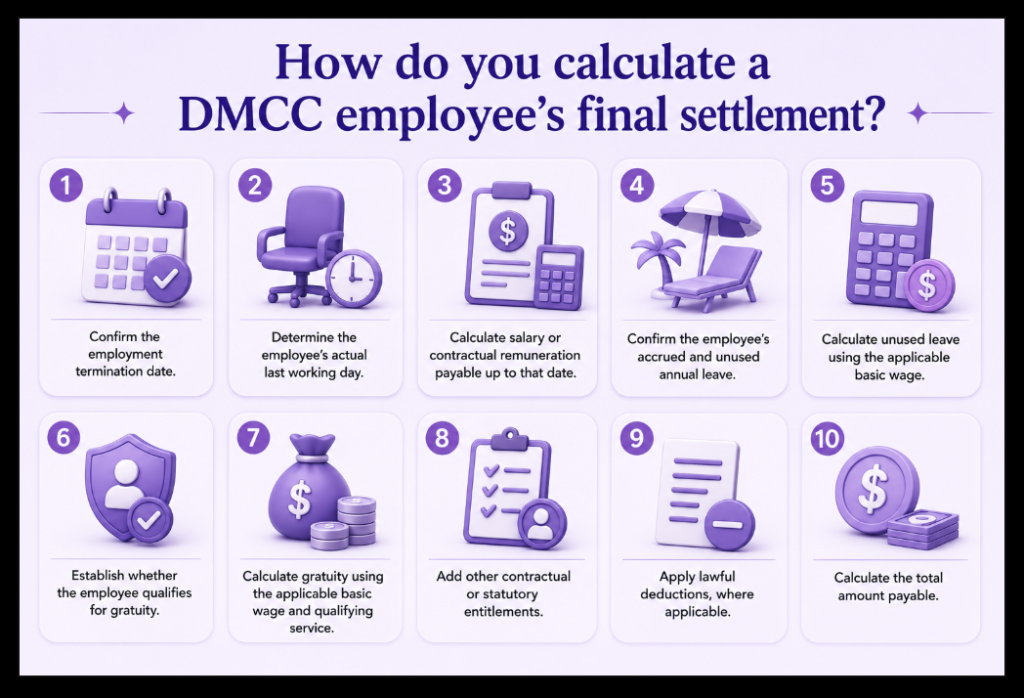
Each component should be calculated separately before the amounts are combined.
What happens to unused annual leave when a DMCC employee leaves?
An employee who leaves employment may be entitled to payment for accrued but unused annual leave. DMCC specifically states that an employee is entitled to payment for unused annual leave calculated up to the termination date when they are terminated or resign, subject to the applicable conditions.
The employer should therefore verify:
- Total leave entitlement
- Leave already taken
- Remaining balance
- Leave accrued during the final period
- Applicable basic wage at termination
The resulting leave balance can then be converted into the applicable cash entitlement.
When is a DMCC employee entitled to end-of-service gratuity?
For eligible full-time expatriate employees, one year of continuous service is generally the minimum qualifying period for statutory gratuity. An employee who has worked for less than one year does not receive gratuity under the standard statutory calculation.
After completing one year, eligible fractions of subsequent service can be calculated proportionately.
Employers should establish eligibility before calculating the amount because service history, unpaid absence and employment arrangements can affect the calculation.
How do allowances affect DMCC final settlement calculations?
Allowances can form part of an employee’s contractual remuneration without forming part of the basic wage used for statutory termination benefits.
Common examples include:
- Housing allowance
- Transport allowance
- Utility allowance
- Other contractual allowances
Using the earlier example:
Basic salary: AED 5,000
Housing allowance: AED 2,000
Transport allowance: AED 1,000
Gross salary: AED 8,000
The AED 8,000 may be relevant when calculating contractual salary payable through the final working period, while AED 5,000 is generally the relevant statutory basis for gratuity and DMCC’s termination leave calculation.
Does the DMCC final settlement differ depending on how employment ends?
The circumstances surrounding termination can affect the employee’s entitlements and the calculation process.
Employers may need to consider:
- Resignation
- Employer-initiated termination
- Contract expiry
- Mutual termination
- Termination under applicable law
- Notice period
- Actual last working day
For example, UAE rules generally require written notice, with the notice period ordinarily falling between 30 and 90 days unless the law or an applicable agreement provides otherwise.
The final settlement should therefore not be calculated solely by asking whether the employee resigned or was terminated. The contract, service history, notice arrangements and applicable statutory provisions should all be reviewed.
When should a DMCC employee’s final settlement be paid?
UAE labour law requires employers to pay the employee’s wages and other contractual or statutory entitlements within 14 days from the end date of the contract.
This includes applicable end-of-service benefits.
Employers should therefore prepare the calculation before or immediately after the employee’s final working date, allowing sufficient time to verify leave balances, gratuity eligibility, outstanding salary and other payments.
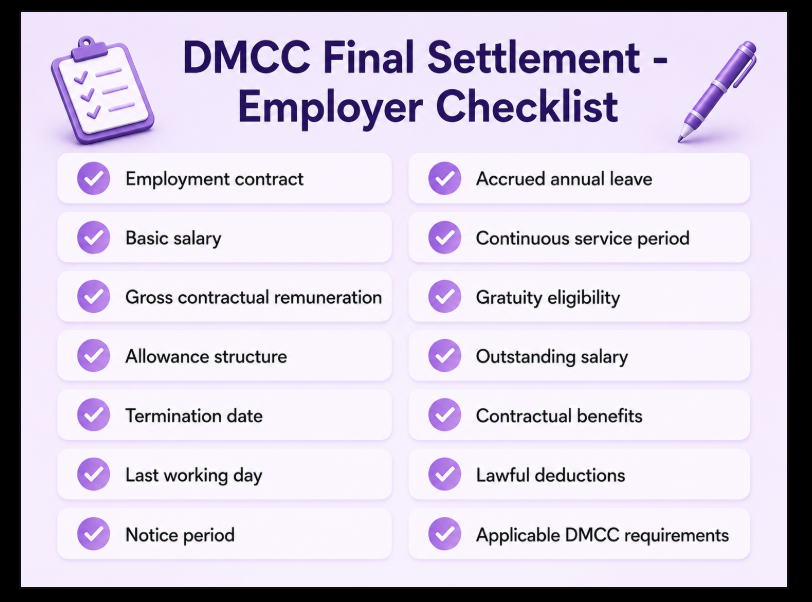
What should employers check before processing a DMCC final settlement?
Before finalising the calculation, employers should review:
What is an example of a DMCC final settlement calculation?
Consider a hypothetical employee with:
- Basic salary: AED 5,000
- Housing and transport allowances: AED 3,000
- Gross salary: AED 8,000
- Unused annual leave: 15 days
- Qualifying service for gratuity
1. Salary until the last working day
The salary component is calculated using the applicable contractual remuneration.
2. Unused annual leave
AED 5,000 ÷ 30 × 15 = AED 2,500
3. End-of-service gratuity
The gratuity is calculated separately using the employee’s basic salary and qualifying period of service.
4. Other entitlements
Any applicable contractual or statutory amounts are then added.
| Component | Calculation basis | Amount |
| Salary to last working day | Contractual remuneration | AED X |
| Unused annual leave | Basic salary | AED 2,500 |
| Gratuity | Basic salary + service period | AED X |
| Other entitlements | Applicable basis | AED X |
| Total final settlement | Combined components | AED X |
“X” is mentioned as several variable amounts in this table. This is an illustrative example only. The actual entitlement depends on the employee’s contract, service history, leave balance, termination circumstances and applicable law.
How can Arnifi help with DMCC employment and business setup?
Managing employee exits involves more than calculating a final payment. Businesses also need to coordinate employment documentation, workforce administration and wider compliance requirements.
Arnifi can support businesses with:
- DMCC company formation
- Business setup
- Employment and workforce considerations
- Compliance support
- Employment-related administrative processes
- UAE business requirements
- Ongoing support for companies operating in DMCC
For businesses establishing or expanding their DMCC operations, Arnifi can help connect company setup with the broader administrative and compliance requirements involved in running a UAE business.
FAQs
How is a DMCC final settlement calculated?
A DMCC final settlement combines salary, unused leave, gratuity, and applicable contractual or statutory entitlements.
Is DMCC gratuity calculated on basic or gross salary?
DMCC gratuity is generally calculated using the employee’s last basic salary, excluding applicable allowances.
Is unused annual leave in DMCC calculated on basic salary?
Yes, DMCC states that termination holiday pay should be calculated using the employee’s basic wage.
What is included in a DMCC employee final settlement?
It may include salary, unused leave, gratuity, contractual benefits, statutory entitlements, and applicable repatriation benefits.
When should a DMCC employee receive their final settlement?
Employers generally must pay outstanding wages and applicable entitlements within 14 days after contract termination.
Conclusion
A DMCC final settlement is not simply the employee’s monthly gross salary multiplied or divided by a particular number. Different components can have different calculation bases.
Salary payable through the final working day is linked to the applicable contractual remuneration, while unused annual leave compensation and end-of-service gratuity generally use the employee’s basic wage.
Employers should therefore separate each component, verify the employee’s service and leave records, review the employment contract and account for any applicable contractual or statutory entitlements before confirming the final amount.
For businesses operating in DMCC, maintaining accurate employment records and handling the settlement process systematically can make employee exits considerably easier to manage. Arnifi can support companies with DMCC business setup and the wider administrative and compliance requirements involved in operating in the UAE. Reach out to us at Arnifi today!
REFERENCES:
DMCC Employment FAQs – Final Settlement and Annual Leave
UAE Government – End-of-Service Benefits for Private-Sector Employees
Top UAE Packages


Related Articles



Top UAE Packages
Get in Touch