
Alternative Fund Services Explained | Administration, Compliance and Investor Support

Anushka
Content Writer
Anushka Basu is a business content writer specialised in global business market insights. She aims to simplify complex regulatory, financial, and business concepts into… Read more

Tulika Saxena
AVP, Sales & Marketing | IIM Nagpur
Tulika Saxena specializes in business finance, sales strategy, and market positioning. Leads growth and partnerships, ensuring seamless business setup experiences and client success across… Read more


Key Fact: Alternative fund services provide the operational, administrative, accounting, investor and compliance support required to run alternative investment funds efficiently. The exact service mix depends on the fund structure, strategy, investor base and regulatory requirements.
Table of contents
- What are alternative fund services?
- What is alternative fund administration?
- What alternative investment services are commonly provided?
- How do alternative fund services support different fund types?
- What does fund accounting cover?
- How does investor administration work?
- What compliance services do alternative funds need?
- What role do valuation and NAV services play?
- What is middle-office support for alternative funds?
- Why do alternative fund managers outsource fund services?
- How do you choose an alternative fund services provider?
- What are the risks of poor alternative fund administration?
- What should be considered before outsourcing?
- How can Arnifi help with alternative fund services?
- FAQs
- Conclusion
What are alternative fund services?
Alternative fund services cover the operational functions that support an investment fund throughout its lifecycle. They can begin before launch with structuring and operational planning, continue through fundraising and investor onboarding, and extend into accounting, reporting, compliance and ongoing administration.
These services are commonly used by private equity, venture capital, hedge fund, private credit, real estate and infrastructure managers.
Alternative fund services do not replace investment management. The investment manager makes portfolio and investment decisions, while administrators and other specialist providers support the processes needed to operate the fund.
The service model can involve fund administrators, accountants, compliance providers, auditors, legal advisers, valuation specialists and other professionals working alongside the fund manager.
What is alternative fund administration?
Alternative fund administration provides the day-to-day operational infrastructure required to maintain a fund’s financial and investor records.
Depending on the structure, administration can include:
- Fund accounting and bookkeeping
- NAV calculation and support
- Investor onboarding and register maintenance
- Subscription processing
- Capital call and distribution administration
- Cash and transaction reconciliation
- Financial statement preparation
- Investor statements and reporting
- Corporate and fund recordkeeping
- Document and data management
The scope can be broader for complex structures involving multiple entities, investment vehicles, jurisdictions or investor classes.
Administration supports the fund’s operations but does not automatically replace the responsibilities of the fund manager, AIFM, governing body or other appointed professionals.
What alternative investment services are commonly provided?
Alternative investment services can cover several operational layers:
| Service | Typical activities |
| Fund administration | Investor, accounting and operational processes |
| Fund accounting | Transactions, expenses, income and capital activity |
| Investor services | Onboarding, records, notices and statements |
| Middle-office support | Transaction processing and portfolio data |
| Valuation support | Asset valuation and NAV processes |
| Regulatory reporting | Preparation and coordination of regulatory information |
| Compliance support | AML/KYC, controls and regulatory processes |
| Entity administration | Corporate and fund-vehicle maintenance |
| Audit coordination | Records, schedules and information for auditors |
| Treasury support | Cash monitoring and reconciliation |
The appropriate combination depends on the fund’s strategy and operating model.
How do alternative fund services support different fund types?
Different alternative investment strategies create different operational requirements.
| Fund type | Common service requirements | Operational considerations |
| Private equity | Accounting, capital calls, investor reporting, valuation | Illiquid investments and portfolio-company data |
| Venture capital | Accounting, investor administration, valuation, reporting | Multiple portfolio investments |
| Hedge funds | NAV, reconciliation, investor reporting, compliance | Higher transaction frequency |
| Private credit | Accounting, valuation, investor reporting, compliance | Loan, interest and repayment data |
| Real estate | Accounting, valuation, investor reporting | Property-level information |
| Infrastructure | Accounting, valuation, reporting, compliance | Long-term assets and project-level data |
Open-ended and closed-ended funds can also have different requirements. A closed-ended private equity fund may focus heavily on commitments, drawdowns and distributions, while a liquid or open-ended strategy may require more frequent NAV calculations, subscriptions, redemptions and reconciliations.
What does fund accounting cover?
Fund accounting records the financial activity of the fund and provides information for financial reporting, investor statements and other operational requirements.
Typical activities include:
- Recording investment transactions
- Accounting for income and expenses
- Processing capital contributions and distributions
- Calculating investor allocations
- Reconciling cash and transaction records
- Supporting NAV calculations
- Maintaining accounting records for audits
- Preparing financial reporting information
- Coordinating accounting data across related entities and investment vehicles
For complex alternative structures, accounting may need to connect information from the fund, general partner, management company, special purpose vehicles and portfolio investments.
How does investor administration work?
Investor administration manages the information and processes associated with the fund’s investors. It can cover:
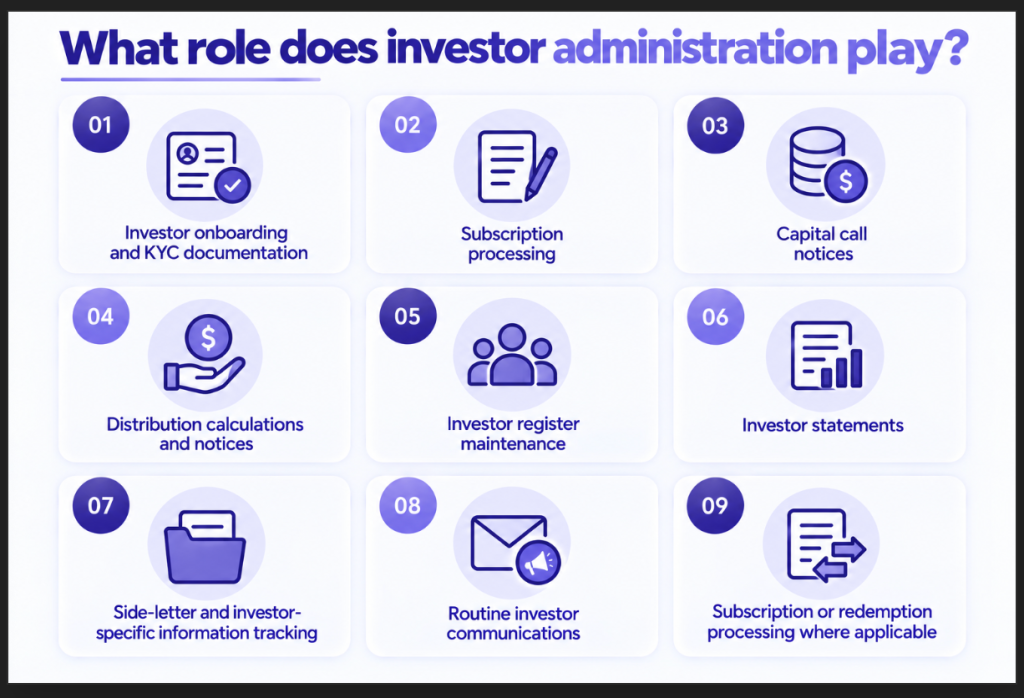
Accurate investor records are particularly important where a fund has multiple investor classes, different fee arrangements or jurisdiction-specific requirements.
What compliance services do alternative funds need?
Compliance requirements vary according to the fund’s activities, structure, regulatory status and jurisdictions.
Common support areas include:
- AML/KYC and investor due diligence
- Beneficial ownership verification
- Sanctions screening
- PEP and adverse-media checks
- Regulatory reporting support
- Compliance calendars
- Policy and documentation support
- Recordkeeping
- Risk and control monitoring
- Ongoing compliance reviews
A compliance programme should therefore be built around the fund’s actual activities rather than treated as a universal checklist.
Where regulated functions are delegated, the relevant manager may still have oversight responsibilities. For example, FCA rules require applicable UK AIFMs to maintain appropriate oversight of delegated functions and ensure that delegates are capable of performing the activities assigned to them.
What role do valuation and NAV services play?
Valuation and NAV processes help determine the financial position of a fund and the value attributable to its investors.
Services can include:
- NAV calculation and review
- Portfolio investment valuation
- Income, expenses and accrual calculations
- Capital contribution and distribution processing
- Valuation policy support
- Pricing and valuation data management
- Coordination with valuation specialists
- Audit support
The approach can differ significantly between liquid securities and illiquid assets such as private companies, property or private credit investments.
For regulated funds, valuation responsibilities can remain with the relevant fund manager even when another party performs supporting or external valuation functions. The FCA’s AIFM framework, for example, contains specific requirements around valuation and external valuation arrangements.
What is middle-office support for alternative funds?
Middle-office services connect investment activity with the fund’s accounting, reporting and operational processes.
They can include:
- Trade and transaction processing
- Portfolio data management
- Reconciliation
- Cash monitoring
- Investment data management
- Performance and exposure reporting
- Transaction lifecycle support
- Coordination between investment teams and administrators
For managers handling multiple investments or frequent transactions, a structured middle-office function can reduce manual processing and improve consistency between investment and accounting records.
Why do alternative fund managers outsource fund services?
Outsourcing can give managers access to specialist operational capabilities without building every function internally.
Potential benefits include:
- Access to specialist operational expertise
- Reduced internal administrative workload
- Support for complex fund structures
- More structured investor servicing
- Centralised accounting and reporting
- Scalability as assets and investor numbers increase
- Established technology and operational processes
- Additional support for controls and documentation
- More capacity for investment and fundraising activities
The appropriate outsourcing model depends on which functions the manager wants to retain internally and which can be delegated.
Outsourcing also does not automatically remove oversight responsibilities. In regulated environments, managers may need to monitor delegated activities and maintain sufficient expertise and resources to oversee them.
How do you choose an alternative fund services provider?
A provider should be assessed against the fund’s actual operating model rather than simply its headline service list.
| Evaluation area | What to check |
| Fund administration | Scope and depth of administrative services |
| Accounting | Reporting, reconciliation and NAV capabilities |
| Investor services | Onboarding, capital calls and reporting |
| Compliance | KYC, AML and regulatory support |
| Technology | Integrations, security and accessibility |
| Valuation | Processes for the relevant asset classes |
| Reporting | Investor, financial and regulatory reporting |
| Scalability | Ability to support future growth |
| Cross-border experience | Experience with relevant jurisdictions |
| Service levels | Responsibilities, response times and escalation processes |
Data security, audit coordination, communication processes and the provider’s experience with the relevant asset class should also be reviewed.
What are the risks of poor alternative fund administration?
Weak administration can affect financial records, investor servicing and compliance processes.
Common risks include:
- Inaccurate accounting records
- NAV or valuation errors
- Delayed investor reporting
- Incomplete KYC/AML documentation
- Missed regulatory deadlines
- Reconciliation issues
- Poor data management
- Inconsistent information across systems
- Weak oversight of outsourced functions
- Operational disruption as the fund grows
These issues can become more difficult to manage as the number of investors, investments and entities increases.
What should be considered before outsourcing?
Before appointing a service provider, managers should establish which functions need external support and how those activities will be supervised. Key considerations include:
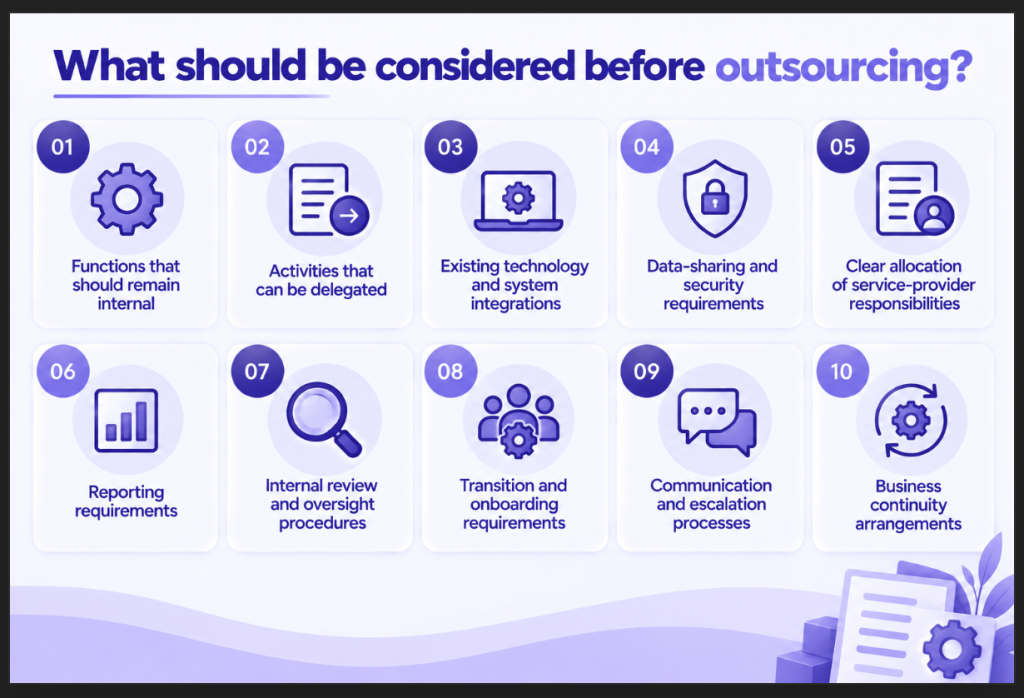
A detailed service agreement can help establish responsibilities, deliverables, reporting requirements and escalation procedures from the outset.
How can Arnifi help with alternative fund services?
Arnifi can support alternative investment structures with services across the fund lifecycle, including:
- Fund and investment-structure support
- Accounting and bookkeeping assistance
- Compliance and administrative support
- Investor and corporate documentation coordination
- Regulatory and reporting support
- Cross-border operational assistance
- Service-provider coordination
- Ongoing administrative support
The scope can be tailored to the fund’s structure, investment strategy, jurisdictions and operational requirements.
FAQs
What are alternative fund services?
Alternative fund services are operational, administrative, accounting, investor and compliance functions supporting alternative investment funds.
What is alternative fund administration?
It is the operational support required to maintain fund records, process investor activity, support accounting and coordinate reporting.
What services does an alternative fund administrator provide?
Services can include fund accounting, investor administration, reconciliations, reporting, capital activity and recordkeeping.
What are alternative investment services?
They include administration, accounting, investor services, middle-office support, valuation, compliance and regulatory reporting.
Which types of alternative funds use fund administration services?
Private equity, venture capital, hedge funds, private credit, real estate and infrastructure funds can use administration services.
What does fund accounting include?
It can include transaction recording, income and expense accounting, reconciliations, investor allocations, NAV support and financial reporting.
Why do alternative fund managers outsource administration?
Outsourcing can provide specialist expertise, technology, operational scalability and additional administrative capacity.
How do I choose an alternative fund services provider?
Consider asset-class experience, accounting capabilities, technology, compliance, reporting, security, scalability and service levels.
What compliance services do alternative investment funds need?
Requirements vary, but common services include KYC, AML, sanctions screening, regulatory reporting and compliance monitoring.
What is the difference between fund administration and investment management?
Fund administration supports operational processes, while investment management involves making and implementing investment decisions.
Conclusion
Alternative fund services provide the operational infrastructure that supports accounting, administration, investor servicing, valuation, compliance and middle-office activities. The right service model depends on the fund’s strategy, structure, investor base and regulatory environment. Managers should assess providers on specialist expertise, technology, controls, compliance capabilities and scalability while maintaining appropriate oversight of outsourced functions.
Official references
Top UAE Packages


Related Articles


Top UAE Packages
Get in Touch