
NAV Calculation Errors in Cayman Funds | When Valuation Goes Wrong

Ishika Bhandari
Content Writer
Ishika Bhandari is a content writer with experience in creating SEO-focused content across diverse industries, including business, lifestyle, and jewellery. She specializes in turning… Read more


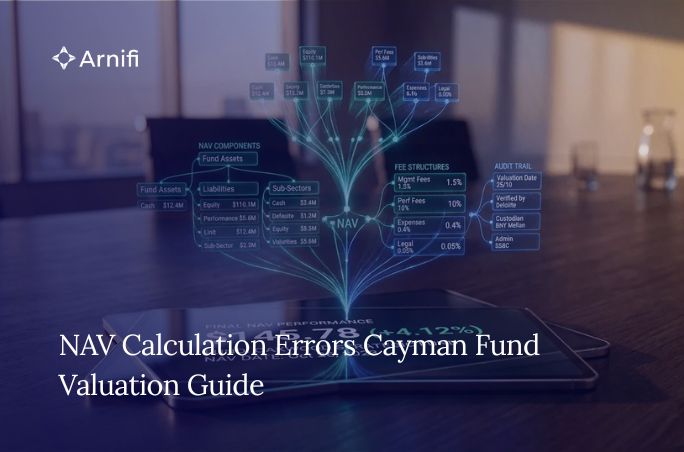
NAV calculation errors Cayman fund valuation issues can create serious investor, audit and governance problems. A small pricing mistake may affect subscriptions, redemptions, management fees, performance fees and investor statements.
For Cayman funds, NAV is not only an accounting output. It is the number investors use to enter, exit and assess the fund. When that number is wrong, the fund may need to correct investor allocations, explain the issue to the board and decide if a NAV restatement is required.
Table of contents
- A Quick Overview of NAV Error Risk Areas
- A Valuation Policy Must Be More Than Hard Wired Text
- Hard-To-Value Assets Need A Stronger Review Path
- Side Pockets Must Match The Fund Documents
- Administrator Errors Should Be Managed Before They Happen
- NAV Restatements Need A Clear Decision Framework
- Conflicts Must Be Visible In The Valuation Process
- Investor Communication Should Be Timely And Clear
- Conclusion
- FAQs
A Quick Overview of NAV Error Risk Areas
| NAV Area | Common Pitfall |
| Valuation Policy | Policy is too generic or not followed |
| Price Sources | No clear source for each investment type |
| Hard-To-Value Assets | Manager marks are accepted without challenge |
| Side Pockets | Illiquid assets are moved without clear rules |
| Administrator Errors | Contract does not clearly manage error responsibility |
| Restatements | No threshold or process for correcting past NAVs |
| Investor Reporting | NAV changes are not explained clearly |
| Board Oversight | Operators do not review valuation models regularly |
A Valuation Policy Must Be More Than Hard Wired Text
Hard wired valuation policy Cayman drafting can create false comfort. A fund may include a valuation policy in its documents, but still fail if the policy is too rigid, outdated or impossible to apply in real conditions.
The policy should explain how assets are valued, which accounting standards apply, who provides prices, who reviews exceptions, and how conflicts are managed. It should also work for the fund’s actual strategy.
For example, listed securities, private credit, crypto assets, distressed positions and private equity holdings may need different valuation inputs. A single generic line saying assets will be valued at fair value may not be enough for a complex portfolio.
A strong policy is practical. It should help the administrator, manager and board know what to do when prices are missing, stale or disputed.
Hard-To-Value Assets Need A Stronger Review Path
Hard-to-value assets are a common source of Cayman fund NAV restatement risk.
Private investments, side pocket assets, thinly traded securities and complex instruments may not have a reliable market price. In these cases, the fund may need pricing models, broker quotes, valuation committees or independent review.
CIMA’s private fund NAV rule refers to fair value and pricing models. It also expects the fund to use techniques that are appropriate for the nature, facts and circumstances of the investment.
The mistake is accepting manager-provided values without a review path. If the manager has a fee interest linked to NAV, conflicts can arise. The board should know what support was used and if assumptions changed.
A hard-to-value asset should never become a blind spot inside the NAV process.
Side Pockets Must Match The Fund Documents
Side pocket Cayman fund mistakes often happen when illiquid assets are moved out of the main portfolio without enough document support.
A side pocket can help separate assets that are difficult to value or sell. But the fund documents should allow it, the process should be clear, and the affected investors should be identified correctly.
Problems arise when the side pocket is created too late, investors are treated inconsistently, or the valuation basis is not explained. The fund may also face questions if fees continue on side pocket assets without proper disclosure.
A side pocket should not be used only to hide valuation uncertainty. It should be supported by the fund terms, board approval, investor communication, and a clear method for future valuation and realization.
Administrator Errors Should Be Managed Before They Happen
Fund administrator NAV error indemnity clauses are often reviewed only after something has gone wrong.
The administration agreement should explain the administrator’s role in NAV preparation, what information it relies on, what liability standard applies and how errors are handled. It should also state which party is responsible for prices supplied by the manager or another source.
If the administrator calculates NAV using incorrect data provided by the manager, the fund needs a clear process to identify the issue and correct it. If the administrator makes a processing error, the agreement should explain notification, correction and responsibility.
The board should understand these terms before signing the agreement. A weak contract can create confusion when investors ask who is responsible for the loss.
NAV Restatements Need A Clear Decision Framework
Not every NAV error requires the same response. Some errors may be immaterial. Others may affect investor dealing, fee calculations or financial statements.
A Cayman fund NAV restatement process should include materiality thresholds, board escalation, investor impact review and communication steps. The process should also consider if subscriptions, redemptions or transfers happened using the wrong NAV.
If investors bought or redeemed at an incorrect price, the fund may need to assess who was affected and how correction should be made. This can become sensitive if some investors benefited while others were disadvantaged.
The board should document the decision. The file should show what caused the error, how it was measured, who reviewed it and why the chosen correction was reasonable.
Conflicts Must Be Visible In The Valuation Process
Valuation conflicts are common in funds. The investment manager may provide price inputs. The manager may also receive fees based on NAV. The administrator may rely on information from the manager. The board may need to approve a difficult valuation during stressed market conditions.
CIMA guidance expects conflicts to be identified, managed and disclosed where relevant. This is especially important where the investment manager is materially involved in pricing or NAV production.
The practical solution is not to remove every conflict. That may not be possible. The fund should instead show how the conflict is controlled.
This may include independent pricing, valuation committee review, board challenge, audit review or external valuation support.
Investor Communication Should Be Timely And Clear
NAV errors become worse when investors hear about them late or through unclear messages.
If an error affects reported NAV, investor balances or dealing prices, the fund should prepare clear communication. The message should explain what happened, what period was affected, what correction is being made and what investors need to do.
The language should be careful but not evasive. Investors need enough detail to understand the financial effect.
The board should also consider if the offering document, audit, administrator records or regulatory filings need updating. A corrected NAV should not remain isolated in one spreadsheet while other records continue to show the wrong number.
Conclusion
NAV mistakes can damage investor trust faster than many compliance failures because they affect pricing, fees and fairness directly. Cayman funds need a valuation process that is documented, tested and realistic for the assets held. The expert team at Arnifi helps fund sponsors see NAV control as a governance system, not just an administrator output.
FAQs
What Are Common NAV Calculation Errors Cayman Fund Valuation Teams Face?
Common errors include wrong price sources, outdated valuations, missing liabilities, incorrect fee accruals, side pocket errors, wrong investor allocations and weak review of hard-to-value assets.
When Does A Cayman Fund NAV Restatement Become Necessary?
A restatement may be needed when the error is material or affects subscriptions, redemptions, fees, investor balances or financial statements. The board should document the review and correction decision.
What Are Side Pocket Cayman Fund Mistakes?
Common mistakes include creating side pockets without document authority, unclear investor allocation, weak valuation support, poor fee disclosure and inconsistent treatment of investors.
Can A Fund Administrator Be Responsible For NAV Errors?
It depends on the administration agreement and the cause of the error. The agreement should explain the administrator’s role, reliance on data, liability standard and correction process.
Why Is A Hard Wired Valuation Policy Risky?
A policy can be risky if it is too rigid or too generic. It should be practical enough to handle missing prices, hard-to-value assets, conflicts and changing market conditions.
Top UAE Packages


Related Articles


Top UAE Packages
Get in Touch