
How UAE Designated Free Zone Tax Rules Apply to a Manufacturing Business | VAT on Goods, CT on Profits
by Anushka Basu Jun 13, 2026  6 MIN READ


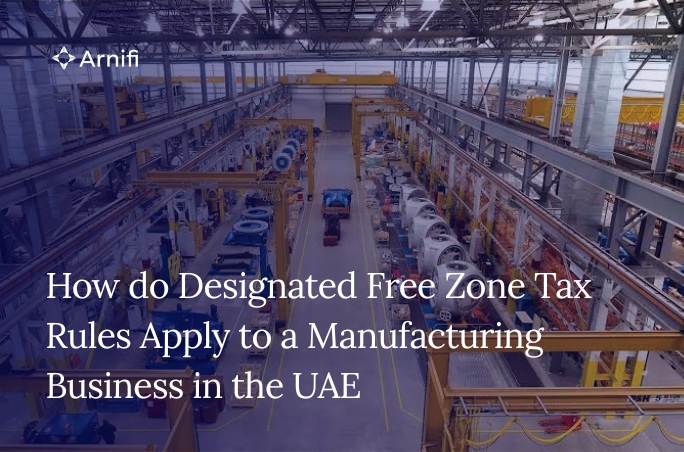
Manufacturing companies often go for UAE free zones as they get easy access to logistics paths, industrial capabilities, and international markets. But once the production actually starts, the whole tax aspect of things tends to become more important than the early setup phase.
VAT handling for goods and Corporate Tax handling for profits can end up being different, depending on where the products move to, and if the business really meets the free zone incentives.
Table of contents
- Introduction
- What is a designated free zone?
- How does VAT apply to manufactured goods?
- Does a designated zone remove VAT completely?
- How does Corporate Tax apply to manufacturers?
- Can manufacturers qualify as a QFZP?
- What is the difference between VAT and Corporate Tax?
- Which manufacturers benefit most from designated zones?
- How can Arnifi help manufacturing businesses?
- FAQs
- Conclusion
Introduction
The UAE has positioned itself as a regional manufacturing & export centre, pulling in businesses handling food processing, industrial machinery, packaging, electronics, chemicals, and consumer products.
Many manufacturers choose to run inside free zones because of the built infrastructure, customs advantages, and smoother connections to global trade routes. Some are even operating in designated areas, which can lead to special VAT treatment for select goods dealings.
But at the same time, the UAE Corporate Tax rules mean manufacturers now have more things to think about. Knowing the UAE free zone manufacturing VAT and corporate tax obligations is now essential for staying compliant, while also controlling cost, in a way that makes sense.
What is a designated free zone?
A designated free zone is a specific free zone area that’s recognised under the UAE VAT Executive Regulations. To qualify, the zone generally has to:
- Be a fenced geographical area, operate under customs controls
- Track the movement of goods
- Satisfy Federal Tax Authority requirements
For certain goods transactions, a designated zone may be treated in a different way for VAT purposes. This becomes especially important for manufacturers that import raw materials, keep inventory, and then export final goods.
How does VAT apply to manufactured goods?
VAT treatment usually depends on where the goods are supplied, and where they move after production finishes. A manufacturer may:
- Import raw materials into a designated zone
- Produce finished goods inside the facility
- Store products in warehouses
- Export products outside the UAE
- Supply goods to mainland UAE buyers
So the VAT on manufactured goods that UAE free zone businesses face will shift based on these actions. Exports outside the UAE often get treated differently from goods that are supplied into the mainland market. Keeping customs records and inventory records accurate is still critical to support the right VAT position.
Does a designated zone remove VAT completely?
No. That’s one common misunderstanding people still repeat. A designated zone doesn’t automatically mean every single transaction is VAT-free. The “special” handling generally applies to specific goods transactions only, as long as they meet the regulatory conditions. Businesses may still run into VAT obligations when:
- Goods enter the mainland UAE
- Products are supplied locally
- The documentation rules are not met
Manufacturers should really assess VAT exposure per transaction, rather than assuming blanket exemptions, as that can backfire.
How does Corporate Tax apply to manufacturers?
Corporate Tax works separately from VAT. The CT UAE designated zone position for a manufacturing business depends on factors such as:
- The nature of the manufacturing activities
- The source of income
- Where the customers are located
- How well the business complies with free zone requirements
- Whether it qualifies as a Qualifying Free Zone Person (QFZP)
Just operating in a designated zone does not automatically guarantee Corporate Tax benefits. Manufacturers need to measure what they do against the Corporate Tax framework to see whether they can access preferential treatment.
Can manufacturers qualify as a QFZP?
In many cases, yes. Manufacturing is generally treated as a qualifying activity under the UAE free zone Corporate Tax framework, but only if the regulatory conditions are met.
The QFZP manufacturing qualifying activity UAE rules can allow qualifying income to benefit from a 0% Corporate Tax rate, potentially. However, businesses still need to keep several requirements satisfied, including:
- Maintaining adequate substance
- Following the transfer pricing rules where it applies
- Meeting free zone regulatory requirements
- Earning a qualifying income
If these conditions aren’t met, the tax outcome can change, and it might not be the result you were expecting.
What is the difference between VAT and Corporate Tax?
A lot of businesses mix these concepts, like they’re interchangeable.
| Area | VAT | Corporate Tax |
| Applies To | Goods and services transactions | Business profits |
| Designated Zone Impact | May provide special treatment for goods | No automatic impact |
| Manufacturing Activities | Depends on movement of goods | Depends on income qualification |
| Compliance Focus | Transaction documentation | Financial plus tax reporting |
To properly understand the UAE free zone manufacturing tax rules, businesses need to look at both systems independently, not as one combined element.
Which manufacturers benefit most from designated zones?
Designated zones often work best for manufacturers that:
- Import raw materials
- Export finished products
- Run regional distribution centres
- Carry out international trading activities
- Keep large inventory facilities
These businesses may benefit from customs efficiencies and from VAT treatment linked to the way goods are moved. If a company is mainly selling to the mainland UAE, the results can be different, so it should evaluate the structure and setup carefully.
How can Arnifi help manufacturing businesses?
Picking the right free zone is not only about comparing licence costs. Manufacturers also need to consider VAT exposure, Corporate Tax implications, warehouse needs, customs processes, and even how the operation might expand later.
Arnifi helps businesses assess designated zone eligibility, evaluate QFZP opportunities, understand UAE free zone manufacturing VAT and corporate tax obligations, and manage company formation requirements. This helps manufacturers build structured setups that support both operational needs and tax objectives, with less confusion and fewer hindrances.
FAQs
What is UAE free zone manufacturing VAT corporate tax?
It is the VAT and Corporate Tax rules that apply to manufacturing businesses running inside UAE free zones.
Does a designated zone automatically remove VAT?
No. designated zones may offer special VAT treatment for certain goods transactions, but VAT responsibilities can still show up in different circumstances.
Can manufacturing count as a QFZP activity?
Usually, yes. Manufacturing is seen as a qualifying activity, as long as the business meets the Corporate Tax conditions that apply.
How is VAT handled on manufactured goods, for UAE free zone businesses?
It depends on where the goods are made, stored, shipped out from, or ultimately supplied.
Do designated zones change Corporate Tax?
Not in a direct way. Corporate Tax eligibility usually turns on qualifying income, and meeting the specific free zone tax requirements.
Conclusion
Manufacturing businesses in UAE free zones need to look at VAT and Corporate Tax as two separate tracks, especially when designated zone rules start playing a role. Arnifi assists manufacturers to understand what the tax implications are, evaluate which free zone opportunities are actually qualifying, manage the setup requirements, and form compliant business structures that help with long term growth across the region and beyond.
Top UAE Packages


Related Articles
Top UAE Packages
Get in Touch