
10 Common Form C Filing Mistakes That Trigger LHDN Audits

Anushka
Content Writer
Anushka Basu is a business content writer specialised in global business market insights. She aims to simplify complex regulatory, financial, and business concepts into… Read more


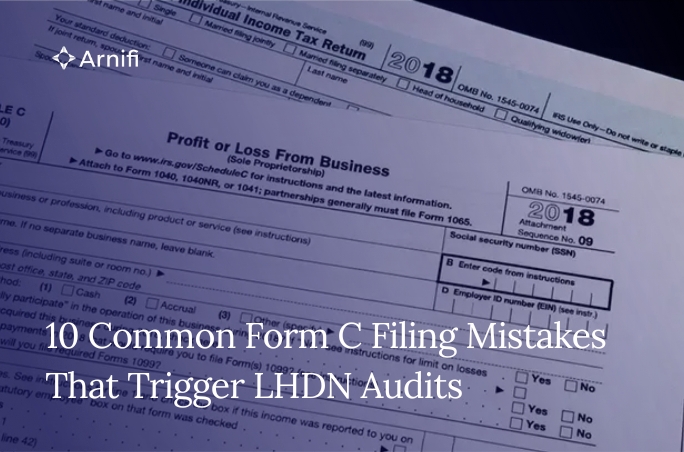
Form C filing mistakes Malaysia LHDN reviewers notice are not always complex tax issues. Many begin with wrong periods, weak tax adjustments, missing schedules, or figures that do not match the accounts. For Sdn Bhd, Form C is not just a yearly upload. It is the company’s income tax return under Section 77A of the Income Tax Act 1967, and the declaration confirms that the details are true, correct, and complete. Companies must submit Form C and Form R within 7 months after the closing date of accounts.
Table of contents
- Quick View Of Common Form C Mistakes
- 1. Using The Wrong Accounting Period Or Basis Period
- 2. Reporting Revenue That Does Not Match The Accounts
- 3. Making Common Tax Computation Errors Malaysia Companies Often Miss
- 4. Claiming Capital Allowances Without A Clean Schedule
- 5. Missing Related Party And Transfer Pricing Review
- 6. Applying SME Tax Treatment Without Checking Conditions
- 7. Ignoring Income Outside Malaysia Received In Malaysia
- 8. Not Reconciling CP204 Installments And Final Tax Payable
- 9. Filing Without Section 82B Backup
- 10. Treating Auditor And Tax Agent Review As A Last-Minute Job
- Conclusion
- FAQs
Quick View Of Common Form C Mistakes
| Mistake | Why LHDN May Review It | Practical Fix |
| Wrong accounting period | Taxable income may fall in the wrong YA | Match accounts with the basis period |
| Revenue mismatch | Sales may not match ledgers or bank data | Reconcile before filing |
| Non-deductible expenses | Book profit is not tax profit | Add back disallowed items |
| Weak capital allowance schedule | Claims may lack asset support | Keep asset details ready |
| Related party gaps | Controlled transactions can raise review risk | Prepare support early |
| Wrong SME tax treatment | The rate category may be applied wrongly | Check capital and income limits |
| Missing foreign income review | Offshore receipts may be missed | Review receipts into Malaysia |
| CP204 mismatch | Instalments may not match the final tax | Reconcile estimates and payments |
| Poor Section 82B backup | MITRS documents may be incomplete | Prepare the PDF pack early |
| Last-minute tax agent review | Errors remain hidden until filing | Start reviewing before the deadline |
1. Using The Wrong Accounting Period Or Basis Period
The first mistake is using the wrong accounting period or basis period. This can affect revenue, expenses, capital allowances and loss set-off. It can also create timing differences between audited accounts and tax computation.
A simple example is a company that changes its financial year-end but keeps using the old tax working file. The Form C numbers may look complete, but the period itself may be wrong. The finance team should confirm the accounting period before any tax adjustment work begins.
2. Reporting Revenue That Does Not Match The Accounts
Revenue mismatch is one of the biggest LHDN audit triggers Form C teams should watch. IRBM’s audit framework states that audit cases may be selected through computerized analysis based on tax risk criteria, information received, industry issues and significant controlled transactions.
A company should compare sales ledgers, bank collections, e-commerce records, SST or service tax records where applicable, management accounts and audited revenue. A small unexplained gap can lead to extra questions during review.
3. Making Common Tax Computation Errors Malaysia Companies Often Miss
Common tax computation errors Malaysia companies make usually happen when the accountant starts with accounting profit but does not adjust it properly for tax.
Examples include private expenses, fines, non-business entertainment, unsupported payments and provisions that are not deductible yet. These may be valid accounting entries, but they may still need tax add-backs.
IRBM can request documents and information during the audit. If a taxpayer does not submit the requested documents within the stated period, claimed expenses may be disallowed, and an additional assessment may be raised.
4. Claiming Capital Allowances Without A Clean Schedule
Capital allowance claims should not be treated as a rough estimate. A weak schedule can create issues if asset purchase dates, qualifying expenditure, disposal details or balancing charges are missing.
This matters more now because the MITRS submission for YA 2025 includes the complete schedule of capital allowances and charges under Schedule 3.
The company should keep invoices, payment proof, asset registers and disposal records together. If the asset is not used for business, the claim should be reviewed carefully before filing.
5. Missing Related Party And Transfer Pricing Review
Related party transactions need careful handling because they can affect taxable profit. Management fees, royalty charges, interest, shared service fees and director-linked transactions should have clear commercial support.
IRBM’s audit framework lists significant controlled transactions with related companies as one example that may form the basis for audit case selection.
This does not mean every related party transaction is a problem. The issue starts when pricing, invoices, agreements and business purpose are not clear.
6. Applying SME Tax Treatment Without Checking Conditions
A Sdn Bhd may apply the wrong tax rate category when it does not check the paid-up ordinary share capital, gross business income and related conditions. LHDN’s company tax rate page lists reduced tier rates for companies with paid-up capital not more than RM2.5 million and gross business income not more than RM50 million for YA 2023 to YA 2024.
This should not be copied blindly into every filing. The team should check the current year rules, shareholding conditions and group structure before using any reduced rate position.
7. Ignoring Income Outside Malaysia Received In Malaysia
Form C includes sections for statutory income linked to sources outside Malaysia that are received in Malaysia. The sample Form C also includes details such as country code, gross income, foreign tax charged and statutory income for relevant overseas receipts.
This area can be missed when a company has foreign customers, overseas platforms, regional service income, dividends, royalties or interest. The tax team should review bank credits and revenue contracts before finalizing Form C.
8. Not Reconciling CP204 Installments And Final Tax Payable
Tax adjustment mistakes Sdn Bhd teams make often include poor CP204 reconciliation. A new company must submit e-CP204 within 3 months after business starts, and installments begin in the sixth month of the “basis” period.
The final Form C should compare estimated tax, revised estimates, installments paid, and balance tax payable. If this file is weak, the payment side may not support the tax computation.
9. Filing Without Section 82B Backup
Form C is no longer a standalone year-end task. The Section 82B document pack matters because financial statements, tax computation, capital allowance schedules, and incentive computations may need electronic submission through MITRS after the return deadline.
A good tax file should include the return, tax computation, audited accounts, schedules, payment proof and management approvals. This makes a future LHDN review easier to handle.
10. Treating Auditor And Tax Agent Review As A Last-Minute Job
The final mistake is waiting until the filing week to involve the auditor or tax agent. By that time, the accounts may be closed, schedules may be incomplete and staff may struggle to explain old transactions.
Form C includes a declaration that the return contains true, correct and complete information. It also identifies if the return is prepared using audited financial statements, unaudited financial statements or a liquidator’s account where relevant.
Conclusion
A clean Form C file is not only about filing on time. It is about matching numbers, proving claims, and keeping every adjustment easy to explain. LHDN reviews are easier to manage when the tax file is built during the year. Arnifi’s expert team helps companies prepare cleaner tax records, filing checks and long-term compliance workflows.
FAQs
What is Form C in Malaysia?
Form C is the company income tax return for a Malaysian company. It is filed under Section 77A of the Income Tax Act 1967 and must reflect true, correct and complete company tax details.
What are the common LHDN audit triggers Form C filers should avoid?
Common triggers include revenue mismatch, unsupported deductions, weak capital allowance schedules, related party gaps, poor tax computation and missing documents. IRBM may select audit cases using tax risk criteria, information received and industry issues.
What is the Section 113 incorrect return penalty?
The Section 113 incorrect return penalty may apply when a taxpayer omits or understates income, or gives incorrect information that affects tax liability. The listed penalty is RM1,000 to RM10,000 and 200% of tax undercharged.
How can a SDN BHD avoid tax adjustment mistakes?
A Sdn Bhd should reconcile accounts early, review disallowed expenses, support capital allowance claims, check related party transactions and prepare MITRS documents before filing. This makes Form C review easier and reduces avoidable tax adjustment risk.
Top UAE Packages


Related Articles

Top UAE Packages
Get in Touch