
Mauritius PAYE, NPF, NSF & CSG | The Complete Payroll Compliance Stack

Zahira Shaik
SEO Content Writer
Zahira Shaik is an SEO Content Writer and Published Author specializing in research-based content. She excels at analyzing market trends, regulations, and industry developments… Read more

Tulika Saxena
AVP, Sales & Marketing | IIM Nagpur
Tulika Saxena specializes in business finance, sales strategy, and market positioning. Leads growth and partnerships, ensuring seamless business setup experiences and client success across… Read more


Key Fact: Mauritius payroll requires navigating complex tax, pension, and social contribution frameworks (PAYE, CSG, NSF). Failing to align monthly MRA filings with general accounting ledgers triggers financial penalties, interest charges, and costly due diligence red flags.
Table of contents
- Introduction
- Why Does Payroll Compliance in Mauritius Become Complicated So Quickly?
- What Exactly Falls Under Payroll Compliance in Mauritius?
- How Does PAYE Work For Employers in Mauritius?
- Are NPF and NSF Still Relevant After CSG Changes?
- What is Contribution Sociale Généralisée (CSG) and Why Does It Matter?
- How Often Must Payroll Filings Happen in Mauritius?
- Can Payroll Software Reduce Compliance Mistakes?
- What Are the Biggest Payroll Mistakes Employers Make?
- How Can Payroll Errors Affect Investor Due Diligence?
- How Should Founders Structure Payroll Operations Properly?
- Where Does Arnifi Help Businesses With Payroll Compliance?
- Frequently Asked Questions
- Conclusion
- References
Introduction
The payroll process in Mauritius not only encompasses the calculation of net wages and their subsequent transfer to employees’ bank accounts, but also includes several complex procedures that should be followed under a strict statutory environment controlled by the Mauritius Revenue Authority (MRA) and the Ministry of Labour, Human Resource Development and Training.
Though numerous payroll guides provide instructions only for the calculation of monthly net wage, payroll compliance actually requires management of the underlying processes: Pay As You Earn (PAYE), Contribution Sociale Généralisée (CSG), National Savings Fund (NSF), National Pensions Fund (NPF), and Portable Retirement Gratuity Fund (PRGF).
Any payroll errors and delays in payments do not occur in isolation but rather create a cascading effect that leads to problems in corporate taxation, flawed accounting records, and numerous red flags raised during the due diligence process conducted by investors or audits carried out by auditors. This article provides a thorough manual to ensure proper payroll compliance and statutory record-keeping in Mauritius.
Why Does Payroll Compliance in Mauritius Become Complicated So Quickly?
Payroll compliance becomes complicated very quickly because it is a process involving tax legislation, labor legislation, and social security obligations.
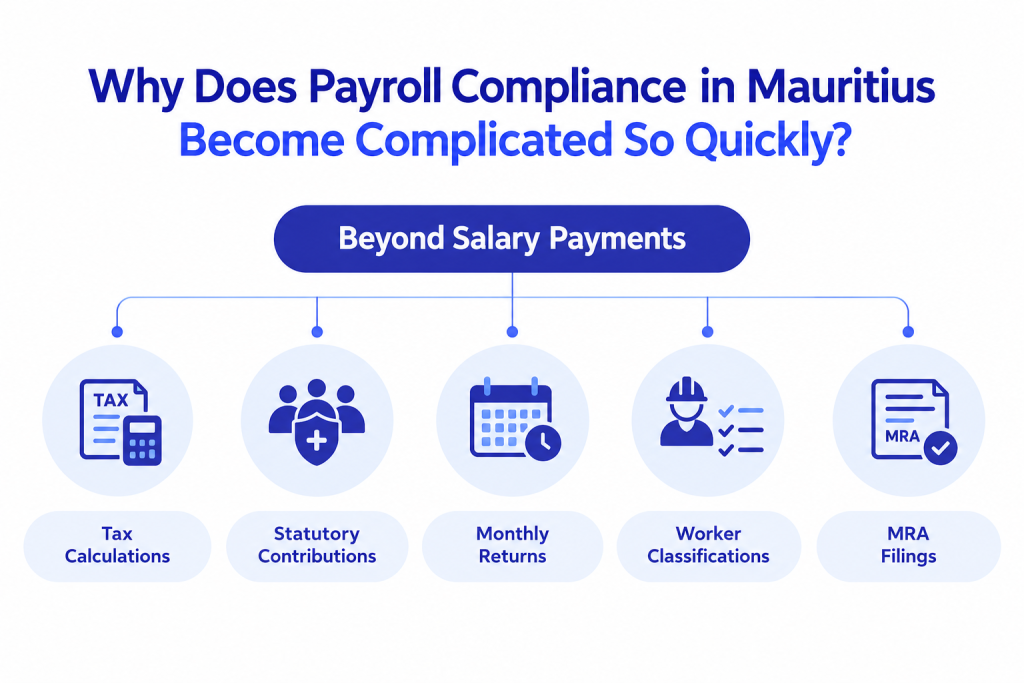
Beyond Salary Payments
Running payroll requires managing several interconnected obligations simultaneously:
- Tax Calculations: Calculating correct PAYE withholding based on dynamic tax brackets and employee declarations.
- Statutory Contributions: Applying accurate rates and caps across social security regimes (CSG, NSF, PRGF).
- Monthly Returns: Processing complex monthly MRA filings with exact alignment across statutory buckets.
- Worker Classifications: Distinguishing strictly between full-time employees, part-time staff, and independent contractors.
- MRA Filings: Submitting precise digital returns within strict monthly deadlines.
The Ripple Effect of Payroll Errors
A single mistake made during monthly payroll processing does not stay confined to the payslip. It immediately triggers a cascade of operational risks across your business:
- Tax Deduction Discrepancies: Triggers MRA audits, formal notices, and late interest penalties.
- Accounting Mismatches: Creates unreconciled general ledgers and distorts monthly financial statements.
- Incorrect Statutory Reports: Leads to potential loss of employee social benefits and regulatory fines.
- Employee Disputes: Erodes workforce trust and exposes the firm to legal liabilities.
- Due Diligence Red Flags: Delays fundraising rounds and depresses company valuations during investor reviews.
Need for Tight Governance
As operations grow, complexity multiplies. Modern businesses must maintain strict internal controls across diverse workforce structures:
- Local Employees: Ensuring precise deductions, statutory reliefs, and local labor law protections.
- Foreign Hires: Managing work permits, residence statuses, specific tax statuses, and cross-border obligations.
- Remote Operations: Balancing distributed teams while remaining compliant with Mauritius payroll and tax jurisdictions.
- Monthly Controls: Implementing multi-tiered review steps before executing payments and statutory filings.
What Exactly Falls Under Payroll Compliance in Mauritius?
At its core, Mauritius payroll compliance relies on four major statutory frameworks managed primarily through the Mauritius Revenue Authority (MRA).
The Four Pillars of Mauritius Payroll Compliance
| Pillar | Statutory Name | Primary Purpose |
| PAYE | Pay As You Earn | Direct tax withholding collected on personal income at the source. |
| CSG | Contribution Sociale Généralisée | Universal social security regime funding national retirement & benefits. |
| NSF | National Savings Fund | Statutory savings fund providing lump-sum payouts upon retirement/redundancy (includes Training Levy). |
| PRGF | Portable Retirement Gratuity Fund | Accumulates long-term worker retirement gratuities across changing employers. |
Separate Calculation and Filing Logic
Each statutory component operates under its own distinct calculation rules, rate structures, and deduction caps. Employers must:
- Maintain distinct logic formulas for tax vs. social contributions.
- Apply correct statutory deductions to gross remuneration before salary payouts.
- Submit consolidated monthly remittances to the MRA electronically via the MRA e-Services portal.
How Does PAYE Work For Employers in Mauritius?
Direct Tax Withholding
Under the PAYE system, employers act as tax collection agents for the government. Income tax is withheld directly from an employee’s gross taxable earnings every pay cycle and remitted to the MRA monthly.
What Determines PAYE?
Several dynamic variables dictate the exact PAYE amount withheld from an employee:
- Employee Earnings: Basic salary, allowances, overtime, bonuses, commission, and fringe benefits.
- Applicable Tax Rates: Progressive tax rates set by current government tax legislation.
- Statutory Reliefs & Exemptions: Deductions claimed by the employee on their Employee Declaration Form (EDF).
- Employee Tax Declarations: Up-to-date EDF submissions filed by the employee at the start of the financial year or upon joining.
- Residency Status: Differing rules and tax treaties applicable to resident vs. non-resident employees.
Common PAYE Errors
- Outdated Tax Cards: Failing to update system parameters when employees submit revised EDFs.
- Incorrect Earnings Categorization: Misclassifying taxable allowances as non-taxable fringe benefits.
- Improper Bonus Treatment: Applying standard monthly tax brackets to end-of-year bonuses without annualizing or adjusting tax tiers.
- Delayed Remittances: Submitting PAYE deductions past the statutory monthly MRA deadline.
- Spreadsheet Vulnerabilities: Relying on manual Excel formulas that break as headcount expands.
Are NPF and NSF Still Relevant After CSG Changes?
Understanding the Transition
The introduction of the Contribution Sociale Généralisée (CSG) fundamentally restructured the social security landscape in Mauritius, replacing the traditional National Pensions Fund (NPF) for active service contributions.
- CSG as the Primary System: CSG now serves as the primary social contribution mechanism collected via the MRA for retirement and social benefits.
- Legacy NPF Rules: Basic NPF contributions for ongoing pension accumulation have been replaced by CSG. However, historical NPF records remain vital for verifying prior service periods and pension entitlements.
- NSF and Levy Continuity: The National Savings Fund (NSF) and the Human Resource Development Council (HRDC) Training Levy remain fully active and must be computed alongside CSG.
Why Historical Payroll Records Matter
Maintaining complete historical payroll data is essential for long-term legal compliance. Key factors include:
- Original Employment Dates: Verifying accurate entry points into the national pension database.
- Contribution Periods: Demonstrating continuous compliance across NPF, NSF, and CSG transitions.
- Worker Status History: Auditing changes in employment classification (e.g., part-time to full-time).
- Long-Term Record Maintenance: Ensuring past records are accessible for MRA verification, employee benefit claims, and labor office inspections.
What is Contribution Sociale Généralisée (CSG) and Why Does It Matter?
How CSG Works
CSG is a mandatory, payroll-based contribution collected by the MRA to fund national social welfare programs. Key features include:
- Shared Contribution: Both the employer and the employee contribute a percentage of the employee’s monthly basic wage or remuneration.
- Payroll-Based Collection: Collected directly through monthly employer payroll filings.
- Remuneration Thresholds: Progressive percentage rates apply depending on whether an employee’s monthly basic remuneration falls above or below statutory earnings thresholds.
Common CSG Calculation Mistakes
- Incorrect Base Salary Classification: Computing CSG on total remuneration instead of basic salary (or vice versa, depending on statutory updates).
- Mishandling Overtime: Improperly including or excluding overtime pay from the CSG calculation base.
- Ignoring Contribution Caps: Failing to adjust rates when employees cross statutory monthly earning thresholds.
- Undocumented Manual Adjustments: Overriding automated CSG software outputs without maintaining supporting audit logs.
How Often Must Payroll Filings Happen in Mauritius?
Monthly Payroll Compliance Cycle
Payroll compliance operates on a strict monthly schedule. Every cycle follows a sequential workflow:
- Compute PAYE, CSG, NSF, PRGF, and HRDC Levy amounts.
- Collect and update Employee Declaration Forms (EDFs).
- Issue detailed monthly payslips to staff.
- File consolidated monthly returns via the MRA e-Services portal.
- Remit total statutory deductions to the MRA (typically by the 20th or end of the following month).
What Happens When Filings Are Delayed?
Failing to submit returns or remit payments on time results in swift statutory enforcement by the MRA:
- Financial Penalties: Fixed monetary fines applied automatically for late monthly submissions.
- Interest Charges: Compounding monthly interest applied to all unpaid statutory amounts (PAYE, CSG, NSF).
- Compliance Notices: Formal warnings and statutory compliance notices issued by tax inspectors.
- Audit Complications: Increased probability of triggering comprehensive, multi-year MRA payroll and corporate tax audits.
Why Monthly Reconciliation Matters
To guarantee compliance, finance teams must perform three-way monthly reconciliations. You must systematically cross-check:
| Source A | Source B | Expected Outcome |
| Internal Payroll Calculation | Statutory MRA Monthly Returns | 100% Data Alignment |
| Statutory MRA Monthly Returns | Bank Disbursement Records | Exact Match on Payments |
| Internal Payroll Calculation | Accounting General Ledger | Zero Variance in Expense/Liability Accounts |
Performing this monthly reconciliation prevents cumulative error buildup, eliminating stressful year-end corrections.
Can Payroll Software Reduce Compliance Mistakes?
How Payroll Software Helps
Transitioning from manual spreadsheets to dedicated, local-compliant payroll software mitigates operational risk by delivering:
- Standardized Tax Calculations: Automated updates to PAYE tax slabs and reliefs.
- Automated Deduction Formulas: Built-in calculation logic for CSG, NSF, PRGF, and HRDC levies.
- Compliant Payslip Generation: Automated creation of detailed payslips satisfying all Mauritius Labor Act disclosure mandates.
- Centralized Employee Records: Secure digital archives of tax declarations, contracts, and salary histories.
MRA Digital Support
Modern payroll software integrates seamlessly with Mauritius’ digital infrastructure:
- Digital Filings: Direct generation of formatted CSV files for seamless upload into the MRA e-Services portal.
- Audit Support: Detailed historical logs that satisfy MRA tax inspector inquiries instantly.
- Dispute Resolution: Clear, transparent proof of deductions to resolve internal worker queries.
- Investor Due Diligence: Exportable, audit-ready contribution schedules for legal and financial reviewers.
Why Initial Configuration Matters
Software is only as accurate as its setup. Correct initial configuration ensures:
- Accurate statutory rules and rate tables are implemented from day one.
- Custom earnings and allowance types are mapped correctly for tax and CSG purposes.
- Company parameters align precisely with local registration details.
What Are the Biggest Payroll Mistakes Employers Make?
1. Misclassifying Workers
Treating full-time employees as independent contractors to avoid social contributions is a major compliance violation. The MRA and Ministry of Labour look at operational realities (e.g., control over hours, integration into business operations) rather than contract labels. Misclassification leads to heavy retroactive liabilities for unpaid CSG, NSF, and PAYE, plus penalties.
2. Delayed Statutory Deductions
Using statutory funds (withheld PAYE or CSG) to manage short-term cash flow constraints creates severe legal risks. Statutory liabilities accumulate rapidly, leading to personal liability risks for company directors under Mauritius law.
3. Poor Documentation
Failing to document payroll adjustments, ad-hoc bonuses, or manual tax overrides leaves the business defenseless during an audit. Every change to an employee’s pay must be backed by written approval and clear calculation logic.
4. Ignoring Monthly Payroll Reconciliation
Failing to reconcile payroll software summaries against general ledger accounting entries creates permanent discrepancies in tax filings. Over time, these accounting mismatches undermine financial statement integrity.
5. Weak Internal Approvals
Allowing a single individual to calculate, approve, and disburse payroll without independent review creates major control vulnerabilities, increasing the risk of calculation errors and unauthorized payroll adjustments.
How Can Payroll Errors Affect Investor Due Diligence?
During fundraising, mergers, acquisitions, or cross-border expansion, legal and financial investors perform rigorous due diligence on target entities. Payroll is frequently where hidden liabilities surface.
Hidden Payroll Risks That Derail Deals
- Unresolved Statutory Liabilities: Back taxes and unpaid social security contributions accumulating unnoticed.
- Incorrect Employer Contribution Records: Under-calculated CSG or PRGF liabilities that require retroactive payouts.
- Legacy Contribution Issues: Missing documentation covering NPF-to-CSG transitions for long-term employees.
- Inconsistent Payroll Documentation: Discrepancies between employment contracts, payslips, and MRA returns.
Impact During Business Transactions
When due diligence uncovers systematic payroll errors, the consequences are immediate:
- Escrow Holdbacks: Investors demand setting aside significant funds in escrow to cover potential MRA fines.
- Depressed Valuation: Valuations are adjusted downward to reflect unrecorded statutory liabilities.
- Delayed Closings: Transactions are stalled while historical payroll records are manually audited and corrected.
What Founders Should Maintain
To pass due diligence smoothly, businesses should keep an audit-ready compliance repository:
- Fully reconciled monthly MRA filings and payment receipts.
- Updated Employee Declaration Forms (EDFs) for all historical tax years.
- Clear proof of monthly CSG, NSF, and PRGF contributions.
- Documented policies for allowances, bonuses, and worker classifications.
How Should Founders Structure Payroll Operations Properly?
Build a Documented Payroll Framework
Establish clear operational guardrails to maintain ongoing compliance:
- Written Compensation Policies: Standardize how allowances, overtime, and bonuses are classified and taxed.
- Monthly Payroll Reviews: Implement a two-tier approval workflow (Preparer vs. Approver).
- Automated Calculations: Eliminate spreadsheets in favor of validated payroll software.
- Filing Calendar: Set non-negotiable internal deadlines for monthly MRA returns and bank transfers.
Align Payroll With Other Business Functions
Cross-departmental synchronization ensures payroll remains completely accurate:
- HR & Contracts: Ensures wage rates, benefits, and job titles match official contract terms and PRGF allocations.
- Leave Records: Connects unpaid leave, sick days, and vacation accruals directly into monthly payroll computations.
- MRA Reporting: Guarantees monthly statutory filings reflect actual disbursements accurately.
- Accounting Ledger: Maps payroll outputs directly to general ledger accounts to maintain balanced trial balances.
Maintain Clean Records for Future Compliance Changes
Statutory regulations evolve regularly. Preparing your business for upcoming labor law and social security adjustments requires:
- Maintaining pristine, audited digital records of all historical CSG, NSF, and PRGF payments.
- Reconciling statutory payments monthly to prevent historical contribution gaps.
- Working with professional corporate service providers to adapt quickly to new legislative mandates.
Where Does Arnifi Help Businesses With Payroll Compliance?
Cross-border payroll requirements and local statutory requirements for Mauritius may prove overwhelming for growing management teams. Arnifi delivers up-to-date corporate solutions and compliance infrastructure that make it easy to do business internationally.
Company Setup and Statutory Registration
Arnifi takes care of the entire process of onboarding your company in Mauritius, including:
- Business registration and corporate structuring.
- Taxation and Employer Social Security registrations in MRA (PAYE, CSG, NSF).
- Implementation of audit-proof processes from the first day of work.
Ongoing Compliance Support
Arnifi saves you and your internal finance department the trouble by providing:
- Payroll processing and MRA statutory submissions.
- Compliance across jurisdictions for international operations.
- Regular audits of your payroll and accounting as well as corporate governance records.
Who Can Benefit From Arnifi?
- Founders Managing Cross-Border Teams: Managing global expansion in line with local compliance requirements in Mauritius.
- Foreign Entities: Setting up a regional headquarters or GBC in Mauritius.
- Growing Businesses: Consolidating scattered spreadsheets into corporate governance solutions based on software.
- Lean Internal Teams: Delegating complicated regulation management functions to expert company staff.
Frequently Asked Questions
What does payroll compliance in Mauritius include?
Payroll compliance in Mauritius involves Pay As You Earn (PAYE) income tax deductions, calculation and payments for Contribution Sociale Généralisée (CSG), National Savings Fund (NSF), Portable Retirement Gratuity Fund (PRGF), and HRDC Training Levy, as well as the issue of compliant payslips and submission of monthly returns to the MRA.
How does PAYE work in Mauritius?
PAYE is a withholding system in which personal income tax is calculated by employers on their employees’ salaries according to statutory rates and tax relief declared through the Employee Declaration Form (EDF).
Are NPF and NSF still applicable in Mauritius?
Though CSG has superseded the conventional NPF contributions for active service, NSF and Training Levy are still completely relevant. The historical records of NPF need to be maintained as well for future benefit calculation and past service confirmation.
What is CSG in Mauritius payroll?
CSG (Contribution Sociale Généralisée) is the social contribution that is collected by MRA for the purpose of national pension and social benefits. This involves shared contributions of both employer and employee according to statutory earnings ceilings.
How often must payroll filings be made in Mauritius?
Payroll filings and remittances need to be submitted on a monthly basis. The employer has to make filings and remittances through the MRA e-Services portal within the month of filing payroll or until the 20th of the month if paying through manual payment.
What happens if payroll filings are delayed?
Late payroll filings or delayed statutory remittances will incur monetary penalties automatically, along with monthly interest charges from MRA.
Can payroll software help with Mauritius payroll compliance?
Yes, customized payroll software can automate all tax calculations, CSG/NSF deduction processes, and payslip generation. Also, it can format your monthly returns for uploading directly to the MRA e-Services portal, which greatly reduces human error.
What are the most common payroll compliance mistakes?
These errors are misclassification of full-time employees as independent contractors, incorrect calculation of the CSG base earnings, delays in making the monthly MRA payments, non-receipt of new employee tax card (EDF) forms, and failure to perform monthly reconciliation of payroll and accounting ledgers.
How should businesses maintain payroll records for investor due diligence?
Companies should have well-organized, electronic archives of monthly MRA return documents, payment receipts, EDF forms, contract information, and ledger reconciliation. Having good records will show there are no outstanding taxes or social payments at the time of due diligence.
How can businesses prepare their payroll records for future compliance changes?
Companies can be ready for changes by keeping centralized, audit-ready electronic archives of all the CSG, NSF, and PRGF documents, doing monthly three-way reconciliation, and using advanced payroll software or professional corporate services that easily adjust to changes in labor laws.
Conclusion
Compliance in payroll for Mauritius is much more than just making calculations about take-home salary. Proper payroll compliance needs to cover the intricacies of PAYE withholding, CSG social contributions, NSF duties, and accurate monthly MRA filings.
With the implementation of payroll software to automate payroll calculations, regular monthly reconciliations, and strict internal control reviews, it will be possible to prevent compliance errors before they occur. Maintenance of clear and auditable statutory records not only helps you to avoid fines but also allows you to easily get past due diligence during growth.
References
For official statutory guidelines, rate updates, and digital filing portals, consult the following governing authorities:
- Mauritius Revenue Authority (MRA): Official portal for PAYE, CSG, and NSF electronic returns, payment portals, and tax legislation updates.
- Ministry of Labour, Human Resource Development and Training: Regulatory body overseeing the Workers’ Rights Act, PRGF mandates, and employment standards.
- MRA e-Services Portal: The official platform for submitting monthly statutory filings and tax declarations.
Top UAE Packages
Related Articles



Top UAE Packages
Get in Touch
