
Malaysia SME Tax Rate 2026 Qualification | Understanding The Three-Tier Structure

Anushka
Content Writer
Anushka Basu is a business content writer specialised in global business market insights. She aims to simplify complex regulatory, financial, and business concepts into… Read more

Tulika Saxena
AVP, Sales & Marketing | IIM Nagpur
Tulika Saxena specializes in business finance, sales strategy, and market positioning. Leads growth and partnerships, ensuring seamless business setup experiences and client success across… Read more


KEY FACT: Qualifying Malaysian SMEs can access preferential Corporate Tax rates of 15%, 17% and 24% based on chargeable income, subject to conditions covering residence, paid-up capital, gross business income and ownership.
Introduction
Malaysia provides preferential Corporate Tax rates for qualifying small and medium-sized companies. However, being a small business does not automatically make a company eligible for these rates.
For 2026, qualifying companies can benefit from a 15% rate on the first RM150,000 of chargeable income, 17% on the next RM450,000 and 24% on chargeable income above RM600,000. Eligibility also depends on factors such as Malaysian residence, paid-up capital, gross business income and foreign ownership.
Understanding these conditions before preparing a tax computation can help businesses apply the correct rate and avoid relying on SME status alone.
What Is the Malaysia SME Tax Rate Structure for 2026?
The preferential Corporate Tax structure for qualifying companies is:
| Chargeable Income | Tax Rate |
| First RM150,000 | 15% |
| RM150,001–RM600,000 | 17% |
| Above RM600,000 | 24% |
Companies that do not fall within the qualifying category are generally subject to the 24% Corporate Tax rate.
Key Point
The 15% and 17% rates apply to their respective income bands. A qualifying SME does not pay 15% on its entire chargeable income.
Which Businesses Qualify for Malaysia SME Tax Rates in 2026?
For the preferential rate, a company generally needs to satisfy several conditions. It must be:
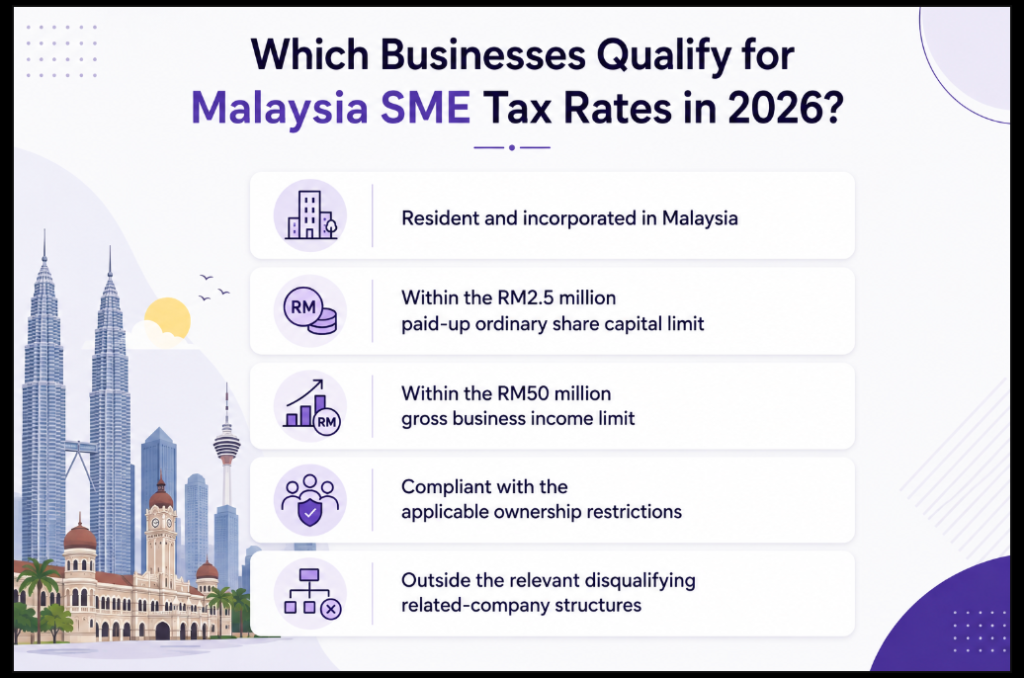
For YA 2024 onwards, a company is not eligible for the special rate if more than 20% of its paid-up ordinary share capital is directly or indirectly owned by foreign companies or individuals who are not Malaysian citizens.
Key Point
SME tax rate Malaysia 2026 depends on more than revenue and profit. The company’s ownership and corporate structure also matter.
Why Is the RM2.5 Million Paid-Up Capital Limit Important?
The paid-up capital test looks at the company’s ordinary share capital at the beginning of the relevant basis period.
A company with paid-up ordinary share capital of RM2.5 million or less may satisfy this part of the eligibility test. If the capital exceeds the threshold, the preferential SME rate may not be available.
Businesses planning a share issue, funding round or capital restructuring should therefore consider how the change could affect their tax position.
What Is the RM50 Million Gross Income Threshold?
The preferential rate also applies only where gross income from business sources does not exceed RM50 million for the relevant basis period.
This is different from chargeable income.
A business may have significant revenue but relatively modest taxable profit. The RM50 million test still needs to be considered separately from the calculation of chargeable income.
Note
The RM50 million threshold relates to gross business income, not simply the profit remaining after expenses.
Does Foreign Shareholding Affect Malaysia SME Tax Qualification?
Yes. Foreign ownership can affect eligibility for the preferential rate.
From YA 2024, a company is not eligible for the special tax rate if more than 20% of its paid-up ordinary share capital at the beginning of the basis period is directly or indirectly owned by one or more foreign companies or non-Malaysian citizens.
This means businesses should review both direct and indirect ownership when assessing eligibility.
How Do Related Companies Affect SME Tax Qualification?
Related-company relationships can also affect whether a company qualifies for the preferential treatment.
LHDN’s guidance considers ownership and control relationships, including situations involving companies with paid-up ordinary share capital exceeding RM2.5 million. Direct and indirect ownership can be traced through the corporate structure to the ultimate holding company.
Key Point
A company’s own capital and revenue may fall within the SME thresholds, but its wider corporate structure can still affect qualification.
What Is the Difference Between SME Status and SME Tax Qualification?
“SME” is not necessarily a single test used for every Malaysian regulatory purpose.
For general SME classification, factors such as annual sales and employee numbers can be relevant, depending on the industry. LHDN separately applies specific conditions for preferential tax treatment.
Therefore, a company should not assume that being classified as an SME for one purpose automatically means it qualifies for the special Corporate Tax rates.
Key Note
General SME status and tax-rate eligibility are not the same thing.
How Does the 15% SME Tax Rate Benefit Malaysian Businesses?
The 15% rate applies to the first RM150,000 of chargeable income for an eligible company.
For example, if chargeable income is RM150,000:
- At 15%: RM22,500
- At 24%: RM36,000
- Difference: RM13,500
The actual tax position depends on the company’s eligibility and applicable tax rules.
How Does the 17% SME Tax Rate Apply?
The next band of chargeable income, from RM150,001 to RM600,000, is taxed at 17%.
For a company with RM600,000 of chargeable income:
- First RM150,000 × 15% = RM22,500
- Next RM450,000 × 17% = RM76,500
- Total tax = RM99,000
This illustrates why the 17% rate is a marginal rate rather than a rate applied to the entire chargeable income.
What Happens When Chargeable Income Exceeds RM600,000?
For an eligible company, the tax bands continue progressively:
- First RM150,000 → 15%
- Next RM450,000 → 17%
- Amount above RM600,000 → 24%
Therefore, exceeding RM600,000 does not mean that the entire chargeable income is automatically taxed at 24%.
What Happens If a Company Does Not Qualify for the SME Tax Rate Malaysia 2026?
Companies that do not satisfy the conditions for the preferential treatment are generally subject to the standard 24% Corporate Tax rate.
Potential reasons for losing eligibility include:
- Paid-up capital exceeding RM2.5 million
- Gross business income exceeding RM50 million
- Failing the Malaysian residence/incorporation requirement
- Exceeding the applicable foreign ownership threshold
- Falling within a disqualifying corporate structure
Businesses should reassess eligibility for each relevant year rather than assuming that a previous year’s treatment will automatically continue.
How Should Malaysian SMEs Plan for Corporate Tax?
Businesses can make the process easier by monitoring their tax position throughout the year.
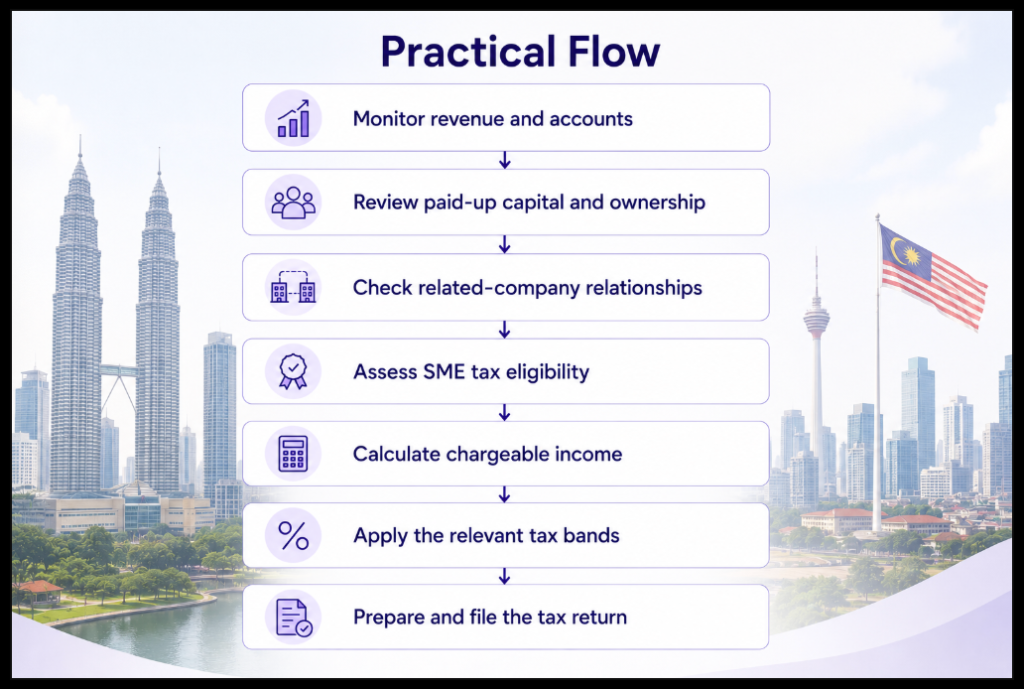
Businesses should also avoid artificial arrangements designed solely to obtain preferential tax treatment.
What Accounting Records Should SMEs Maintain for Malaysia Tax Compliance?
Businesses should maintain records that support both their tax calculation and eligibility assessment.
These may include:
- Sales records
- Purchase invoices
- Expense records
- Bank statements
- Payroll records
- Fixed-asset records
- Shareholder records
- Capital records
- Related-party transaction records
- Financial statements
- Tax computations
Accurate accounting makes it easier to establish chargeable income and support figures reported to LHDN.
How Can Businesses Avoid Losing SME Tax Eligibility?
Before making major corporate changes, businesses should review:
- Paid-up capital
- Shareholding
- Foreign ownership
- Related companies
- Changes in control
- Gross business income
- Chargeable income
Practical Checklist
- Capital reviewed
- Ownership reviewed
- Foreign shareholding checked
- Related companies reviewed
- Gross income checked
- Chargeable income calculated
- Applicable tax rate confirmed
How Can Arnifi Help With Accounting and SME Tax Rate Malaysia 2026?
Managing SME tax rate Malaysia 2026 eligibility requires more than calculating the final tax amount. Businesses also need organised accounting records and accurate information about their ownership, capital and corporate structure.
Arnifi can support Malaysian businesses with:
- Bookkeeping
- Financial statement preparation
- Tax-ready accounts
- Corporate Tax calculations
- SME tax eligibility assessment
- Shareholding and capital reviews
- Tax filing support
- Ongoing accounting and compliance
This can help businesses keep their financial information organised and better prepared for tax-compliance requirements.
FAQs
What is the SME tax rate in Malaysia for 2026?
Qualifying companies are generally taxed at 15%, 17% and 24% across specified chargeable-income bands.
Who qualifies for the 15% SME tax rate in Malaysia?
Eligible Malaysian-resident companies meeting the applicable capital, income, ownership and structural conditions can access the 15% first-band rate.
What is the RM2.5 million paid-up capital rule?
A qualifying company generally must have paid-up ordinary share capital not exceeding RM2.5 million at the beginning of the basis period.
Does foreign ownership affect SME tax rates in Malaysia?
Yes. From YA 2024, more than 20% direct or indirect foreign ownership can prevent access to the preferential rate.
What happens when a Malaysian SME earns more than RM600,000?
For a qualifying company, the amount above RM600,000 is generally taxed at 24%, while the lower bands retain their respective rates.
What is the difference between SME status and SME tax qualification?
General SME classification and eligibility for preferential Corporate Tax rates are based on different criteria.
Conclusion
Malaysia’s Preferential SME Corporate Tax will lower the tax liability of eligible companies, and eligibility is based on criteria besides being an SME.
Eligible companies for 2026 will pay 15% on the first RM150,000 of chargeable income, 17% on the second RM450,000 and 24% in excess of RM600,000.
It is also important to note the cap on paid-up capital of RM2.5 million, gross business income of RM50 million, residency within Malaysia, foreign control limitations and corporate associations.
Maintaining accurate accounting records and reviewing ownership and capital changes before they occur can help businesses determine whether they continue to qualify for the preferential treatment. To know more, connect with our team of experts at Arnifi today!
Official References
Top UAE Packages


Related Articles

Top UAE Packages
Get in Touch