
Singapore Expense Claims Do’s And Don’ts | What IRAS Actually Allows As Deductible

Anushka
Content Writer
Anushka Basu is a business content writer specialised in global business market insights. She aims to simplify complex regulatory, financial, and business concepts into… Read more


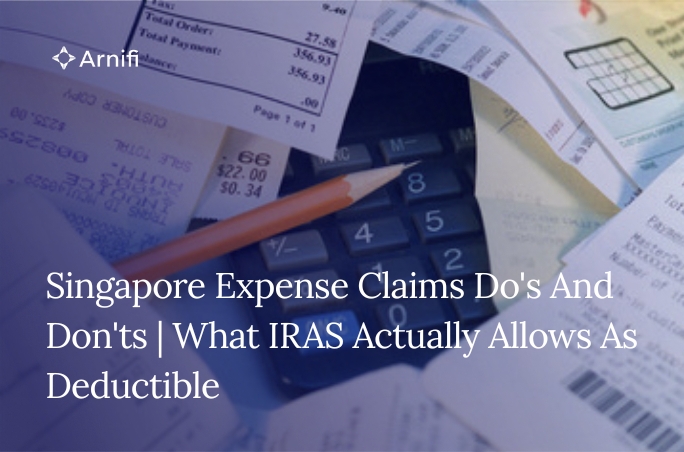
Preparing a company’s tax computation can become confusing when allowable business expenses Singapore IRAS rules are not clearly understood. Many SME directors assume that every business payment is deductible because it was paid through the company bank account. IRAS applies a stricter test. The expense must be linked to income production, properly incurred, revenue in nature, and not blocked under the Income Tax Act.
Table of contents
- What Makes a Business Expense Deductible?
- Section 14 Income Tax Act Deductions
- Tax-Deductible Expenses Singapore SME Directors Usually See
- IRAS Disallowed Expenses List SMEs Should Check
- Entertainment Expenses Tax Deduction Singapore
- Do’s And Don’ts Before Claiming Expenses
- Common Mistakes That Trigger Tax Adjustments
- How Arnifi Can Help With Singapore Expense Claims?
- Conclusion
- FAQs
What Makes a Business Expense Deductible?
IRAS treats business expenses as costs incurred to run the business. Deductible expenses reduce taxable income, but only if they meet the main deductibility conditions. The expense must be wholly and exclusively incurred in producing income, legally incurred, revenue in nature, and not prohibited by the Income Tax Act 1947.
This means a payment can still be disallowed even if it looks commercial. For example, the purchase of a fixed asset may help the company operate, but the cost is capital in nature. The company may need to claim capital allowances instead of deducting the full cost as a normal expense.
Section 14 Income Tax Act Deductions
Section 14 Income Tax Act deductions are built around the same core idea: The expense must have a clear connection with income production. IRAS guidance on statutory and regulatory expenses explains that Section 14(1) allows deductions when expenses are wholly and exclusively incurred in producing income.
For SMEs, the practical question should be: “Can this expense be explained as a real business cost that helped earn taxable income?” If the answer needs too much explanation, the finance team should review the claim before filing.
Tax-Deductible Expenses Singapore SME Directors Usually See
Many common operating costs can qualify if they meet IRAS conditions and are properly supported. Examples include accounting fees, administrative expenses, advertising, auditors’ remuneration, trade bad debts, bank charges, bookkeeping services, commission, directors’ fees, salaries, office upkeep, tax agent fees, telephone bills, public transport for business, wages, and utilities.
| Expense Type | Usually Deductible? | Practical Note |
| Rent For Business Premises | Yes | Claim based on contractual rental payments |
| Staff Salaries And Wages | Yes | Keep payroll records and CPF support |
| Accounting And Tax Agent Fees | Yes | Keep invoices and engagement records |
| Advertising And Marketing | Yes | Must relate to business income |
| Private Car Costs | No | S-plated cars and many business cars are blocked |
| Fixed Asset Purchase Cost | Not As Normal Expense | Claim capital allowances if eligible |
| Private Or Domestic Expenses | No | Keep personal spending outside company accounts |
| General Provisions | Usually No | Deduction is generally allowed only when incurred |
IRAS Disallowed Expenses List SMEs Should Check
The IRAS disallowed expenses list includes costs that do not meet deductibility conditions. Common examples include personal expenses, private or domestic expenses, capital expenses, fixed asset acquisition costs, depreciation, statutory fines, non-statutory fines, Singapore income tax, voluntary CPF above statutory rates, and general provisions for bad or doubtful debts.
Private car expenses are a common mistake. IRAS states that no deduction is allowed for motor vehicle expenses incurred on private cars such as S-plated cars and certain business cars. Even when the cars are used for business purposes. Goods and commercial vehicles such as vans, lorries, and buses are treated differently.
Entertainment Expenses Tax Deduction Singapore
The entertainment expenses tax deduction Singapore claims needs careful support. It can be deductible if it is fully related to running the business and meets the normal deductibility conditions. Entertainment that is personal or not fully related to the business is non-deductible.
A client lunch may be easier to support when the company keeps the receipt, client name, business purpose, and staff involved. A vague meal receipt with no business reason can be challenged. For GST-registered businesses, IRAS also requires supporting details for entertainment-related input tax claims, especially when higher-value entertainment expenses are involved.
Do’s And Don’ts Before Claiming Expenses
- Do keep invoices, contracts, receipts, bank records, payroll files, CPF support, and payment proof for each claim.
- Do separate personal spending, capital purchases, and shareholder-related costs before tax computation.
- Do review motor vehicle costs, entertainment, medical expenses, director costs, and provisions carefully.
- Don’t assume a company-paid expense is automatically deductible.
- Don’t claim private car costs, general provisions, capital costs, or personal expenses as normal deductions.
- Don’t wait until Form C-S or Form C filing to clean up expense categories.
Good expense classification saves time during corporate tax filing. It also reduces back-and-forth questions between directors, accountants, and tax agents.
Common Mistakes That Trigger Tax Adjustments
Many SMEs lose deductions because the expense was booked in the wrong account or had weak evidence. A common example is recording a founder’s personal travel as business travel without a clear meeting trail. Another is claiming renovation costs as repairs without checking the Section 14N treatment for qualifying renovation and refurbishment works.
IRAS notes that qualifying renovation or refurbishment works may be claimed under Section 14N, while normal repairs and maintenance can follow separate treatment. Rental claims also need care. IRAS states that rental for business premises is generally deductible. But if only part of a premises is used for business, only the business portion should be claimed.
How Arnifi Can Help With Singapore Expense Claims?
Arnifi helps Singapore SMEs keep tax and compliance decisions practical. Our team can support company setup, accounting coordination, tax filing preparation, corporate secretarial alignment, and annual compliance planning through suitable specialists. We help founders classify expenses early so deductible claims stay cleaner and tax filing does not become a last-minute correction exercise.
Conclusion
Allowable business expenses Singapore IRAS rules are not about how much the company paid. They are about purpose, timing, evidence, and legal treatment. SMEs should check if each expense is income-producing, revenue in nature, supported by records, and not disallowed. A clean review before filing helps reduce tax adjustments and IRAS queries.
FAQs
1. What Business Expenses Are Deductible In Singapore?
Business expenses are generally deductible if they are wholly and exclusively incurred in producing income, legally incurred, revenue in nature, and not prohibited under the Income Tax Act.
2. Are Entertainment Expenses Tax-Deductible In Singapore?
Entertainment expenses may be deductible if they are fully related to running the business and meet normal deductibility conditions. Personal or weakly supported entertainment claims may be disallowed.
3. Are Private Car Expenses Deductible For Business Use?
No. IRAS does not allow deductions on expenses for private cars such as S-plated cars and certain business cars, even when used for business purposes.
4. Are Fixed Assets Treated As Allowable Business Expenses?
The purchase cost of fixed assets is capital in nature and is not claimed as a normal business expense. The company may claim capital allowances if the asset qualifies.
Top Singapore Packages


Related Articles
Top Singapore Packages
Get in Touch