
BVI VISTA Trust Structure: A Founder’s Guide to Corporate Governance, Share Retention, and Succession

Zahira Shaik
SEO Content Writer
Zahira Shaik is an SEO Content Writer and Published Author specializing in research-based content. She excels at analyzing market trends, regulations, and industry developments… Read more

Tulika Saxena
AVP, Sales & Marketing | IIM Nagpur
Tulika Saxena specializes in business finance, sales strategy, and market positioning. Leads growth and partnerships, ensuring seamless business setup experiences and client success across… Read more



Key Fact: A British Virgin Islands Special Trusts Act (VISTA) trust is a trust that is free from the requirement that the trustee manage his investments in a way that would disengage him from his traditional trust requirement to diversify assets.
Table of contents
- Introduction
- What Is a BVI VISTA Trust?
- Quick Overview of BVI VISTA Trusts
- Why Do Founders Use a VISTA Trust?
- How Does Share Retention Work Under VISTA?
- Trustee Powers and Director Control
- What Should the VISTA Trust Document Cover?
- When May a BVI VISTA Trust Not Fit?
- BVI VISTA Trust Regulatory Framework
- BVI VISTA Trusts and Beneficial Ownership Privacy in 2026
- VISTA Trust Succession Planning for Death or Incapacity
- How Does a VISTA Trust Compare With a Traditional Trust?
- BVI VISTA Trust Structure: Practical Example
- How Arnifi Can Help With BVI Corporate Trust Structures
- Frequently Asked Questions
- Conclusion
- References
Introduction
Putting company shares into a trust will inevitably lead to an internal conflict because the principle of a standard trust requires trustees to be “prudent investors” and diversify their assets, minimize risks, and interfere in company operations when its performance changes. However, for founders of a closely-held business, such an obligation will become an additional burden in the form of trustee interference or sale of private enterprise shares.
The British Virgin Islands Special Trusts Act (VISTA) trust eliminates such a conflict by disengaging from trustee management rights and setting a statutory obligation of share retention. The current paper discusses how share retention works, director management, required trust documentation, compliance, and examples of when a VISTA structure makes sense or not for founders. Considerations around beneficial ownership privacy for 2026 and multi-jurisdictional families are also addressed.
What Is a BVI VISTA Trust?
As defined under the Virgin Islands Special Trusts Act, a VISTA trust is a unique statutory trust regime created to hold the shares of a British Virgin Islands (BVI) business company.
Core Structural Roles
- Founder (Settlor): Creates the trust and assigns the shares of the BVI company.
- VISTA Trust: Owns the legal title to the BVI company shares with an obligation to hold them without interference.
- Licensed Trustee: A licensed BVI trust company as the owner of record.
- Board of Directors: Maintains control of operations, business strategy, and management.
- Business Operations: The underlying assets, subsidiaries worldwide or commercial operations of the company.
Primary Purpose
- Separation of Powers: Legal ownership of the shares is in the hands of the licensed trustee, but management of operations and management is completely in the hands of the company’s board of directors.
- Succession & Protection: Facilitates succession planning, asset protection, and continuity of the business without losing corporate control.
Quick Overview of BVI VISTA Trusts
In a VISTA trust ecosystem, particular stakeholders are connected to create an ownership structure that excludes the influence of the trustee on the company’s decision-making process.
- Settlor (Founder): Creates the trust, transferring the shares of the BVI company and setting the terms of governance inside the trust deed.
- Trustee: A licensed BVI professional trust corporation that legally owns specified shares without any interference in the corporate activities of the company according to the statutory “office of director rules”.
- BVI Company: A company that owns the operating assets, business units, or commercial investments.
- Board of Directors: Oversees business activities, voting rights, business strategies, and appointments of executives.
- Beneficiaries: Family members, corporations, or charitable organizations that will get the economic benefits (distributions) created by the company.
- Protector or Family Adviser: An independent body appointed to monitor the activities of the trustee and give consent for some structural modifications or beneficiary distributions.
Why Do Founders Use a VISTA Trust?
Trust laws require trustees to protect trust values by diversifying risky investments. In situations where most of the assets of a trust consist of shares in a private company, a traditional trustee would have to divest from shares or direct the board to minimize risks.
The reasons founders opt for a VISTA trust include:
- Eliminate Trustee Interference: Prevent the trustee from influencing operations and board selection.
- Ensure Voting Continuity: Achieving continuity of leadership in the corporation over several generations.
- Preserve Private Enterprise: Safeguarding the closely held family enterprise from forced sales and unnecessary diversification of the portfolio.
- Plan for Incapacity or Death: Achieving automatic succession of directorship or beneficiary rights without probate.
- Unify Multi-Jurisdictional Assets: Keeping international operations under one legitimate corporate umbrella.
How Does Share Retention Work Under VISTA?
Designated Shares & Statutory Duty
The legal framework of a VISTA trust lies in the designation of particular shares of a BVI company as designated shares within the VISTA trust deed.
- Duty to Retain: The principal statutory duty of the trustee in relation to designated shares is the duty to hold such shares, which totally supersedes the general common law duty to sell, balance, and diversify assets.
- Trustee Immunity: The trustees have statutory immunity from any losses that may arise, directly or indirectly, from the holding of designated shares if they comply with the requirements of the Act.
Practical Example: An IT entrepreneur transfers 100% of the shares held in their BVI holding company to a VISTA trust. No matter how erratic the value of the IT business becomes, the trustee cannot compel them to sell or liquidate their shares.
Trustee Powers and Director Control
In the case of a VISTA trust, there is a clear bifurcation of corporate powers between the trustee and the board of directors.
Role of the Board
- Operations & Strategy: The board conducts the day-to-day operations of the company, controls the bank account, signs off on contracts, and sets up strategic business goals.
- Dividends: The board decides when corporate profits are declared as dividends for the shareholder (the trust).
Trustee Limits & Intervention Rules
- Non-Interference: The trustee does not have any statutory power to vote on shareholdings, change the decisions of the board, or decide on the strategy of the corporation.
- Permitted Intervention: The trustee can only intervene in certain circumstances outlined in the trust deed or if he or she receives an intervention call from one of the parties that are eligible (e.g., beneficiaries, directors, or the protector) due to either breach of duty by the board or corporate insolvency.
Balancing Influence & Governance
The founders of the corporation can exercise the reserved powers or protector committee powers to control director nominations without depriving the board of its duties.
What Should the VISTA Trust Document Cover?
As statutory default rules do not apply when standard trustee management ceases to function, the VISTA trust deed should define its own mechanisms of governance.
- 1. Identify Designated Shares: Make a clear list of particular BVI company shares to be governed by the VISTA scheme and subject to a retention requirement.
- 2. Director Appointment & Removal Rules: Specify who has the right to appoint, remove or replace company directors and how directors’ remuneration is determined.
- 3. Trustee Intervention Provisions: Clearly indicate the precise thresholds for trustees’ intervention and who can issue an “intervention call.”
- 4. Beneficiary Rights & Distribution Terms: Establish income and capital entitlement rules for family members and release conditions (for example, particular age limits).
- 5. Protector / Family Adviser Powers: Define veto or consent powers over changes in structure, trustees’ replacement or major releases.
When May a BVI VISTA Trust Not Fit?
Despite their usefulness, however, VISTA Trusts do not serve as appropriate solutions for every form of wealth structuring or business situation.
- Non-BVI Assets: VISTA trusts are limited to shareholdings in BVI companies. When assets include property, art, or direct holdings in non-BVI corporations (without the BVI intermediary), other arrangements such as a regular discretionary trust can apply.
- Active Investment Portfolio Oversight: For founders interested in active management of the financial assets held by a trustee, as well as balancing investment portfolios, other forms of trust can be more suitable.
- Institutional Supervision Desired: Where families wish to monitor company board members through institutions, VISTA trusts are unsuitable because of their limiting nature on trustee powers.
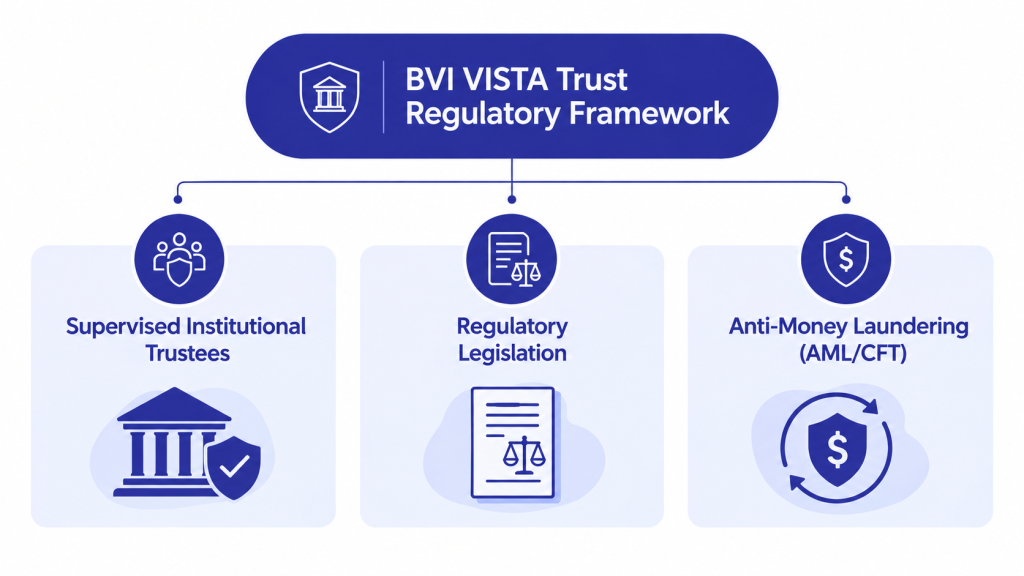
BVI VISTA Trust Regulatory Framework
The VISTA trust business operates under an established regulatory regime regulated by the BVI Financial Services Commission (FSC).
- Supervised Institutional Trustees: All VISTA trusts require a suitably qualified trustee of the BVI, which includes licensed trust companies that fall under the regulations of the Banks and Trust Companies Act or private trust companies (PTC) in the BVI.
- Regulatory Legislation: Regulated by the Financial Services Commission Act, the BVI Trustee Act, and the Regulatory Code of the FSC.
- Anti-Money Laundering (AML/CFT): Licensed trust providers require rigorous CDD, KYC, wealth sourcing, and proper record-keeping.
BVI VISTA Trusts and Beneficial Ownership Privacy in 2026
Changes in regulation about corporate transparency have changed the way in which ownership information is managed by legal entities.
- Legitimate-Interest Access Framework: With regard to beneficial ownership in the BVI, the regime for accessing the beneficial ownership registry operates using the legitimate-interest access model. The registry provides information to those that have demonstrated a legitimate interest, such as the authorities and those involved in law enforcement.
- Transparency vs. Public Access: Transparency is not public access, but rather it includes privacy within the framework of compliance with international standards of bodies such as FATF and OECD.
- Cross-Border Data Cleanliness: The founders of multi-jurisdictional entities should manage ownership data in order to achieve compliance with statutory requirements in their operating regions such as the GCC, EU, or US.
VISTA Trust Succession Planning for Death or Incapacity
VISTA trusts obviate the requirement of expensive probate procedures on the death of a founder in the BVI.
- Incapacity or Death: In the case of incapacity or death of the founder, pre-defined succession provisions of the trust document are triggered at once.
- Director Transition: Pre-nominated alternate directors take over as directors without any intervention of courts or trustees.
- Beneficiary Provisions: Transfer of distribution processes takes place from primary settlors to secondary beneficiaries smoothly.
- Multi-Jurisdictional Families: In the case of GCC-based families or internationally dispersed families, the assets do not get frozen in the process of cross-border probates.
How Does a VISTA Trust Compare With a Traditional Trust?
| Feature | BVI VISTA Trust | Traditional Discretionary Trust |
| Primary Asset Focus | BVI Company Shares | Multi-asset portfolios, real estate, cash, stock |
| Share Retention | Statutory duty to retain company shares | Duty to diversify, preserve value, and manage risk |
| Company Management | Board of Directors retains complete control | Trustee can intervene, replace board, or force asset sales |
| Trustee Intervention | Restricted to explicit deed terms or “office rules” | Active monitoring and potential operational interference |
| Probate Avoidance | Yes, direct continuity via corporate board | Yes, through trustee legal ownership |
| Best Suited For | Active businesses, family firms, holding structures | Diversified liquid investments, managed fund portfolios |
BVI VISTA Trust Structure: Practical Example
- Step 1 (Establishment): Founder forms a VISTA Trust and assigns legal ownership of the shares of the BVI corporation to an authorized BVI Trustee.
- Step 2 (Retention Duty): Trustee retains the selected shares in strict statutory compliance without interfering with company management.
- Step 3 (Board Governance): Directors govern day-to-day business and manage investments while setting corporate policy.
- Step 4 (Succession Event): On death or disability of the founder, nominated successor directors automatically join the board of directors.
- Step 5 (Continuity): Corporate governance takes place without any interruption, and beneficiaries get their share from the trust.
How Arnifi Can Help With BVI Corporate Trust Structures
Cross-border corporate governance necessitates corporate structuring, documentation, and compliance assistance. Arnifi assists in:
- Multi-Jurisdictional Structuring: Integration of the businesses of the region in relation to BVI trust structures.
- Documentation & Compliance: Alignment of the conditions of trust deeds, protector governance, and FSC compliance.
- Ownership Mapping & Maintenance: Keeping the documentation ready for compliance audits.
- Succession Planning Design: Designing scenarios during death or incapacitation of the person.
Frequently Asked Questions
Can a VISTA Trust own shares in a non-BVI company?
Not directly, as the designated shares must always be issued by a BVI company. However, the VISTA company itself can act as the holding company of a non-BVI subsidiary anywhere in the world.
Does a VISTA trustee manage the underlying company?
No. The management remains under the board of directors. The VISTA trustee only holds the title of the shares while being forbidden by law from any interference in the management process of the company.
Can a founder retain control under a VISTA Trust?
Yes. The founders will have the ability to influence the management process through designation as a member of the board of directors or having other powers reserved for themselves according to the terms of the VISTA Trust.
What are “designated shares” in a VISTA Trust?
Designated shares are those shares of the BVI company which are transferred to the trust in accordance with the provisions of the Virgin Islands Special Trusts Act.
Can a VISTA Trust be used for family business succession?
Yes, it can be used in succession because the VISTA trust facilitates passing wealth from the founding family to successors while ensuring smooth transfer of control of the corporate leadership to competent board members without court probate.
Who regulates VISTA Trusts in the BVI?
The administration of the VISTA trust should be performed by the trustee who is licensed and regulated by the FSC in line with the Banks and Trust Companies Act or a registered Private Trust Company (PTC).
Can VISTA trusts be used for commercial or corporate arrangements?
Yes, apart from family wealth, VISTA trusts are also widely used in joint ventures, off-balance-sheet financing, pre-IPO structures, and private trust company structures.
How does beneficial ownership transparency affect VISTA trusts?
Beneficial ownership data should be correctly gathered and kept by the registered agent in accordance with BVI regulatory requirements that include legitimate interest access provisions. Public access is very limited.
What happens to company management if a founder becomes incapacitated?
The nominated successor or alternate directors take control of the firm under the Articles of Association and trust deed procedures, without any court involvement.
Can a settlor also be a beneficiary of a VISTA Trust?
Yes. The settlor can become the beneficiary of the trust as long as there is another co-beneficiary or secondary beneficiary in the trust deed.
Are VISTA trusts public record in the BVI?
No. Trust deeds in the BVI do not require any public registration. The terms of the trust, its beneficiaries, and the asset distribution remain confidential between the involved parties and the licensed trustee.
What protection does a VISTA trust provide against foreign forced heirship laws?
The VISTA Trust is supported by strong firewall protections in the BVI Trustee Act. This means that BVI trusts cannot be set aside or modified by any other foreign court by applying foreign forced-heirship legislation, family law, or inheritance matters.
Can a VISTA Trust be revoked by the founder?
Yes, if the trust document clearly identifies it as a revocable trust. In the case of an irrevocable trust, it cannot be revoked, providing better protection for assets.
Conclusion
It is very important to understand how a BVI VISTA Trust can separate the legal title of shares from company management. Through establishing special shares, defining the rules of directors’ appointment and succession, and keeping up-to-date with new beneficial ownership regulations, the founders can preserve their assets and ensure business sustainability in the future.
References
Top UAE Packages


Related Articles
BVI vs Cayman Company Formation (2026) | Entity Ty...
Key Fact Both jurisdictions provide English common law frameworks for international business. BVI offers cost-efficient corporate management for private asset...

Top UAE Packages
Get in Touch