
Singapore vs Cayman Family Office | Where Should APAC UHNW Families Set Up?
by Anushka Basu May 06, 2026  7 MIN READ


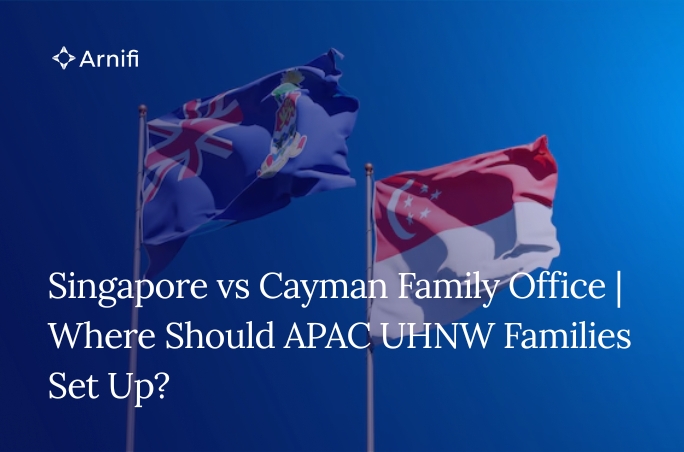
A Singapore vs Cayman family office decision is not only about tax. It is about where the family wants real governance, investment control, banking comfort, professional talent and long-term succession support. For APAC ultra-high-net-worth families, Singapore and Cayman both offer strong advantages, but they have very different planning models.
Singapore is usually chosen as an active wealth management base. Cayman is often used as a tax-neutral structuring jurisdiction for trusts, companies and investment vehicles. The right answer depends on how the family wants to operate, not only where the structure is registered.
Table of contents
Why APAC Families Compare Singapore and Cayman
APAC families are dealing with more complex wealth today. Many have operating businesses, listed shares, private investments, overseas real estate, succession needs and next-generation governance questions. A simple holding company or investment account may not be enough.
Singapore has become attractive because it offers a real business and wealth ecosystem. The Singapore Economic Development Board says global business families can access services such as wealth management, legal and tax advisory, trust, philanthropy and governance support in Singapore.
Cayman works differently. The Cayman Islands Government describes the jurisdiction as tax-neutral, with no income, corporate, capital gains, inheritance or property taxes. It is also known as a major international financial centre with a strong financial services base.
Quick Comparison For UHNW Families
| Factor | Singapore family office | Cayman family office route |
| Best fit | Families wanting an active APAC wealth base | Families wanting tax-neutral holding and structuring options |
| Regulatory style | Strong local substance with MAS and Singapore tax incentive rules | Trust and fiduciary services regulated through CIMA |
| Common use | Single-family offices, investment teams, VCCs and regional governance | Trusts, private trust companies, holding companies and fund structures |
| Talent access | Strong banking, legal, tax, fund and governance talent in Asia | Strong offshore fiduciary and structuring support |
| Tax planning | 13O 13U incentive planning may apply when criteria are met | Tax-neutral jurisdiction, but home-country tax duties still matter |
| Practical advantage | Real operating base near APAC assets and families | Flexible neutral platform for global wealth structures |
Singapore as a Family Office Base
Singapore is usually the stronger choice when the family wants a staffed office, regional investment team and closer access to APAC opportunities. It can support governance meetings, investment committees, philanthropy planning, banking relationships and next-generation involvement in one location.
The 13O 13U incentive framework is a key reason many families assess Singapore. MAS states that section 13O, 13OA and 13U schemes apply to eligible fund vehicles managed by family offices, subject to listed criteria throughout the incentive period.
EDB’s single-family office highlights requirements linked to the 13O and 13U incentives, including tiered business spending with a minimum of S$200,000 in local business spending. This means Singapore is not only a registration choice. It expects substance, spending, management activity and proper documentation.
Singapore may suit families when:
- The family wants an APAC wealth structuring hub with real staff and governance.
- The investment team needs access to banks, lawyers, tax advisers and fund service providers in Asia.
- The family wants to apply for the 13O 13U incentive where eligibility can be met.
- Succession planning must involve family members living or investing in Asia.
- Philanthropy, venture capital, private markets and operating business oversight matter.
The trade-off is cost and scrutiny. Singapore is not a passive shelf structure. Families must be ready for compliance, due diligence, management substance and ongoing reporting.
Cayman as a Family Office Route
Cayman is often stronger when the family wants a neutral offshore structure rather than a staffed regional office. A Cayman SFO structure stays alongside trusts, private trust companies, holding entities or fund vehicles. This can be useful for families with global assets and advisers in more than one region.
CIMA regulates trust business in the Cayman Islands under laws including the Banks and Trust Companies Act and Private Trust Companies Regulations. CIMA also notes that trust business includes acting as trustee, executor or administrator, and that private trust company registration may support services for connected persons.
This makes Cayman useful for families that want governance around ownership, succession and asset holding without necessarily building a large physical office. It is also familiar to many international lawyers, trustees, fund administrators and private banks.
Cayman may suit families when:
- The family needs a tax-neutral holding or trust structure for global assets.
- A private trust company or fiduciary structure is central to succession planning.
- The family office team sits in another country, but the assets need a neutral platform.
- Investors, advisers or trustees are already comfortable with Cayman vehicles.
- The structure is more about ownership control than day-to-day operating presence.
The trade-off is that Cayman may not give the same “real regional base” value as Singapore. For families with major APAC activity, Singapore may feel more practical for meetings, hiring, investment execution and banking.
Governance and Control Planning
The real question is not only where money is held. It is how decisions are made. UHNW families need clear answers on who approves investments, who manages distributions, how younger family members participate and how disputes are handled.
Singapore supports this through active governance. Families can build an office with directors, investment professionals, operations staff and external advisers. This can work well when the family wants regular reporting, education for heirs and professional management close to APAC markets.
Cayman supports governance through legal structuring. Families may use trusts, protectors, private trust companies or fund vehicles to separate control, benefit and administration. This can work well when the family wants continuity across generations with less need for a daily operating office in Cayman.
Cost and Compliance Reality
Singapore often costs more as an operating base because families may need office space, employees, local service providers, tax filings, MAS-related applications and ongoing governance work. However, those costs may be justified when the family wants substance, reputation and APAC access.
Cayman may be more efficient for holding and fiduciary structures, but professional trustee, legal, administration and compliance fees still apply. It should not be treated as a low-effort route. Banks and advisers will still ask for source-of-wealth records, ownership details and purpose behind the structure.
How Arnifi Can Assist?
Arnifi, helps families, founders and investors compare jurisdictions with a practical setup lens. We support entity setup, compliance coordination, documentation guidance and banking preparation across leading business hubs. For family office planning, we help organise the early structure so legal, tax and wealth advisers can move with better clarity.
Conclusion
A Singapore vs Cayman family office choice should follow the family’s real operating model. Singapore works better for families building an APAC base with people, governance and investment activity. Cayman works better for tax-neutral structuring, trusts and global holding needs. Many UHNW families may even use both, with each jurisdiction playing a clear role.
FAQs
1. Is Singapore better than Cayman for a family office?
Singapore may be better for families that want an active APAC base, investment team and governance setup. Cayman may be better for tax-neutral holding, fiduciary planning and global asset structures.
2. What is a Cayman SFO?
A Cayman SFO usually refers to a family office or related structure using Cayman entities, trusts or private trust companies to manage family wealth, succession and asset holding.
3. What is the 13O 13U incentive in Singapore?
The 13O 13U incentive refers to Singapore fund tax incentive routes for eligible fund vehicles managed by family offices. Families must meet MAS criteria and should get tax advice before applying.
4. Does a MAS family office approval remove all tax duties?
No. A MAS family office incentive does not remove tax duties in every country linked to the family, assets or income. Cross-border tax advice is still essential.
Top Singapore Packages


Related Articles
Top Singapore Packages
Get in Touch