
Financial Year in Mauritius | Dates, Tax Year & Filing Obligations

Anushka
Content Writer
Anushka Basu is a business content writer specialised in global business market insights. She aims to simplify complex regulatory, financial, and business concepts into… Read more

Tulika Saxena
AVP, Sales & Marketing | IIM Nagpur
Tulika Saxena specializes in business finance, sales strategy, and market positioning. Leads growth and partnerships, ensuring seamless business setup experiences and client success across… Read more


Key Fact: For individual income tax purposes, Mauritius uses an income year running from 1 July to 30 June. The following Year of Assessment relates to that completed income year. For companies, tax filing is linked to the company’s accounting year-end.
Table of contents
- Introduction
- What Is the Financial Year in Mauritius?
- What Is the Year of Assessment in Mauritius?
- Is the Financial Year the Same for Individuals and Companies in Mauritius?
- How Does a Company’s Accounting Year Affect Tax Filing?
- What Are the Main Tax Filing Obligations During the Mauritius Financial Year?
- What Are the Key Mauritius Tax Filing Deadlines?
- What Happens If a Business Misses a Mauritius Tax Filing Deadline?
- How Should Businesses Prepare for the End of Their Financial Year?
- What Records Should Businesses Maintain for Tax Filing?
- How Does the Mauritius Financial Year Affect International Businesses?
- What Should Businesses Know About the MRA e-Filing System?
- How Can Arnifi Help?
- FAQs
- Conclusion
- References
Introduction
Understanding the financial year in Mauritius is important for individuals and businesses because tax returns are linked to specific income or accounting periods. Knowing which period applies helps taxpayers identify the correct Year of Assessment, filing requirement and payment deadline.
The terms financial year, accounting year, income year, Year of Assessment and tax filing deadline are connected, but they do not mean exactly the same thing.
For individuals, the income year generally runs from 1 July to 30 June. For companies, the relevant tax period is connected to the company’s accounting year-end. The Mauritius Revenue Authority (MRA) administers the country’s tax system and provides different filing requirements depending on the taxpayer and type of obligation.
As a result, an individual, company, société or another taxable person may have different filing requirements and deadlines.
What Is the Financial Year in Mauritius?
For individual income-tax purposes, the income year runs from 1 July to 30 June. The MRA currently identifies the income year for Year of Assessment 2026–2027 as 1 July 2025 to 30 June 2026.
The Year of Assessment follows the completed income year. This means taxpayers first identify the period in which income was earned and then determine the corresponding Year of Assessment for reporting purposes.
For example:
Income Year: 1 July 2025 – 30 June 2026
Year of Assessment: 2026–2027
The Year of Assessment should therefore not be treated as another name for the financial or income year. It identifies the assessment period associated with the relevant completed income year.
What Is the Year of Assessment in Mauritius?
The Year of Assessment is used to identify the tax period associated with income earned during the preceding income year.
The current MRA sequence illustrates the relationship:
- YA 2026–2027 → income year 1 July 2025 to 30 June 2026
- YA 2025–2026 → income year 1 July 2024 to 30 June 2025
- YA 2024–2025 → income year 1 July 2023 to 30 June 2024
The correct Year of Assessment matters when completing a tax return because the return, supporting information and applicable filing requirements must correspond to the relevant period.
Is the Financial Year the Same for Individuals and Companies in Mauritius?
The relevant period differs depending on the type of taxpayer.
| Taxpayer | Relevant Period | How It Is Used |
| Individual | Income year generally runs from 1 July to 30 June | Used to determine the income reported for the relevant Year of Assessment |
| Company | Relevant accounting year determined by the company’s accounting period/year-end | Corporate tax return is linked to the company’s accounting year |
| Société | MRA return framework uses the relevant income year | Return is filed for the applicable Year of Assessment |
Businesses should therefore not assume that every taxpayer follows exactly the same filing calendar.
For companies, the MRA specifically links the Year of Assessment to the company’s accounting year-end. For example, the MRA states that YA 2026–2027 relates to accounting years ending between 1 January 2026 and 31 December 2026.
How Does a Company’s Accounting Year Affect Tax Filing?
For a company, the relationship can be viewed as:
Accounting year-end → relevant Year of Assessment → corporate tax return → filing and payment deadline
A company’s accounting period determines the relevant filing timetable. The MRA states that a company must generally submit its annual return no later than six months from the end of the month in which its accounting period ends. Specific rules apply to companies whose accounting years end on 30 June or 31 December.
This means there is no single universal annual filing date for every company.
For example, a company with a June accounting year-end follows the MRA’s applicable timetable for that accounting period. The exact deadline can also depend on whether the company has tax payable, declares a loss or has an applicable Advance Payment System (APS) obligation.
What Are the Main Tax Filing Obligations During the Mauritius Financial Year?
An annual income-tax return is not the only compliance obligation a business may have during the year.
Depending on the taxpayer and its activities, obligations can include:
- Corporate income tax return
- Individual income tax return where applicable
- VAT returns
- Monthly TDS returns
- Annual TDS statement
- PAYE and related employee returns where applicable
- APS statements and payments where applicable
- Other sector- or taxpayer-specific returns and statements
The MRA’s current e-services and tax-calendar information covers corporate tax, VAT, individual returns, TDS and other recurring tax obligations.
Businesses should therefore track their monthly, quarterly and annual obligations rather than focusing only on the annual income-tax return.
What Are the Key Mauritius Tax Filing Deadlines?
There is no single deadline that applies to every taxpayer or tax return. The applicable date depends on the type of taxpayer, filing and accounting period.
| Obligation | Relevant Timing / Deadline |
| Individual income tax return | MRA currently provides a 30 September due date, with an extended 15 October deadline for qualifying electronic filing/payment arrangements |
| Annual TDS Statement | For the income year ended 30 June 2026, the deadline is 17 August 2026 |
| VAT returns | Deadlines depend on the applicable VAT filing period and are published in the MRA tax calendar |
| Company tax return | Depends on the company’s accounting year-end and applicable circumstances |
| APS | Depends on the applicable company accounting period and APS requirements |
For the income year ended 30 June 2026, the MRA states that the Annual TDS Statement must be filed electronically by 17 August 2026.
Filing dates can change, so businesses should check the current MRA tax calendar before relying on a deadline.
What Happens If a Business Misses a Mauritius Tax Filing Deadline?
Missing a filing deadline can result in penalties and other compliance consequences. Businesses should distinguish between late submission, late payment and submitting an incorrect or incomplete return because different rules can apply.
The applicable penalty should always be checked against the specific tax obligation rather than applying one general penalty figure to every return.
Companies can also face penalties for late filing or late payment of corporate tax. The applicable consequences depend on the circumstances and the relevant provisions.
How Should Businesses Prepare for the End of Their Financial Year?
Businesses can make year-end tax compliance easier by preparing their records well before the filing deadline.
1. Review accounting records
Check that the accounting records for the relevant period are complete and properly maintained
2. Reconcile bank and financial records
Ensure bank balances and financial records are reconciled and outstanding items are identified
3. Check income and expense documentation
Review invoices, receipts and supporting records for income, expenses and deductions
4. Review VAT and TDS records
Check that relevant VAT and TDS filings and payments have been properly recorded
5. Reconcile tax payments and filings
Compare submitted returns with payments made to identify outstanding amounts or discrepancies
6. Confirm the company’s accounting year-end
Identify the accounting period that determines the company’s relevant tax filing timetable
7. Identify the relevant Year of Assessment
Match the relevant income or accounting period with the correct Year of Assessment
8. Review applicable filing deadlines
Check the current MRA calendar for each return, statement and payment obligation
9. Prepare supporting documents
Keep the records required to support information reported in the relevant return
10. Submit returns electronically
Use the applicable MRA e-services or authorised electronic filing channel and retain confirmation of submission
The key is to begin preparing before the deadline rather than treating the deadline as the starting point of the compliance process.
What Records Should Businesses Maintain for Tax Filing?
Businesses should maintain accurate records that support their tax returns and financial statements. These can include:
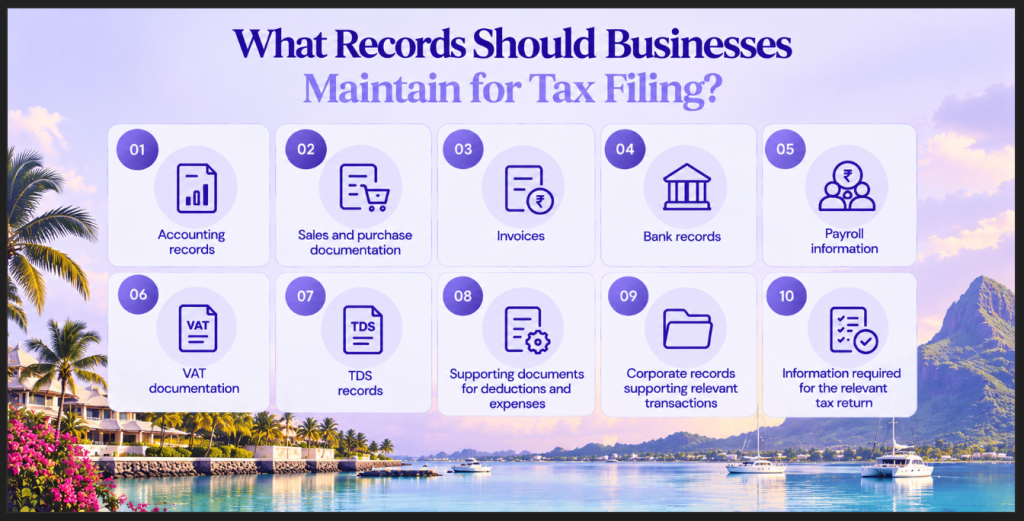
The records should provide a clear basis for the figures reported to the MRA. Companies should also ensure that their accounting records, tax filings and supporting documentation are consistent.
How Does the Mauritius Financial Year Affect International Businesses?
International businesses operating through Mauritius entities also need to understand the local accounting and tax calendar.
A Mauritius company may have cross-border transactions involving related parties, overseas customers, service providers or group companies. These transactions can require additional tax and accounting review.
Businesses may need to consider:
- Related-party transactions
- Cross-border payments
- Tax residency considerations
- Transfer pricing where applicable
- VAT where applicable
- Supporting documentation
The Mauritius accounting and tax year should also be considered alongside reporting requirements that may apply in other jurisdictions where the business or its group operates.
What Should Businesses Know About the MRA e-Filing System?
The MRA provides electronic filing facilities for several tax returns and statements, including corporate tax, VAT and individual income-tax returns.
Businesses and taxpayers need the relevant login credentials and information required for the return being submitted. Companies can use the applicable MRA or Mauritius Network Services electronic filing arrangements depending on the filing process.
After submitting a return electronically, businesses should retain the acknowledgement or confirmation showing that the submission was successfully received.
Electronic filing does not remove the underlying tax or recordkeeping obligations. Taxpayers remain responsible for providing correct and complete information.
How Can Arnifi Help?
Arnifi can help businesses understand Mauritius tax filing requirements and organise their accounting and compliance processes.
Support can include:
- Understanding relevant filing periods and deadlines
- Assistance with accounting and tax documentation
- Preparation of supporting information for tax filings
- Coordination of ongoing compliance requirements
- Support for businesses establishing or maintaining a Mauritius structure
The focus is on helping businesses manage tax compliance throughout the year rather than waiting until the end of the accounting period.
FAQs
1. What is the financial year in Mauritius?
For individual income-tax purposes, the financial year in Mauritius generally runs from 1 July to 30 June. Companies follow the tax timetable associated with their accounting year-end.
2. What is the difference between the income year and Year of Assessment in Mauritius?
The income year is the period during which income is earned. The Year of Assessment identifies the subsequent tax assessment period associated with that completed income year.
3. When does the Mauritius tax year end?
For individual income-tax purposes, the income year ends on 30 June. Company tax filing is connected to the company’s accounting year-end, which may be different.
4. When do companies in Mauritius file their tax returns?
A company generally files its annual return within six months from the end of the month in which its accounting period ends, subject to specific rules and exceptions.
5. What happens if a Mauritius business misses a tax filing deadline?
Late filing or payment can result in applicable penalties and other compliance consequences. The exact consequence depends on the type of return or payment involved.
Conclusion
The financial year in Mauritius, income year and Year of Assessment are important concepts for understanding Mauritius tax compliance. For individuals, the MRA currently uses a 1 July–30 June income year, while company filing requirements are connected to the company’s accounting year-end.
Tax deadlines vary according to the taxpayer and type of filing. Businesses therefore need to track annual, monthly and quarterly obligations rather than focusing only on the annual income-tax return.
Maintaining accurate accounting records, reconciling tax information and preparing documentation before the relevant deadline can make the filing process more manageable.
For businesses establishing or maintaining a Mauritius structure, professional support can also help keep accounting, tax filings and ongoing compliance organised throughout the year.
References
Top UAE Packages
Related Articles



Top UAE Packages
Get in Touch
